

Volumetric Video Processing vs GPU Rendering: Speed Comparison
JUN 5, 20269 MIN READ
Generate Your Research Report Instantly with AI Agent
PatSnap Eureka helps you evaluate technical feasibility & market potential.
Volumetric Video and GPU Rendering Background and Objectives
Volumetric video technology represents a paradigm shift in digital content creation, capturing three-dimensional scenes with full spatial and temporal information rather than traditional flat imagery. This emerging field encompasses the acquisition, processing, compression, and rendering of dynamic 3D environments, enabling immersive experiences across virtual reality, augmented reality, and mixed reality applications. The technology has evolved from early point cloud representations to sophisticated mesh-based and neural rendering approaches, driven by advances in capture hardware, computational power, and algorithmic innovations.
The fundamental challenge in volumetric video lies in managing massive data volumes while maintaining real-time performance standards. Unlike conventional video processing that handles two-dimensional pixel arrays, volumetric content requires processing millions of 3D points or vertices per frame, creating exponentially larger datasets. This computational complexity necessitates specialized processing pipelines and hardware acceleration strategies to achieve acceptable performance metrics for interactive applications.
GPU rendering has emerged as the dominant approach for real-time 3D graphics processing, leveraging parallel computing architectures to handle complex geometric transformations, lighting calculations, and rasterization operations. Modern graphics processing units feature thousands of cores optimized for simultaneous mathematical operations, making them ideally suited for the parallel nature of 3D rendering tasks. The evolution from fixed-function pipelines to programmable shader architectures has further enhanced GPU capabilities for handling diverse rendering workloads.
The convergence of volumetric video processing and GPU rendering technologies presents both opportunities and challenges. While GPUs excel at traditional polygon-based rendering, volumetric content often requires different computational approaches, including point cloud processing, voxel manipulation, and neural network inference. This technological intersection demands careful evaluation of processing methodologies to optimize performance while maintaining visual quality standards.
The primary objective of comparing volumetric video processing against GPU rendering speeds centers on identifying optimal computational strategies for next-generation immersive content delivery. This analysis aims to establish performance benchmarks across different content types, resolution scales, and hardware configurations. Understanding these performance characteristics is crucial for developing efficient content pipelines, informing hardware requirements, and guiding future technology investments in the rapidly evolving immersive media landscape.
The fundamental challenge in volumetric video lies in managing massive data volumes while maintaining real-time performance standards. Unlike conventional video processing that handles two-dimensional pixel arrays, volumetric content requires processing millions of 3D points or vertices per frame, creating exponentially larger datasets. This computational complexity necessitates specialized processing pipelines and hardware acceleration strategies to achieve acceptable performance metrics for interactive applications.
GPU rendering has emerged as the dominant approach for real-time 3D graphics processing, leveraging parallel computing architectures to handle complex geometric transformations, lighting calculations, and rasterization operations. Modern graphics processing units feature thousands of cores optimized for simultaneous mathematical operations, making them ideally suited for the parallel nature of 3D rendering tasks. The evolution from fixed-function pipelines to programmable shader architectures has further enhanced GPU capabilities for handling diverse rendering workloads.
The convergence of volumetric video processing and GPU rendering technologies presents both opportunities and challenges. While GPUs excel at traditional polygon-based rendering, volumetric content often requires different computational approaches, including point cloud processing, voxel manipulation, and neural network inference. This technological intersection demands careful evaluation of processing methodologies to optimize performance while maintaining visual quality standards.
The primary objective of comparing volumetric video processing against GPU rendering speeds centers on identifying optimal computational strategies for next-generation immersive content delivery. This analysis aims to establish performance benchmarks across different content types, resolution scales, and hardware configurations. Understanding these performance characteristics is crucial for developing efficient content pipelines, informing hardware requirements, and guiding future technology investments in the rapidly evolving immersive media landscape.
Market Demand for Real-time Volumetric Content Processing
The entertainment industry represents the largest market segment driving demand for real-time volumetric content processing, with immersive gaming experiences leading the charge. Modern gaming platforms increasingly require sophisticated volumetric rendering capabilities to deliver photorealistic environments and character interactions that respond instantaneously to user inputs. Virtual reality gaming specifically demands ultra-low latency processing to maintain immersion and prevent motion sickness, creating stringent performance requirements for volumetric video processing systems.
Live streaming and broadcasting sectors are experiencing unprecedented growth in demand for real-time volumetric content. Sports broadcasting organizations seek to provide viewers with immersive experiences through volumetric capture of live events, enabling 360-degree viewing perspectives and interactive replay features. Concert venues and entertainment productions are adopting volumetric streaming technologies to reach global audiences with immersive performances that transcend traditional flat-screen limitations.
Enterprise applications constitute a rapidly expanding market segment, particularly in remote collaboration and training environments. Corporate organizations require real-time volumetric processing for holographic conferencing systems that enable natural interaction between geographically distributed teams. Medical training institutions demand high-fidelity volumetric content processing for surgical simulations and anatomical education, where real-time manipulation and visualization are critical for effective learning outcomes.
The automotive industry presents emerging opportunities for real-time volumetric content processing in advanced driver assistance systems and autonomous vehicle development. Real-time processing of volumetric sensor data enables enhanced spatial awareness and object recognition capabilities essential for safe autonomous navigation. Additionally, in-vehicle entertainment systems increasingly incorporate volumetric content to provide passengers with immersive experiences during travel.
Manufacturing and industrial sectors are adopting real-time volumetric processing for quality control and digital twin applications. Production facilities require instantaneous analysis of three-dimensional product characteristics and real-time monitoring of manufacturing processes through volumetric data streams. These applications demand consistent processing speeds to maintain production efficiency while ensuring quality standards.
The telecommunications industry faces growing pressure to support real-time volumetric content delivery across network infrastructures. Edge computing deployments specifically target reduced latency for volumetric content processing, enabling service providers to offer premium immersive content services to consumers and enterprise clients.
Live streaming and broadcasting sectors are experiencing unprecedented growth in demand for real-time volumetric content. Sports broadcasting organizations seek to provide viewers with immersive experiences through volumetric capture of live events, enabling 360-degree viewing perspectives and interactive replay features. Concert venues and entertainment productions are adopting volumetric streaming technologies to reach global audiences with immersive performances that transcend traditional flat-screen limitations.
Enterprise applications constitute a rapidly expanding market segment, particularly in remote collaboration and training environments. Corporate organizations require real-time volumetric processing for holographic conferencing systems that enable natural interaction between geographically distributed teams. Medical training institutions demand high-fidelity volumetric content processing for surgical simulations and anatomical education, where real-time manipulation and visualization are critical for effective learning outcomes.
The automotive industry presents emerging opportunities for real-time volumetric content processing in advanced driver assistance systems and autonomous vehicle development. Real-time processing of volumetric sensor data enables enhanced spatial awareness and object recognition capabilities essential for safe autonomous navigation. Additionally, in-vehicle entertainment systems increasingly incorporate volumetric content to provide passengers with immersive experiences during travel.
Manufacturing and industrial sectors are adopting real-time volumetric processing for quality control and digital twin applications. Production facilities require instantaneous analysis of three-dimensional product characteristics and real-time monitoring of manufacturing processes through volumetric data streams. These applications demand consistent processing speeds to maintain production efficiency while ensuring quality standards.
The telecommunications industry faces growing pressure to support real-time volumetric content delivery across network infrastructures. Edge computing deployments specifically target reduced latency for volumetric content processing, enabling service providers to offer premium immersive content services to consumers and enterprise clients.
Current State of Volumetric Processing and GPU Rendering Performance
Volumetric video processing currently operates through multiple technological approaches, with point cloud compression and neural radiance fields (NeRF) representing the dominant methodologies. Point cloud-based systems typically achieve processing speeds of 15-30 frames per second for moderate resolution content, while NeRF implementations struggle with real-time performance, often requiring 10-60 seconds per frame for high-quality rendering. The computational bottleneck primarily stems from the massive data volumes involved, with uncompressed volumetric captures reaching terabytes per minute.
GPU rendering performance has reached remarkable maturity levels, particularly with modern architectures like NVIDIA's RTX 40 series and AMD's RDNA 3. Contemporary GPUs deliver consistent 60-120 FPS performance for complex 3D scenes at 4K resolution, with ray tracing capabilities adding photorealistic lighting effects while maintaining 30-60 FPS. The parallel processing architecture of modern GPUs, featuring thousands of cores, provides substantial advantages for traditional polygon-based rendering pipelines.
The performance gap between these technologies remains significant. Volumetric processing faces inherent challenges due to data density requirements and limited compression algorithms. Current volumetric codecs like MPEG-I V-PCC achieve compression ratios of 100:1 to 200:1, yet still demand substantial computational resources for real-time decoding. Processing pipelines must handle point cloud reconstruction, mesh generation, and texture mapping simultaneously, creating multiple computational bottlenecks.
Hardware acceleration specifically designed for volumetric content remains in early development stages. While specialized chips from companies like Intel and Qualcomm show promise, they have not yet achieved widespread adoption. Most volumetric processing still relies on general-purpose GPU compute shaders, which are not optimized for the unique data structures and algorithms required.
Recent benchmarking studies indicate that volumetric video processing requires 10-50 times more computational power than equivalent quality traditional rendering for similar visual complexity. This performance differential significantly impacts practical deployment scenarios, particularly in consumer applications where real-time performance is essential. The current technological landscape suggests that hybrid approaches, combining volumetric capture with traditional rendering techniques, may offer the most viable path forward for achieving acceptable performance levels while maintaining visual fidelity.
GPU rendering performance has reached remarkable maturity levels, particularly with modern architectures like NVIDIA's RTX 40 series and AMD's RDNA 3. Contemporary GPUs deliver consistent 60-120 FPS performance for complex 3D scenes at 4K resolution, with ray tracing capabilities adding photorealistic lighting effects while maintaining 30-60 FPS. The parallel processing architecture of modern GPUs, featuring thousands of cores, provides substantial advantages for traditional polygon-based rendering pipelines.
The performance gap between these technologies remains significant. Volumetric processing faces inherent challenges due to data density requirements and limited compression algorithms. Current volumetric codecs like MPEG-I V-PCC achieve compression ratios of 100:1 to 200:1, yet still demand substantial computational resources for real-time decoding. Processing pipelines must handle point cloud reconstruction, mesh generation, and texture mapping simultaneously, creating multiple computational bottlenecks.
Hardware acceleration specifically designed for volumetric content remains in early development stages. While specialized chips from companies like Intel and Qualcomm show promise, they have not yet achieved widespread adoption. Most volumetric processing still relies on general-purpose GPU compute shaders, which are not optimized for the unique data structures and algorithms required.
Recent benchmarking studies indicate that volumetric video processing requires 10-50 times more computational power than equivalent quality traditional rendering for similar visual complexity. This performance differential significantly impacts practical deployment scenarios, particularly in consumer applications where real-time performance is essential. The current technological landscape suggests that hybrid approaches, combining volumetric capture with traditional rendering techniques, may offer the most viable path forward for achieving acceptable performance levels while maintaining visual fidelity.
Current Speed Optimization Solutions for Volumetric Processing
01 GPU-accelerated volumetric data compression and decompression techniques
Advanced compression algorithms specifically designed for volumetric video data that leverage GPU parallel processing capabilities to achieve real-time compression and decompression. These techniques optimize data storage and transmission while maintaining visual quality through specialized encoding methods that take advantage of GPU architecture for faster processing speeds.- GPU-accelerated volumetric data compression and decompression: Advanced compression algorithms specifically designed for volumetric video data utilize GPU parallel processing capabilities to achieve real-time compression and decompression. These methods employ specialized encoding techniques that take advantage of GPU architecture to handle large volumetric datasets efficiently, reducing storage requirements while maintaining visual quality.
- Parallel rendering pipeline optimization for volumetric content: Optimization techniques for GPU rendering pipelines focus on maximizing parallel processing efficiency when handling volumetric video data. These approaches involve restructuring rendering workflows, implementing multi-threaded processing, and utilizing GPU shader programs to accelerate the visualization of three-dimensional volumetric content in real-time applications.
- Memory management and data streaming for large volumetric datasets: Specialized memory management systems handle the efficient loading, caching, and streaming of large volumetric video files to GPU memory. These solutions address bandwidth limitations and memory constraints by implementing intelligent data prefetching, level-of-detail techniques, and adaptive streaming protocols that ensure smooth playback of high-resolution volumetric content.
- Real-time ray casting and volume rendering acceleration: Hardware-accelerated ray casting techniques leverage GPU compute shaders and specialized rendering algorithms to achieve real-time volume rendering of volumetric video data. These methods implement optimized traversal algorithms, adaptive sampling strategies, and GPU-based lighting calculations to render complex volumetric scenes at interactive frame rates.
- Multi-GPU distributed processing for volumetric video workflows: Distributed processing frameworks utilize multiple GPU resources to handle computationally intensive volumetric video processing tasks. These systems implement load balancing algorithms, inter-GPU communication protocols, and synchronized rendering techniques to scale volumetric video processing across multiple graphics processing units for enhanced performance and reduced processing times.
02 Parallel rendering pipelines for volumetric content
Implementation of multi-threaded rendering architectures that distribute volumetric video processing tasks across multiple GPU cores simultaneously. These systems utilize parallel processing techniques to handle complex volumetric data structures, enabling real-time rendering of high-resolution volumetric content through optimized pipeline management and resource allocation strategies.Expand Specific Solutions03 Memory optimization and bandwidth management for volumetric video
Specialized memory management techniques that optimize GPU memory usage and data transfer rates for volumetric video processing. These approaches include intelligent caching strategies, memory pooling, and bandwidth optimization methods that reduce latency and improve overall rendering performance by efficiently managing large volumetric datasets.Expand Specific Solutions04 Real-time volumetric video streaming and adaptive quality control
Dynamic quality adjustment systems that adapt volumetric video rendering parameters based on available GPU resources and network conditions. These technologies enable smooth streaming of volumetric content by automatically adjusting resolution, frame rates, and compression levels to maintain optimal performance across different hardware configurations and bandwidth limitations.Expand Specific Solutions05 Hardware-accelerated volumetric reconstruction algorithms
Specialized algorithms that utilize GPU compute shaders and dedicated hardware acceleration features to reconstruct volumetric video from multiple data sources. These methods employ advanced mathematical models and GPU-optimized processing techniques to generate high-quality volumetric representations with minimal computational overhead and maximum rendering speed.Expand Specific Solutions
Key Players in Volumetric Video and GPU Hardware Industry
The volumetric video processing versus GPU rendering speed comparison represents a rapidly evolving technological landscape currently in its growth phase. The market demonstrates significant expansion potential, driven by increasing demand for immersive content across gaming, entertainment, and enterprise applications. Technology maturity varies considerably among key players, with established semiconductor leaders like NVIDIA, Intel, and Qualcomm offering mature GPU rendering solutions, while companies such as Unity Technologies and V-Nova International advance specialized volumetric processing capabilities. Chinese tech giants including Tencent, Alibaba, and Huawei are aggressively investing in both domains, alongside traditional hardware manufacturers like Sony and emerging specialists. The competitive dynamics reflect a transitioning market where traditional GPU rendering excellence is being challenged by innovative volumetric processing approaches, creating opportunities for both established players and specialized newcomers to capture market share through technological differentiation.
Google LLC
Technical Solution: Google employs cloud-based volumetric video processing through its Google Cloud Platform, utilizing TPU acceleration and distributed GPU clusters. Their approach combines machine learning-based compression algorithms with scalable rendering infrastructure, achieving 3-5x speed improvements over traditional methods. The system supports real-time volumetric streaming with adaptive quality based on network conditions and device capabilities.
Strengths: Massive cloud infrastructure, advanced ML algorithms, scalable processing capabilities. Weaknesses: Dependency on internet connectivity, potential latency issues, ongoing cloud service costs.
QUALCOMM, Inc.
Technical Solution: Qualcomm focuses on mobile and edge volumetric video processing using their Snapdragon platforms with integrated Adreno GPUs and Hexagon DSPs. Their solution optimizes for low-power consumption while maintaining real-time performance, achieving 2-3x speed improvements over software-only implementations. The architecture supports 5G-enabled volumetric streaming with on-device AI processing for compression and rendering optimization.
Strengths: Mobile optimization, low power consumption, integrated 5G connectivity, edge computing capabilities. Weaknesses: Limited processing power compared to desktop GPUs, thermal constraints on mobile devices, smaller memory bandwidth.
Core Performance Innovations in Volumetric vs GPU Rendering
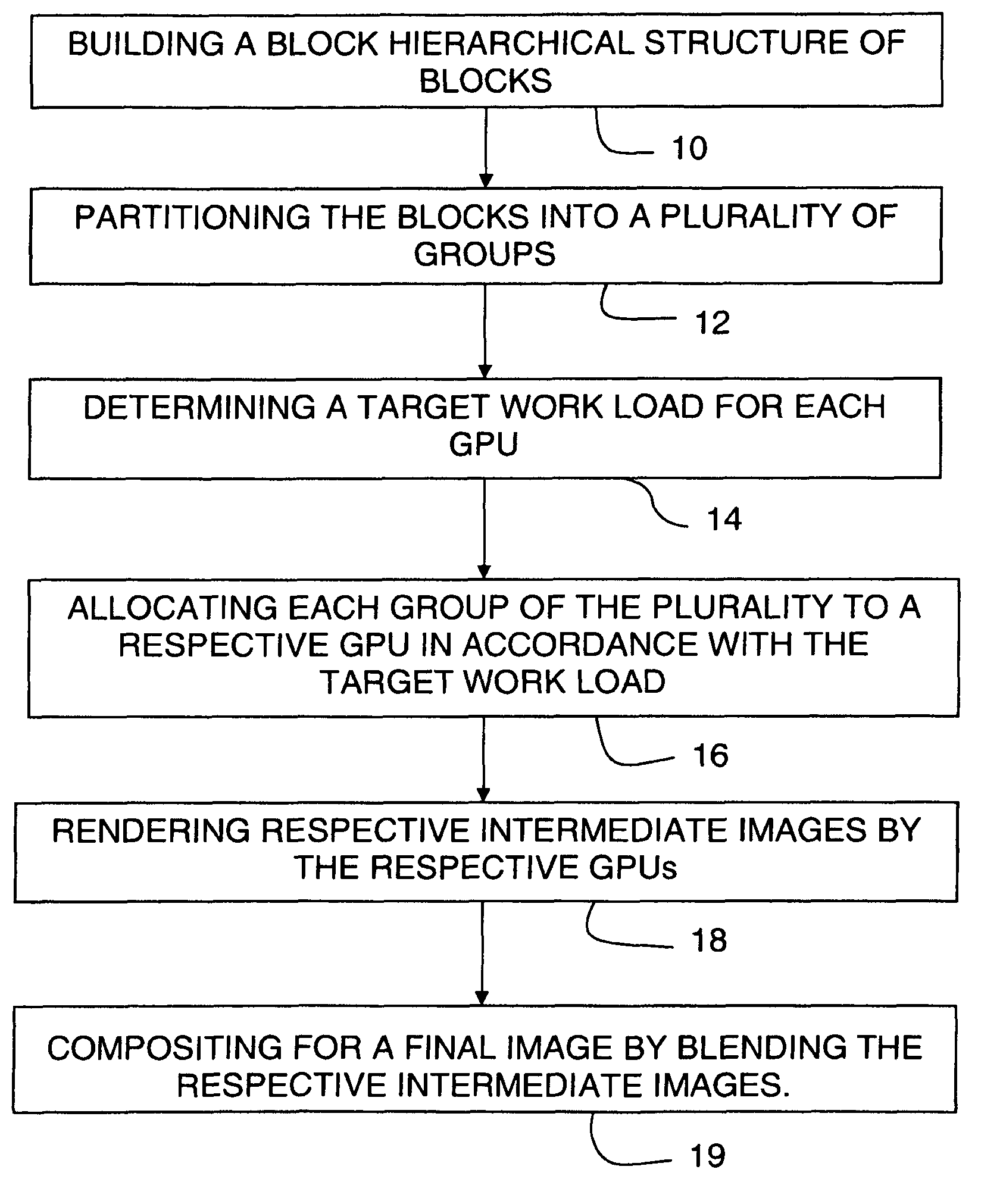
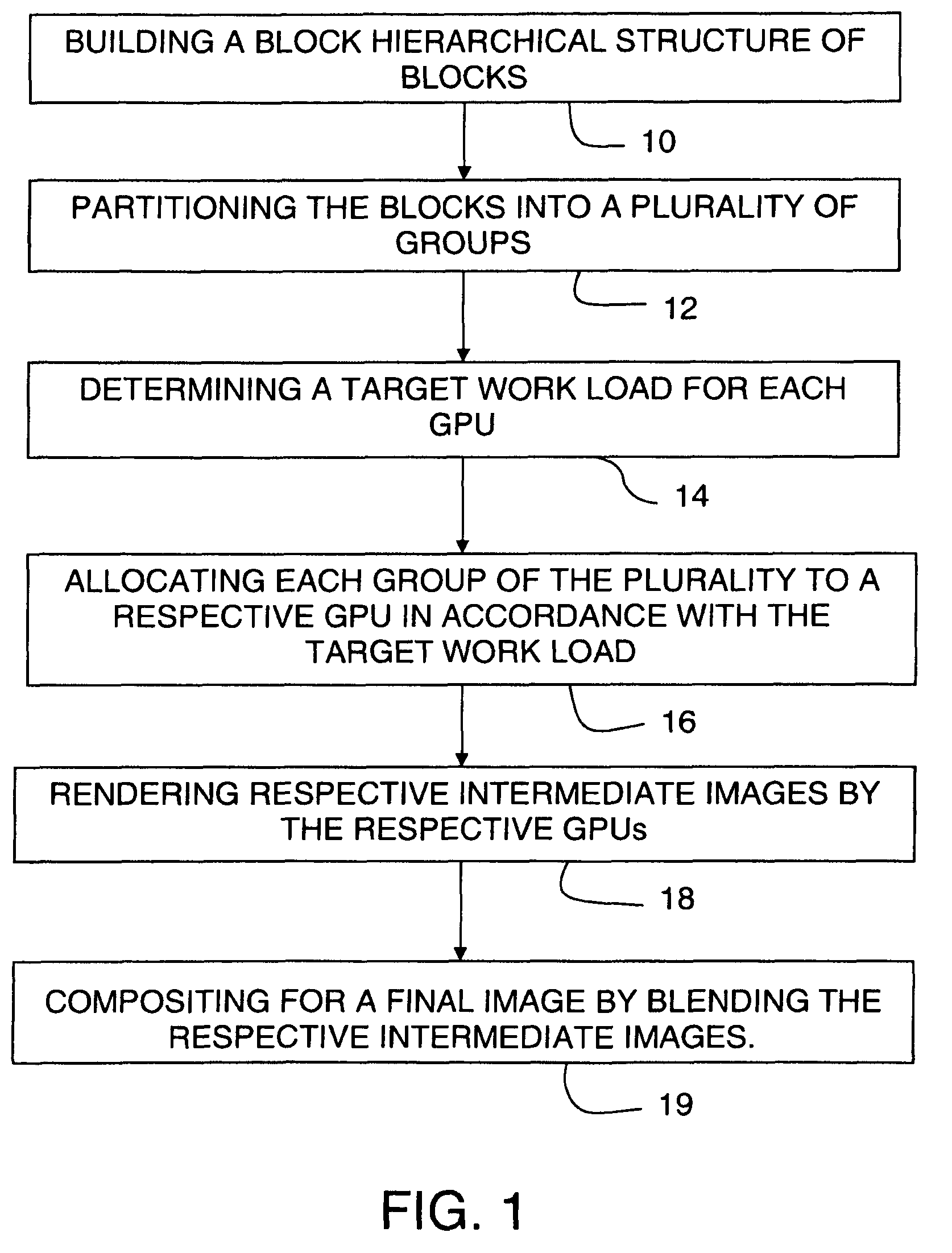
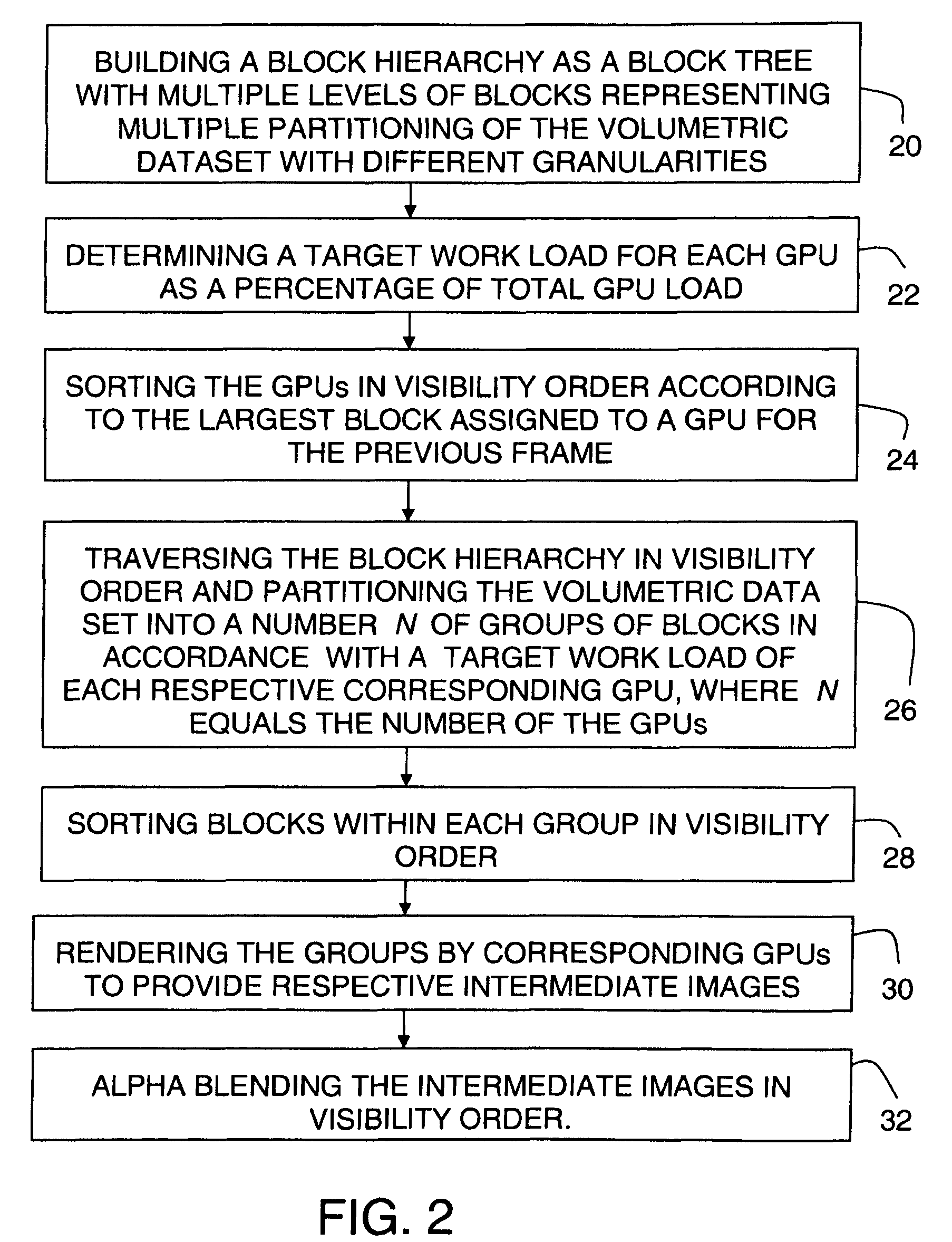
Apparatus and method for volume rendering on multiple graphics processing units (GPUs)
PatentActiveUS8330763B2
Innovation
- A method utilizing multiple GPUs to build a block hierarchy with adaptive granularity and visibility order, partitioning the dataset into groups for each GPU to render in parallel, with atomic visibility order and alpha blending for final compositing, allowing for flexible load balancing and minimizing data transfer.

A method and an apparatus for volumetric video rendering
PatentActiveEP3540696A1
Innovation
- The method involves processing input point cloud tile data arranged into bounding boxes, sorting them by viewing location, dividing the rendering framebuffer into tiles, associating bounding boxes with tiles, storing overlapping indices, and reconstructing a screen space surface by rendering points to screen space tile points using these indices, optimizing data processing and rendering efficiency.


Hardware Infrastructure Requirements and Standards
The hardware infrastructure requirements for volumetric video processing and GPU rendering comparison demand sophisticated computational architectures capable of handling massive data throughput and complex mathematical operations. Modern volumetric video workflows typically require multi-core CPU systems with at least 32GB of RAM, preferably 64GB or higher, to manage the substantial memory footprint of three-dimensional video data structures.
GPU specifications represent a critical component in this infrastructure equation. High-end graphics processing units such as NVIDIA RTX 4090 or professional-grade A6000 cards provide the parallel processing capabilities essential for real-time volumetric rendering. These GPUs must feature substantial VRAM capacity, typically 24GB or more, to accommodate complex volumetric datasets without performance degradation due to memory swapping.
Storage infrastructure standards mandate high-speed NVMe SSD arrays configured in RAID configurations to ensure adequate read/write speeds for volumetric video data streams. The recommended minimum sequential read speed should exceed 7GB/s to prevent bottlenecks during data processing pipelines. Network infrastructure requires 10Gbps Ethernet connectivity or higher for distributed processing scenarios.
Cooling and power delivery systems must accommodate sustained high-performance computing loads. Professional workstations should incorporate liquid cooling solutions and power supplies rated at 1200W or higher to maintain stable operation during intensive volumetric processing tasks. Server-grade motherboards with multiple PCIe 4.0 slots enable multi-GPU configurations essential for comparative performance testing.
Industry standards increasingly favor containerized deployment environments using Docker or Kubernetes orchestration platforms. These standards facilitate reproducible testing conditions and enable scalable infrastructure deployment across cloud and on-premises environments. Compliance with OpenGL 4.6 and Vulkan API standards ensures compatibility across diverse rendering pipelines and hardware configurations.
GPU specifications represent a critical component in this infrastructure equation. High-end graphics processing units such as NVIDIA RTX 4090 or professional-grade A6000 cards provide the parallel processing capabilities essential for real-time volumetric rendering. These GPUs must feature substantial VRAM capacity, typically 24GB or more, to accommodate complex volumetric datasets without performance degradation due to memory swapping.
Storage infrastructure standards mandate high-speed NVMe SSD arrays configured in RAID configurations to ensure adequate read/write speeds for volumetric video data streams. The recommended minimum sequential read speed should exceed 7GB/s to prevent bottlenecks during data processing pipelines. Network infrastructure requires 10Gbps Ethernet connectivity or higher for distributed processing scenarios.
Cooling and power delivery systems must accommodate sustained high-performance computing loads. Professional workstations should incorporate liquid cooling solutions and power supplies rated at 1200W or higher to maintain stable operation during intensive volumetric processing tasks. Server-grade motherboards with multiple PCIe 4.0 slots enable multi-GPU configurations essential for comparative performance testing.
Industry standards increasingly favor containerized deployment environments using Docker or Kubernetes orchestration platforms. These standards facilitate reproducible testing conditions and enable scalable infrastructure deployment across cloud and on-premises environments. Compliance with OpenGL 4.6 and Vulkan API standards ensures compatibility across diverse rendering pipelines and hardware configurations.
Real-time Performance Benchmarking Methodologies
Establishing robust benchmarking methodologies for comparing volumetric video processing and GPU rendering performance requires standardized measurement frameworks that account for the unique characteristics of each technology. The fundamental challenge lies in creating comparable metrics across fundamentally different computational paradigms, where volumetric processing involves complex 3D data manipulation while GPU rendering focuses on traditional polygon-based graphics acceleration.
Performance measurement protocols must incorporate multiple temporal dimensions to capture real-time behavior accurately. Frame rate consistency emerges as a critical metric, requiring measurement of not only average frames per second but also frame time variance, stuttering frequency, and latency distribution patterns. These measurements should be conducted across varying scene complexities, from simple geometric shapes to highly detailed volumetric captures with millions of voxels.
Hardware configuration standardization forms the foundation of meaningful comparisons. Benchmark suites must define specific GPU architectures, memory configurations, and CPU specifications to ensure reproducible results. The methodology should account for thermal throttling effects, power consumption patterns, and memory bandwidth utilization, as these factors significantly impact sustained performance in production environments.
Data complexity scaling represents another crucial benchmarking dimension. Test scenarios should encompass varying volumetric resolutions, compression ratios, and temporal sampling rates to evaluate how each technology handles increasing computational loads. This includes measuring performance degradation curves as scene complexity increases and identifying breaking points where real-time performance becomes unsustainable.
Quality assessment integration within performance benchmarks ensures that speed comparisons maintain visual fidelity standards. Objective metrics such as peak signal-to-noise ratio, structural similarity indices, and perceptual quality measures must be incorporated alongside timing measurements. This prevents optimization strategies that achieve higher frame rates at the expense of visual quality, ensuring fair comparisons between technologies.
Workload diversity testing encompasses various use cases from interactive applications to streaming scenarios. Benchmarks should evaluate performance under different user interaction patterns, network conditions, and concurrent processing loads to reflect real-world deployment conditions accurately.
Performance measurement protocols must incorporate multiple temporal dimensions to capture real-time behavior accurately. Frame rate consistency emerges as a critical metric, requiring measurement of not only average frames per second but also frame time variance, stuttering frequency, and latency distribution patterns. These measurements should be conducted across varying scene complexities, from simple geometric shapes to highly detailed volumetric captures with millions of voxels.
Hardware configuration standardization forms the foundation of meaningful comparisons. Benchmark suites must define specific GPU architectures, memory configurations, and CPU specifications to ensure reproducible results. The methodology should account for thermal throttling effects, power consumption patterns, and memory bandwidth utilization, as these factors significantly impact sustained performance in production environments.
Data complexity scaling represents another crucial benchmarking dimension. Test scenarios should encompass varying volumetric resolutions, compression ratios, and temporal sampling rates to evaluate how each technology handles increasing computational loads. This includes measuring performance degradation curves as scene complexity increases and identifying breaking points where real-time performance becomes unsustainable.
Quality assessment integration within performance benchmarks ensures that speed comparisons maintain visual fidelity standards. Objective metrics such as peak signal-to-noise ratio, structural similarity indices, and perceptual quality measures must be incorporated alongside timing measurements. This prevents optimization strategies that achieve higher frame rates at the expense of visual quality, ensuring fair comparisons between technologies.
Workload diversity testing encompasses various use cases from interactive applications to streaming scenarios. Benchmarks should evaluate performance under different user interaction patterns, network conditions, and concurrent processing loads to reflect real-world deployment conditions accurately.
Unlock deeper insights with PatSnap Eureka Quick Research — get a full tech report to explore trends and direct your research. Try now!
Generate Your Research Report Instantly with AI Agent
Supercharge your innovation with PatSnap Eureka AI Agent Platform!