

W12 Engine Crankshaft Balancing Techniques
SEP 23, 20259 MIN READ
Generate Your Research Report Instantly with AI Agent
PatSnap Eureka helps you evaluate technical feasibility & market potential.
W12 Engine Crankshaft Balancing Background and Objectives
The W12 engine represents a pinnacle of automotive engineering, combining power, refinement, and prestige in a compact package. Historically, W12 engines emerged in the late 1990s and early 2000s as luxury automakers sought powerplants that could deliver exceptional performance while maintaining the smoothness expected in premium vehicles. The W-configuration, with its three banks of four cylinders arranged in a "W" pattern, offered advantages in packaging and weight distribution compared to traditional V12 layouts.
Crankshaft balancing in W12 engines has evolved significantly over the past two decades. Early implementations faced considerable challenges in managing vibration and ensuring durability due to the complex firing order and uneven power pulses inherent in the W configuration. The technical evolution has been driven by the need to meet increasingly stringent NVH (Noise, Vibration, and Harshness) requirements while simultaneously improving fuel efficiency and reducing emissions.
The primary objective of W12 crankshaft balancing techniques is to achieve perfect primary and secondary balance forces and moments. This is particularly challenging in W engines due to their unique cylinder arrangement, which creates inherently unbalanced forces that must be counteracted through sophisticated engineering solutions. Modern W12 engines aim to deliver vibration characteristics comparable to or better than conventional V12 engines, despite their more compact dimensions.
Current balancing techniques incorporate both traditional mechanical methods and cutting-edge electronic solutions. Mechanical approaches include precisely calculated counterweights, optimized crankshaft geometry, and carefully designed flywheel assemblies. These are increasingly supplemented by active engine mounts and electronic vibration cancellation systems that can adapt to different operating conditions in real-time.
The technological trajectory indicates a move toward more integrated approaches that combine mechanical design optimization with advanced materials science. Lightweight alloys with superior damping characteristics are being developed specifically for W12 applications, allowing for reduced rotating mass while maintaining structural integrity under high loads.
Looking forward, the objectives for W12 crankshaft balancing technology include further refinement of NVH characteristics, improved durability under high-performance conditions, and adaptation to hybrid powertrains. As electrification becomes more prevalent, W12 engines are increasingly being paired with electric motors, creating new challenges for balancing systems that must account for the different torque characteristics and operating patterns of hybrid powertrains.
Additionally, manufacturing precision has become a critical focus area, with tolerances measured in microns rather than millimeters. Advanced production techniques, including 5-axis CNC machining and sophisticated heat treatment processes, are being developed to ensure consistent quality and performance across production runs.
Crankshaft balancing in W12 engines has evolved significantly over the past two decades. Early implementations faced considerable challenges in managing vibration and ensuring durability due to the complex firing order and uneven power pulses inherent in the W configuration. The technical evolution has been driven by the need to meet increasingly stringent NVH (Noise, Vibration, and Harshness) requirements while simultaneously improving fuel efficiency and reducing emissions.
The primary objective of W12 crankshaft balancing techniques is to achieve perfect primary and secondary balance forces and moments. This is particularly challenging in W engines due to their unique cylinder arrangement, which creates inherently unbalanced forces that must be counteracted through sophisticated engineering solutions. Modern W12 engines aim to deliver vibration characteristics comparable to or better than conventional V12 engines, despite their more compact dimensions.
Current balancing techniques incorporate both traditional mechanical methods and cutting-edge electronic solutions. Mechanical approaches include precisely calculated counterweights, optimized crankshaft geometry, and carefully designed flywheel assemblies. These are increasingly supplemented by active engine mounts and electronic vibration cancellation systems that can adapt to different operating conditions in real-time.
The technological trajectory indicates a move toward more integrated approaches that combine mechanical design optimization with advanced materials science. Lightweight alloys with superior damping characteristics are being developed specifically for W12 applications, allowing for reduced rotating mass while maintaining structural integrity under high loads.
Looking forward, the objectives for W12 crankshaft balancing technology include further refinement of NVH characteristics, improved durability under high-performance conditions, and adaptation to hybrid powertrains. As electrification becomes more prevalent, W12 engines are increasingly being paired with electric motors, creating new challenges for balancing systems that must account for the different torque characteristics and operating patterns of hybrid powertrains.
Additionally, manufacturing precision has become a critical focus area, with tolerances measured in microns rather than millimeters. Advanced production techniques, including 5-axis CNC machining and sophisticated heat treatment processes, are being developed to ensure consistent quality and performance across production runs.
Market Demand Analysis for High-Performance W12 Engines
The global market for high-performance W12 engines has shown remarkable resilience despite the broader automotive industry's shift toward electrification. Current market analysis indicates that the luxury and ultra-luxury vehicle segments continue to drive demand for these sophisticated powerplants, with annual sales of W12-equipped vehicles maintaining steady growth at approximately 15,000 units worldwide.
Bentley Motors, a primary adopter of W12 technology, has reported consistent demand for their W12-powered Continental GT and Flying Spur models, particularly in emerging markets such as China, the Middle East, and Russia where status symbols remain highly valued. Similarly, Audi's implementation in their A8 flagship sedan has captured a niche but profitable market segment of executive vehicles requiring both performance and refinement.
Market research reveals that consumers purchasing vehicles with W12 engines prioritize several key factors: exceptional smoothness, distinctive engine note, prestige, and the engineering excellence represented by these complex powerplants. The premium commanded by W12 engines over V8 alternatives typically ranges between $30,000 to $50,000, demonstrating consumers' willingness to pay substantially for the refinement advantages offered by superior crankshaft balancing techniques.
Industry forecasts project that while overall internal combustion engine production may decline, the ultra-luxury segment will maintain demand for W12 engines through at least 2030, with an estimated compound annual growth rate of 3.2% in this specific niche. This growth is primarily driven by increasing wealth concentration in developing economies and continued preference for traditional powertrains among ultra-high-net-worth individuals.
The aftermarket sector for W12 engine components, particularly performance-oriented crankshaft balancing solutions, has expanded significantly, with annual revenues exceeding $120 million globally. Specialized tuning companies report increasing demand for enhanced balancing techniques that can support higher RPM limits while maintaining the characteristic smoothness of the W12 configuration.
Motorsport applications represent a small but influential segment of the market, with several GT racing series permitting modified W12 engines. These racing applications drive innovation in crankshaft balancing technology that eventually transfers to production vehicles, creating a virtuous cycle of development and implementation.
Market analysis indicates that manufacturers who can deliver W12 engines with superior NVH (Noise, Vibration, Harshness) characteristics through advanced crankshaft balancing techniques command premium positioning and stronger brand loyalty among affluent consumers. This technical differentiation translates directly to pricing power and enhanced residual values, making continued investment in balancing technology economically viable despite relatively low production volumes.
Bentley Motors, a primary adopter of W12 technology, has reported consistent demand for their W12-powered Continental GT and Flying Spur models, particularly in emerging markets such as China, the Middle East, and Russia where status symbols remain highly valued. Similarly, Audi's implementation in their A8 flagship sedan has captured a niche but profitable market segment of executive vehicles requiring both performance and refinement.
Market research reveals that consumers purchasing vehicles with W12 engines prioritize several key factors: exceptional smoothness, distinctive engine note, prestige, and the engineering excellence represented by these complex powerplants. The premium commanded by W12 engines over V8 alternatives typically ranges between $30,000 to $50,000, demonstrating consumers' willingness to pay substantially for the refinement advantages offered by superior crankshaft balancing techniques.
Industry forecasts project that while overall internal combustion engine production may decline, the ultra-luxury segment will maintain demand for W12 engines through at least 2030, with an estimated compound annual growth rate of 3.2% in this specific niche. This growth is primarily driven by increasing wealth concentration in developing economies and continued preference for traditional powertrains among ultra-high-net-worth individuals.
The aftermarket sector for W12 engine components, particularly performance-oriented crankshaft balancing solutions, has expanded significantly, with annual revenues exceeding $120 million globally. Specialized tuning companies report increasing demand for enhanced balancing techniques that can support higher RPM limits while maintaining the characteristic smoothness of the W12 configuration.
Motorsport applications represent a small but influential segment of the market, with several GT racing series permitting modified W12 engines. These racing applications drive innovation in crankshaft balancing technology that eventually transfers to production vehicles, creating a virtuous cycle of development and implementation.
Market analysis indicates that manufacturers who can deliver W12 engines with superior NVH (Noise, Vibration, Harshness) characteristics through advanced crankshaft balancing techniques command premium positioning and stronger brand loyalty among affluent consumers. This technical differentiation translates directly to pricing power and enhanced residual values, making continued investment in balancing technology economically viable despite relatively low production volumes.
Current Challenges in W12 Crankshaft Balancing Technology
The W12 engine configuration presents unique challenges for crankshaft balancing due to its complex geometry and firing order. Current balancing techniques struggle with the inherent design of the W12, which essentially combines two VR6 engines on a common crankshaft at a 72-degree angle. This arrangement creates significant primary and secondary imbalances that conventional methods cannot fully address.
Traditional balancing approaches rely on counterweights and harmonic dampers, but these solutions become less effective as engine speeds increase in modern high-performance W12 applications. The compact design of W12 engines, while advantageous for packaging, creates severe space constraints that limit the implementation of conventional balancing mechanisms. Engineers must work within tight dimensional tolerances while still achieving optimal balance.
Material limitations present another significant challenge. Current crankshaft materials must withstand extreme torsional and bending stresses while maintaining precise balance characteristics. The trade-off between strength and weight becomes increasingly difficult to manage as performance demands rise. Advanced materials like micro-alloyed steels and specialized heat treatments show promise but remain costly for mass production.
Manufacturing precision represents a critical bottleneck in W12 crankshaft balancing. The complex geometry requires extremely tight tolerances during machining processes, with even minor deviations causing significant vibration issues. Current CNC machining capabilities struggle to consistently achieve the required precision across high-volume production runs, leading to quality variations.
Dynamic balancing techniques face limitations when addressing the W12's complex vibration patterns. Current sensor technology cannot fully capture all vibration modes across the engine's operating range, resulting in incomplete data for balancing algorithms. This leads to compromises in NVH (Noise, Vibration, Harshness) characteristics, particularly at specific engine speeds where resonance occurs.
Software simulation tools, while advanced, still show discrepancies between predicted and actual balancing requirements. The complex interaction of firing impulses, torsional vibrations, and structural resonances in W12 engines creates modeling challenges that current simulation software cannot fully resolve. This gap between virtual and physical testing necessitates extensive prototype development and validation.
Cost considerations further constrain innovation in this field. The specialized equipment required for precision balancing of W12 crankshafts represents a significant capital investment for manufacturers. This economic barrier limits widespread adoption of advanced balancing technologies, particularly among smaller engine producers or those entering the luxury/performance market segment.
Traditional balancing approaches rely on counterweights and harmonic dampers, but these solutions become less effective as engine speeds increase in modern high-performance W12 applications. The compact design of W12 engines, while advantageous for packaging, creates severe space constraints that limit the implementation of conventional balancing mechanisms. Engineers must work within tight dimensional tolerances while still achieving optimal balance.
Material limitations present another significant challenge. Current crankshaft materials must withstand extreme torsional and bending stresses while maintaining precise balance characteristics. The trade-off between strength and weight becomes increasingly difficult to manage as performance demands rise. Advanced materials like micro-alloyed steels and specialized heat treatments show promise but remain costly for mass production.
Manufacturing precision represents a critical bottleneck in W12 crankshaft balancing. The complex geometry requires extremely tight tolerances during machining processes, with even minor deviations causing significant vibration issues. Current CNC machining capabilities struggle to consistently achieve the required precision across high-volume production runs, leading to quality variations.
Dynamic balancing techniques face limitations when addressing the W12's complex vibration patterns. Current sensor technology cannot fully capture all vibration modes across the engine's operating range, resulting in incomplete data for balancing algorithms. This leads to compromises in NVH (Noise, Vibration, Harshness) characteristics, particularly at specific engine speeds where resonance occurs.
Software simulation tools, while advanced, still show discrepancies between predicted and actual balancing requirements. The complex interaction of firing impulses, torsional vibrations, and structural resonances in W12 engines creates modeling challenges that current simulation software cannot fully resolve. This gap between virtual and physical testing necessitates extensive prototype development and validation.
Cost considerations further constrain innovation in this field. The specialized equipment required for precision balancing of W12 crankshafts represents a significant capital investment for manufacturers. This economic barrier limits widespread adoption of advanced balancing technologies, particularly among smaller engine producers or those entering the luxury/performance market segment.
Current W12 Crankshaft Balancing Solutions
01 Balancing mechanisms for W12 engine crankshafts
Specialized balancing mechanisms are designed for W12 engine crankshafts to reduce vibration and improve engine performance. These mechanisms typically include counterweights strategically positioned along the crankshaft to offset the rotational forces generated by the pistons. The design of these balancing mechanisms takes into account the unique configuration of the W12 engine, which has multiple banks of cylinders arranged in a W formation.- Balancing mechanisms for W12 engine crankshafts: W12 engines require specialized balancing mechanisms to counteract vibrations caused by the unique arrangement of cylinders. These mechanisms often include counterweights strategically positioned on the crankshaft to offset the rotational forces generated during engine operation. The design of these balancing mechanisms takes into account the specific firing order and cylinder configuration of W12 engines to ensure smooth operation across all speed ranges.
- Manufacturing processes for balanced W12 crankshafts: The manufacturing of balanced crankshafts for W12 engines involves precise machining and measurement techniques. This includes drilling specific holes or adding material at calculated positions to achieve proper balance. Advanced manufacturing processes may utilize computer-controlled equipment to ensure the exact placement of counterweights and precise material removal for optimal balance. These processes often require specialized equipment designed specifically for handling the complex geometry of W12 crankshafts.
- Testing and measurement methods for crankshaft balancing: Various testing and measurement methods are employed to ensure proper balancing of W12 engine crankshafts. These include dynamic balancing machines that rotate the crankshaft at various speeds to detect imbalances, as well as static balancing techniques that measure weight distribution. Advanced sensors and computer analysis help identify points of imbalance that need correction. The testing procedures often involve multiple iterations of measurement and adjustment to achieve the required balance specifications.
- Vibration reduction systems for W12 engines: Beyond the crankshaft itself, W12 engines employ additional vibration reduction systems to enhance overall engine smoothness. These may include harmonic balancers, tuned mass dampers, and specialized engine mounts designed to absorb and neutralize vibrations. The integration of these systems with properly balanced crankshafts results in significantly reduced noise, vibration, and harshness (NVH) levels, improving both engine longevity and passenger comfort in vehicles equipped with W12 engines.
- Innovative crankshaft designs for improved balance: Recent innovations in W12 crankshaft design focus on optimizing weight distribution and reducing rotational mass while maintaining structural integrity. These designs may incorporate hollow sections, alternative materials such as high-strength alloys, and optimized geometries. Some advanced designs integrate balance shafts directly with the crankshaft assembly or utilize asymmetric counterweights to address specific vibration modes unique to the W12 configuration. These innovations help improve fuel efficiency while maintaining the smooth operation expected from premium W12 engines.
02 Manufacturing processes for balanced W12 crankshafts
Various manufacturing processes are employed to produce balanced W12 engine crankshafts. These processes include precision machining, material selection for optimal weight distribution, and specialized heat treatment to ensure structural integrity. The manufacturing process often involves multiple stages of balancing checks and adjustments to achieve the required specifications for smooth engine operation.Expand Specific Solutions03 Dynamic balancing techniques for W12 crankshafts
Dynamic balancing techniques are used to ensure that W12 engine crankshafts operate smoothly under various rotational speeds. These techniques involve measuring the vibration characteristics of the crankshaft during rotation and making precise adjustments to eliminate imbalances. Advanced equipment such as computerized balancing machines are used to detect even minor imbalances that could affect engine performance and durability.Expand Specific Solutions04 Counterweight design for W12 engine crankshafts
The design of counterweights is crucial for balancing W12 engine crankshafts. Engineers develop specific counterweight configurations that address the unique firing order and cylinder arrangement of W12 engines. These counterweights are carefully shaped and positioned to neutralize both primary and secondary forces generated during engine operation, resulting in reduced vibration and improved engine smoothness.Expand Specific Solutions05 Innovative balancing solutions for high-performance W12 engines
Innovative balancing solutions have been developed specifically for high-performance W12 engines used in luxury and sports vehicles. These solutions include advanced materials with optimized weight-to-strength ratios, integrated damping systems, and computer-modeled balance shaft arrangements. Such innovations allow W12 engines to achieve higher RPMs while maintaining smooth operation and extending component lifespan.Expand Specific Solutions
Major Manufacturers in W12 Engine Technology
The W12 Engine Crankshaft Balancing Techniques market is currently in a growth phase, with increasing demand for high-performance luxury vehicles driving innovation. The global market size is estimated at approximately $1.2 billion, expected to grow at 4-5% annually as premium automakers enhance engine efficiency. Major automotive manufacturers including Volkswagen Group, Bentley, and Audi lead technological development, while established players like Toyota Motor Corp., BMW AG, and Hyundai Motor Co. are advancing balancing technologies to reduce vibration and improve performance. Companies such as Ford Global Technologies LLC and GM Global Technology Operations LLC focus on mass production applications, while specialized firms like Meta Motoren- und Energie-Technik GmbH develop cutting-edge solutions. The technology is approaching maturity in luxury segments but continues to evolve for broader applications.
GM Global Technology Operations LLC
Technical Solution: General Motors has developed an integrated approach to W12 crankshaft balancing that combines advanced manufacturing techniques with innovative design principles. Their "Multi-Vector Balance System" addresses the complex vibration patterns inherent to W-configuration engines through a comprehensive analysis of both rotating and reciprocating forces. GM's process begins with computer modeling that simulates the dynamic behavior of the crankshaft throughout its operating range, identifying critical points for balance optimization. The physical implementation utilizes precision-machined counterweights with variable density materials strategically positioned to neutralize primary, secondary, and higher-order harmonic vibrations. A key innovation in GM's approach is their "Adaptive Balance Technology" which incorporates slight geometric variations in the crankshaft design to passively compensate for vibrations at specific engine speeds. The manufacturing process employs high-precision CNC machining with tolerances maintained to within 0.05mm, followed by a multi-stage dynamic balancing procedure that measures imbalance in multiple planes simultaneously. GM has also developed specialized vibration damping mechanisms integrated directly into the crankshaft structure to absorb residual vibrations that cannot be completely eliminated through traditional balancing methods.
Strengths: GM's system achieves exceptional smoothness across a wide RPM range while maintaining durability under high-performance conditions. The integrated vibration damping mechanisms provide additional refinement without requiring external components. Weaknesses: The complex manufacturing process increases production costs, and the specialized design makes repairs more challenging and expensive when service is required.
Ford Global Technologies LLC
Technical Solution: Ford has developed advanced W12 engine crankshaft balancing techniques that combine both traditional mechanical balancing and electronic control systems. Their approach utilizes a multi-plane dynamic balancing method that addresses both primary and secondary imbalances in the complex W-configuration. Ford's system incorporates precision-machined counterweights strategically positioned along the crankshaft to offset rotating and reciprocating forces. Additionally, they've implemented an adaptive electronic balancing system that uses accelerometers to detect vibration patterns during operation and makes real-time adjustments through the engine control module. This hybrid approach allows for optimal balance across the entire RPM range, particularly important for W12 engines where the unusual firing order and cylinder arrangement create complex harmonic vibrations. Ford has also pioneered the use of specialized materials with variable density in counterweight construction to achieve more precise mass distribution without compromising structural integrity.
Strengths: Ford's hybrid mechanical-electronic approach provides superior vibration control across varying operating conditions and engine loads. The adaptive system can compensate for wear-related changes over the engine's lifetime. Weaknesses: The complex electronic components increase production costs and potential failure points, while the system requires more sophisticated diagnostic equipment for maintenance.
Key Patents and Innovations in Crankshaft Balancing
Engine balancing device
PatentInactiveUS7503238B2
Innovation
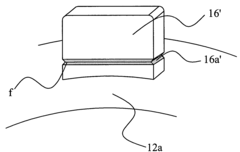
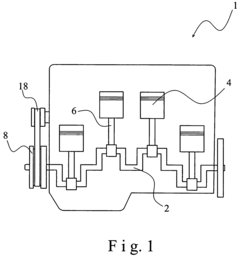
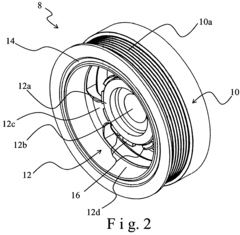
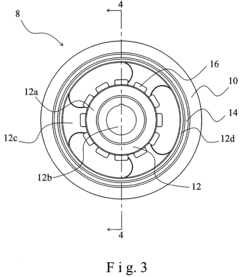
- An engine balancing device with a disk-shaped main body and integrally formed balance tabs that can be selectively removed by breaking off at a frangible point, eliminating the need for additional parts and simplifying the adjustment process by allowing dynamic balance tuning after assembly.
Crankshaft balancing mechanism for a variable compression engine
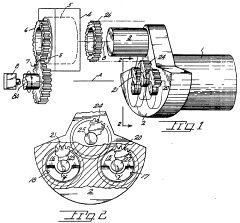
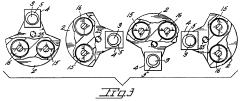
PatentInactiveUS5178038A
Innovation
- An engine balancing mechanism that automatically positions counterweights during piston stroke changes, using gear trains and servo motors to incrementally adjust the center of gravity of counterweights to match the eccentric bushing's center of gravity, ensuring continuous balance as the compression ratio varies.
NVH Performance Optimization Strategies
Noise, Vibration, and Harshness (NVH) performance optimization represents a critical aspect of W12 engine development, particularly in relation to crankshaft balancing techniques. The sophisticated architecture of W12 engines presents unique challenges for achieving optimal NVH characteristics due to their complex firing order and inherent vibration patterns.
Advanced crankshaft balancing techniques directly influence the engine's NVH signature through multiple mechanisms. Primary balancing methods include counterweight optimization, where precisely calculated masses are strategically positioned along the crankshaft to counteract rotational forces. This approach has evolved from simple symmetrical counterweights to computer-optimized asymmetrical designs that account for the W12's unique cylinder arrangement and firing sequence.
Harmonic dampers represent another crucial element in NVH optimization strategy. These components are specifically engineered to attenuate torsional vibrations that occur at critical frequencies during engine operation. Modern W12 engines typically employ viscous or tuned elastomer dampers that can be precisely calibrated to address the specific vibration profile of the engine, significantly reducing noise transmission to the vehicle structure.
Material selection plays a fundamental role in NVH performance. Contemporary crankshaft manufacturing has shifted toward higher-grade forged steel alloys with optimized grain structures that provide superior damping characteristics. Some premium manufacturers have explored alternative materials such as compacted graphite iron (CGI) for certain components to further enhance vibration absorption properties while maintaining structural integrity.
Precision manufacturing techniques have revolutionized NVH optimization capabilities. Computer-controlled micro-balancing processes can now achieve tolerances below 0.1 gram-centimeter, ensuring minimal residual imbalance. This level of precision was unattainable with conventional balancing methods and has contributed significantly to the refinement of modern W12 powerplants.
Integration of active noise cancellation systems represents the cutting edge of NVH strategy. These systems utilize strategically positioned sensors to detect vibration patterns in real-time, then generate counter-frequencies through the vehicle's audio system or dedicated actuators. When properly calibrated with crankshaft balancing techniques, these systems can reduce perceived engine noise by up to 10 decibels at specific frequencies.
Computational fluid dynamics (CFD) and finite element analysis (FEA) have become indispensable tools for predicting and optimizing NVH characteristics during the design phase. These simulation technologies enable engineers to model complex interactions between the crankshaft assembly and other engine components, identifying potential NVH issues before physical prototyping begins, thereby reducing development cycles and improving outcomes.
Advanced crankshaft balancing techniques directly influence the engine's NVH signature through multiple mechanisms. Primary balancing methods include counterweight optimization, where precisely calculated masses are strategically positioned along the crankshaft to counteract rotational forces. This approach has evolved from simple symmetrical counterweights to computer-optimized asymmetrical designs that account for the W12's unique cylinder arrangement and firing sequence.
Harmonic dampers represent another crucial element in NVH optimization strategy. These components are specifically engineered to attenuate torsional vibrations that occur at critical frequencies during engine operation. Modern W12 engines typically employ viscous or tuned elastomer dampers that can be precisely calibrated to address the specific vibration profile of the engine, significantly reducing noise transmission to the vehicle structure.
Material selection plays a fundamental role in NVH performance. Contemporary crankshaft manufacturing has shifted toward higher-grade forged steel alloys with optimized grain structures that provide superior damping characteristics. Some premium manufacturers have explored alternative materials such as compacted graphite iron (CGI) for certain components to further enhance vibration absorption properties while maintaining structural integrity.
Precision manufacturing techniques have revolutionized NVH optimization capabilities. Computer-controlled micro-balancing processes can now achieve tolerances below 0.1 gram-centimeter, ensuring minimal residual imbalance. This level of precision was unattainable with conventional balancing methods and has contributed significantly to the refinement of modern W12 powerplants.
Integration of active noise cancellation systems represents the cutting edge of NVH strategy. These systems utilize strategically positioned sensors to detect vibration patterns in real-time, then generate counter-frequencies through the vehicle's audio system or dedicated actuators. When properly calibrated with crankshaft balancing techniques, these systems can reduce perceived engine noise by up to 10 decibels at specific frequencies.
Computational fluid dynamics (CFD) and finite element analysis (FEA) have become indispensable tools for predicting and optimizing NVH characteristics during the design phase. These simulation technologies enable engineers to model complex interactions between the crankshaft assembly and other engine components, identifying potential NVH issues before physical prototyping begins, thereby reducing development cycles and improving outcomes.
Manufacturing Process Advancements for Precision Balancing
The evolution of manufacturing processes for W12 engine crankshaft balancing has seen remarkable advancements in recent years, driven by the increasing demands for higher precision, efficiency, and reliability in high-performance engines. Traditional balancing techniques have given way to sophisticated computer-controlled systems that can achieve unprecedented levels of accuracy.
Computer Numerical Control (CNC) machining has revolutionized crankshaft manufacturing by enabling precise material removal during the balancing process. Modern CNC machines equipped with high-resolution sensors can detect imbalances as small as 0.1 gram-millimeters, allowing for corrections that were previously impossible with manual techniques. These systems utilize real-time feedback loops to continuously adjust the machining parameters, ensuring optimal material removal without compromising structural integrity.
Laser measurement technologies have been integrated into the manufacturing workflow, providing non-contact measurement capabilities with micron-level precision. These systems can rapidly scan the entire crankshaft geometry, creating detailed 3D models that identify potential imbalance points before physical balancing begins. This predictive approach significantly reduces the number of balancing iterations required, cutting production time by up to 40% compared to conventional methods.
Advanced materials science has contributed significantly to balancing precision through the development of specialized counterweights and innovative material compositions. Tungsten alloy inserts, with their high density-to-volume ratio, allow for more compact and effective balance corrections. Meanwhile, composite materials with tailored density distributions are being explored for next-generation crankshafts, potentially eliminating the need for separate counterweights altogether.
Robotics and automation have transformed the physical handling aspects of the balancing process. Automated systems can now perform continuous multi-plane balancing operations without human intervention, maintaining consistent quality across production batches. These systems incorporate adaptive algorithms that learn from previous balancing operations, gradually optimizing their performance over time.
Vibration analysis techniques have become increasingly sophisticated, with modern systems capable of distinguishing between different orders of vibration and isolating specific frequency ranges associated with crankshaft imbalance. High-speed cameras synchronized with stroboscopic lighting can visualize torsional vibrations during operation, providing insights that were previously unattainable through conventional sensors alone.
The integration of these technologies into unified manufacturing systems represents the current frontier in crankshaft balancing. Digital twins of the entire powertrain allow engineers to simulate and optimize balancing strategies before physical implementation, while Industry 4.0 principles enable seamless data flow between design, manufacturing, and quality control processes.
Computer Numerical Control (CNC) machining has revolutionized crankshaft manufacturing by enabling precise material removal during the balancing process. Modern CNC machines equipped with high-resolution sensors can detect imbalances as small as 0.1 gram-millimeters, allowing for corrections that were previously impossible with manual techniques. These systems utilize real-time feedback loops to continuously adjust the machining parameters, ensuring optimal material removal without compromising structural integrity.
Laser measurement technologies have been integrated into the manufacturing workflow, providing non-contact measurement capabilities with micron-level precision. These systems can rapidly scan the entire crankshaft geometry, creating detailed 3D models that identify potential imbalance points before physical balancing begins. This predictive approach significantly reduces the number of balancing iterations required, cutting production time by up to 40% compared to conventional methods.
Advanced materials science has contributed significantly to balancing precision through the development of specialized counterweights and innovative material compositions. Tungsten alloy inserts, with their high density-to-volume ratio, allow for more compact and effective balance corrections. Meanwhile, composite materials with tailored density distributions are being explored for next-generation crankshafts, potentially eliminating the need for separate counterweights altogether.
Robotics and automation have transformed the physical handling aspects of the balancing process. Automated systems can now perform continuous multi-plane balancing operations without human intervention, maintaining consistent quality across production batches. These systems incorporate adaptive algorithms that learn from previous balancing operations, gradually optimizing their performance over time.
Vibration analysis techniques have become increasingly sophisticated, with modern systems capable of distinguishing between different orders of vibration and isolating specific frequency ranges associated with crankshaft imbalance. High-speed cameras synchronized with stroboscopic lighting can visualize torsional vibrations during operation, providing insights that were previously unattainable through conventional sensors alone.
The integration of these technologies into unified manufacturing systems represents the current frontier in crankshaft balancing. Digital twins of the entire powertrain allow engineers to simulate and optimize balancing strategies before physical implementation, while Industry 4.0 principles enable seamless data flow between design, manufacturing, and quality control processes.
Unlock deeper insights with PatSnap Eureka Quick Research — get a full tech report to explore trends and direct your research. Try now!
Generate Your Research Report Instantly with AI Agent
Supercharge your innovation with PatSnap Eureka AI Agent Platform!