

Warpage Reduction in PLA for Biodegradable Packaging Applications
MAY 22, 20269 MIN READ
Generate Your Research Report Instantly with AI Agent
PatSnap Eureka helps you evaluate technical feasibility & market potential.
PLA Warpage Challenges in Biodegradable Packaging Goals
Polylactic acid (PLA) has emerged as a leading biodegradable polymer for sustainable packaging applications, driven by increasing environmental regulations and consumer demand for eco-friendly alternatives to conventional petroleum-based plastics. The global shift toward circular economy principles has positioned PLA as a critical material for reducing plastic waste accumulation in landfills and marine environments. However, the widespread adoption of PLA in packaging applications faces significant technical barriers, with warpage being one of the most persistent and economically impactful challenges.
Warpage in PLA packaging manifests as dimensional distortion during processing and cooling phases, resulting in products that deviate from intended geometries. This deformation compromises package integrity, affects seal quality, and leads to substantial material waste and production inefficiencies. The phenomenon is particularly problematic in thin-walled packaging applications where precise dimensional control is essential for automated filling and sealing operations.
The primary technical objectives for addressing PLA warpage encompass multiple interconnected goals. Dimensional stability represents the foremost priority, requiring the development of processing methodologies and material formulations that maintain geometric precision within ±0.5mm tolerance across typical packaging dimensions. This level of control is essential for ensuring compatibility with existing packaging machinery and maintaining consumer acceptance standards.
Thermal management constitutes another critical objective, focusing on optimizing cooling protocols and mold design to minimize differential shrinkage rates that drive warpage formation. Advanced temperature control systems and innovative cooling channel configurations are being investigated to achieve uniform heat dissipation throughout the packaging structure.
Material enhancement objectives target the development of PLA formulations with improved crystallization behavior and reduced internal stress generation. This includes incorporating nucleating agents, plasticizers, and reinforcing fillers that can modify the polymer's thermal and mechanical properties while maintaining biodegradability characteristics.
Process optimization goals emphasize the refinement of injection molding parameters, including melt temperature profiles, injection speeds, and holding pressures, to minimize residual stresses that contribute to post-molding deformation. Additionally, the integration of real-time monitoring systems for quality control represents a key technological advancement target.
The ultimate objective extends beyond mere warpage reduction to establish PLA as a viable replacement for conventional packaging materials across diverse applications, from food containers to protective packaging systems, thereby accelerating the transition toward sustainable packaging solutions in global markets.
Warpage in PLA packaging manifests as dimensional distortion during processing and cooling phases, resulting in products that deviate from intended geometries. This deformation compromises package integrity, affects seal quality, and leads to substantial material waste and production inefficiencies. The phenomenon is particularly problematic in thin-walled packaging applications where precise dimensional control is essential for automated filling and sealing operations.
The primary technical objectives for addressing PLA warpage encompass multiple interconnected goals. Dimensional stability represents the foremost priority, requiring the development of processing methodologies and material formulations that maintain geometric precision within ±0.5mm tolerance across typical packaging dimensions. This level of control is essential for ensuring compatibility with existing packaging machinery and maintaining consumer acceptance standards.
Thermal management constitutes another critical objective, focusing on optimizing cooling protocols and mold design to minimize differential shrinkage rates that drive warpage formation. Advanced temperature control systems and innovative cooling channel configurations are being investigated to achieve uniform heat dissipation throughout the packaging structure.
Material enhancement objectives target the development of PLA formulations with improved crystallization behavior and reduced internal stress generation. This includes incorporating nucleating agents, plasticizers, and reinforcing fillers that can modify the polymer's thermal and mechanical properties while maintaining biodegradability characteristics.
Process optimization goals emphasize the refinement of injection molding parameters, including melt temperature profiles, injection speeds, and holding pressures, to minimize residual stresses that contribute to post-molding deformation. Additionally, the integration of real-time monitoring systems for quality control represents a key technological advancement target.
The ultimate objective extends beyond mere warpage reduction to establish PLA as a viable replacement for conventional packaging materials across diverse applications, from food containers to protective packaging systems, thereby accelerating the transition toward sustainable packaging solutions in global markets.
Market Demand for Warpage-Free PLA Packaging Solutions
The global biodegradable packaging market is experiencing unprecedented growth driven by stringent environmental regulations and increasing consumer awareness of plastic pollution. Traditional petroleum-based packaging materials face mounting pressure from legislative initiatives such as the European Union's Single-Use Plastics Directive and similar regulations across North America and Asia-Pacific regions. This regulatory landscape creates substantial opportunities for PLA-based packaging solutions that can demonstrate both environmental benefits and functional performance.
Food and beverage packaging represents the largest market segment demanding warpage-free PLA solutions. The sector requires packaging materials that maintain structural integrity throughout the supply chain, from manufacturing and filling processes to retail display and consumer use. Warpage issues in PLA packaging can compromise seal integrity, affect product presentation, and lead to increased rejection rates during automated packaging operations. Major food manufacturers are actively seeking PLA formulations that can match the dimensional stability of conventional plastics while meeting sustainability targets.
E-commerce packaging emerges as another significant growth driver for improved PLA materials. The rapid expansion of online retail creates demand for protective packaging that can withstand shipping stresses without deformation. Warpage in PLA packaging can result in poor fit during automated packing processes, increased material usage, and potential product damage during transit. Companies operating large-scale fulfillment operations require consistent dimensional performance to maintain packaging line efficiency and cost-effectiveness.
Consumer electronics packaging presents specialized requirements for warpage-free PLA solutions. Electronic products demand precise-fitting packaging that provides adequate protection while maintaining aesthetic appeal. Warpage can compromise the protective function of packaging and create poor unboxing experiences that affect brand perception. The electronics industry's growing commitment to sustainable packaging creates opportunities for PLA materials that can meet strict dimensional tolerances.
The cosmetics and personal care industry represents an emerging market segment with specific demands for premium packaging aesthetics. Warpage issues can significantly impact the visual appeal of cosmetic packaging, affecting brand positioning and consumer perception. Luxury brands particularly require packaging materials that maintain perfect form while supporting sustainability messaging. This segment often accepts premium pricing for materials that deliver both environmental benefits and superior performance characteristics.
Agricultural and horticultural packaging applications require PLA materials that resist warpage under varying temperature and humidity conditions. Greenhouse environments and outdoor storage conditions can exacerbate warpage issues in conventional PLA formulations. The agricultural sector's increasing adoption of biodegradable mulch films and plant containers creates demand for dimensionally stable PLA materials that can perform reliably across diverse environmental conditions.
Food and beverage packaging represents the largest market segment demanding warpage-free PLA solutions. The sector requires packaging materials that maintain structural integrity throughout the supply chain, from manufacturing and filling processes to retail display and consumer use. Warpage issues in PLA packaging can compromise seal integrity, affect product presentation, and lead to increased rejection rates during automated packaging operations. Major food manufacturers are actively seeking PLA formulations that can match the dimensional stability of conventional plastics while meeting sustainability targets.
E-commerce packaging emerges as another significant growth driver for improved PLA materials. The rapid expansion of online retail creates demand for protective packaging that can withstand shipping stresses without deformation. Warpage in PLA packaging can result in poor fit during automated packing processes, increased material usage, and potential product damage during transit. Companies operating large-scale fulfillment operations require consistent dimensional performance to maintain packaging line efficiency and cost-effectiveness.
Consumer electronics packaging presents specialized requirements for warpage-free PLA solutions. Electronic products demand precise-fitting packaging that provides adequate protection while maintaining aesthetic appeal. Warpage can compromise the protective function of packaging and create poor unboxing experiences that affect brand perception. The electronics industry's growing commitment to sustainable packaging creates opportunities for PLA materials that can meet strict dimensional tolerances.
The cosmetics and personal care industry represents an emerging market segment with specific demands for premium packaging aesthetics. Warpage issues can significantly impact the visual appeal of cosmetic packaging, affecting brand positioning and consumer perception. Luxury brands particularly require packaging materials that maintain perfect form while supporting sustainability messaging. This segment often accepts premium pricing for materials that deliver both environmental benefits and superior performance characteristics.
Agricultural and horticultural packaging applications require PLA materials that resist warpage under varying temperature and humidity conditions. Greenhouse environments and outdoor storage conditions can exacerbate warpage issues in conventional PLA formulations. The agricultural sector's increasing adoption of biodegradable mulch films and plant containers creates demand for dimensionally stable PLA materials that can perform reliably across diverse environmental conditions.
Current PLA Warpage Issues and Processing Limitations
PLA warpage represents one of the most significant technical barriers limiting the widespread adoption of this biodegradable polymer in packaging applications. The phenomenon manifests as dimensional distortion during cooling phases of processing, where differential shrinkage rates across part thickness create internal stresses that result in permanent deformation. This issue is particularly pronounced in thin-walled packaging components where even minimal warpage can compromise functionality and aesthetic appeal.
The root cause of PLA warpage stems from its semi-crystalline nature and relatively high glass transition temperature of approximately 60°C. During processing, rapid cooling creates temperature gradients that lead to non-uniform crystallization patterns. The amorphous regions shrink at different rates compared to crystalline domains, generating internal stresses that exceed the material's yield strength at processing temperatures.
Current injection molding processes face significant limitations when processing PLA for packaging applications. Mold temperatures typically require precise control between 40-80°C to balance cycle time efficiency with warpage minimization. However, this narrow processing window often proves insufficient for complex geometries or varying wall thicknesses common in packaging designs. Additionally, cooling rates must be carefully managed, as rapid cooling reduces crystallinity but increases residual stress, while slow cooling promotes crystallization but extends cycle times beyond economically viable limits.
Thermoforming applications encounter similar challenges, where non-uniform heating and cooling across large sheet areas create differential shrinkage patterns. The material's tendency to exhibit stress whitening under deformation further complicates processing, as attempts to minimize warpage through mechanical restraint often result in visible stress marks that compromise package appearance.
Extrusion blow molding processes struggle with PLA's narrow processing temperature range and sensitivity to thermal history. Parison programming becomes critical as wall thickness variations directly correlate with warpage severity. The material's relatively low melt strength compared to conventional packaging polymers also limits processing flexibility and contributes to dimensional instability.
These processing limitations collectively restrict PLA's application scope in packaging markets, particularly for precision-fit components, large flat surfaces, and thin-walled containers where dimensional accuracy is paramount for functionality and consumer acceptance.
The root cause of PLA warpage stems from its semi-crystalline nature and relatively high glass transition temperature of approximately 60°C. During processing, rapid cooling creates temperature gradients that lead to non-uniform crystallization patterns. The amorphous regions shrink at different rates compared to crystalline domains, generating internal stresses that exceed the material's yield strength at processing temperatures.
Current injection molding processes face significant limitations when processing PLA for packaging applications. Mold temperatures typically require precise control between 40-80°C to balance cycle time efficiency with warpage minimization. However, this narrow processing window often proves insufficient for complex geometries or varying wall thicknesses common in packaging designs. Additionally, cooling rates must be carefully managed, as rapid cooling reduces crystallinity but increases residual stress, while slow cooling promotes crystallization but extends cycle times beyond economically viable limits.
Thermoforming applications encounter similar challenges, where non-uniform heating and cooling across large sheet areas create differential shrinkage patterns. The material's tendency to exhibit stress whitening under deformation further complicates processing, as attempts to minimize warpage through mechanical restraint often result in visible stress marks that compromise package appearance.
Extrusion blow molding processes struggle with PLA's narrow processing temperature range and sensitivity to thermal history. Parison programming becomes critical as wall thickness variations directly correlate with warpage severity. The material's relatively low melt strength compared to conventional packaging polymers also limits processing flexibility and contributes to dimensional instability.
These processing limitations collectively restrict PLA's application scope in packaging markets, particularly for precision-fit components, large flat surfaces, and thin-walled containers where dimensional accuracy is paramount for functionality and consumer acceptance.
Existing Warpage Reduction Solutions for PLA Processing
01 Material composition modification for warpage reduction
Modifying the material composition of PLA by incorporating additives, fillers, or blending with other polymers to reduce internal stress and improve dimensional stability. This approach focuses on altering the molecular structure and crystallization behavior to minimize warpage during processing and cooling.- Material composition modification for warpage reduction: Modifying the material composition of PLA by incorporating additives, fillers, or blending with other polymers can significantly reduce warpage during processing. These modifications help improve dimensional stability, reduce thermal expansion coefficients, and enhance the overall mechanical properties of the final product. The approach focuses on optimizing the polymer matrix to minimize internal stresses that lead to warpage.
- Processing parameter optimization: Controlling processing parameters such as temperature profiles, cooling rates, and molding conditions is crucial for minimizing warpage in PLA products. Proper optimization of these parameters helps achieve uniform cooling, reduces residual stresses, and ensures better dimensional accuracy. This approach involves systematic adjustment of manufacturing conditions to prevent differential shrinkage that causes warpage.
- Mold design and tooling solutions: Implementing specific mold design features and tooling modifications can effectively address warpage issues in PLA manufacturing. This includes optimizing gate locations, runner systems, cooling channel designs, and incorporating specialized mold features that promote uniform material flow and cooling. The focus is on engineering solutions that prevent uneven shrinkage patterns.
- Reinforcement and fiber incorporation: Adding reinforcing materials such as fibers, nanoparticles, or other strengthening agents to PLA formulations helps reduce warpage by improving dimensional stability and reducing thermal expansion. These reinforcements create a more stable matrix that resists deformation during cooling and use, leading to better shape retention and reduced warpage tendencies.
- Post-processing and annealing treatments: Applying controlled post-processing treatments including annealing, stress relief procedures, and controlled cooling cycles can significantly reduce warpage in PLA components. These treatments help relieve internal stresses, promote molecular relaxation, and achieve better dimensional stability. The approach focuses on thermal and mechanical treatments applied after initial forming to minimize deformation.
02 Processing parameter optimization
Controlling processing conditions such as temperature profiles, cooling rates, and molding parameters to minimize warpage formation. This involves optimizing the thermal history and stress distribution during manufacturing to achieve better dimensional accuracy and reduced deformation.Expand Specific Solutions03 Mold design and tooling solutions
Implementing specific mold designs, cooling systems, and tooling configurations to control warpage. This includes optimizing gate locations, runner systems, and cooling channel arrangements to ensure uniform temperature distribution and minimize differential shrinkage.Expand Specific Solutions04 Reinforcement and fiber incorporation
Adding reinforcing materials such as fibers or nanoparticles to improve the mechanical properties and dimensional stability of PLA products. These reinforcements help distribute stress more evenly and reduce the tendency for warpage by providing structural support.Expand Specific Solutions05 Post-processing and annealing treatments
Applying post-processing techniques including annealing, stress relief treatments, and controlled cooling procedures to minimize residual stresses and warpage. These methods help stabilize the material structure and reduce deformation after the initial forming process.Expand Specific Solutions
Key Players in PLA and Biodegradable Packaging Industry
The warpage reduction in PLA for biodegradable packaging applications represents an emerging technology sector within the broader sustainable packaging industry, which is experiencing rapid growth driven by environmental regulations and consumer demand for eco-friendly alternatives. The market is in its early-to-mid development stage, with significant expansion potential as companies seek to replace traditional petroleum-based plastics. Technology maturity varies considerably across players, with established companies like Novamont SpA and Wanhua Chemical Group demonstrating advanced bioplastic formulations, while research institutions such as Cornell University and University of Coimbra contribute fundamental material science innovations. Companies like Sulapac Oy and Northern Technologies International Corp. are developing specialized solutions for luxury and industrial applications respectively, indicating market segmentation. The competitive landscape includes a mix of chemical giants, specialized bioplastic manufacturers, and academic institutions, suggesting the technology is transitioning from research-focused to commercially viable applications, though warpage control remains a critical technical challenge requiring continued innovation.
Novamont SpA
Technical Solution: Novamont has developed advanced biodegradable polymer formulations specifically designed to reduce warpage in PLA-based packaging applications. Their Mater-Bi technology incorporates specialized plasticizers and nucleating agents that control crystallization behavior and thermal expansion coefficients. The company's approach focuses on molecular-level modifications to PLA chains, incorporating bio-based additives that enhance dimensional stability during cooling phases of injection molding and thermoforming processes. Their proprietary blend technology creates more uniform stress distribution throughout the material matrix, significantly reducing internal stresses that typically cause warpage in conventional PLA formulations.
Strengths: Established market leader in biodegradable materials with proven commercial applications and extensive R&D capabilities. Weaknesses: Higher material costs compared to conventional PLA and potential processing complexity requiring specialized equipment.
Avantium Knowledge Centre BV
Technical Solution: Avantium has developed innovative PEF (polyethylene furanoate) and PLA hybrid formulations that address warpage issues through controlled polymer architecture. Their technology utilizes renewable feedstock-based polymers with enhanced thermal properties and reduced shrinkage characteristics. The company's approach involves molecular design strategies that incorporate furan-based building blocks into PLA matrices, creating materials with improved dimensional stability and reduced coefficient of thermal expansion. Their processing technology includes specialized temperature control systems and modified cooling protocols that minimize differential shrinkage across part geometries, effectively reducing warpage in complex packaging shapes while maintaining full biodegradability and compostability standards.
Strengths: Strong expertise in renewable chemistry and innovative polymer design with excellent thermal stability properties. Weaknesses: Technology still in development phase with limited commercial scale production and higher processing temperatures required.
Core Innovations in PLA Warpage Control Patents
Biodegradable polymer blend
PatentInactiveUS20210246303A1
Innovation
- A biodegradable polyester blend comprising predominantly PLA, poly-LD-lactide, poly-D-lactide, and other biodegradable polyesters, with a nucleating agent to enhance crystallization and impact strength, and a low molecular weight polyester for improved flow rates, eliminating the need for non-degradable additives and secondary processing steps.
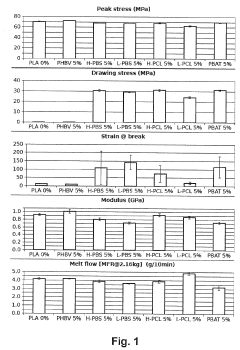
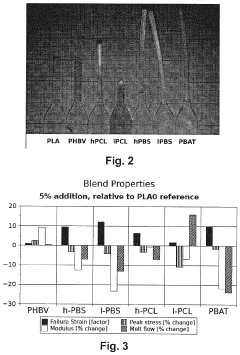
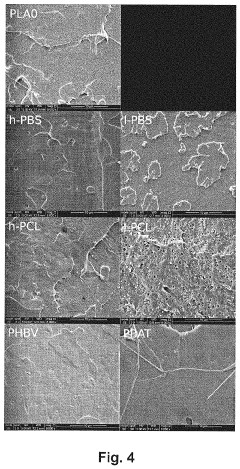
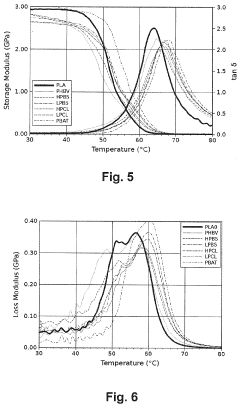
Use of polylactide and method of manufacturing a heat-sealed paper or board container or package
PatentWO2015110981A1
Innovation
- Incorporating a cross-linking catalyst into the PLA blend and subjecting the coating layer to electron beam (EB) radiation to enhance adhesion, heat-sealability, and thermal stability, allowing for the production of biodegradable, ovenable containers and packages.


Environmental Regulations for Biodegradable Packaging
The regulatory landscape for biodegradable packaging has evolved significantly in response to growing environmental concerns and the urgent need to address plastic pollution. The European Union has been at the forefront of establishing comprehensive frameworks, with the Single-Use Plastics Directive (2019/904) mandating restrictions on conventional plastic products and promoting biodegradable alternatives. This directive specifically targets items like food containers, cups, and cutlery, creating substantial market opportunities for PLA-based packaging solutions.
In the United States, regulatory approaches vary by state, with California leading through the California Circular Economy and Plastic Pollution Reduction Act, which requires significant reductions in single-use packaging waste by 2032. The FDA has approved PLA for food contact applications under specific conditions, establishing clear guidelines for biodegradable packaging manufacturers. These regulations emphasize the importance of maintaining structural integrity during use while ensuring complete biodegradation under industrial composting conditions.
International standards organizations have developed critical certification frameworks that directly impact PLA packaging development. ASTM D6400 and EN 13432 standards define biodegradability requirements, specifying that materials must achieve 90% biodegradation within 180 days under controlled composting conditions. These standards create technical constraints that influence material formulation and processing parameters, making warpage reduction crucial for meeting both performance and environmental compliance requirements.
Emerging regulations in Asia-Pacific markets, particularly in Japan and South Korea, are establishing similar frameworks with additional emphasis on marine biodegradability. The Japanese government's plastic resource circulation strategy promotes bio-based materials while requiring demonstration of end-of-life environmental safety. These regulations often include specific testing protocols for mechanical properties and dimensional stability, directly linking warpage control to regulatory compliance.
The regulatory trend toward extended producer responsibility schemes across multiple jurisdictions creates additional compliance requirements for packaging manufacturers. These frameworks mandate that producers demonstrate the environmental performance of their packaging throughout its lifecycle, including manufacturing efficiency and waste reduction. Consequently, addressing warpage issues in PLA packaging becomes not only a technical necessity but also a regulatory imperative for market access and long-term business sustainability.
In the United States, regulatory approaches vary by state, with California leading through the California Circular Economy and Plastic Pollution Reduction Act, which requires significant reductions in single-use packaging waste by 2032. The FDA has approved PLA for food contact applications under specific conditions, establishing clear guidelines for biodegradable packaging manufacturers. These regulations emphasize the importance of maintaining structural integrity during use while ensuring complete biodegradation under industrial composting conditions.
International standards organizations have developed critical certification frameworks that directly impact PLA packaging development. ASTM D6400 and EN 13432 standards define biodegradability requirements, specifying that materials must achieve 90% biodegradation within 180 days under controlled composting conditions. These standards create technical constraints that influence material formulation and processing parameters, making warpage reduction crucial for meeting both performance and environmental compliance requirements.
Emerging regulations in Asia-Pacific markets, particularly in Japan and South Korea, are establishing similar frameworks with additional emphasis on marine biodegradability. The Japanese government's plastic resource circulation strategy promotes bio-based materials while requiring demonstration of end-of-life environmental safety. These regulations often include specific testing protocols for mechanical properties and dimensional stability, directly linking warpage control to regulatory compliance.
The regulatory trend toward extended producer responsibility schemes across multiple jurisdictions creates additional compliance requirements for packaging manufacturers. These frameworks mandate that producers demonstrate the environmental performance of their packaging throughout its lifecycle, including manufacturing efficiency and waste reduction. Consequently, addressing warpage issues in PLA packaging becomes not only a technical necessity but also a regulatory imperative for market access and long-term business sustainability.
Sustainability Impact Assessment of PLA Packaging
The sustainability impact assessment of PLA packaging represents a critical evaluation framework for understanding the environmental implications of polylactic acid-based packaging solutions, particularly in the context of warpage reduction technologies. This assessment encompasses multiple dimensions of environmental performance, from raw material sourcing through end-of-life disposal, providing essential insights for sustainable packaging development.
Life cycle assessment studies demonstrate that PLA packaging exhibits significantly lower carbon footprint compared to conventional petroleum-based plastics, with greenhouse gas emissions reduced by approximately 25-75% depending on production methods and energy sources. The renewable feedstock origin of PLA, primarily derived from corn starch, sugarcane, and other plant-based materials, contributes to this environmental advantage by sequestering atmospheric carbon during biomass growth phases.
Biodegradability characteristics of PLA packaging present both opportunities and challenges for sustainability outcomes. Under industrial composting conditions at temperatures exceeding 58°C, PLA materials decompose within 90-180 days, producing water, carbon dioxide, and biomass without toxic residues. However, degradation rates in marine environments and home composting systems remain significantly slower, requiring 6-24 months under optimal conditions.
Warpage reduction technologies specifically enhance sustainability performance by minimizing material waste during manufacturing processes and improving packaging efficiency ratios. Advanced thermal management systems and modified polymer formulations reduce defect rates by 40-60%, directly translating to decreased raw material consumption and energy usage per functional packaging unit.
The circular economy potential of PLA packaging systems shows promising developments through mechanical and chemical recycling pathways. Recent innovations in depolymerization technologies enable recovery of lactide monomers with 85-95% efficiency, supporting closed-loop material flows. However, current recycling infrastructure limitations and contamination sensitivity remain significant barriers to widespread implementation.
Regional sustainability impacts vary considerably based on agricultural practices, energy grid compositions, and waste management infrastructure. European and North American markets demonstrate superior environmental performance due to established industrial composting networks and renewable energy integration, while developing regions face challenges in optimizing sustainability outcomes through improved infrastructure development.
Life cycle assessment studies demonstrate that PLA packaging exhibits significantly lower carbon footprint compared to conventional petroleum-based plastics, with greenhouse gas emissions reduced by approximately 25-75% depending on production methods and energy sources. The renewable feedstock origin of PLA, primarily derived from corn starch, sugarcane, and other plant-based materials, contributes to this environmental advantage by sequestering atmospheric carbon during biomass growth phases.
Biodegradability characteristics of PLA packaging present both opportunities and challenges for sustainability outcomes. Under industrial composting conditions at temperatures exceeding 58°C, PLA materials decompose within 90-180 days, producing water, carbon dioxide, and biomass without toxic residues. However, degradation rates in marine environments and home composting systems remain significantly slower, requiring 6-24 months under optimal conditions.
Warpage reduction technologies specifically enhance sustainability performance by minimizing material waste during manufacturing processes and improving packaging efficiency ratios. Advanced thermal management systems and modified polymer formulations reduce defect rates by 40-60%, directly translating to decreased raw material consumption and energy usage per functional packaging unit.
The circular economy potential of PLA packaging systems shows promising developments through mechanical and chemical recycling pathways. Recent innovations in depolymerization technologies enable recovery of lactide monomers with 85-95% efficiency, supporting closed-loop material flows. However, current recycling infrastructure limitations and contamination sensitivity remain significant barriers to widespread implementation.
Regional sustainability impacts vary considerably based on agricultural practices, energy grid compositions, and waste management infrastructure. European and North American markets demonstrate superior environmental performance due to established industrial composting networks and renewable energy integration, while developing regions face challenges in optimizing sustainability outcomes through improved infrastructure development.
Unlock deeper insights with PatSnap Eureka Quick Research — get a full tech report to explore trends and direct your research. Try now!
Generate Your Research Report Instantly with AI Agent
Supercharge your innovation with PatSnap Eureka AI Agent Platform!