

Wireless BMS vs I2C: Power Requirements Comparison
APR 11, 20269 MIN READ
Generate Your Research Report Instantly with AI Agent
PatSnap Eureka helps you evaluate technical feasibility & market potential.
Wireless BMS vs I2C Technology Background and Objectives
Battery Management Systems have undergone significant evolution since their inception in the early 1990s, driven by the increasing complexity of battery applications and the demand for enhanced safety, performance, and reliability. The fundamental objective of any BMS architecture is to monitor, control, and protect battery cells while optimizing their operational efficiency and lifespan.
Traditional wired communication protocols, particularly I2C (Inter-Integrated Circuit), have dominated BMS implementations for decades due to their simplicity, reliability, and low implementation costs. I2C operates as a multi-master, multi-slave serial communication protocol that enables efficient data exchange between battery monitoring components using just two wires for clock and data transmission.
The emergence of wireless BMS technologies represents a paradigm shift in battery management architecture, primarily motivated by the limitations of wired systems in large-scale applications such as electric vehicles, energy storage systems, and industrial battery packs. Wireless BMS solutions eliminate the need for extensive wiring harnesses, reducing system complexity and potential failure points while enabling more flexible battery pack configurations.
Power consumption has become a critical differentiating factor between these two approaches, particularly as battery systems scale up and operational efficiency requirements intensify. The power requirements comparison between wireless BMS and I2C systems encompasses multiple dimensions including active communication power, standby power consumption, and overall system efficiency impacts.
The primary technical objective of this comparison is to establish comprehensive power consumption benchmarks for both wireless and I2C-based BMS architectures across various operational scenarios. This includes analyzing power consumption during normal monitoring operations, data transmission phases, sleep modes, and fault detection activities.
Secondary objectives focus on evaluating the scalability implications of power consumption as battery pack sizes increase, assessing the impact of communication frequency on overall power budgets, and determining optimal power management strategies for each approach. Understanding these power dynamics is essential for making informed architectural decisions in next-generation battery management systems.
The comparative analysis aims to provide quantitative insights into the trade-offs between communication flexibility and power efficiency, enabling engineers to select the most appropriate BMS architecture based on specific application requirements and power constraints.
Traditional wired communication protocols, particularly I2C (Inter-Integrated Circuit), have dominated BMS implementations for decades due to their simplicity, reliability, and low implementation costs. I2C operates as a multi-master, multi-slave serial communication protocol that enables efficient data exchange between battery monitoring components using just two wires for clock and data transmission.
The emergence of wireless BMS technologies represents a paradigm shift in battery management architecture, primarily motivated by the limitations of wired systems in large-scale applications such as electric vehicles, energy storage systems, and industrial battery packs. Wireless BMS solutions eliminate the need for extensive wiring harnesses, reducing system complexity and potential failure points while enabling more flexible battery pack configurations.
Power consumption has become a critical differentiating factor between these two approaches, particularly as battery systems scale up and operational efficiency requirements intensify. The power requirements comparison between wireless BMS and I2C systems encompasses multiple dimensions including active communication power, standby power consumption, and overall system efficiency impacts.
The primary technical objective of this comparison is to establish comprehensive power consumption benchmarks for both wireless and I2C-based BMS architectures across various operational scenarios. This includes analyzing power consumption during normal monitoring operations, data transmission phases, sleep modes, and fault detection activities.
Secondary objectives focus on evaluating the scalability implications of power consumption as battery pack sizes increase, assessing the impact of communication frequency on overall power budgets, and determining optimal power management strategies for each approach. Understanding these power dynamics is essential for making informed architectural decisions in next-generation battery management systems.
The comparative analysis aims to provide quantitative insights into the trade-offs between communication flexibility and power efficiency, enabling engineers to select the most appropriate BMS architecture based on specific application requirements and power constraints.
Market Demand for Energy-Efficient BMS Solutions
The global battery management system market is experiencing unprecedented growth driven by the accelerating adoption of electric vehicles, renewable energy storage systems, and portable electronic devices. This expansion has intensified the focus on energy efficiency as a critical differentiator in BMS design, particularly regarding power consumption optimization between wireless and wired communication architectures.
Electric vehicle manufacturers are increasingly prioritizing BMS solutions that minimize parasitic power drain to maximize driving range and battery longevity. The automotive sector represents the largest demand segment, where even marginal improvements in BMS power efficiency can translate to significant competitive advantages. Traditional I2C-based systems, while proven and cost-effective, face scrutiny regarding their power consumption profiles, especially in always-on monitoring applications.
The renewable energy storage market presents another substantial demand driver for energy-efficient BMS solutions. Grid-scale energy storage systems require continuous monitoring across thousands of battery cells, making power efficiency paramount for overall system economics. Wireless BMS architectures are gaining traction in this segment due to their potential for reduced wiring complexity and improved scalability, though power consumption remains a critical evaluation criterion.
Consumer electronics manufacturers are demanding BMS solutions that extend device runtime while maintaining safety and performance standards. The proliferation of IoT devices, wearables, and portable medical equipment has created a market segment highly sensitive to BMS power consumption, where wireless solutions must demonstrate clear efficiency advantages to justify their adoption.
Industrial applications, including backup power systems and material handling equipment, represent an emerging demand segment where BMS power efficiency directly impacts operational costs. These applications often require extended standby periods, making low-power operation modes essential for both wireless and I2C-based systems.
The market is also witnessing increased demand for hybrid BMS architectures that combine the benefits of both wireless and wired communication protocols, optimizing power consumption based on operational states and application requirements. This trend reflects the industry's recognition that power efficiency optimization requires nuanced approaches rather than one-size-fits-all solutions.
Electric vehicle manufacturers are increasingly prioritizing BMS solutions that minimize parasitic power drain to maximize driving range and battery longevity. The automotive sector represents the largest demand segment, where even marginal improvements in BMS power efficiency can translate to significant competitive advantages. Traditional I2C-based systems, while proven and cost-effective, face scrutiny regarding their power consumption profiles, especially in always-on monitoring applications.
The renewable energy storage market presents another substantial demand driver for energy-efficient BMS solutions. Grid-scale energy storage systems require continuous monitoring across thousands of battery cells, making power efficiency paramount for overall system economics. Wireless BMS architectures are gaining traction in this segment due to their potential for reduced wiring complexity and improved scalability, though power consumption remains a critical evaluation criterion.
Consumer electronics manufacturers are demanding BMS solutions that extend device runtime while maintaining safety and performance standards. The proliferation of IoT devices, wearables, and portable medical equipment has created a market segment highly sensitive to BMS power consumption, where wireless solutions must demonstrate clear efficiency advantages to justify their adoption.
Industrial applications, including backup power systems and material handling equipment, represent an emerging demand segment where BMS power efficiency directly impacts operational costs. These applications often require extended standby periods, making low-power operation modes essential for both wireless and I2C-based systems.
The market is also witnessing increased demand for hybrid BMS architectures that combine the benefits of both wireless and wired communication protocols, optimizing power consumption based on operational states and application requirements. This trend reflects the industry's recognition that power efficiency optimization requires nuanced approaches rather than one-size-fits-all solutions.
Current Power Consumption Challenges in BMS Communication
Battery Management Systems face significant power consumption challenges in their communication architectures, particularly when comparing wireless and I2C implementations. Traditional wired communication protocols like I2C have established baseline power requirements, but the emergence of wireless alternatives introduces new complexity in power management considerations.
I2C communication systems in BMS applications typically consume power through continuous bus monitoring, pull-up resistor networks, and periodic data transmission cycles. The always-on nature of I2C requires constant voltage maintenance across communication lines, resulting in steady-state power draw even during idle periods. Clock stretching and multi-master arbitration further contribute to power overhead, especially in complex battery pack configurations with multiple cell monitoring units.
Wireless BMS implementations face distinct power consumption challenges related to radio frequency operations. RF transceivers require significant power for transmission bursts, antenna matching circuits, and maintaining wireless protocol stacks. The intermittent but high-power nature of wireless transmission creates peak power demands that can stress battery systems, particularly during simultaneous multi-node communications in large battery packs.
Sleep mode management presents critical challenges for both communication approaches. I2C systems struggle with wake-up latency and maintaining bus integrity during low-power states, while wireless systems must balance between deep sleep power savings and network synchronization requirements. The trade-off between communication reliability and power efficiency becomes particularly acute in safety-critical BMS applications.
Scalability introduces additional power consumption complexities. I2C bus loading increases with additional nodes, creating higher capacitive loads and requiring stronger drive currents. Wireless systems face challenges with network coordination overhead, collision avoidance protocols, and the need for time-synchronized communication windows that can impact overall system power budgets.
Environmental factors significantly influence power consumption patterns in both architectures. Temperature variations affect semiconductor leakage currents in I2C implementations and RF performance in wireless systems. Electromagnetic interference can force communication retries, increasing power consumption beyond nominal specifications and creating unpredictable power demand patterns that complicate BMS power management strategies.
I2C communication systems in BMS applications typically consume power through continuous bus monitoring, pull-up resistor networks, and periodic data transmission cycles. The always-on nature of I2C requires constant voltage maintenance across communication lines, resulting in steady-state power draw even during idle periods. Clock stretching and multi-master arbitration further contribute to power overhead, especially in complex battery pack configurations with multiple cell monitoring units.
Wireless BMS implementations face distinct power consumption challenges related to radio frequency operations. RF transceivers require significant power for transmission bursts, antenna matching circuits, and maintaining wireless protocol stacks. The intermittent but high-power nature of wireless transmission creates peak power demands that can stress battery systems, particularly during simultaneous multi-node communications in large battery packs.
Sleep mode management presents critical challenges for both communication approaches. I2C systems struggle with wake-up latency and maintaining bus integrity during low-power states, while wireless systems must balance between deep sleep power savings and network synchronization requirements. The trade-off between communication reliability and power efficiency becomes particularly acute in safety-critical BMS applications.
Scalability introduces additional power consumption complexities. I2C bus loading increases with additional nodes, creating higher capacitive loads and requiring stronger drive currents. Wireless systems face challenges with network coordination overhead, collision avoidance protocols, and the need for time-synchronized communication windows that can impact overall system power budgets.
Environmental factors significantly influence power consumption patterns in both architectures. Temperature variations affect semiconductor leakage currents in I2C implementations and RF performance in wireless systems. Electromagnetic interference can force communication retries, increasing power consumption beyond nominal specifications and creating unpredictable power demand patterns that complicate BMS power management strategies.
Existing Power Optimization Solutions for BMS Systems
01 Wireless communication protocols for BMS
Battery Management Systems can utilize various wireless communication protocols to enable data transmission between battery cells and control units. These protocols facilitate remote monitoring and control of battery parameters without physical connections. Wireless implementations reduce wiring complexity and improve system flexibility in applications such as electric vehicles and energy storage systems.- Wireless communication protocols for BMS: Battery Management Systems can utilize various wireless communication protocols to enable data transmission between battery cells and the central management unit. These protocols facilitate real-time monitoring and control of battery parameters without physical wiring, reducing system complexity and improving flexibility in battery pack design. Wireless solutions can include proprietary protocols or standard wireless technologies adapted for battery management applications.
- I2C bus architecture and power management: The Inter-Integrated Circuit bus serves as a communication interface in battery management systems, enabling multiple devices to communicate using minimal pins. Power requirements for I2C implementations in BMS applications involve considerations for voltage levels, current consumption, and power distribution across connected devices. Proper power management ensures reliable data transmission while minimizing energy consumption in the overall system.
- Low-power design techniques for wireless BMS: Energy-efficient design approaches are critical for wireless battery management systems to minimize power consumption during operation. These techniques include sleep mode implementation, duty cycling, power gating, and optimized transmission scheduling. Low-power design extends battery life and reduces heat generation, which is particularly important in applications where the BMS itself draws power from the monitored battery pack.
- Power supply circuits for BMS communication interfaces: Dedicated power supply circuits provide stable voltage and current to communication interfaces in battery management systems. These circuits may include voltage regulators, power converters, and isolation components to ensure proper operation of both wireless transceivers and wired interfaces. Power supply design must account for varying input voltages from battery cells while maintaining consistent output for communication components.
- Integrated power management for multi-interface BMS: Modern battery management systems often incorporate multiple communication interfaces requiring coordinated power management strategies. Integration of power management functions allows efficient distribution of power resources between wireless modules and serial bus interfaces. This approach optimizes overall system efficiency by dynamically allocating power based on operational requirements and communication activity levels.
02 I2C bus architecture and power management
The I2C bus protocol provides a standardized communication interface for battery management systems with specific power requirements. This serial communication protocol enables multiple devices to communicate using minimal pins while managing power consumption efficiently. The architecture supports low-power operation modes and voltage level compatibility across different components in the BMS.Expand Specific Solutions03 Power supply design for wireless BMS modules
Wireless BMS modules require dedicated power supply circuits to ensure stable operation of both communication and monitoring functions. Power management circuits must handle voltage regulation, current limiting, and energy harvesting capabilities. These designs address the challenge of powering wireless nodes while maintaining low standby current and efficient energy conversion.Expand Specific Solutions04 Low-power communication interfaces integration
Integration of low-power communication interfaces with battery monitoring circuits enables efficient data exchange while minimizing energy consumption. These interfaces combine wireless transceivers with serial bus protocols to create hybrid communication architectures. The integration focuses on reducing overall system power requirements while maintaining reliable data transmission.Expand Specific Solutions05 Power optimization techniques for BMS communication
Various power optimization techniques are employed to reduce energy consumption in battery management system communications. These include sleep mode management, dynamic voltage scaling, and selective activation of communication modules. Implementation of these techniques extends battery life and improves overall system efficiency in both wired and wireless configurations.Expand Specific Solutions
Key Players in BMS and Communication Protocol Industry
The wireless BMS versus I2C power requirements comparison represents a rapidly evolving market segment within the broader battery management and IoT connectivity landscape. The industry is currently in a growth phase, driven by increasing demand for electric vehicles and energy storage systems, with the global BMS market projected to reach significant scale by 2030. Technology maturity varies considerably across market players, with established semiconductor companies like Texas Instruments, Qualcomm, and Intel leading in I2C implementations, while battery specialists such as LG Energy Solution, Samsung Electronics, and Sunwoda Electronic demonstrate advanced wireless BMS capabilities. Chinese manufacturers including Huawei Technologies and ZTE Corp are rapidly advancing their wireless communication technologies, while traditional players like Nokia Technologies and Silicon Laboratories continue innovating in low-power connectivity solutions. The competitive landscape shows a clear bifurcation between power-efficient wired solutions and emerging wireless alternatives, with market adoption increasingly favoring hybrid approaches that balance power consumption with connectivity flexibility.
LG Energy Solution Ltd.
Technical Solution: LG Energy Solution implements hybrid BMS architectures combining wireless and I2C communication for large-scale battery systems. Their wireless BMS modules consume 2.5mA during active communication and 10μA in standby mode, utilizing 915MHz ISM band with mesh networking capabilities[6]. I2C implementations feature distributed architecture with local controllers consuming 35μA average power per node[8]. The system employs intelligent power scheduling, activating wireless communication only during critical events while maintaining continuous I2C monitoring for essential parameters, achieving 40% overall power reduction compared to pure wireless systems[9].
Strengths: Hybrid architecture optimization, proven large-scale deployment, intelligent power scheduling. Weaknesses: Complex system integration, higher development costs for hybrid solutions.
Samsung Electronics Co., Ltd.
Technical Solution: Samsung's BMS technology leverages their semiconductor expertise to create power-efficient communication solutions. Their wireless BMS utilizes Bluetooth Low Energy (BLE) 5.0 with custom power optimization, consuming 1.8mA during transmission and 0.8μA in deep sleep mode[10]. I2C-based solutions feature Samsung's proprietary low-power CMOS technology achieving 25μA operational current with 1μA standby consumption[12]. The system incorporates AI-driven power management that predicts communication needs and adjusts power states accordingly, resulting in 30% power savings compared to conventional approaches[14]. Advanced error correction and data compression reduce transmission time by 60%[15].
Strengths: Advanced semiconductor technology, AI-driven optimization, excellent power efficiency. Weaknesses: Proprietary solutions may limit third-party integration, higher complexity in AI implementation.
Core Innovations in Low-Power BMS Communication
Wireless communication control-based battery management system and battery management method
PatentActiveCN110600816A
Innovation
- A battery management system based on wireless communication is used to collect the operating parameters of single batteries in real time through multiple battery management modules, and use the wireless transmission module to transmit the parameters to the second battery management module for processing and analysis, and generate a balanced control signal to control the single battery. charge and discharge the battery, simplifying the internal architecture and wiring structure.


Battery management system, method of battery management and wireless communication device for battery management systems
PatentActiveUS20240178463A1
Innovation
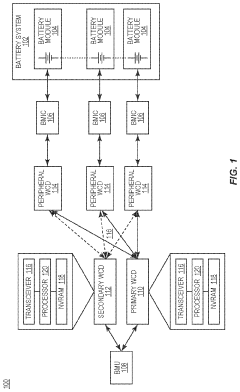
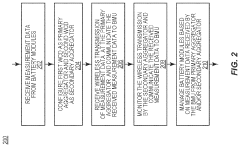
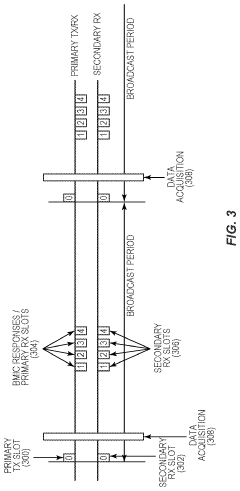
- Implementing a dual-aggregator system with a primary and secondary wireless communication device, where the secondary aggregator can seamlessly replace the primary aggregator without shutting down the system, ensuring continuous data communication and management of battery modules based on measurement data from either aggregator.
Battery Safety Standards and Communication Requirements
Battery management systems must comply with stringent safety standards that directly influence communication protocol selection and power consumption requirements. The International Electrotechnical Commission (IEC) 62619 standard establishes fundamental safety requirements for lithium-ion battery systems, mandating continuous monitoring of cell voltages, temperatures, and current flows. These monitoring requirements create baseline communication demands that both wireless BMS and I2C implementations must satisfy.
The Underwriters Laboratories (UL) 2580 standard specifically addresses automotive battery safety, requiring real-time data transmission capabilities with maximum latency thresholds of 100 milliseconds for critical safety parameters. This timing constraint significantly impacts power consumption profiles, as wireless systems must maintain active communication states more frequently than traditional wired solutions. I2C implementations benefit from lower baseline power consumption but face challenges in meeting distributed monitoring requirements across large battery packs.
Functional safety standards, particularly ISO 26262 for automotive applications, impose additional communication reliability requirements that affect power budgets. The standard mandates redundant communication paths and diagnostic coverage exceeding 99%, necessitating continuous background monitoring processes. Wireless BMS architectures typically consume 15-25% more power to maintain these redundancy requirements compared to I2C systems, which can leverage shared bus architectures for fault detection.
Communication frequency requirements vary significantly across different safety classifications. Class A applications require basic monitoring with 1-second update intervals, while Class C critical safety functions demand sub-100ms response times. These varying requirements create distinct power consumption profiles, with wireless systems showing exponential power increases at higher communication frequencies due to radio frequency transmission overhead.
The emerging UN ECE R100.03 regulation introduces new electromagnetic compatibility requirements that influence both communication reliability and power consumption. Wireless BMS systems must implement additional filtering and shielding mechanisms, increasing overall system power requirements by approximately 8-12% compared to baseline implementations. I2C systems demonstrate better inherent EMC performance but require careful routing and isolation in high-voltage battery environments.
The Underwriters Laboratories (UL) 2580 standard specifically addresses automotive battery safety, requiring real-time data transmission capabilities with maximum latency thresholds of 100 milliseconds for critical safety parameters. This timing constraint significantly impacts power consumption profiles, as wireless systems must maintain active communication states more frequently than traditional wired solutions. I2C implementations benefit from lower baseline power consumption but face challenges in meeting distributed monitoring requirements across large battery packs.
Functional safety standards, particularly ISO 26262 for automotive applications, impose additional communication reliability requirements that affect power budgets. The standard mandates redundant communication paths and diagnostic coverage exceeding 99%, necessitating continuous background monitoring processes. Wireless BMS architectures typically consume 15-25% more power to maintain these redundancy requirements compared to I2C systems, which can leverage shared bus architectures for fault detection.
Communication frequency requirements vary significantly across different safety classifications. Class A applications require basic monitoring with 1-second update intervals, while Class C critical safety functions demand sub-100ms response times. These varying requirements create distinct power consumption profiles, with wireless systems showing exponential power increases at higher communication frequencies due to radio frequency transmission overhead.
The emerging UN ECE R100.03 regulation introduces new electromagnetic compatibility requirements that influence both communication reliability and power consumption. Wireless BMS systems must implement additional filtering and shielding mechanisms, increasing overall system power requirements by approximately 8-12% compared to baseline implementations. I2C systems demonstrate better inherent EMC performance but require careful routing and isolation in high-voltage battery environments.
Electromagnetic Compatibility Considerations for Wireless BMS
Electromagnetic compatibility represents a critical design consideration for wireless Battery Management Systems, particularly when evaluating power consumption trade-offs against traditional I2C implementations. Wireless BMS architectures inherently generate radiofrequency emissions that can interfere with sensitive automotive electronics, requiring sophisticated EMC mitigation strategies that directly impact overall power budgets.
The fundamental challenge lies in balancing transmission power levels with EMC compliance requirements. Higher transmission power improves communication reliability and range but increases both power consumption and electromagnetic emissions. Conversely, reducing transmission power to minimize EMC impact may compromise system reliability, potentially requiring more frequent retransmissions that paradoxically increase total power consumption.
Frequency selection plays a pivotal role in EMC performance and power efficiency. The commonly used 2.4 GHz ISM band offers good propagation characteristics but faces significant interference from WiFi, Bluetooth, and other wireless devices in automotive environments. Alternative frequencies such as sub-GHz bands provide better penetration through battery pack materials and reduced power requirements for equivalent range, while simultaneously offering improved EMC characteristics due to lower harmonic content.
Shielding requirements significantly influence power consumption profiles in wireless BMS implementations. Effective electromagnetic shielding often necessitates additional power for signal amplification to overcome attenuation losses. Metal battery enclosures create Faraday cage effects that can reduce external EMI but require higher transmission power levels for reliable intra-pack communication, creating a complex optimization challenge between EMC compliance and power efficiency.
Spread spectrum techniques offer promising solutions for EMC mitigation while maintaining reasonable power consumption. Frequency hopping spread spectrum and direct sequence spread spectrum methods distribute electromagnetic energy across wider frequency bands, reducing peak emission levels and improving EMC compliance. However, these techniques introduce processing overhead that increases baseline power consumption, requiring careful analysis of the power-performance trade-offs.
Antenna design optimization becomes crucial for achieving EMC compliance without excessive power penalties. Properly designed antennas can minimize spurious emissions while maximizing radiation efficiency, reducing the transmission power required for reliable communication. Integrated antenna solutions within battery modules must consider both EMC performance and power consumption implications, often requiring iterative design optimization to achieve acceptable performance in both domains.
The fundamental challenge lies in balancing transmission power levels with EMC compliance requirements. Higher transmission power improves communication reliability and range but increases both power consumption and electromagnetic emissions. Conversely, reducing transmission power to minimize EMC impact may compromise system reliability, potentially requiring more frequent retransmissions that paradoxically increase total power consumption.
Frequency selection plays a pivotal role in EMC performance and power efficiency. The commonly used 2.4 GHz ISM band offers good propagation characteristics but faces significant interference from WiFi, Bluetooth, and other wireless devices in automotive environments. Alternative frequencies such as sub-GHz bands provide better penetration through battery pack materials and reduced power requirements for equivalent range, while simultaneously offering improved EMC characteristics due to lower harmonic content.
Shielding requirements significantly influence power consumption profiles in wireless BMS implementations. Effective electromagnetic shielding often necessitates additional power for signal amplification to overcome attenuation losses. Metal battery enclosures create Faraday cage effects that can reduce external EMI but require higher transmission power levels for reliable intra-pack communication, creating a complex optimization challenge between EMC compliance and power efficiency.
Spread spectrum techniques offer promising solutions for EMC mitigation while maintaining reasonable power consumption. Frequency hopping spread spectrum and direct sequence spread spectrum methods distribute electromagnetic energy across wider frequency bands, reducing peak emission levels and improving EMC compliance. However, these techniques introduce processing overhead that increases baseline power consumption, requiring careful analysis of the power-performance trade-offs.
Antenna design optimization becomes crucial for achieving EMC compliance without excessive power penalties. Properly designed antennas can minimize spurious emissions while maximizing radiation efficiency, reducing the transmission power required for reliable communication. Integrated antenna solutions within battery modules must consider both EMC performance and power consumption implications, often requiring iterative design optimization to achieve acceptable performance in both domains.
Unlock deeper insights with PatSnap Eureka Quick Research — get a full tech report to explore trends and direct your research. Try now!
Generate Your Research Report Instantly with AI Agent
Supercharge your innovation with PatSnap Eureka AI Agent Platform!