Fastest
Eureka on the web
When you want the answer in the next five minutes.
The agent works the prompt against patents and technical literature, citing every source.
Run your analysis now →A data-driven look at code-based public key encryption decoding patents: filing trends since 2007, the concentration of top assignees, IPC technology mix, and where claim space remains open.
Filing growth = 2021 (4 records) → 2024 (1); 2024 is the last year we treat as complete. Top-5 share = the 5 largest assignees ÷ all 65 records in scope (CR5), not the ranked leaders only.
This landscape covers patent records tagged for code-based cryptography and McEliece-style encryption where the claims involve a decoding step, including syndrome decoding. The scope runs from filings as early as 2007 through publications up to the 2026 data cut-off, capturing 65 records in total.
The picture that emerges is a field anchored by a small group of specialist and academic filers, with claim activity concentrated in transmission-layer protocols rather than the decoding algorithm alone. Filing volume peaked in 2022 and has since thinned, though recent years remain incomplete due to publication lag.
The dataset spans records published between 2015 and 2026, with the underlying filings running back to 2007. Because publication lags filing by roughly 18 months, the most recent years are still filling in and should not be read as a slowdown.
Annual filings climbed from 4 in 2007 to a peak of 12 in 2022. From 2021 (4) to 2024 (1) — the most recent year that can be treated as complete — filings fell 75%, a decline worth watching but not yet a verdict on the technology's relevance.
Publication lags filing by roughly 18 months, so 2025 onwards are still filling in. Growth rates on this page therefore end at 2024; running them to the last bar would understate the field.
H04L (digital information transmission) appears on 92.3% of the 65 records in scope, far ahead of H03M (coding & code conversion) at 20.0% and G06F (electric digital data processing) at 18.5%. Smaller classes — H04B, G06K, G06N, H04N and B82Y — each sit at 4.6% or below, marking the thinner branches of the field.
Shares are the percentage of the 65 records in scope. A patent can carry several IPC classes, so the shares add up to more than 100%.
This page is one run against one query. Ask Eureka your own question about code-based public key encryption decoding algorithm patent landscape and every answer comes back with the patent numbers behind it.
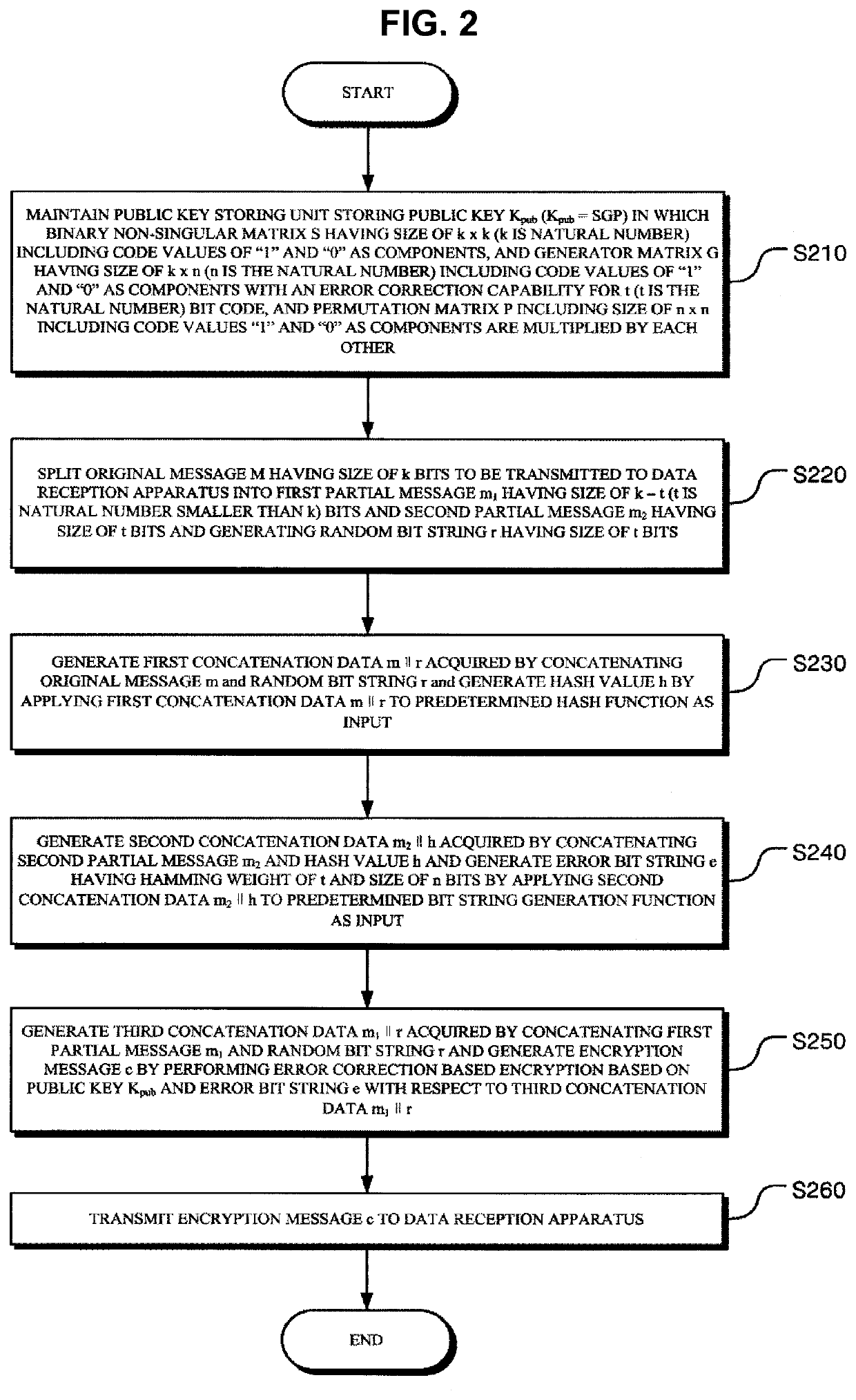
Try EurekaDisclosed is an electronic device for performing code-based encryption supporting integrity verification of a message and an operating method thereof. When a data transmission side encrypts a message through code-based encryption and transmits the encrypted message to a data reception apparatus, the data transmission side is allowed to use a hash value generated based on a part of the message as an error in code-based encryption to support the data reception apparatus to verify an integrity of a received message by using the hash value.Filed by Dongguk University Industry-Academic Cooperation Foundation; published 2020-05-14.

When you want the answer in the next five minutes.
The agent works the prompt against patents and technical literature, citing every source.
Run your analysis now →When it has to run inside your own pipeline.
Patent search, landscape analysis and assignee resolution as MCP tools. Drop them into any agent framework, or call REST directly.
Browse MCP servers →Four figures from this dataset carry direct implications for where to file, where to watch, and where claim space is still open.
The top 5 assignees together account for 28 of the 65 records in scope — 43.1% — while the ranking runs to 36 companies total. That gap between the top and the long tail means freedom-to-operate work should start with the leaders' full portfolios, not a general prior-art sweep.
Filings hit 12 in 2022, the high point of the dataset, then dropped to 1 by 2024 — a 75% decline over that span. Because publication lags filing by about 18 months, 2025–2026 figures are still incomplete and shouldn't be read as confirming the trend continues.
H04L (digital information transmission) appears on 92.3% of records, versus 20.0% for H03M (coding & code conversion) — the class closest to the decoding algorithm itself. Most protection in this field is built around decoding embedded in a communication protocol, not the algorithm in isolation.
G06N, G06K and H04N each cover 3.1% or less of the 65 records, and B82Y covers just 1.5%. These branches carry far less claim density than the H04L/H03M core, making them the more open territory for a new filing.
Eureka can read the same corpus for gaps instead of for coverage: under-claimed branches adjacent to code-based public key encryption decoding algorithm patent landscape, with the prior art for and against each one.
The figures here establish the shape of the field. Turning that into a filing or freedom-to-operate decision means going deeper on specific claims and portfolios.
With 43.1% of records held by the top 5 assignees, a full review of their portfolios — not just the headline records — is the first step before filing into the H04L/H03M core.
Run a portfolio check in EurekaG06N, G06K, H04N and B82Y each carry minimal claim density. A closer read of the handful of records in each can show exactly what has and hasn't been claimed.
Explore white space in EurekaPublication lag means 2025–2026 filings are still arriving. Set up monitoring to catch new entrants before the picture settles.
Set up monitoring in EurekaCode-based public key encryption, exemplified by the McEliece and Niederreiter constructions, hides a message by encoding it with an error-correcting code and deliberately injecting an error pattern that only the holder of the private key can remove. Decoding — recovering the original message by correcting that injected error, typically via syndrome decoding — is the computationally hard step that gives the scheme its security, so most of the claimable invention sits in how that decoding step is structured, accelerated, or combined with other functions. Patent claims in this field tend to describe either the decoding algorithm itself or a system that uses it inside a larger communication or verification flow. Understanding which of those two claim styles dominates the prior art is essential before drafting a new application.
The assignee ranking covers 36 companies and research institutions across the 65 records in scope, with the leading assignee holding 7 records. Filing is concentrated rather than evenly spread: the top 5 assignees together account for 43.1% of all 65 records, and the top 10 account for 69.2%. That leaves a long tail of single- or few-filing entrants, which is typical of a field still anchored by a small number of specialist and academic filers rather than broad industry adoption.
Filings rose from 4 in 2007 to a peak of 12 in 2022, then fell to 1 by 2024 — a 75% decline over that 2021-to-2024 span. Because publication typically lags actual filing by around 18 months, the 2025 and 2026 figures in this dataset are still incomplete and should not be read as confirming a continued drop. The honest read is that the field cooled after its 2022 peak, but the most recent trend line has not yet settled.
H04L (digital information transmission) is by far the dominant classification, appearing on 92.3% of the 65 records in scope, which reflects that most claims wrap the decoding step inside a broader communication or transmission protocol. H03M (coding and code conversion) covers 20.0% of records and is the closest thing to a class dedicated to the decoding algorithm itself. Smaller shares appear in G06F (electric digital data processing, 18.5%), H04B, G06K, G06N, H04N and B82Y, each under 5%, marking areas with much thinner claim coverage.
The thinnest classification branches in this dataset — G06N (AI-based computing), G06K (data recognition), H04N (pictorial communication) and B82Y (nanotechnology) — each cover 3.1% or less of the 65 records, meaning very little claim density has built up there relative to the H04L and H03M core. A workable strategy is to tie a code-based decoding step to one of these adjacent functions, such as a learned model guiding error-locator search, rather than filing directly into the crowded transmission-layer claim pattern held by the leading assignees.
Go past this page: query the whole code-based public key encryption decoding algorithm patent landscape corpus yourself, in your own scope.
Every answer comes back with patent numbers you can open.
Disclaimer. This page is generated from Patsnap Eureka data drawn from a limited snapshot of global patent and scientific-literature records, and is provided for general information and reference only.
Patent data carries inherent limitations: recent filings (typically the most recent 18–24 months) are under-counted due to standard publication lag; counts may be reported at either a patent-family or a patent-record basis and are not always directly comparable; classification, applicant-name, and citation data may contain errors, duplicates, or omissions; and the underlying search query defines and constrains the scope shown. As a result, the analysis may be incomplete or inaccurate and may not reflect the full technology landscape.
Nothing on this page constitutes an exhaustive prior-art, novelty, freedom-to-operate, or validity search, nor does it constitute legal, financial, investment, or professional advice, and it should not be relied upon as such. Any patent, commercial, or strategic decision should be verified independently and reviewed with qualified patent, legal, and domain professionals. Patsnap makes no warranties, express or implied, as to the accuracy, completeness, or fitness for any particular purpose of the information presented.
Help us improve
Something wrong, out of date, or missing on this page? Tell us and it goes straight to the team that maintains it.
This page