Fastest
Eureka on the web
When you want the answer in the next five minutes.
The agent works the prompt against patents and technical literature, citing every source.
Run your analysis now →Filing growth compares 2021 (1,721 records) with 2024 (1,164) — a three-year span. 2024 is the most recent year we treat as complete: publication lags filing by roughly 18 months, so 2025 onwards are still filling in and any growth rate that ends there would understate the field. Top-5 share is the combined record count of the five largest assignees divided by all 206,749 records in scope (CR5), not by the ranked leaders only.
This dataset tracks published patent records touching accelerated query processing — FPGA and dedicated database accelerators, operator offload, kernel scheduling, and the data-movement problem between host and accelerator. The search pairs hardware terms (database accelerator, field programmable gate arrays) with the functional claims that make offload work in practice: data transfer, memory bandwidth, query planning and host fallback. It spans 206,749 published records from 2015 through the 2026-07-31 cut-off.
Because publication lags filing by roughly 18 months, the 2025 and 2026 figures in any trend line are still filling in. Treat the most recent two years as a floor, not a ceiling, and read the 2021-to-2024 comparison as the reliable signal of direction.
Pick a task. Every answer cites the patents behind it.
The record set spans eleven years of publication activity across the IPC subclasses that carry accelerated query processing claims.
Annual filings moved from 1,175 in 2017 to a peak of 1,787 in 2020. The reliable comparison window, 2021 to 2024, shows a -32% move from 1,721 to 1,164 filings — a real cooling, not an artifact of publication lag, though the 2025–2026 figures are still incomplete.
G06F (electric digital data processing) touches 4.8% of all 206,749 records, ahead of H04L digital transmission at 2.3% and H04W wireless networks at 1.4%. Every class below G06N's 0.9% represents thinner claim coverage relative to the full record set — these are the subclasses worth checking before assuming a route is occupied.
Shares are the percentage of the 206,749 records in scope. A patent can carry several IPC classes, so the shares add up to more than 100%.
This page is one run against one query. Ask Eureka your own question about hardware accelerated query processing and every answer comes back with the patent numbers behind it.
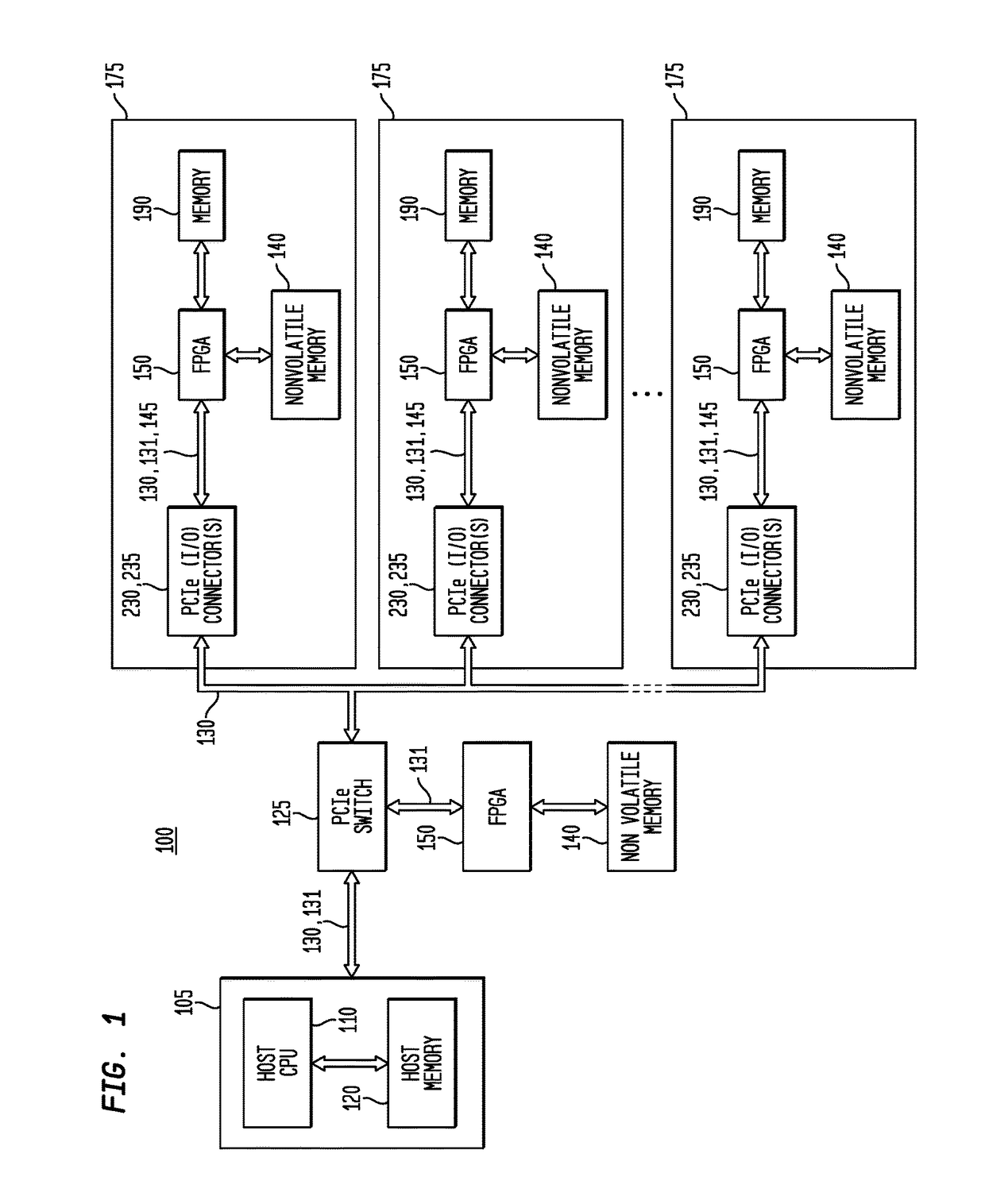
Try EurekaMicron's filing describes a PCIe-based system connecting a host to multiple field programmable gate arrays through a nonblocking crossbar switch, with each FPGA configurable for direct data transfers to the host or to any other FPGA in the array, each transfer carrying its own memory designation.Filed 2017-12-14; assignee Micron Technology, Inc.

| # | Publication no. | Patent title | Citations |
|---|---|---|---|
| 1 | US20070061487A1 | Systems and methods for use of structured and unstructured distributed data | 1,331 |
| 2 | US20070061266A1 | Security systems and methods for use with structured and unstructured data | 1,117 |
| 3 | US20190349426A1 | The internet of things | 1,104 |
| 4 | US20190258251A1 | Systems and methods for safe and reliable autonomous vehicles | 1,044 |
| 5 | US20200284883A1 | Component for a lidar sensor system, lidar sensor system, lidar sensor device, method for a lidar sensor syst… | 1,013 |
| 6 | US20030093187A1 | PFN/TRAC systemTM FAA upgrades for accountable remote and robotics control to stop the unauthorized use of ai… | 977 |
| 7 | US20190339688A1 | Methods and systems for data collection, learning, and streaming of machine signals for analytics and mainten… | 973 |
| 8 | US20120131253A1 | Pcie nvram card based on nvdimm | 952 |
| 9 | US20070156919A1 | Enforcing network service level agreements in a network element | 883 |
| 10 | US20210144517A1 | Multi-entity resource, security, and service management in edge computing deployments | 840 |
Citation counts favour older filings that have had more time to accumulate citations inside this searched corpus — read them as a signal of influence on the field, not of current technical relevance.
Each row carries its publication number; clicking a row searches Eureka by that number.
When you want the answer in the next five minutes.
The agent works the prompt against patents and technical literature, citing every source.
Run your analysis now →When it has to run inside your own pipeline.
Patent search, landscape analysis and assignee resolution as MCP tools. Drop them into any agent framework, or call REST directly.
Browse MCP servers →Three patterns in this dataset matter more than the raw record count when deciding where to file next.
Five assignees hold 59,705 of all 206,749 records in scope, and the top ten add up to 36.5%. That leaves the majority of the field to a long tail of single- and few-filing entrants — concentration at the top does not mean the door is closed elsewhere.
The reliable year-over-year window shows filings dropping from 1,721 in 2021 to 1,164 in 2024. Individual leading assignees show even steeper year-on-year drops in the most recent year, though that year is still incomplete under the publication-lag effect.
G06F carries more than triple the density of the next subclass, H04L, and every class beyond G06N's 0.9% falls under 1% of records. That drop-off is the clearest signal of where claim space thins out.
The most-cited records in this corpus were published years before the 2020 filing peak, which is typical of citation counts inside a searched corpus — they favour age, not present-day relevance.
Eureka can read the same corpus for gaps instead of for coverage: under-claimed branches adjacent to hardware accelerated query processing, with the prior art for and against each one.
The ranked leaders span semiconductor, mobile and cloud-scale hardware makers, but recent-year filing counts for even the most active assignees have dropped sharply, consistent with the field-wide cooling seen in the trend data.
The leading assignee's record count is more than four times the fifth-place holder's 5,302, which itself is more than double tenth place's 2,206 — the drop-off from first to fifth is steep, and from fifth to tenth more gradual.
Assignees with double-digit filings in the latest year, such as Nvidia at 28, still recorded year-over-year drops as steep as -81% to -96% across the group. Some of this reflects publication lag rather than a genuine stop in filing.
Only ten co-assignee pairs appear in this dataset, and the strongest pair by shared record count sits well above the others — most assignees in this field file independently rather than jointly.
| Assignee | Recent year | YoY |
|---|---|---|
| Nvidia Corp | 28 | -81% |
| Intel Corp | 6 | -93% |
| Micron Technology Inc | 3 | -96% |
| Qualcomm Inc | 2 | -86% |
| Samsung Electronics Co Ltd | 2 | -96% |
| Comcast Cable Communications LLC | 2 | -83% |
| Google LLC | 1 | -91% |
| Advanced Micro Devices, Inc. (AMD) | 1 | -83% |
The landscape points to a field with a stable technical core and a cooling filing rate — the open questions are about positioning within it, not about whether it is still active.
Concentration at the top of the ranking means any new filing in the core G06F and H04L classes should be checked against the leading assignees' specific claim language, not just their record counts.
Explore assignee portfolios in EurekaSubclasses below G06N's 0.9% density, and the specific sub-areas flagged above, are the more promising places to search for open claim space before drafting.
Run a white space search in EurekaBecause publication lags filing by roughly 18 months, the true 2025 and 2026 volumes will only become visible over the next reporting cycles — worth revisiting rather than treating the current dip as final.
Set a monitoring alert in EurekaThe leading assignee holds 24,371 records in this dataset, well ahead of the fifth-place holder at 5,302 and tenth place at 2,206. The top five assignees combined hold 59,705 records, which is 28.9% of all 206,749 records in scope. That leaves a substantial majority of the field spread across a long tail of smaller filers, so leadership at the top does not mean the space is closed to new entrants.
Filing volume peaked at 1,787 records in 2020 and has since eased, with the reliable 2021-to-2024 window showing a -32% move from 1,721 to 1,164 filings. The 2025 and 2026 figures in the trend look lower still, but publication typically lags filing by around 18 months, so those most recent years are undercounted rather than necessarily reflecting a real drop. The 2021-2024 comparison is the figure to rely on for direction.
The densest class is G06F, electric digital data processing, covering 4.8% of all 206,749 records in scope. H04L (digital information transmission) follows at 2.3% and H04W (wireless communication networks) at 1.4%, with the remaining classes — G06N, G06T, H04B, H04N and G11C — all under 1% each. Because a single record can carry multiple IPC classes, these shares add up to more than 100% and should not be summed.
This Micron filing, published 2017-12-14, describes a PCIe-based system linking a host computer to multiple field programmable gate arrays through a nonblocking crossbar switch, where each FPGA can transfer data directly to the host or to any other FPGA with its own memory designation per transfer. The scope centres on direct, parallel inter-FPGA communication rather than routing every transfer back through the host. Anyone designing multi-FPGA data-transfer architectures with a similar crossbar topology should review this filing's specific claim language before finalising an architecture.
The technology composition data shows a steep drop-off after the two leading IPC classes: most subclasses, including G06N (AI-based computing) and everything below it, sit under 1% of the 206,749 records in scope. Specific sub-areas such as host fallback path scheduling, query planner offload to memory-side logic, and memory bandwidth arbitration for accelerator cards show lower claim density than the core FPGA and data-transfer classes. These are reasonable starting points for a freedom-to-operate search, though a low IPC share is a signal to investigate, not proof of an open claim.
Go past this page: query the whole hardware accelerated query processing corpus yourself, in your own scope.
Every answer comes back with patent numbers you can open.
Disclaimer. This page is generated from Patsnap Eureka data drawn from a limited snapshot of global patent and scientific-literature records, and is provided for general information and reference only.
Patent data carries inherent limitations: recent filings (typically the most recent 18–24 months) are under-counted due to standard publication lag; counts may be reported at either a patent-family or a patent-record basis and are not always directly comparable; classification, applicant-name, and citation data may contain errors, duplicates, or omissions; and the underlying search query defines and constrains the scope shown. As a result, the analysis may be incomplete or inaccurate and may not reflect the full technology landscape.
Nothing on this page constitutes an exhaustive prior-art, novelty, freedom-to-operate, or validity search, nor does it constitute legal, financial, investment, or professional advice, and it should not be relied upon as such. Any patent, commercial, or strategic decision should be verified independently and reviewed with qualified patent, legal, and domain professionals. Patsnap makes no warranties, express or implied, as to the accuracy, completeness, or fitness for any particular purpose of the information presented.
Machine translation. Assignee and organisation names originally recorded in Chinese, Japanese or Korean have been rendered into English by an AI translation step so that the tables stay readable. These renderings are best-effort and may not match a company's registered English name; the original name is what the underlying patent record carries, and it is what any Eureka query launched from this page uses.
Help us improve
Something wrong, out of date, or missing on this page? Tell us and it goes straight to the team that maintains it.
This page