Fastest
Eureka on the web
When you want the answer in the next five minutes.
The agent works the prompt against patents and technical literature, citing every source.
Run your analysis now →Filing growth compares 2021 (24 records) with 2024 (32) — a three-year span. 2024 is the most recent year we treat as complete: publication lags filing by roughly 18 months, so 2025 onwards are still filling in and any growth rate that ends there would understate the field.
Sparse and quantized kernel support sits at the intersection of numerical formats and execution scheduling: it covers how a processor decides which zero-valued or reduced-precision elements to skip, how it tracks that decision as sparsity metadata, and how it balances the resulting uneven workload across compute lanes without breaking accuracy guarantees. The search set combines terms for the data structures (sparse matrix format, structured sparsity) with terms for the runtime cost problems those structures are meant to solve (dequantization overhead, row load balancing, accuracy preservation).
The 291 records in scope span 2015 through the July 2026 cut-off. Because publication trails filing by roughly 18 months, the most recent one to two years understate actual filing activity and should be read as provisional rather than a sign of a slowdown.
Two views of the same 291-record corpus: how filing activity has moved year over year, and how those records distribute across IPC subclasses. Because a single record can carry more than one classification, the composition shares add up to more than 100% of the record total.
Filings started from zero in 2017, rose to a peak of 91 records in 2022, and on the last complete comparison window grew from 24 records in 2021 to 32 in 2024 — a +33% increase. Treat 2025 and 2026 as still filling in rather than declining.
G06F (electric digital data processing) and G06T (image data processing) between them touch the majority of records, reflecting how much sparse/quantized kernel work is filed as general compute or GPU-adjacent image processing rather than under a dedicated AI classification like G06N, which covers 13.4% of records.
Shares are the percentage of the 291 records in scope. A patent can carry several IPC classes, so the shares add up to more than 100%.
This page is one run against one query. Ask Eureka your own question about sparse and quantized kernel support and every answer comes back with the patent numbers behind it.
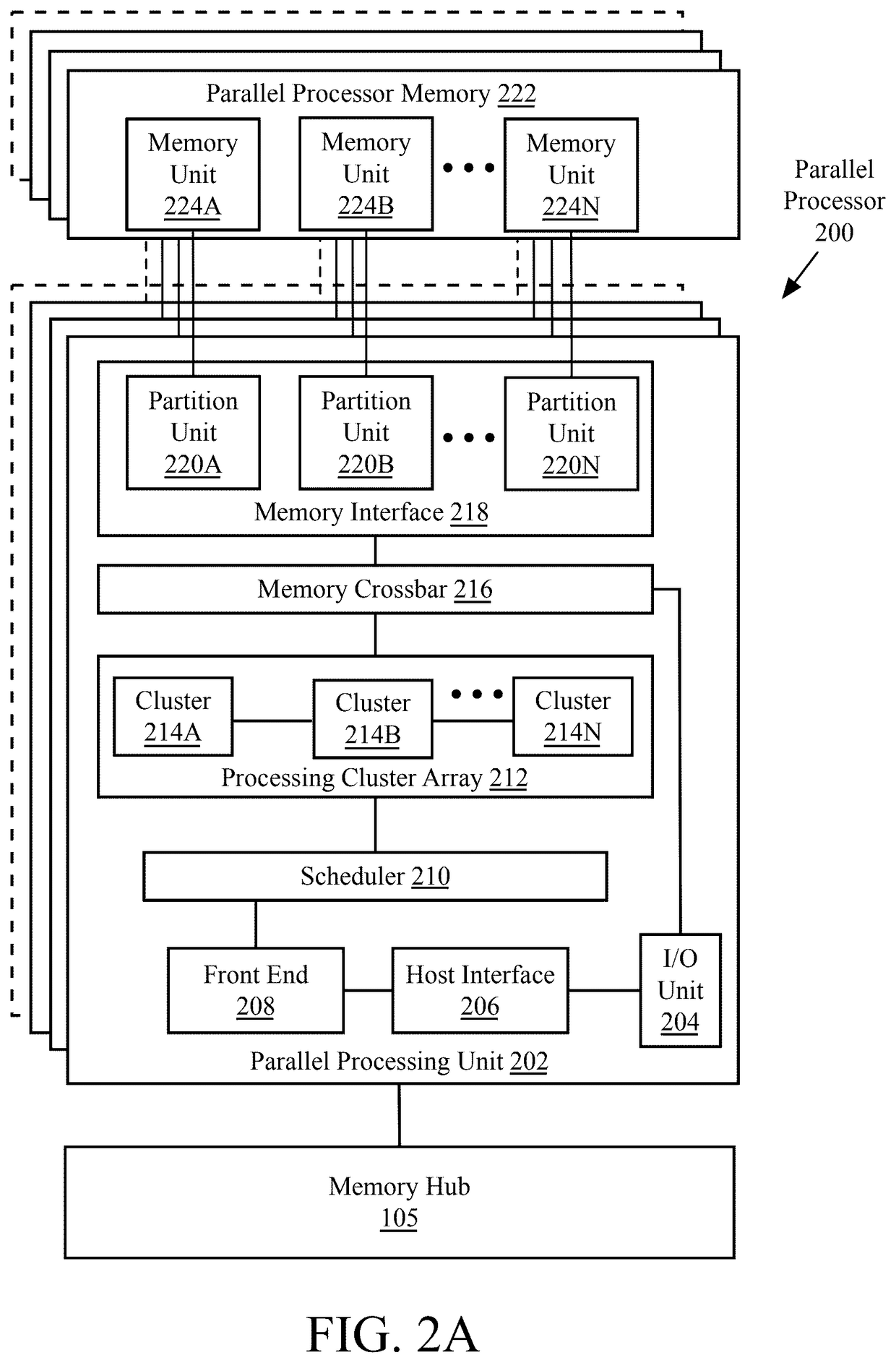
Try EurekaA processing apparatus can include a general-purpose parallel processing engine comprising a matrix accelerator including a multi-stage systolic array, where each stage includes multiple processing elements associated with multiple processing channels. The multiple processing elements are configured to receive output sparsity metadata that is independent of input sparsity of input matrix elements and perform processing operations on the input matrix elements based on the output sparsity metadata.Filed by Intel, published 2025-06-19. Notable for decoupling output sparsity metadata from input sparsity — a distinction that matters for anyone designing around metadata-driven power gating.

| # | Publication no. | Patent title | Citations |
|---|---|---|---|
| 1 | US20250259085A1 | Convergent Intelligence Fabric for Multi-Domain Orchestration of Distributed Agents with Hierarchical Memory … | 208 |
| 2 | US20200342632A1 | Efficient matrix format suitable for neural networks | 76 |
| 3 | US20230014565A1 | Instruction based control of memory attributes | 57 |
| 4 | US11392829B1 | Managing data sparsity for neural networks | 41 |
| 5 | US20240111609A1 | Synchronization utilizing local team barriers for thread team processing | 31 |
| 6 | US20210256384A1 | Computer-implemented methods and systems for achieving real-time DNN execution on mobile devices with pattern… | 28 |
| 7 | US20250323663A1 | AI-Enhanced Distributed Data Compression with Privacy-Preserving Computation | 23 |
| 8 | US20230142467A1 | Temporal gradients of higher order effects to guide temporal accumulation | 23 |
| 9 | US20210081201A1 | Utilizing structured sparsity in systolic arrays | 21 |
| 10 | US20240069914A1 | Hardware enhancements for matrix load/store instructions | 17 |
Citation counts are drawn from within this searched corpus and skew toward older records; read them as a signal of influence on later filings, not as a ranking of current technical importance.
Each row carries its publication number; clicking a row searches Eureka by that number.
When you want the answer in the next five minutes.
The agent works the prompt against patents and technical literature, citing every source.
Run your analysis now →When it has to run inside your own pipeline.
Patent search, landscape analysis and assignee resolution as MCP tools. Drop them into any agent framework, or call REST directly.
Browse MCP servers →Three patterns stand out once you look past the raw record count: where filings concentrate by class, how citation weight is distributed, and what the receiving-office spread implies about where enforcement matters most.
G06F and G06T together cover the large majority of records, meaning most sparse/quantized kernel claims are drafted as general digital-data-processing or image-processing inventions rather than as dedicated AI-model claims under G06N (13.4%). A freedom-to-operate search limited to G06N would miss most of the relevant prior art.
The 2021→2024 complete-year window shows growth of +33% (24 to 32 records), even though the single-year peak was 2022. Because publication lags filing by about 18 months, the apparent dip in 2025–2026 numbers is an artefact of the reporting window, not evidence of cooling interest.
The most-cited records in this corpus include foundational matrix-format and memory-attribute instruction patents; citation counts inside a searched corpus favour older filings simply because they have had more time to be cited, so newer high-value filings will look under-cited for several years yet.
United States filings (206) outnumber the next-largest office, EPO (57), by more than three to one, with WIPO PCT filings (15) suggesting a modest but real appetite for multi-jurisdiction protection beyond the US and Europe.
Eureka can read the same corpus for gaps instead of for coverage: under-claimed branches adjacent to sparse and quantized kernel support, with the prior art for and against each one.
The ranked assignee list returned by this search covers 30 companies, counted in records — it is not a top-50 or top-100 cut, it is the complete ranking the data endpoint returns for this query.
The leading assignee's 279 records dwarf the fifth-place count of 2 and the tenth-place count of 1, meaning the bulk of the ranked field is made up of companies and individuals with only a handful of filings each rather than a tight cluster of comparable competitors.
The leading assignee dropped to 1 filing in the latest year (-99% YoY), and several other tracked assignees show zero filings in the same window. Given the 18-month publication lag, this should be read as an incomplete latest year rather than a confirmed retreat.
Only 10 co-assignee pairs appear in this corpus, and the strongest of them links two academic institutions rather than a corporate-academic or corporate-corporate pairing, suggesting most commercial filers in this space are prosecuting solo.
| Assignee | Recent year | YoY |
|---|---|---|
| Intel Corporation | 1 | -99% |
| Northeastern University (US) | 0 | — |
| NVIDIA Corporation | 0 | — |
| College of William & Mary | 0 | — |
| ATOMBEAM TECH INC | 0 | -100% |
| Huawei Technologies (USA) | 0 | -100% |
| ZORN WILLIAM | 0 | — |
| XIONG WEI | 0 | — |
The dataset points to a concentrated leader, a plateauing filing rate, and technology composition skewed toward general compute classes. The next steps depend on whether you are clearing a design or scouting for a filing gap.
With one assignee holding 279 of the ranked records, any new sparse/quantized kernel design should be checked against that portfolio first, not just the most-cited records.
Open Eureka to search the full portfolioClasses like H03M and G06V sit under 3% of records each; a targeted search in Eureka can confirm whether that reflects real white space or a terminology mismatch with this query.
Explore adjacent IPC classes in EurekaOne assignee holds 279 of the records in the ranked list of 30 companies, a lead so large that the fifth-place entity holds only 2 and the tenth-place entity holds 1. This means the field is not a competitive cluster of comparable filers; it is one dominant portfolio holder surrounded by a long tail of single- or few-filing entrants, including universities and individual inventors. Anyone assessing competitive risk in this space should treat that leader's portfolio as the primary clearance target rather than spreading diligence evenly across the ranked list.
On the complete-year data, filings grew from 24 in 2021 to 32 in 2024, a +33% increase, after peaking at 91 records in the single year 2022. The apparent lower counts in 2025 and 2026 reflect the roughly 18-month lag between filing and publication, not an actual drop in filing activity. Any statement that the field is cooling based on the last one to two years of this dataset would be premature.
The core of the field, by IPC classification, sits in G06F (electric digital data processing, 64.3% of the 291 records) and G06T (image data processing and generation, 52.9%), with a smaller but meaningful presence in G06N (AI-model computing, 13.4%). Smaller classes such as H03M (coding and code conversion), A63F (games and amusements) and G06V (image/video recognition) each cover under 3% of records, pointing to specific niches — coding-layer metadata handling, graphics-adjacent sparse formats, recognition-pipeline quantization — that are far less crowded than the general-compute core.
US20250199863A1, filed by Intel and published 2025-06-19, claims a matrix accelerator that uses output sparsity metadata — tracked independently of the input matrix's actual sparsity — to control processing across a multi-stage systolic array. The practical effect is that it stakes out a specific mechanism (metadata generated from output-side sparsity, used for power-relevant control) rather than sparsity exploitation in general. Designs that skip elements based on input sparsity signals directly, without maintaining a separate output-sparsity metadata channel, sit on different technical ground and would need their own freedom-to-operate review rather than assuming this filing blocks them outright.
The clearest signal of open claim space is the IPC composition: classes like H03M, A63F, G06V and G06K each account for under 3% of the 291 records, far below the 64.3% and 52.9% shares held by G06F and G06T. That gap can mean genuine under-claiming in areas like coding-layer sparsity metadata or recognition-pipeline quantized kernels, or it can mean those areas use different terminology than this search captured — either way, it is worth a targeted follow-up search before assuming the space is empty.
Go past this page: query the whole sparse and quantized kernel support corpus yourself, in your own scope.
Every answer comes back with patent numbers you can open.
Disclaimer. This page is generated from Patsnap Eureka data drawn from a limited snapshot of global patent and scientific-literature records, and is provided for general information and reference only.
Patent data carries inherent limitations: recent filings (typically the most recent 18–24 months) are under-counted due to standard publication lag; counts may be reported at either a patent-family or a patent-record basis and are not always directly comparable; classification, applicant-name, and citation data may contain errors, duplicates, or omissions; and the underlying search query defines and constrains the scope shown. As a result, the analysis may be incomplete or inaccurate and may not reflect the full technology landscape.
Nothing on this page constitutes an exhaustive prior-art, novelty, freedom-to-operate, or validity search, nor does it constitute legal, financial, investment, or professional advice, and it should not be relied upon as such. Any patent, commercial, or strategic decision should be verified independently and reviewed with qualified patent, legal, and domain professionals. Patsnap makes no warranties, express or implied, as to the accuracy, completeness, or fitness for any particular purpose of the information presented.
Machine translation. Assignee and organisation names originally recorded in Chinese, Japanese or Korean have been rendered into English by an AI translation step so that the tables stay readable. These renderings are best-effort and may not match a company's registered English name; the original name is what the underlying patent record carries, and it is what any Eureka query launched from this page uses.
Help us improve
Something wrong, out of date, or missing on this page? Tell us and it goes straight to the team that maintains it.
This page