Fastest
Eureka on the web
When you want the answer in the next five minutes.
The agent works the prompt against patents and technical literature, citing every source.
Run your analysis now →123 patent families on surface code quantum error correction decoders, with filer volumes, IPC mix and filing history to 2026.
357 published records collapse into 123 simple (DOCDB) families; the difference is the same invention filed in more than one country. GOOGLE LLC is named on 18 of the 123 patent families in scope. One patent family can name several filers, so these figures are not slices of a divided whole and do not add up. In force = 145 of 357 records still granted and maintained at the data cut-off; the rest are pending, withdrawn, refused or lapsed.
This landscape is built from the search string TAC:(("surface code") AND ("error correction" OR decoder) AND quantum), which returned 357 published records collapsing to 123 simple patent families. No date limit was applied, so the result set spans whatever years the matching records happen to carry; the filing-trend chart on this page shows only a recent window of that activity, not the full scope.
At retrieval, 145 of the 357 records (41%) were granted and still in force. The remainder are pending, withdrawn, refused, lapsed or not determinable, and this dataset does not break that remainder down further.
Ordered by volume only, not by importance or claim strength. Counted in simple (DOCDB) patent families, so one invention filed in several countries counts once. Names come from Patsnap's standardised assignee field as recorded on each document; subsidiaries and group companies are not merged. The icon before each name is read from the name itself (words such as University, Institute or Ltd); the data carries no organisation-type field, so treat it as a reading aid rather than a classification. Filings held by named individuals rather than organisations are removed where they can be identified (9 here); that identification is not exhaustive, so an individually held filing can still appear below. Either way those filings stay inside the totals above. This table shows the top 30 of the 79 filers returned for this search; the data endpoint returns at most 100 entities, so even that 79 is not the complete set of filers. A single family can name more than one filer, so these counts overlap and do not add up to the total.
Pick a task. Every answer cites the patents behind it.
Two views of the same 123 families: how publications have accumulated by filing year, and which IPC subclasses the records fall under.
Records climb from 32 in 2017 to a peak of 83 in 2024. From 2022 onward the counts are still filling in as later publications arrive, so the most recent years understate eventual totals; this is a publication-lag effect, not a drop in filing.
Counted in published records by earliest filing year, not de-duplicated into families. A filing is counted in the year it was filed, but it only becomes visible after it publishes: roughly 18 months for most routes, and up to 30 months where a PCT application enters national phase. 2022 onwards are therefore still filling in and are shaded; no growth figure on this page uses them. Because this series counts documents rather than inventions, a rise can mean more inventions or the same inventions filed in more countries; this dataset cannot separate the two.
G06N, covering computing based on AI models, appears on 118 of the 123 families (95.9%), the only subclass clearing a double-digit share described in this prose. A record can carry more than one IPC class, so subclass shares add up to more than 100% of the family total.
Shares are the percentage of the 123 patent families in scope. One patent family can carry several IPC classes, so the shares add up to more than 100%.
This page is one run against one query. Ask Eureka your own question about surface code quantum error correction decoder architecture patent landscape and every answer comes back with the patent numbers behind it.
Try EurekaThe abstract describes a method for synthesizing Boolean circuits for a quantum error correction decoder: taking input binary variables derived from syndrome measurements, applying a mapping representative of the decoder to produce output binary variables representing recovery operations for qubits, and using both sets of variables to synthesize at least one Boolean circuit. It also references a decoder chip built from such circuits.US20260030532A1, filed by 1QB INFORMATION TECHNOLOGIES INC, published 2026-01-29. This is simply the first record returned under the database's default order, not a ranking by citations, grant status or breadth.

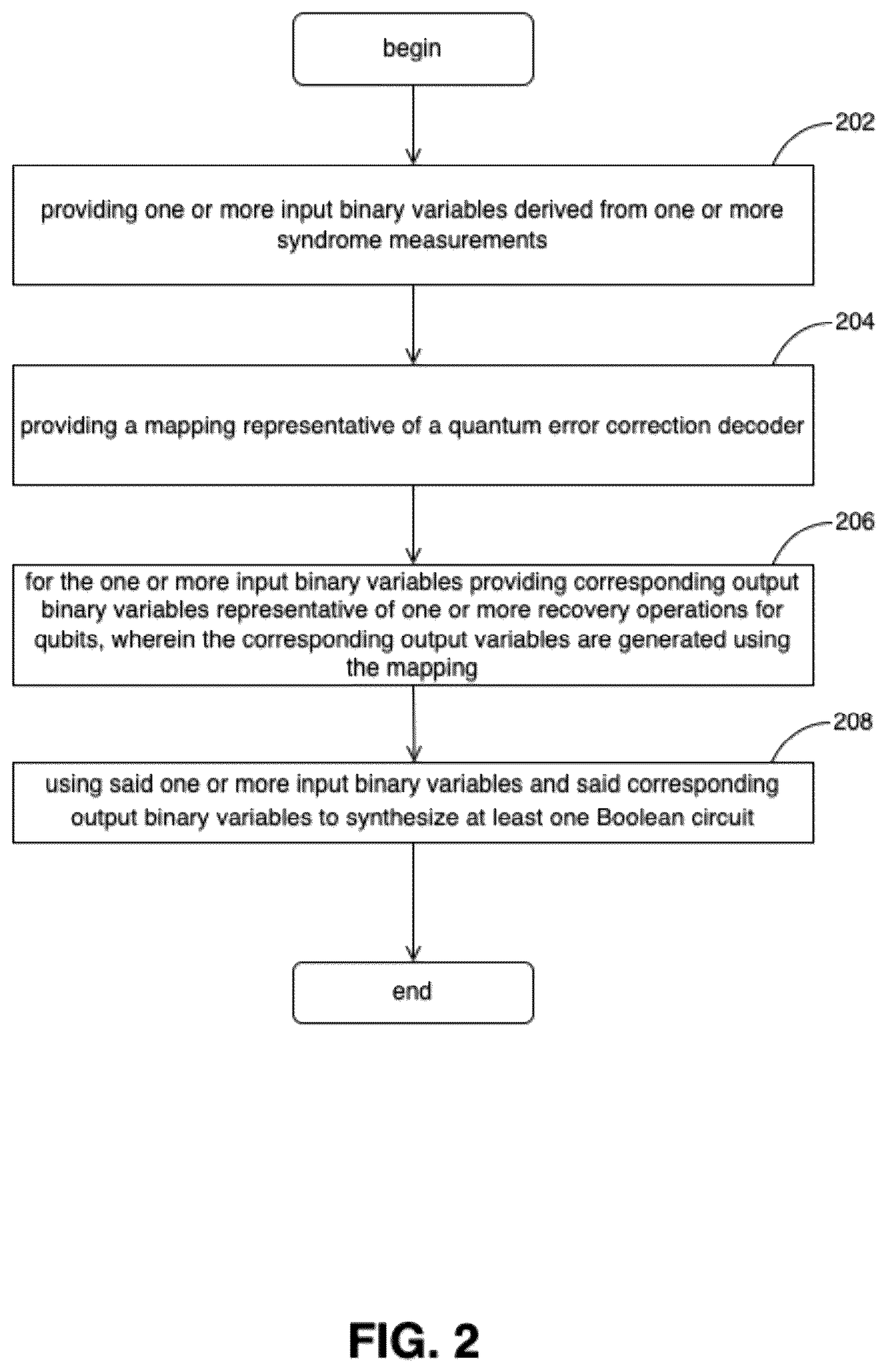
Selected as the first record the search returns under the database default order, then shown in full. It is not ranked by citations, claim breadth or commercial importance, and it is not a judgement about which filing in this space matters most.
When you want the answer in the next five minutes.
The agent works the prompt against patents and technical literature, citing every source.
Run your analysis now →When it has to run inside your own pipeline.
Patent search, landscape analysis and assignee resolution as MCP tools. Drop them into any agent framework, or call REST directly.
Browse MCP servers →Three facts drawn directly from the dataset, each reported as counted rather than interpreted.
GOOGLE LLC is named on 18 of the 123 simple patent families in scope, a 14.6% share. This is the single largest row on the filer list; it is a count of named families, not a measure of claim scope or portfolio strength.
66 of the 79 listed filers hold 2 or fewer simple patent families each. Filer rows are not mutually exclusive, a family can name more than one filer, so this count is reported on its own rather than combined into a share.
G06N, computing based on AI models, is recorded on 118 of the 123 families in scope (95.9%). Records can carry several IPC classes at once, so this share is read against the family total, not against the other subclasses on the chart.
145 of the 357 published records (41%) were granted and still in force at the retrieval date. The remaining 59% covers pending, withdrawn, refused, lapsed and not-determinable statuses combined, which this dataset does not split out further.
Eureka can read the same corpus for gaps instead of for coverage: under-claimed branches adjacent to surface code quantum error correction decoder architecture patent landscape, with the prior art for and against each one.
The figures above describe the shape of the field. Reading individual claim sets, tracking a specific filer's filings over time, or checking a particular record's legal status requires looking past the aggregate counts.
A family count or an abstract cannot establish what a patent covers. For any record that matters to a design decision, pull the granted claim set itself.
Explore in Patsnap EurekaThe filer table shows family counts at a point in time. Filtering by filer and by publication date gives a sense of when a given organisation's filings landed.
Explore in Patsnap EurekaThis dataset returns 357 published records, which collapse to 123 simple patent families once documents covering the same invention across countries are de-duplicated. No date limit was applied to the underlying search, so this reflects every matching record the search string returns, not a fixed year range. Families are the better unit for counting distinct inventions; records count every publication of each one, including multiple filings in different offices.
GOOGLE LLC is named on 18 of the 123 simple patent families in scope, a 14.6% share, the largest single row among the 79 listed filers. That list covers organisations only; filings held by named individuals are excluded from it but remain in the overall totals. A family count reflects filing volume, not claim scope, validity or commercial value, so it should not be read as a ranking of technical strength.
66 of the 79 listed filers hold 2 or fewer simple patent families each, alongside a single row with 18. Filer rows cannot be summed into a combined share because one family can name more than one filer, so there is no single figure for how much of the field a handful of top filers controls. The honest way to describe the spread is the long-tail count itself: most listed filers appear only once or twice.
G06N, the IPC subclass covering computing based on AI models, appears on 118 of the 123 families in scope, a 95.9% share. Records can carry more than one IPC classification, so this figure is read against the 123-family total rather than against other subclasses, and classification shares across the dataset add up to more than 100% for that reason. The dataset lists 15 subclasses in total, with G06N standing well clear of every other one shown on the chart.
145 of the 357 published records, or 41%, were granted and still in force at the 2026-10-21 retrieval date. The remaining 59% spans pending, withdrawn, refused, lapsed and not-determinable statuses, which are not broken out separately in this dataset. In-force status reflects legal standing at a single point in time and changes continuously as applications are prosecuted, renewed or allowed to lapse; it is not a measure of a patent's importance or quality.
The search returned 13 receiving offices in total. The largest few by published record count are the United States with 115, WIPO under the PCT route with 76, and the European Patent Office with 57, with Australia, Canada and China also appearing among the listed offices. These figures count where applications were filed, not where any filer is based, and they do not indicate the nationality of any applicant.
Go past this page: query the whole surface code quantum error correction decoder architecture patent landscape corpus yourself, in your own scope.
Every answer comes back with patent numbers you can open.
Search. Every figure on this page comes from one Patsnap search, run once and not edited afterwards. This is the exact search string:
TAC:(("surface code") AND ("error correction" OR decoder) AND quantum)Reading the field codes: TAC searches the title, abstract and claims of each record, not the full description. The search string sets no date limit, so the scope is every matching record in the database regardless of when it was filed. It is not restricted to recent years. How this string was built matters for how far the counts can be pushed. It was generated in batch from a topic list rather than hand-crafted for this page, and the result set is not manually screened. A keyword search over title, abstract and claims both over-captures (unrelated filings that happen to use the same words) and under-captures (the same invention written in different words). This page cannot measure either effect, so read every figure here as what this particular string returned, not as what exists in the field. One subclass (G06N) carries 95.9% of the patent families, so this search returned a classification-tight set.
What is being counted. Two different units appear on this page and they are not interchangeable. The filer list and the technology split are counted in simple (DOCDB) patent families: one invention counts once however many countries it was filed in. The total, the jurisdiction split and the filing-year chart are counted in published records: the same invention counts once per publication. For this search that is 357 records and 123 families. Record counts reward filing in many jurisdictions; family counts do not. Shares are only ever taken against a denominator in the same unit, and each one names it.
Who the filers are. Names come from Patsnap's standardised assignee field, as recorded on the documents themselves. They are not rolled up to corporate group: a parent and its subsidiaries appear as separate entries, and a portfolio acquired from another company stays under the name on the document unless the assignment is reflected there. This list is meant to carry organisations, not people. Filings held by a named individual are identified by matching the assignee against the inventors on the same search, and, for names written in Chinese, Japanese or Korean characters, by the name carrying no organisational suffix; those are removed from the list (9 of them here). Neither test is exhaustive: the inventor list it matches against is itself capped, and a personal name written in Latin script with no organisational wording in it cannot be told apart from a short company name by rule. So an individually held filing can still appear in the list. Those filings stay inside every total and share on this page either way, so the listed entries can add up to less than the total. A record shown in full further down still names its assignee exactly as the patent office records it, including where that is a person: that name is how the record is identified and checked. What is left out of the ranking is people as ranked entries, not people as cited sources. The table shows the top 30 of the 79 filers returned, ordered by count alone; the data endpoint returns at most 100 entities, so even that 79 is not every filer. One patent family can name several filers and each is counted separately, so these rows are not slices of a divided whole: adding them together over-counts, and this page deliberately publishes no combined "top five" share for that reason. See every filer, individuals included
Dates. The year chart counts by earliest filing year, not publication year. A filing only becomes visible once it publishes: roughly 18 months for most routes, and up to 30 months where a PCT application enters national phase. Measured across these pages, the year four back from today still holds only about 89% of its eventual count. 2022 onwards are therefore shaded on the chart as still filling in. The data behind this page was retrieved on 2026-10-21.
Legal status. "In force" counts documents whose legal status at retrieval was granted and maintained (145 of 357). Everything else is pending, withdrawn, refused, lapsed or not determinable, and those states are not broken out here because the underlying codes do not separate them cleanly. Legal status changes continuously and is reported per document, not per family. Get the status breakdown in Eureka
Classification. The technology split uses IPC subclasses (four characters, for example H01M). A single record usually carries several, so the shares add up to more than 100% and a record can appear in more than one bar. Subclass is a coarse grouping; it describes the field a record was classified into, not what the claims cover. Break the classes down to subgroup level
Who wrote the words. The tables, charts, counts, shares and patent numbers on this page are produced directly from the search result by a program; none of them are written or estimated by a language model. The surrounding prose, headings, FAQ answers and the answers in the question panel are drafted by a language model that is given those same figures and is not permitted to introduce others. Prose can still mis-describe a correct figure, so where the two disagree, the tables and charts are the record.
Disclaimer. This page is generated from Patsnap Eureka data drawn from a limited snapshot of global patent and scientific-literature records, and is provided for general information and reference only.
Patent data carries limitations that apply to every figure above. Recent filings are under-counted, because an application is not public until roughly 18 months after filing and database loading adds further delay. The search string defines and constrains everything shown: records that use different terminology, or that sit outside the fields searched, are absent and cannot be counted. Applicant names, classification codes, legal-status codes and citation records are taken as recorded and may contain errors, duplicates, omissions or stale entries. Ordering by volume is not a measure of quality, scope, enforceability or commercial value, and a larger portfolio is not a stronger one. As a result, the analysis may be incomplete or inaccurate and may not reflect the full technology landscape.
Nothing on this page constitutes an exhaustive prior-art, novelty, freedom-to-operate, validity or infringement search, nor does it constitute legal, financial, investment, or professional advice, and it should not be relied upon as such. No attorney-client relationship is created by it. Any patent, commercial, or strategic decision should be verified independently against the primary records and reviewed with qualified patent, legal, and domain professionals. Patsnap makes no warranties, express or implied, as to the accuracy, completeness, or fitness for any particular purpose of the information presented.
The question panel. The answers behind the suggested questions on this page were written when the page was generated, not in response to your click. The progress steps that play before an answer appears are an animation of how that analysis was done; nothing is being searched or computed at that moment. Typing your own question instead opens Patsnap Eureka, which does run it live.
Help us improve
Something wrong, out of date, or missing on this page? Tell us and it goes straight to the team that maintains it.
This page