
Antiseptic Kit Using Reducing Agent to Neutralize Hypochlorite Residues
Find Innovative SolutionsGenerate Solutions
Solution Overview
Problem
Conventional hypochlorite solutions often leave residues on tissue surfaces after disinfection, posing local undesirable effects, especially with higher concentrations, necessitating improved antiseptic solutions that eliminate active antiseptic remnants to avoid oxidation damage.
Innovation Solution
A device and kit system that uses a solid form antiseptic active ingredient, which is dissolved in a sterile saline solution, allowing for efficient delivery and neutralization by a reduction agent, ensuring no toxic residues are left on tissue surfaces, with pH control to prevent tissue damage.
Engineering Contradictions & Design Principles
Engineering Contradiction Analysis
1Reliability
If hypochlorite solutions are used for disinfection, then antiseptic effect is achieved, but residues remain on tissue surfaces causing local adverse effects
Solution Approach 1:
A reducing agent is introduced as an intermediary substance that reacts with residual hypochlorite on tissue surfaces to convert it into non-toxic products. The kit contains both the hypochlorite solution and a reducing agent (such as sodium thiosulfate or ascorbic acid) that neutralizes residues after disinfection, eliminating toxic effects while preserving the antiseptic benefit.
Solution Approach 2:
The invention transforms the harmful residue into a recoverable non-toxic state by adding a reducing agent that converts residual hypochlorite into chloride ions and water. This allows the system to discard the harmful oxidizing residue and recover a safe end state, effectively eliminating residue toxicity while maintaining disinfection efficacy.
2Reliability
If higher concentrations of hypochlorite solutions are used, then disinfection efficacy is improved, but tissue damage risk increases
Solution Approach 1:
The reducing agent serves as a protective intermediary that neutralizes excess hypochlorite that would otherwise damage tissue. By incorporating this neutralizing agent into the kit, high-concentration hypochlorite solutions can be used for effective disinfection without the risk of tissue damage, as the reducing agent converts any excess or residual oxidizing agent into harmless products.
Solution Approach 2:
The reducing agent is prepared in advance as a cushioning measure against potential tissue damage. The kit is designed to include both the hypochlorite solution and the reducing agent, allowing the user to first apply the disinfectant and then immediately neutralize any residues before they can cause harm, effectively cushioning against the harmful effects of high-concentration oxidizing agents.
3Stability of the object's composition
If solid form active ingredient is used, then storage stability is improved, but dissolution and delivery complexity increases
Solution Approach 1:
The active ingredient is prepared in solid form in advance during manufacturing, which provides superior storage stability and allows for long-term shelf life without degradation. The device includes pre-assembled components (reservoir, filter, connection elements) that are ready for immediate use, eliminating the need for complex preparation steps while maintaining the stability benefits of solid form storage.
Solution Approach 2:
The system is designed to automatically dissolve the solid active ingredient when liquid flows through the reservoir, eliminating the need for manual preparation. The filter automatically retains any undissolved particles, and the connection elements automatically interface with standard containers, making the dissolution and delivery process self-service and minimizing user burden despite the solid form complexity.
Applied Scientific Principles
This section explains which scientific principles are used to turn an abstract innovation direction into a practical engineering solution.
Function Achieved in This Case
The system effectively delivers antiseptic solutions without residual toxicity, enhancing microbial efficacy while minimizing tissue damage by using a reduction agent to neutralize oxidizing agents, thus allowing for safer, more effective antiseptic treatments.
Implementation Method 1
the antiseptic active ingredient is neutralized by a reducing agent after application to the patient
Implementation Method 2
uses a solid form antiseptic active ingredient, which is dissolved in a sterile saline solution
Data Source
 Figure 1~2
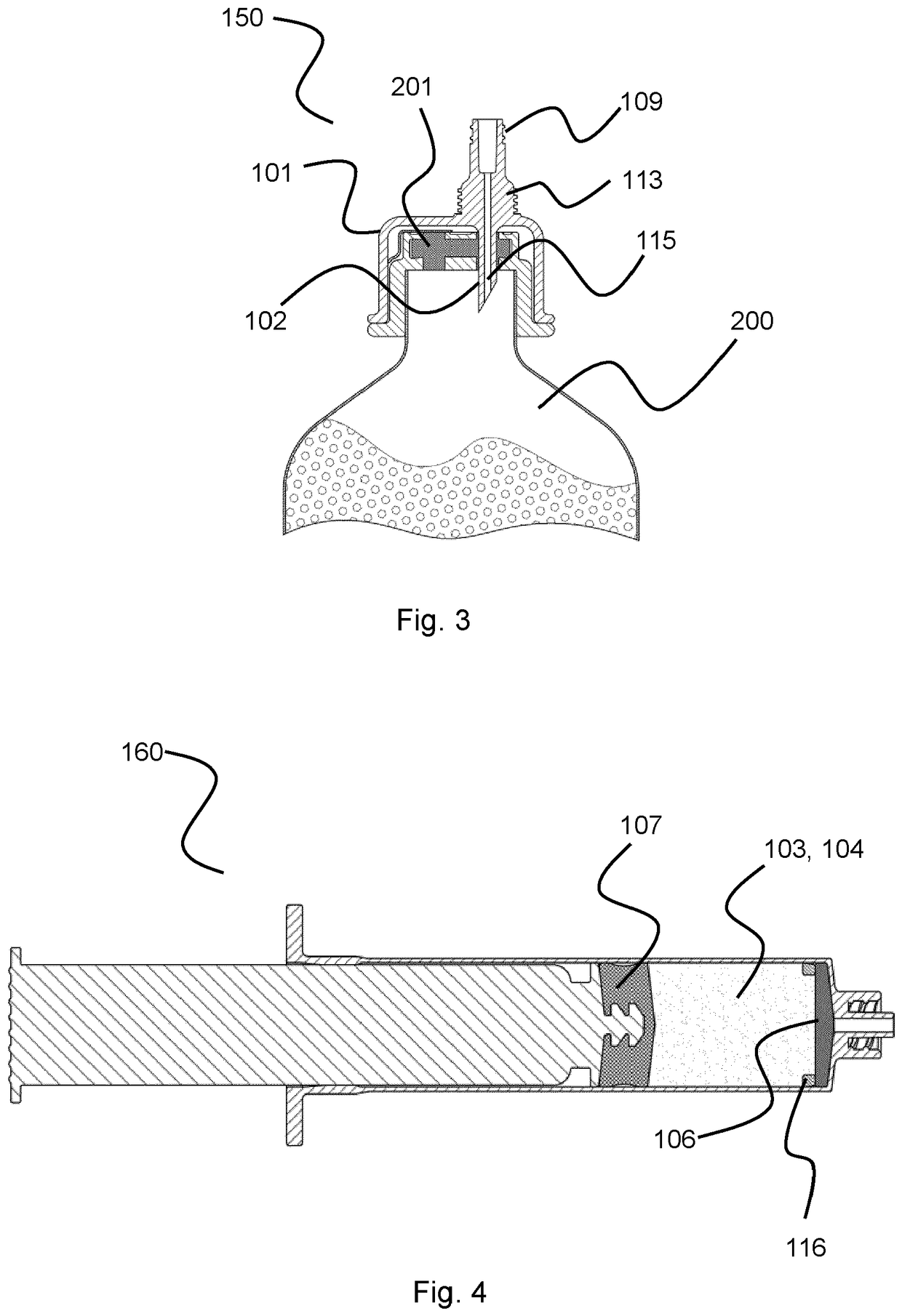 Figure 3~4
 Figure 5
AI summary
The present invention relates to a kit for use in the local antiseptic treatment of a patient, wherein the kit comprises an antiseptic oxidizing agent and a reducing agent, wherein the antiseptic oxidizing agent is decomposable by reaction with the reducing agent.