
Dividable Truss Section With Sliding Halves for Transport Width
Find Innovative SolutionsGenerate Solutions
Solution Overview
Problem
Existing divisible lattice booms for crane operations require separate grid elements to close open sides, increasing storage and assembly costs, and do not efficiently transition between operating and transport positions.
Innovation Solution
A divisible grid element with detachable sections that can be slid into one another transversely, featuring inclined cross-connection structures and longitudinal bars to reduce width for transport, enhancing stability and reducing assembly effort.
Engineering Contradictions & Design Principles
Engineering Contradiction Analysis
1Adaptability or versatility
If separate grid elements are used to close open sides of divisible lattice booms, then the boom can be divided into sections for transport, but storage and assembly costs increase
Solution Approach 1:
The cross-connection structures are integrated directly into the grid section parts, merging the function of closing open sides with the structural components themselves. This eliminates the need for separate grid elements, reducing assembly complexity while maintaining divisibility for transport.
Solution Approach 2:
The cross-connection structures serve multiple functions: they close the open sides of the grid sections, provide structural stability, and enable the divisibility feature. This multi-functionality reduces the number of separate components needed, thereby reducing storage and assembly costs.
2Strength
If grid section width is increased for crane operation, then lateral stiffness increases, but transport width exceeds legal requirements
Solution Approach 1:
The grid section design allows dynamic adjustment of width between operating position (wider for stiffness) and transport position (narrower for compliance). The detachable cross-connection structures enable this dynamic reconfiguration, allowing the same structure to serve different functional requirements.
Solution Approach 2:
The grid boom is segmented into multiple grid section parts that can be connected or separated. This segmentation allows the width to be increased when needed for operation and reduced for transport, resolving the contradiction between structural strength and transport compliance.
3Length of moving object
If grid section parts are separated for transport, then width is reduced, but assembly effort increases
Solution Approach 1:
The cross-connection structures are merged with the grid section parts, eliminating separate components. This integration simplifies the assembly process as fewer parts need to be handled and connected, reducing assembly effort while maintaining the ability to separate for transport.
4Stability of the object's composition
If cross-connection structures are added to join grid section parts, then structural stability increases, but assembly complexity increases
Solution Approach 1:
The cross-connection structures are merged with the grid section parts themselves, so they are not separate components that need to be assembled. This integration maintains structural stability while reducing assembly complexity, as the cross-connections are already part of the grid sections when they are manufactured.
Data Source
 Figure 1
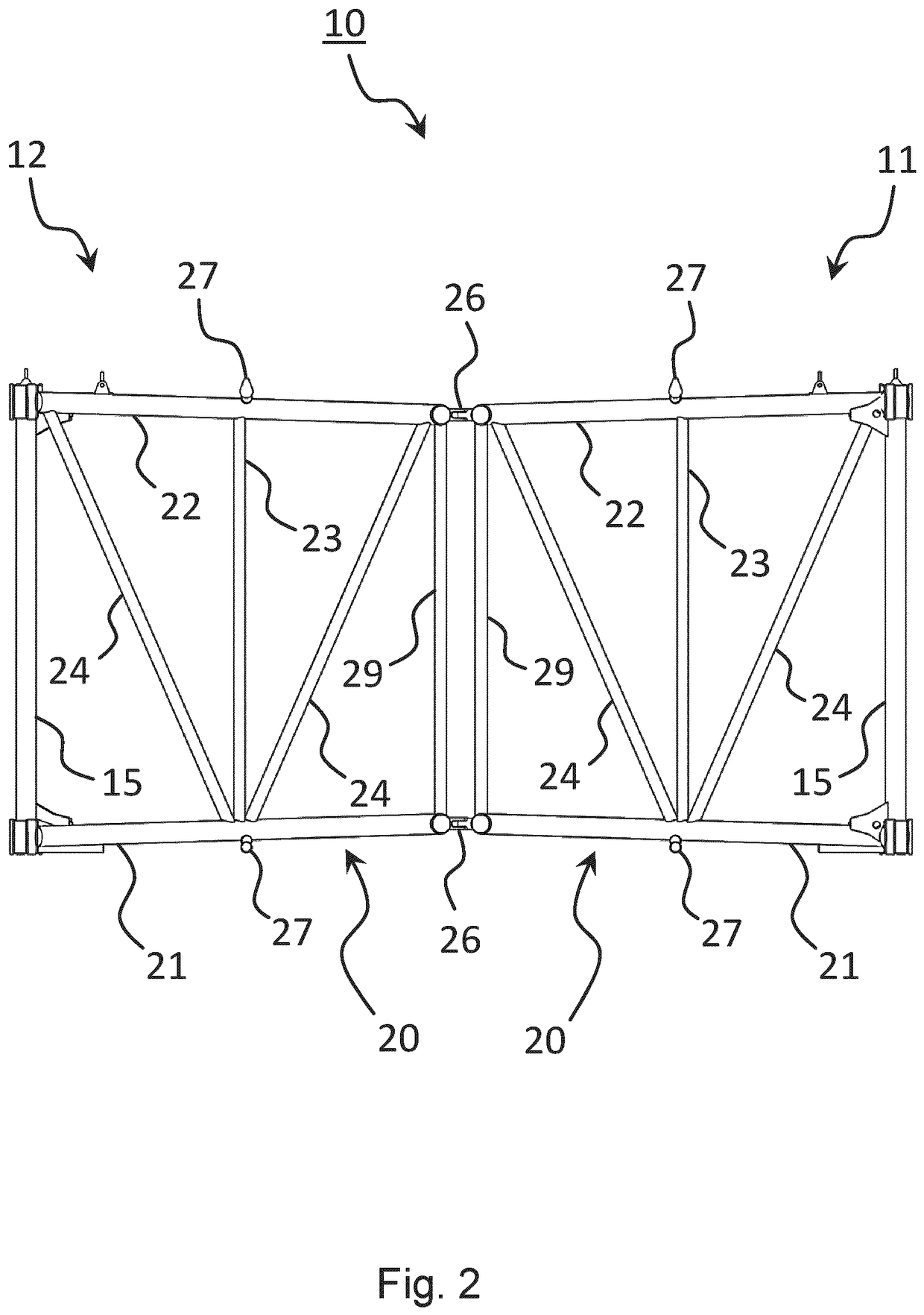 Figure 2
 Figure 3
AI summary
The invention relates to a divisible grid section (10) for a grid boom, comprising two grid section parts (11, 12) that can be detachably connected to one another, which can be detached from one another for transport and can be slid into one another transversely to the longitudinal direction, wherein each of the grid section parts (11, 12) comprises two longitudinally extending corner posts (14) which are firmly connected to one another via several diagonal and vertical bars (15, 16, 17) and together with these define a side surface (30) of the grid section (10), and at least two transverse connection structures (20) that are firmly connected to the corner posts (14), wherein the grid section parts (11, 12) can be detachably connected via connecting means arranged on the transverse connection structures (20).According to the invention, the cross-connection structures (20) each comprise at least two leg bars (21, 22) firmly connected to an upper corner post (14) of a grid section part and at least two leg bars (21, 22) to a lower corner post of the grid section part (11, 12), which together with the respective corner post (14) define an upper and a lower cover surface (31, 32) of the grid section (10), wherein the upper and/or the lower cover surfaces (31, 32) are inclined relative to a plane perpendicular to the side surface (30) towards the other cover surfaces (31, 32) and their leg bars (21, 22) are connected via at least one longitudinal bar (27) running parallel to the corner posts (14) and preferably outside the cover surfaces (31, 32). The invention further relates to a lattice boom (4) with at least one lattice element (10) according to the invention and to a working machine (1) with such a lattice boom (4).