
Flexible Cutting Land Recess for Slicer Blade Support
Find Innovative SolutionsGenerate Solutions
Solution Overview
Problem
Existing slicer apparatuses face difficulties in cutting food items with tough tissues, as these tissues tend to follow the cutting blade orientation, leading to incomplete cuts and adjacent slices sticking together.
Innovation Solution
A cutting land with a recess defined by elongated, opposingly arranged flexible materials that exert elastic forces on the cutting blade, allowing the blade to extend into the recess and follow the thickness of the food item, ensuring effective cutting of difficult tissues.
Engineering Contradictions & Design Principles
Engineering Contradiction Analysis
1Reliability
If a rigid cutting land is used with reciprocating knives, then the structure is simple and stable, but tough tissues cannot be cut effectively and follow the blade orientation causing slices to stick together
Solution Approach 1:
The cutting land uses flexible materials (such as rubber or plastic) instead of rigid structures. These flexible materials can deform and adapt to the thickness variations and tough tissues of the food item, allowing the cutting blade to maintain effective contact and cut through difficult tissues without causing them to follow the blade orientation.
Solution Approach 2:
The cutting land's physical parameters (flexibility, elasticity) are changed to allow dynamic adaptation during cutting. The flexible materials can change their shape and pressure distribution based on the food item's characteristics, enabling effective cutting of tough tissues while maintaining slice separation.
2Manufacturing precision
If the cutting land is made flexible to adapt to food thickness, then cutting quality improves, but the structural complexity and manufacturing difficulty increase
Solution Approach 1:
The cutting land is constructed from flexible materials that can be manufactured in simple shapes. These materials naturally conform to the food item's surface, eliminating the need for complex precision machining or adjustable mechanisms, thereby maintaining ease of manufacture while achieving uniform slice thickness.
3Reliability
If the cutting blade extends deeper into the cutting land recess, then tough tissues are cut more effectively, but the risk of blade deflection and cutting instability increases
Solution Approach 1:
The flexible cutting land material provides continuous support to the cutting blade as it extends into the recess. The material's elasticity allows it to conform to the blade's position while maintaining stable contact, preventing blade deflection and ensuring cutting stability even when the blade extends deeply to cut through tough tissues.
Applied Scientific Principles
This section explains which scientific principles are used to turn an abstract innovation direction into a practical engineering solution.
Function Achieved in This Case
The elastic forces applied by the flexible materials ensure that tough tissues are cut cleanly, preventing them from adhering to the blade and allowing for uniform slice thickness, especially when slicing fish fillets.
Implementation Method 1
the flexible materials exert elastic forces onto the at least one cutting blade causing the flexible materials and thus the width of the recess to follow the thickness of the at least one cutting blade
Data Source
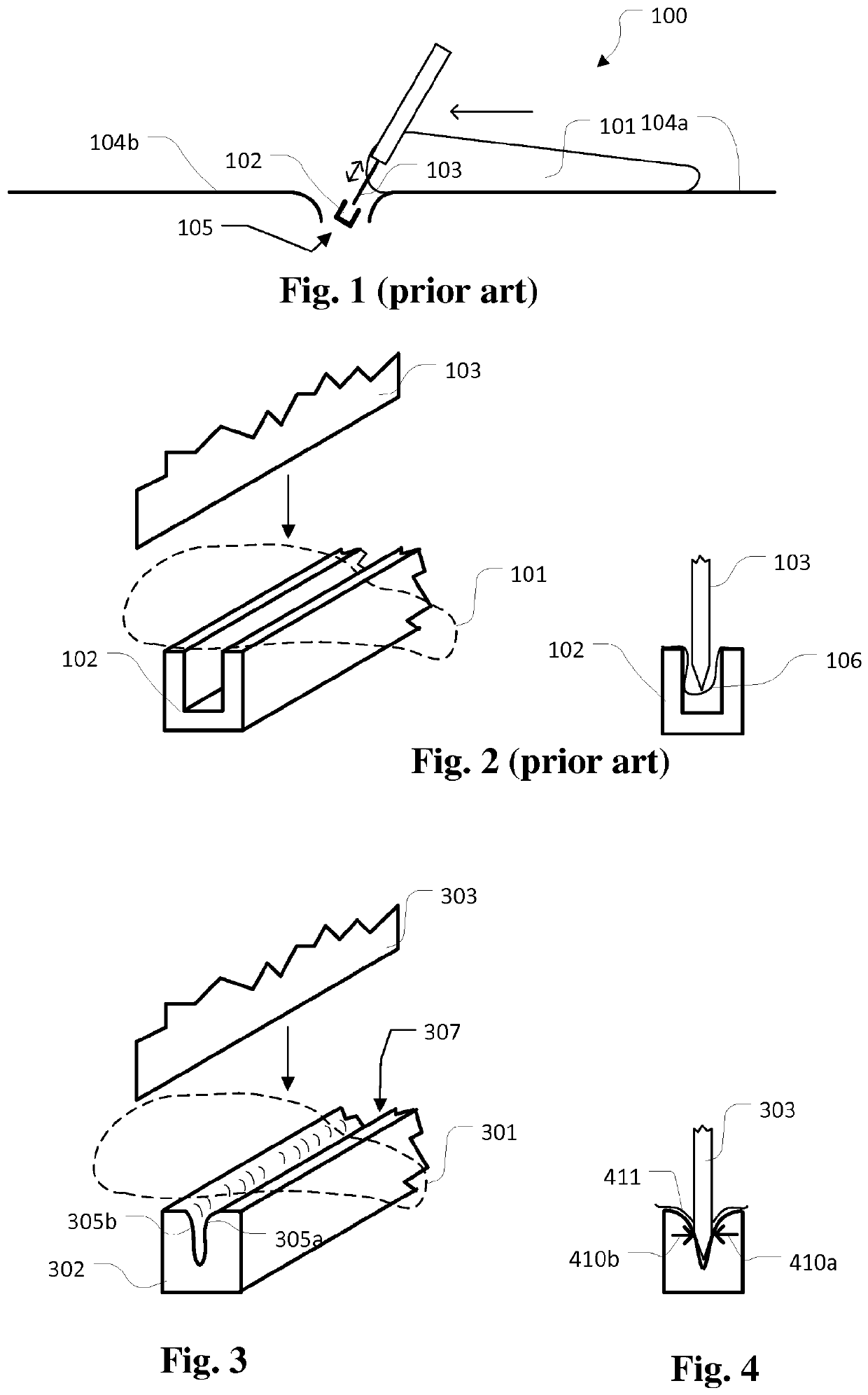 Figure 1~4
AI summary
This invention relates to a cutting land (302) configured to be used in relation with a slicer apparatus (100) for slicing food items (301), where the food items are conveyed by a conveying means (104a,b) along a conveying path, where a gap (105) is provided extending across the conveying path, and where the cutting land is configured to be arranged in and along the gap, where the cutting land comprises a recess (307) facing at least one cutting blade (303) such that during cutting the at least one cutting blade at least partly extends into the recess, wherein the recess is defined by elongated and opposingly arranged flexible materials (305a,b) arranged in relation to each other such that during cutting the flexible materials exert elastic forces (410a,b) onto the at least one cutting blade causing the flexible materials and thus the width of the recess to follow the thickness of the at least one cutting blade.