
Glucocorticosteroid Nanoparticle Suspension Stability
Find Innovative SolutionsGenerate Solutions
Solution Overview
Problem
Aqueous suspensions of glucocorticosteroids like clobetasol propionate face challenges with particle precipitation and agglomeration, leading to instability and reduced efficacy in formulations such as injections and eye drops, due to the hydrophobic nature of these compounds.
Innovation Solution
The development of an aqueous suspension containing nanoparticles of clobetasol propionate, with a mean particle diameter of 300 nm or less, stabilized with physiologically acceptable salts and polyols, and optionally with surfactants, agglomeration inhibitors, and viscosity modifiers, which enhances dispersion stability and bioavailability without using oil solvents.
Engineering Contradictions & Design Principles
Engineering Contradiction Analysis
1Object-affected harmful factors
If glucocorticosteroid aqueous suspension is prepared without oil solvent, then irritation is reduced, but particle precipitation and agglomeration occur leading to poor stability
Solution Approach 1:
The patent reduces particle size to nanometer scale (D50: 50-500 nm, preferably 100-300 nm) and controls particle size distribution (D90/D10 ratio: 2-5), which fundamentally changes the physical parameters of the suspension. This nanoscaling prevents precipitation and agglomeration while maintaining stability without oil solvents, thus resolving the contradiction between reduced irritation and maintained stability
Solution Approach 2:
The patent introduces specific excipients as intermediaries: surfactants (0.01-5% w/v) to reduce surface tension and prevent agglomeration, viscosity modifiers (0.1-10% w/v) to control fluid dynamics and suspend particles, and pH adjusters (pH 3-9) to maintain charge stability. These intermediaries enable stable oil-free formulations by mediating particle-solvent interactions
2Reliability
If particle size is reduced to nanometer scale, then solubility and bioavailability are improved, but manufacturing complexity increases
Solution Approach 1:
The patent incorporates surfactants and viscosity modifiers into the formulation before nanoparticle generation. This preliminary action ensures that particles are immediately stabilized upon formation, preventing agglomeration during the manufacturing process and simplifying downstream processing while achieving the desired nanoscale size distribution
Solution Approach 2:
The patent specifies precise parameter ranges for nanoparticle generation (D50: 50-500 nm, D90/D10 ratio: 2-5) that balance bioavailability enhancement with manufacturing feasibility. These controlled parameter changes enable efficient production through standard nanomilling techniques while ensuring optimal dissolution and absorption characteristics
3Ease of manufacture
If particle size is increased, then manufacturing is simplified, but uniformity and administration dose accuracy are lost
Solution Approach 1:
The patent controls particle size within specific ranges (D50: 50-500 nm, D90/D10 ratio: 2-5) which provides a practical balance between manufacturing simplicity and precision. This narrow size distribution ensures uniform administration dosing while remaining achievable through conventional nanomilling equipment and processes
Solution Approach 2:
The patent implements quality control measures including particle size distribution analysis and visual inspection for precipitation and agglomeration. This feedback mechanism ensures consistent nanoparticle formation and uniformity across batches, maintaining manufacturing precision without excessive complexity
Applied Scientific Principles
This section explains which scientific principles are used to turn an abstract innovation direction into a practical engineering solution.
Function Achieved in This Case
The nanoparticle suspension maintains long-term transparency and dispersibility, achieves high retention in the cornea and aqueous humor, and reduces irritation, providing effective anti-inflammatory action with improved bioavailability and stability.
Implementation Method 1
it has been known that the particle diameter as small as nanometer substantially extends specific surface area in the nanosuspensions, and this enables faster maximization of the serum level of the component due to its increased solubility
Implementation Method 2
The aqueous suspension contains... a surfactant... an agglomeration inhibitor... wherein the nanoparticles... maintain long-term transparency and dispersibility
Implementation Method 3
aqueous suspension containing nanoparticles of clobetasol propionate... enhances dispersion stability
Data Source
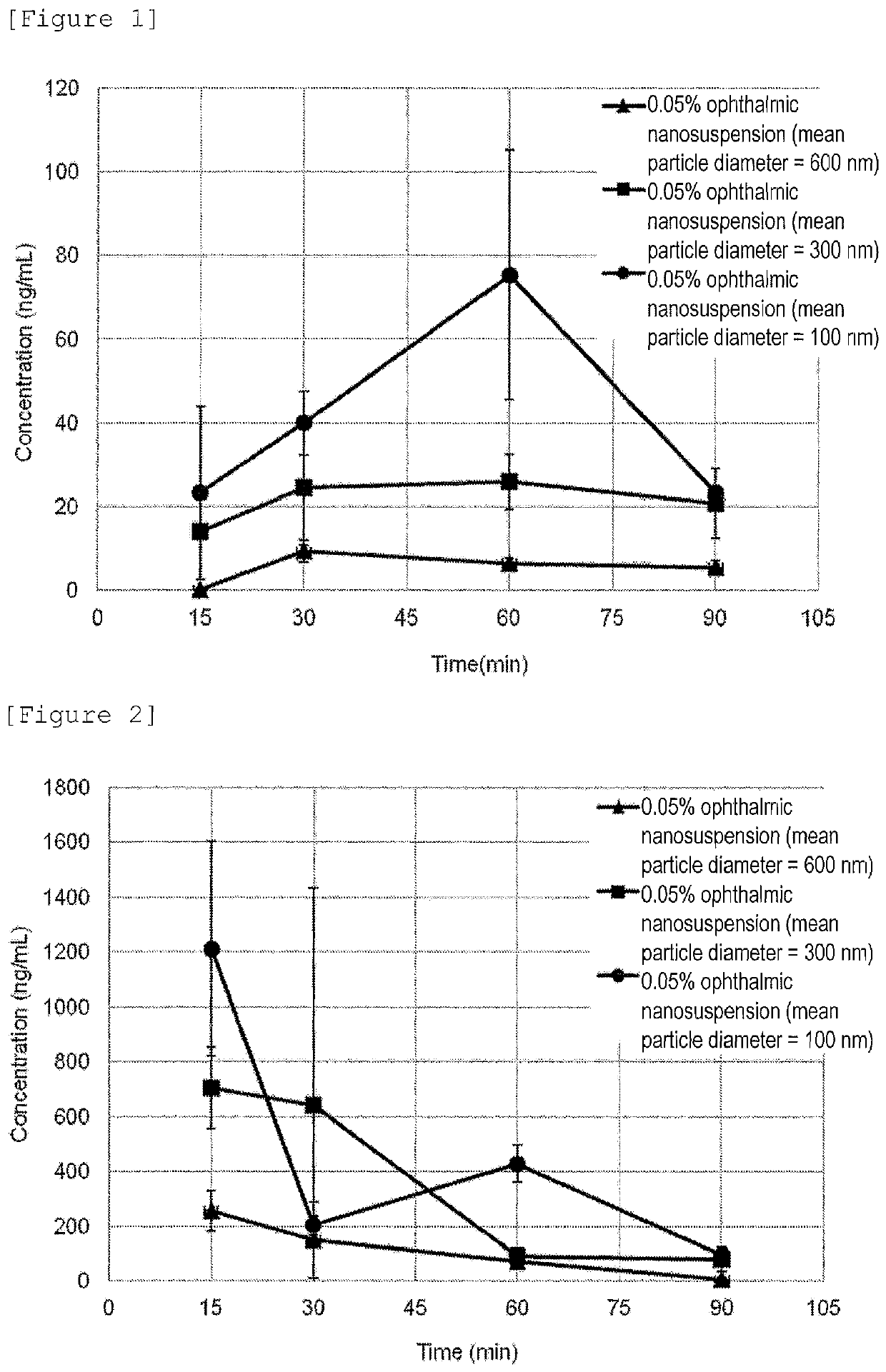 Figure 1~2
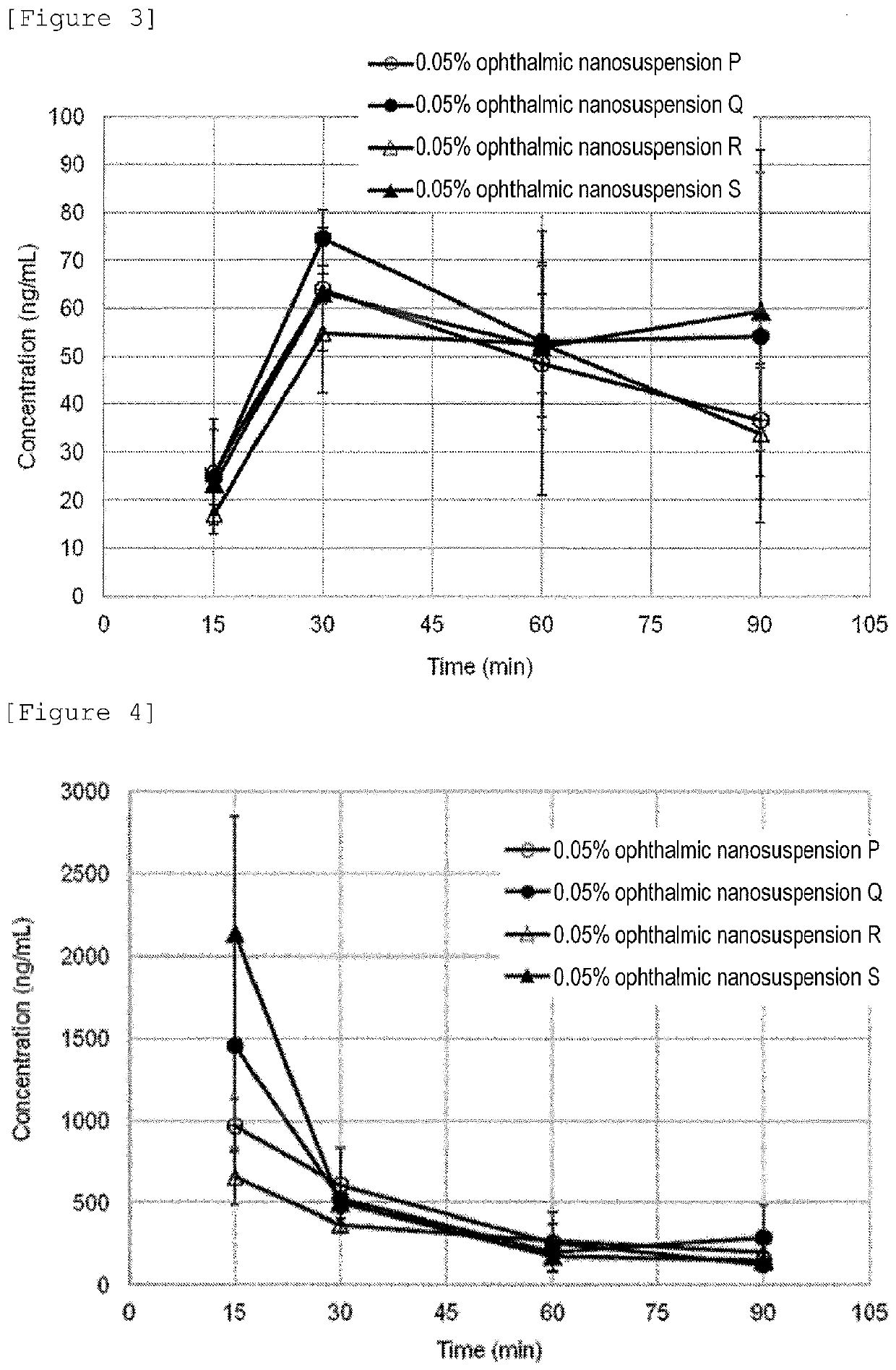 Figure 3~4
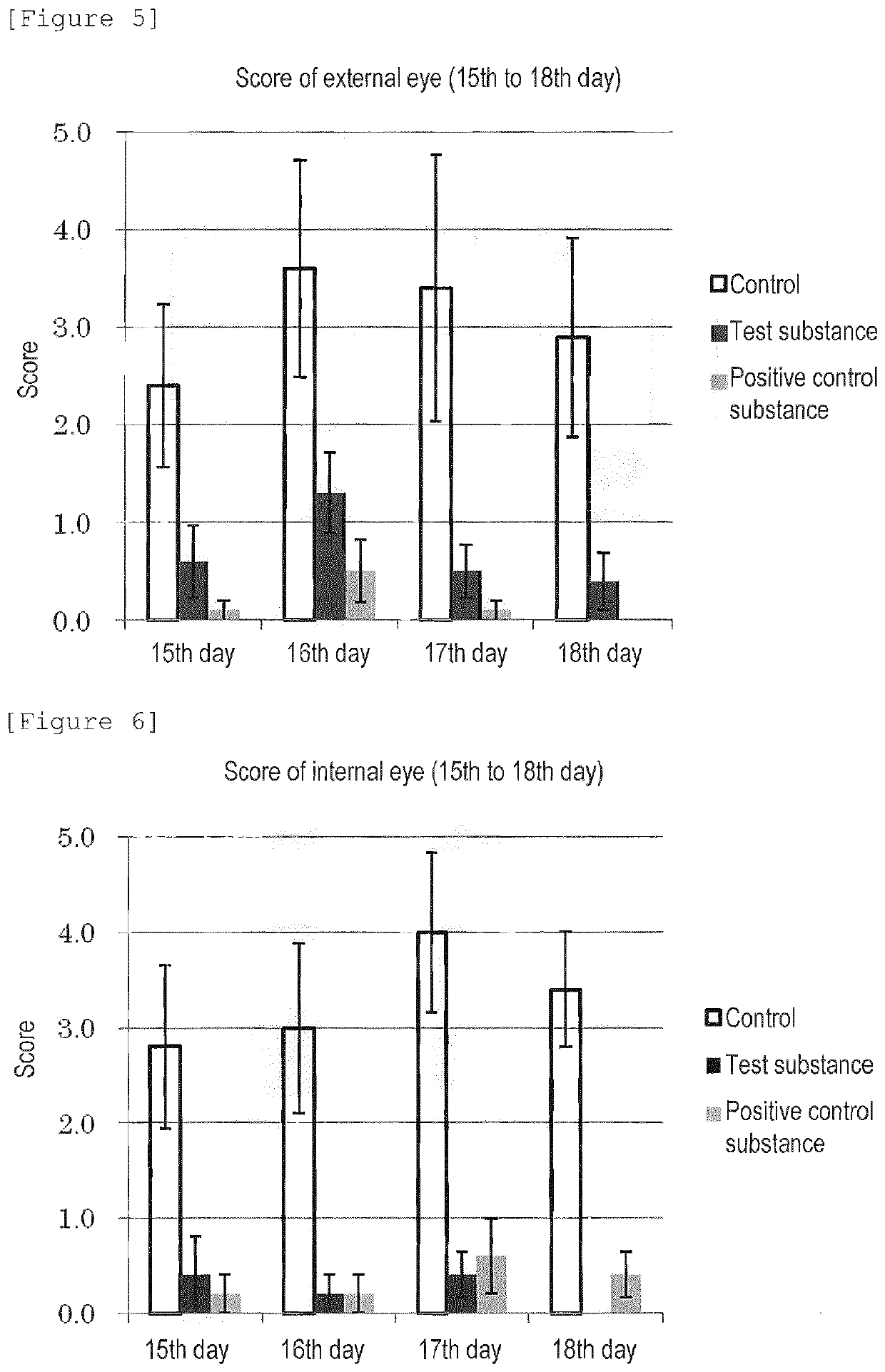 Figure 5~6
AI summary
[Problem to be Solved] An object is to provide an aqueous suspension containing as an active component a glucocorticosteroid compound. The object specifically is to provide a practically usable pharmaceutical composition containing as the active component a glucocorticosteroid compound. [Solution] The present invention is to provide an aqueous suspension containing nanoparticles of a glucocorticosteroid compound and a dispersion stabilizer, the aqueous suspension containing the nanoparticles having a mean particle diameter of 300 nm or less and a D90 particle diameter of 450 nm or less, pharmaceutical compositions for parenteral administrations, injections, eye drops or ear drops containing the aqueous suspension, more specifically an eye drop for treating or preventing inflammatory diseases of the eye or an ear drop for treating or preventing inflammatory diseases of the ear.