

Lightweight Pile Woven Fabric With Reverse-Twist Cotton Pile
Find Innovative SolutionsGenerate Solutions
Solution Overview
Problem
Conventional pile woven fabrics used in towels are too heavy and thick for clothing applications, compromising comfort and ease of sewing due to their high pile height and yarn thickness, which affects their lightness, thinness, water absorbency, breathability, and touch feeling.
Innovation Solution
A pile woven fabric with a cotton yarn of 118-59 dtex, a pile height less than 3 mm, and a density of 15.7-23.6 yarns/cm in the width direction and 7.1-8.7 yarns/cm in the weaving direction, combined with a water-soluble yarn twisted in the opposite direction to enhance weaving capabilities and then removed, maintaining the fabric's characteristics while reducing weight and thickness.
Engineering Contradictions & Design Principles
Engineering Contradiction Analysis
1Reliability
If a pile woven fabric with high pile height and thick yarn is used, then water absorbency and touch feeling are improved, but weight and thickness increase making it unsuitable for clothing
Solution Approach 1:
The patent changes the key parameters of the pile structure: reducing pile height to 1-3mm (from conventional 5-10mm), using finer cotton yarn (118-59 dtex), and adjusting yarn density. These parameter changes maintain water absorbency while reducing fabric weight and thickness to levels suitable for clothing applications.
Solution Approach 2:
The patent applies different qualities to different parts of the fabric structure. The pile portion uses fine cotton yarn with specific twist to provide localized water absorbency and softness, while the base fabric uses a tighter weave structure for durability and appropriate weight. This local differentiation allows the fabric to have both towel-like absorbency and clothing-appropriate weight.
2Reliability
If a pile woven fabric with high pile height is used, then touch feeling is improved, but thickness increases making sewing difficult
Solution Approach 1:
The patent reduces the pile height parameter to 1-3mm, which is significantly shorter than conventional towel piles. This parameter change maintains the soft touch feeling characteristic of towels while reducing overall fabric thickness to a level that allows for easy sewing and garment construction.
3Weight of moving object
If a low pile height is used to reduce weight and thickness, then portability is improved, but touch feeling deteriorates due to increased rigidity
Solution Approach 1:
The patent uses a composite structure combining cotton yarn with specific twist characteristics. The cotton yarn is twisted at 1-5 twists per cm, creating a composite fiber structure that maintains flexibility and softness even at low pile heights. This composite approach prevents the rigidity that would normally accompany low pile structures.
Solution Approach 2:
The patent optimizes the yarn twist parameter (1-5 twists per cm) and pile height (1-3mm) to achieve a balance where the fabric remains lightweight and thin while maintaining the soft, flexible touch feeling characteristic of towels. The specific twist rate prevents excessive rigidity.
4Reliability
If conventional thick yarn is used for pile formation, then water absorbency is improved, but fabric weight and thickness increase
Solution Approach 1:
The patent changes the yarn linear density parameter to 118-59 dtex, which is finer than conventional towel yarn. This parameter change reduces yarn thickness and overall fabric weight while maintaining adequate water absorbency through the pile structure and cotton material properties.
Data Source
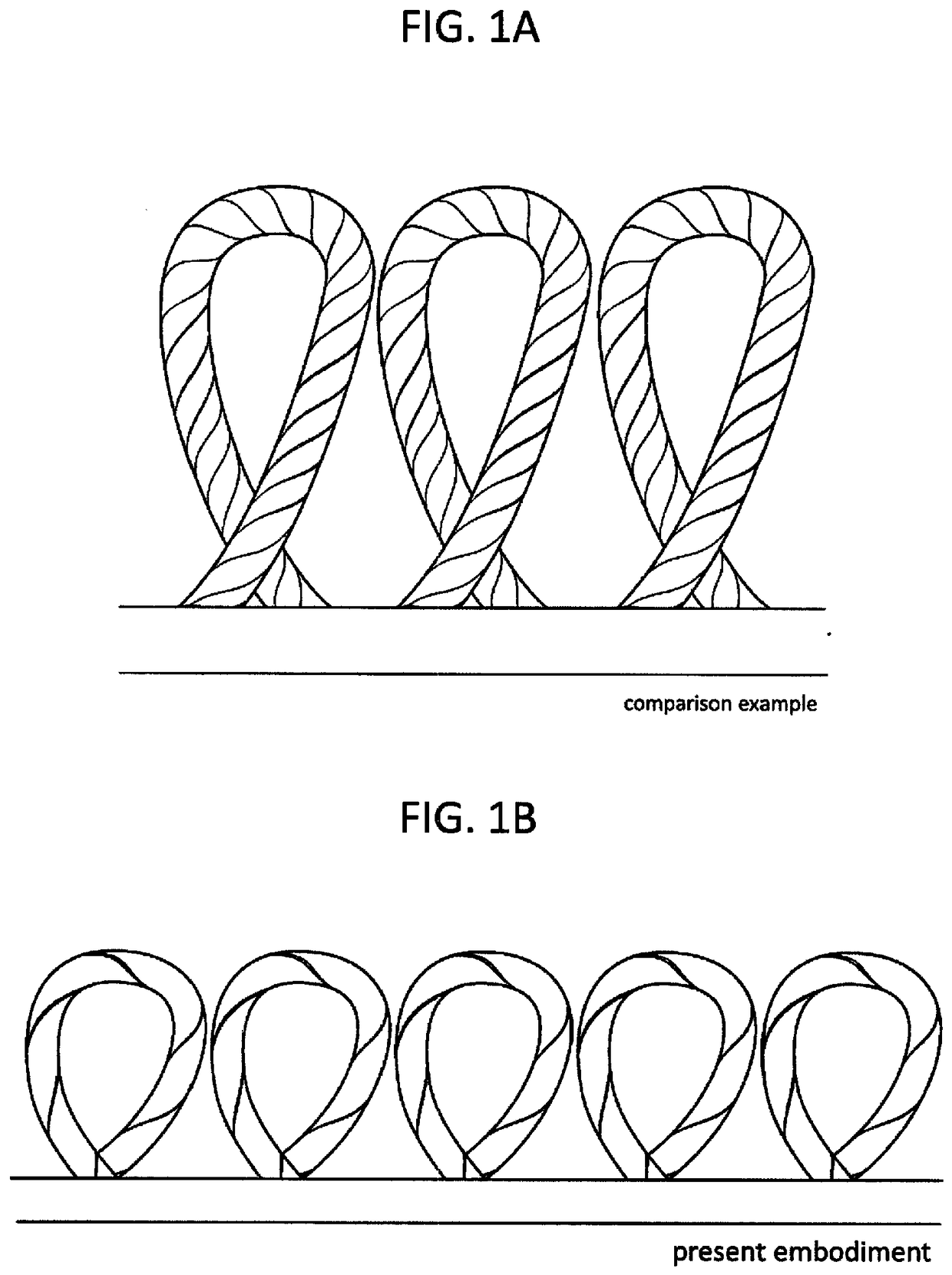 Figure 1A~1B
AI summary
To provide a pile woven fabric that has both of lightness and thinness almost equivalent to those of a typical clothing fabric and water absorbency property, heat-retaining property, breathability, good touch feeling, etc. of towel cloth. The pile woven fabric has pile height lower than the typical towel cloth (comparison example) (first structure). The pile woven fabric has a pile formed of a cotton yarn that has a yarn count finer than that of the comparison example (second structure). The pile woven fabric has pile density higher than that of the comparison example (third structure). In the pile woven fabric, the cotton yarn is twisted together with a water-soluble yarn such that the water-soluble yarn is twisted in a direction opposite to a twisting direction of the cotton yarn, and, after weaving processing, the water-soluble yarn is removed to induce reverse twisting of the cotton yarn (fourth structure).