
Rammer Fall Detection Sensor Using Wave Pattern Matching
Find Innovative SolutionsGenerate Solutions
Solution Overview
Problem
Conventional fall detection sensors struggle to accurately determine if a rammer has fallen during operation due to its large vibrations and impacts, often leading to erroneous determinations.
Innovation Solution
A fall detection sensor system that includes acceleration sensors for three axes, low-pass filters to remove high-frequency noise, integrators to process signals, and comparators to compare signal patterns with stored sample waves, ensuring accurate fall detection and immediate motor shutdown.
Engineering Contradictions & Design Principles
Engineering Contradiction Analysis
1Reliability
If an acceleration sensor is used to detect fall state by monitoring gravitational acceleration changes, then fall detection capability is provided, but measurement precision deteriorates due to complex motion acceleration components from vibrations and impacts
Solution Approach 1:
The acceleration detection is divided into three independent axes (X, Y, Z directions), allowing separate analysis of gravitational acceleration components along each axis. This segmentation enables the system to isolate the gravitational signal from vibration and impact noise by analyzing directional components individually.
Solution Approach 2:
Fall sample waves and non-fall sample waves are stored in advance in the storage unit based on gravitational acceleration patterns detected during normal operation. These pre-stored reference patterns are used for comparison during actual operation, enabling rapid and accurate fall detection without complex real-time analysis.
2Device complexity
If simple acceleration threshold comparison is used for fall detection, then device complexity is reduced, but measurement precision deteriorates due to erroneous detection during vibrations
Solution Approach 1:
Sample waves representing fall and non-fall conditions are pre-collected and stored during normal operation. These reference patterns capture the characteristic acceleration signatures of different states, allowing the system to perform accurate classification during operation through simple pattern matching rather than complex real-time analysis.
Solution Approach 2:
The system creates copies of actual acceleration wave patterns during normal operation and stores them as reference samples. During detection, the current acceleration pattern is compared against these stored copies to determine fall state, replacing complex threshold-based logic with pattern recognition.
3Measurement precision
If multiple processing steps (low-pass filter, integrator, comparators) are added to improve fall detection accuracy, then measurement precision is improved, but device complexity increases
Solution Approach 1:
The system performs signal processing and pattern classification in advance by storing representative sample waves during normal operation. This preliminary action creates a reference library that simplifies real-time detection to a straightforward comparison operation, reducing the complexity of ongoing signal processing while maintaining high accuracy.
Solution Approach 2:
Instead of implementing complex real-time analysis algorithms, the system copies and stores actual acceleration patterns from normal operation as reference samples. The detection process then simply compares current patterns against these stored copies, achieving high precision through pattern recognition rather than complex computational processing.
Applied Scientific Principles
This section explains which scientific principles are used to turn an abstract innovation direction into a practical engineering solution.
Function Achieved in This Case
The system effectively differentiates between fall and non-fall states with high accuracy, avoiding erroneous determinations caused by vibrations and noise, and ensures timely motor shutdown.
Implementation Method 1
an acceleration sensor configured to detect a gravitational acceleration and a motion acceleration with respect to a sensitivity direction, and to output an electrical signal having a level proportional to a magnitude of the detected acceleration
Data Source
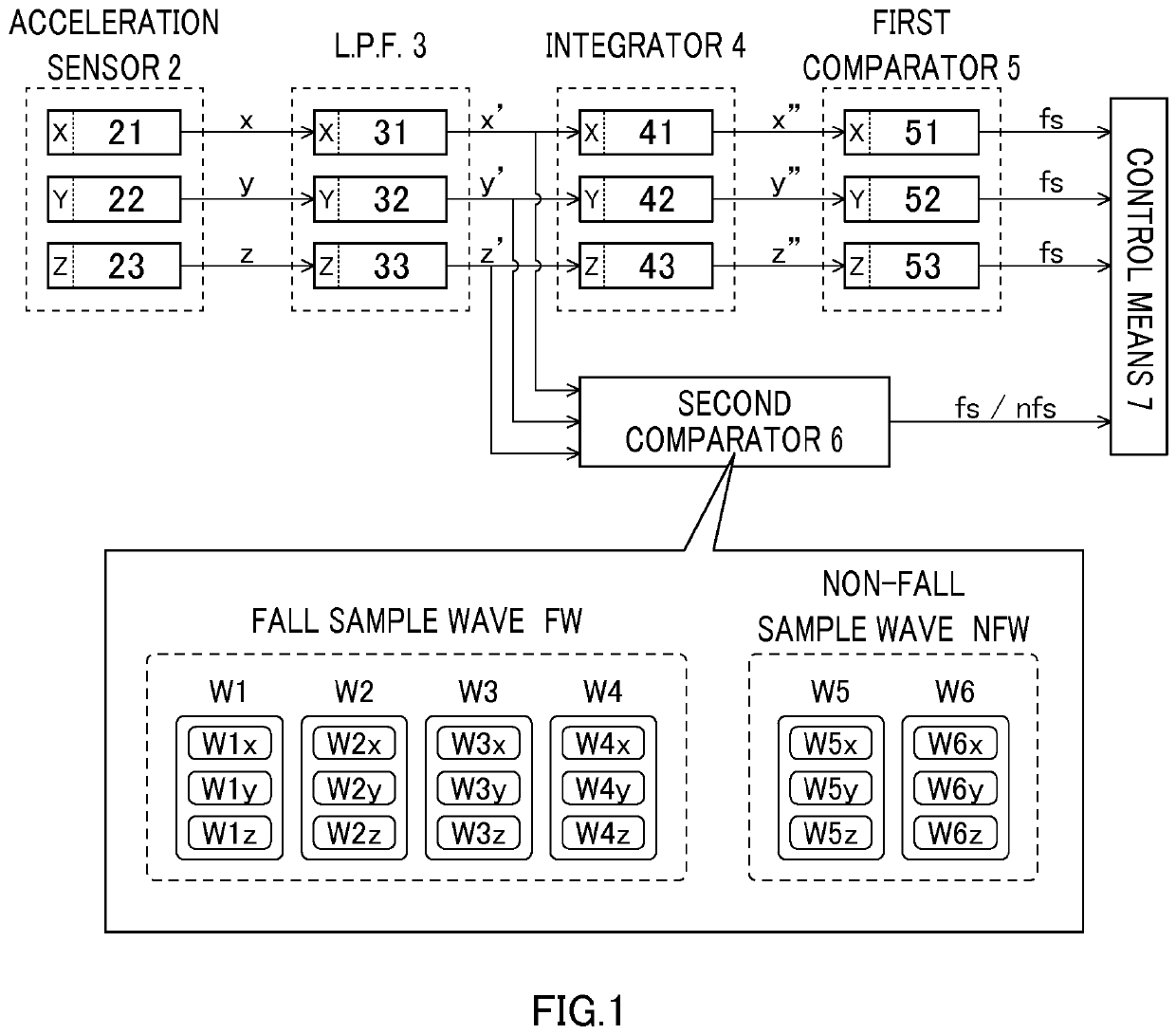 Figure 1
AI summary
Provided is a fall detection sensor for rammer capable of determining a fall state of a rammer, that operates with a large vibration and impact, with high accuracy, and stopping a motor (an engine or the like) immediately. The fall detection sensor for rammer includes an acceleration sensor (2), a low-pass filter (3), an integrator (4), a first comparator (5), a second comparator (6), and control means (7). The second comparator (6) compares wave patterns of input signals (x' - z') with a plurality of types of of fall sample waves (FW) and non-fall sample waves (NFW) stored in advance. The second comparator (6) outputs a fall detection signal (fs) upon determining that the rammer has fallen when the similarity with the fall sample wave (FW) exceeds a threshold, and the second comparator (6) outputs a non-fall signal (nfs) upon determining that the rammer has not fallen when the similarity with the non-fall sample wave (NFW) exceeds a threshold.