
TDR Sensor Distance Measurement for Unknown Media Interfaces
Find Innovative SolutionsGenerate Solutions
Solution Overview
Problem
Conventional methods for measuring distance to multiple interfaces using time domain reflectometry (TDR) face challenges in determining the relative dielectric constant of media and accurately resolving multiple interfaces, especially when reflections overlap and energy decreases, leading to incomplete or inaccurate measurement results.
Innovation Solution
A method that measures the uppermost unknown medium and uses this information to determine other media and interfaces by comparing relative dielectric constants from different probe positions, allowing for the determination of any number of unknown media and interfaces without prior knowledge, and using signal propagation times and amplitudes to calculate distances and permittivities.
Engineering Contradictions & Design Principles
Engineering Contradiction Analysis
1Measurement precision
If conventional TDR evaluation algorithms are used to detect individual reflection signals, then single interface detection is achieved, but multiple interfaces cannot be resolved and measurement accuracy deteriorates
Solution Approach 1:
The patent segments the reflection signal analysis by identifying individual reflection peaks and treating each as a separate interface event. The evaluation algorithm divides the continuous signal into discrete reflection events, allowing multiple interfaces to be detected and measured independently rather than as a single composite signal.
Solution Approach 2:
The patent performs preliminary identification of reflection peaks and their temporal positions before final distance calculation. By pre-identifying and marking individual reflection events in the signal curve, the system prepares the data structure needed for accurate multi-interface measurement, separating peak detection from distance computation.
2Adaptability or versatility
If measurement is performed in media with unknown relative dielectric constant, then general applicability is improved, but measurement accuracy deteriorates due to inability to convert transit time to distance
Solution Approach 1:
The patent makes the measurement system self-sufficient by automatically determining the relative dielectric constant from the reflection signal characteristics itself, rather than requiring external input or calibration. The system extracts the dielectric constant information from the signal amplitude and temporal position data, then uses this determined value to accurately convert transit time to distance for that specific medium.
Solution Approach 2:
The patent changes the approach from requiring fixed known parameters to dynamically determining parameters from the measurement signal itself. The relative dielectric constant is not assumed but derived from the reflection signal characteristics, allowing the system to adapt to any medium while maintaining measurement accuracy through the use of the actually measured parameter values.
3Length of moving object
If probe is inserted deep to cover full measuring range, then measurement range is improved, but signal energy decreases and measurement precision deteriorates
Solution Approach 1:
The patent uses feedback by continuously monitoring the amplitude and temporal position of reflection signals at different probe depths. The evaluation algorithm analyzes the strength and characteristics of returned reflection signals and uses this information to optimize measurement parameters, ensuring that even weak reflections from deep interfaces can be accurately detected and measured.
Solution Approach 2:
The patent employs periodic pulse transmission through the probe, allowing repeated measurements at the same depth. This periodic action enables accumulation of signal data and improvement of signal-to-noise ratio through multiple measurements, enhancing the detection capability for weak reflections from deep interfaces while maintaining measurement precision.
Applied Scientific Principles
This section explains which scientific principles are used to turn an abstract innovation direction into a practical engineering solution.
Function Achieved in This Case
This method achieves higher measurement accuracy and can reliably resolve multiple interfaces and media layers, providing information on the type of media through stored relative dielectric constant assignments, and does not require prior knowledge of interfaces or media.
Implementation Method 1
the method is based on time domain reflectometry (TDR) and uses the fact that, in a TDR measurement, a very short electrical transmit pulse is injected into the conductor and travels through it toward the opposite end. If the pulse encounters a disturbance, which is equivalent to a change in the local characteristic impedance, part of the transmission energy is reflected back to the line input.
Implementation Method 2
determine the distance to at least one first interface and at least one second interface from propagation times of an electromagnetic signal
Implementation Method 3
part of the transmission energy is reflected back to the line input. The exact position of the fault can be calculated from the transit time between the transmission of the transmission pulse and the reception of the reflection.
Data Source
 Figure 1~2
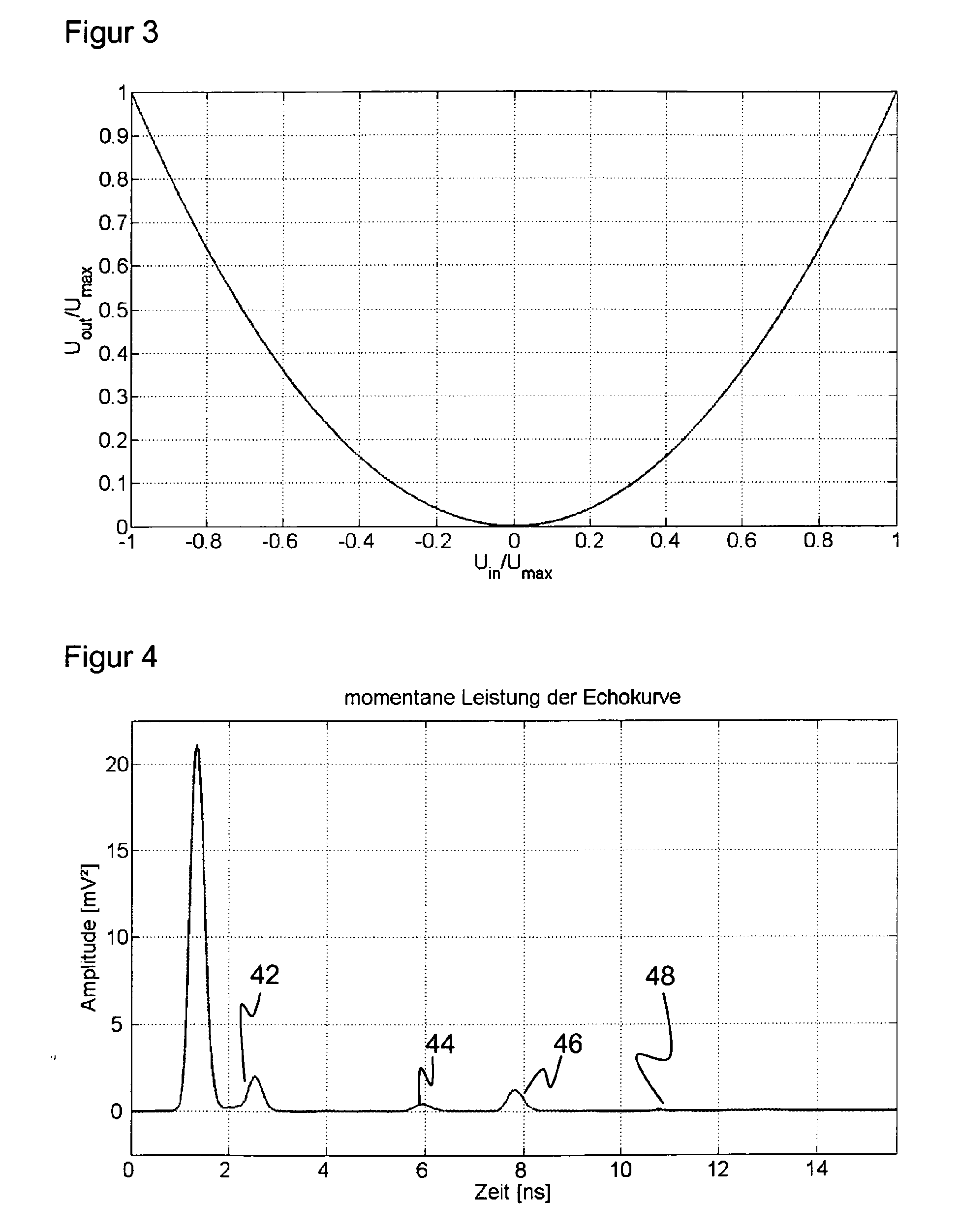 Figure 3~4
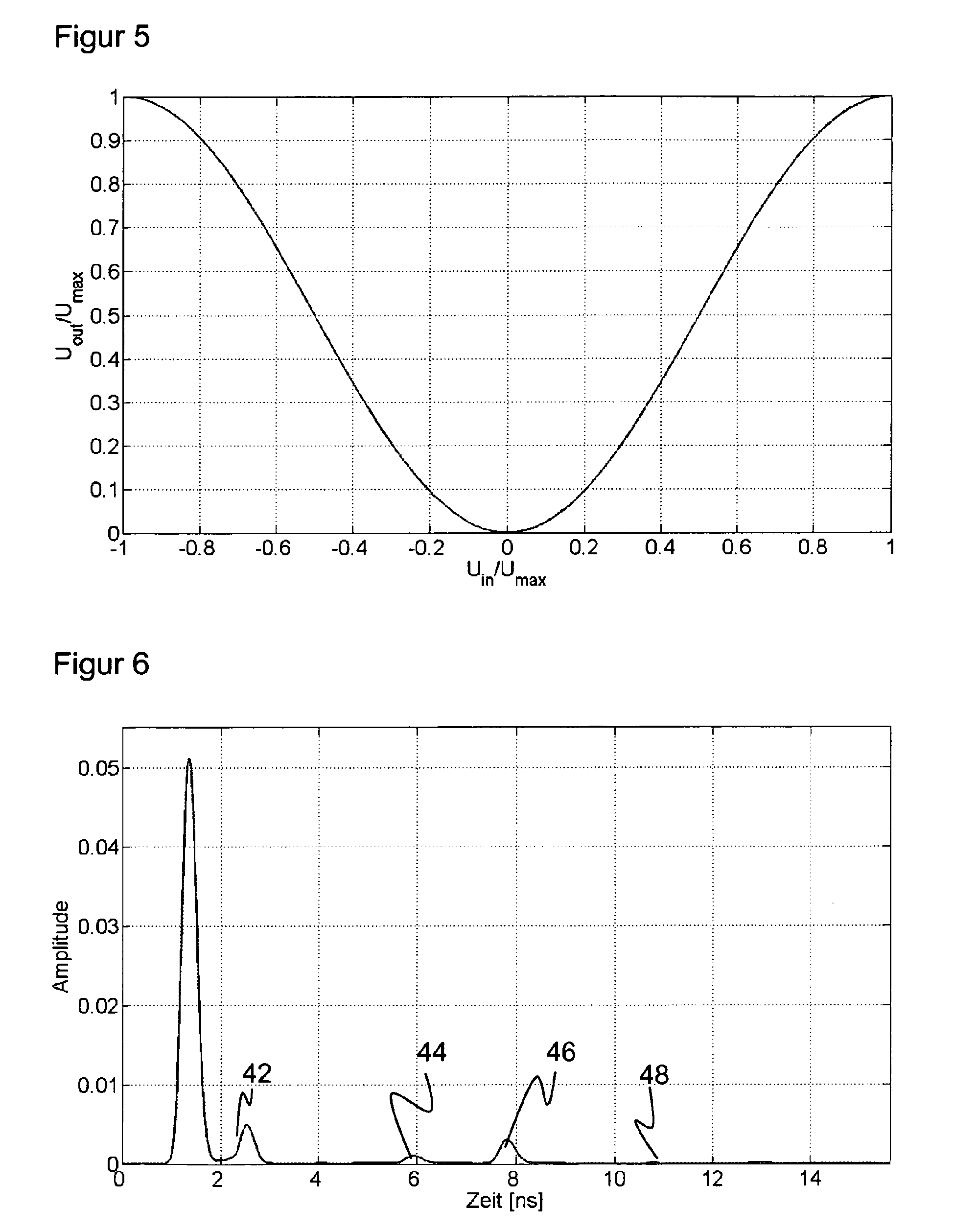 Figure 5~6
AI summary
The method involves determining distance up to an initial boundary area based on a signal sequence. A medium is formed by relative dielectric permittivity of the area, and time is determined by comparison of amplitude of reflected signals at the area with reference amplitude (Astart) of transmitted signals. The time and the distance between the area and a sensor end are determined. An initial boundary area of the medium is provided along a sensor i.e. time domain reflectometry-filling level sensor, during failure correlation of measurements within tolerance regions.