
Thermoplastic Floor Panel Reinforcement for Dimensional Stability
Find Innovative SolutionsGenerate Solutions
Solution Overview
Problem
Existing floor and wall panels face challenges with dimensional stability due to temperature-induced contraction and expansion, leading to deformation and gaps between panels, and they are difficult to print accurately with water-based inks.
Innovation Solution
The panels comprise multiple thermoplastic layers with reinforcement layers in both the substrate and top layers, including a transparent wear layer with relief that is in register with the print layer, and a hard PVC film with low plasticizer content for improved printing and dimensional stability.
Engineering Contradictions & Design Principles
Engineering Contradiction Analysis
1Ease of operation
If panels are made from thermoplastic materials to achieve flexibility and ease of installation, then ease of operation is improved, but dimensional stability deteriorates due to temperature-induced contraction and expansion
Solution Approach 1:
The patent applies composite materials by combining thermoplastic layers with reinforcement layers made of glass fiber, basalt fiber, or organic fibers. This composite structure allows the panel to maintain flexibility and ease of installation while the reinforcement layers provide dimensional stability and reduce temperature-induced deformation.
Solution Approach 2:
The patent changes the physical and chemical parameters of the thermoplastic material by selecting specific types (PVC, polyolefin, polyamide, polyester) and adjusting their properties through additives and plasticizer content control. This allows optimization of both flexibility for installation and dimensional stability for temperature resistance.
2Ease of manufacture
If a flexible intermediate product is printed before lamination to achieve printing capability, then ease of manufacture is improved, but manufacturing precision deteriorates due to difficulty in high-quality printing and ink blooding
Solution Approach 1:
The patent applies preliminary action by providing instructions for printing at an optimal time point in the manufacturing process. The patent specifies that printing should be performed on the first intermediate product before lamination, but with controlled drying conditions to prevent ink blooding, thereby achieving both printing capability and quality.
Solution Approach 2:
The patent uses the first intermediate product as an intermediary carrier for the print layer. This intermediate product serves as a suitable substrate that accepts water-based inks properly and allows controlled drying, acting as a mediator between the printing process and the final panel structure.
3Ease of manufacture
If water-based inks are used for printing to achieve ease of application, then ease of manufacture is improved, but manufacturing precision deteriorates due to ink blooding in controlled conditions
Solution Approach 1:
The patent changes the drying parameters by specifying controlled drying conditions with particular attention to humidity and temperature control. This allows water-based inks to be applied easily while preventing ink blooding through optimized drying parameter management.
Data Source
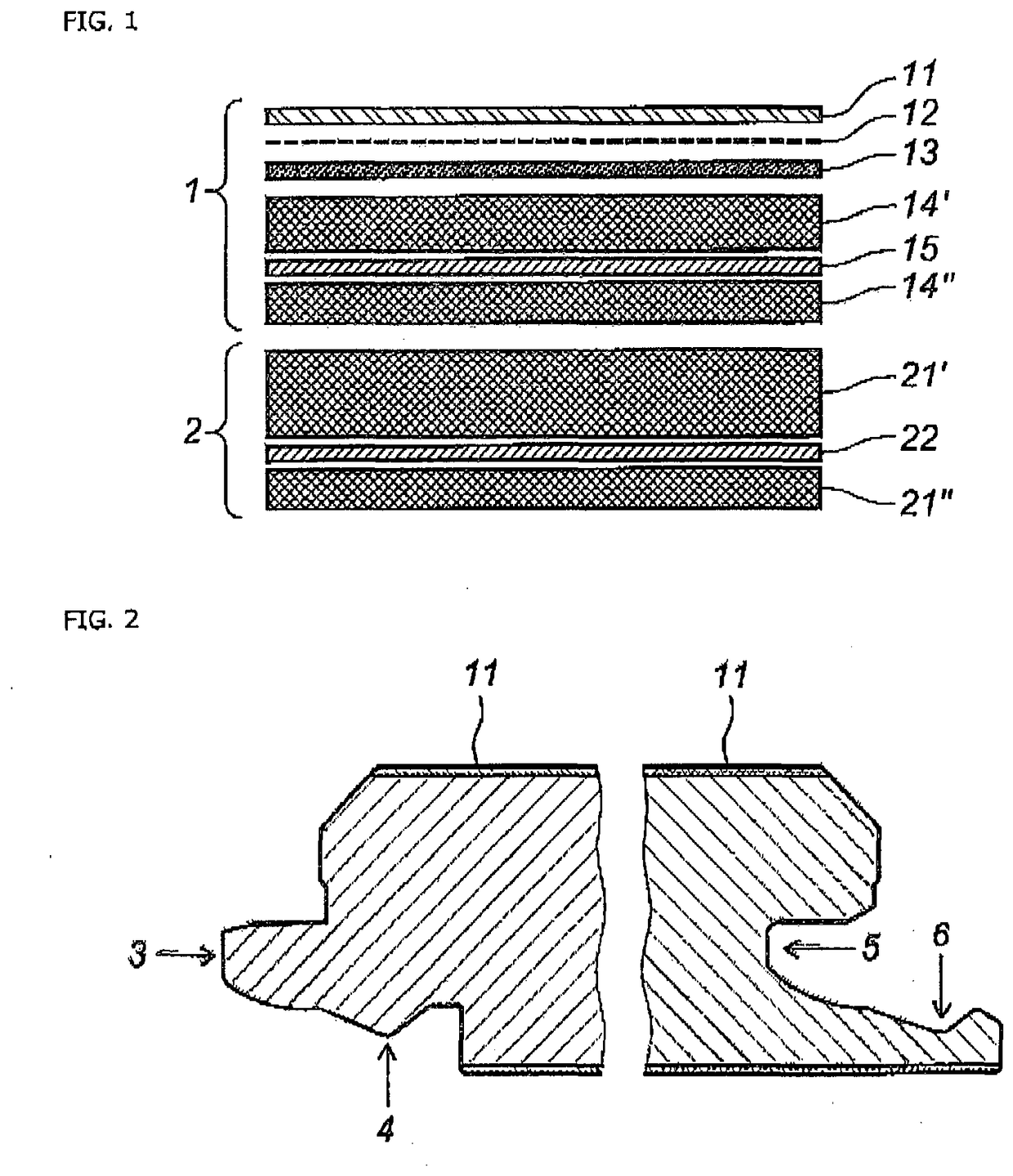 Figure 1~2
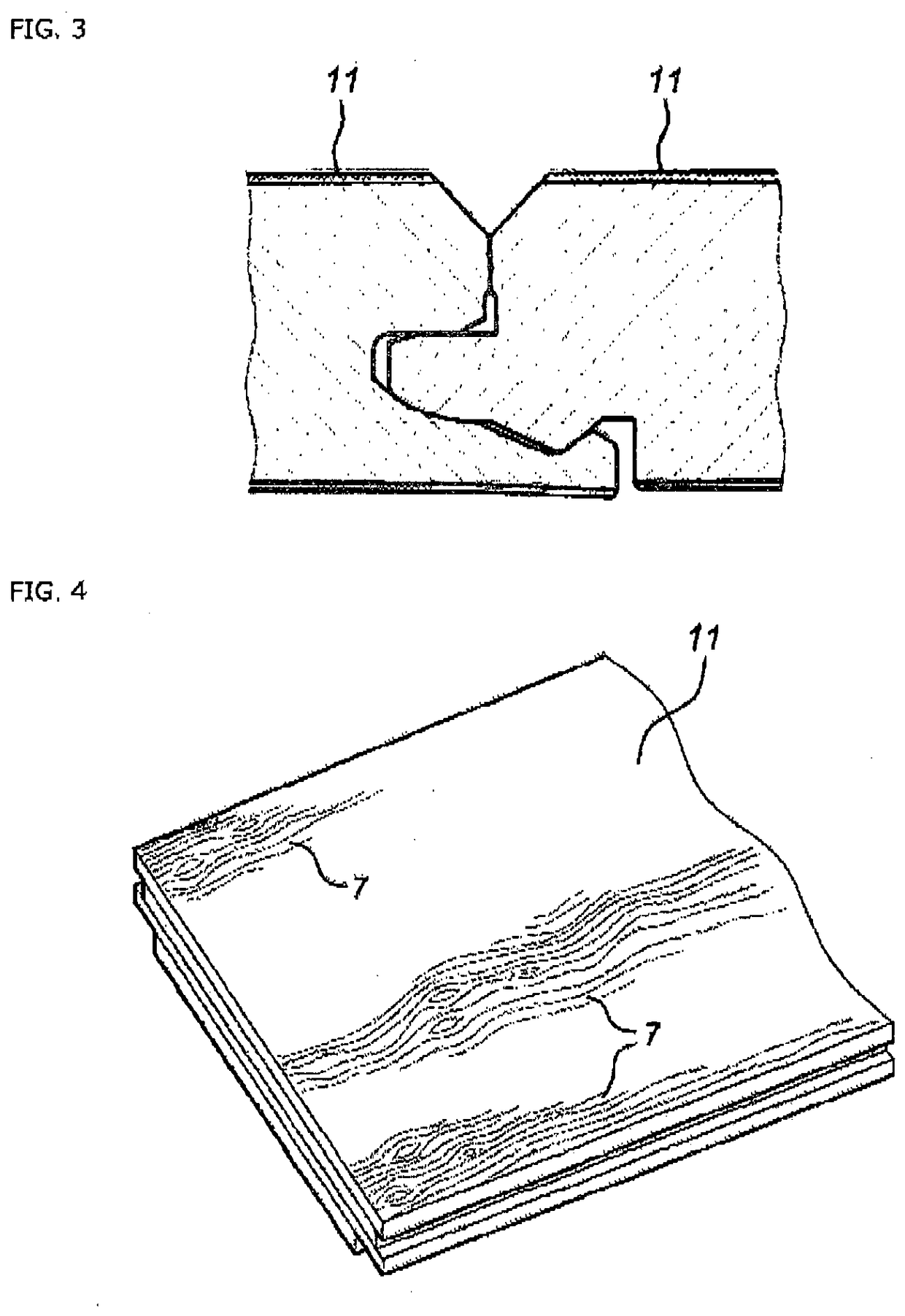 Figure 3~4
AI summary
The present invention relates to a panel and method for manufacturing panels for wall or floor coverings, comprising two or more thermoplastic layers including at least one thermoplastic substrate layer and at least one top layer comprising at least a decor layer, a print layer and a transparent wear layer, and wherein both said thermoplastic substrate layer and said top layer are provided with a reinforcement layer, wherein said transparent wear layer Is provided with a relief.