

Translucent Reinforced Hose Liner for Sewer Inlet Visibility
Find Innovative SolutionsGenerate Solutions
Solution Overview
Problem
Current sewer rehabilitation technologies face challenges in handling and durability, particularly in recognizing inlets and outlets within the sewer system due to opaque outer film systems, which hinder precise localization and resin impregnation, and are prone to damage during insertion.
Innovation Solution
A tubular liner with a mechanically stable outer film system that is translucent to visible light, allowing for UV protection and preventing premature resin hardening, while being designed for improved mechanical stability and visibility of inlets and outlets, featuring a reinforcement web with high tensile strength and low elongation, and a polymer coating for enhanced durability.
Engineering Contradictions & Design Principles
Engineering Contradiction Analysis
1Reliability
If an opaque outer film system is used to protect the pipe liner during insertion, then mechanical protection and UV protection are improved, but visibility of inlets and outlets is worsened
Solution Approach 1:
The outer film system is segmented into multiple functional layers: a mechanically stable opaque layer for protection and UV blocking, and a translucent layer for visibility. This segmentation allows each layer to perform its specific function without compromising the others.
Solution Approach 2:
The outer film system uses a composite structure combining materials with different properties - an opaque mechanically stable material (such as PVC-reinforced fabric) for protection and UV blocking, combined with a translucent material that allows light transmission for visibility of inlets and outlets.
2Reliability
If a sliding film is used to guide the pipe liner into the sewer, then damage during insertion is prevented, but device complexity and handling difficulty increase
Solution Approach 1:
The sliding film component is extracted/removed from the system. Instead of using a separate sliding film, the outer film system itself is designed with sufficient mechanical stability and low friction properties to enable direct insertion without additional guiding components.
Solution Approach 2:
The outer film system serves multiple functions simultaneously: it provides mechanical protection during insertion, blocks UV radiation to prevent premature resin curing, and enables visibility of inlets and outlets. This multi-functionality eliminates the need for separate sliding film components.
3Strength
If the outer film is made mechanically very stable and not stretchable, then durability during insertion is improved, but adaptability to pipe shape variations is worsened
Solution Approach 1:
The outer film system is segmented into a mechanically stable opaque layer for protection and a translucent layer for visibility and flexibility. This segmentation allows the translucent layer to provide the necessary adaptability while the opaque layer maintains mechanical stability.
Solution Approach 2:
The composite structure combines materials with different mechanical properties, allowing the outer film system to maintain overall mechanical stability while the translucent component provides the necessary flexibility and adaptability to pipe shape variations.
Applied Scientific Principles
This section explains which scientific principles are used to turn an abstract innovation direction into a practical engineering solution.
Function Achieved in This Case
The solution enables better recognition of inlets and outlets for precise installation, improved resin impregnation, and enhanced durability by preventing damage during insertion, while maintaining UV protection and allowing for easy identification of resin distribution within the sewer system.
Implementation Method 1
The at least one outer film and the at least one reinforcement web are designed in such a way that the outer film system has an overall transmittance of at least 1% for visible light at at least one wavelength in the range from 550 nm to 800 nm
Implementation Method 2
a UV- and short-wave light-absorbing and/or -reflecting, single-layer or multi-layer film
Implementation Method 3
the resin being curable by means of UV radiation
Data Source
 Figure 1
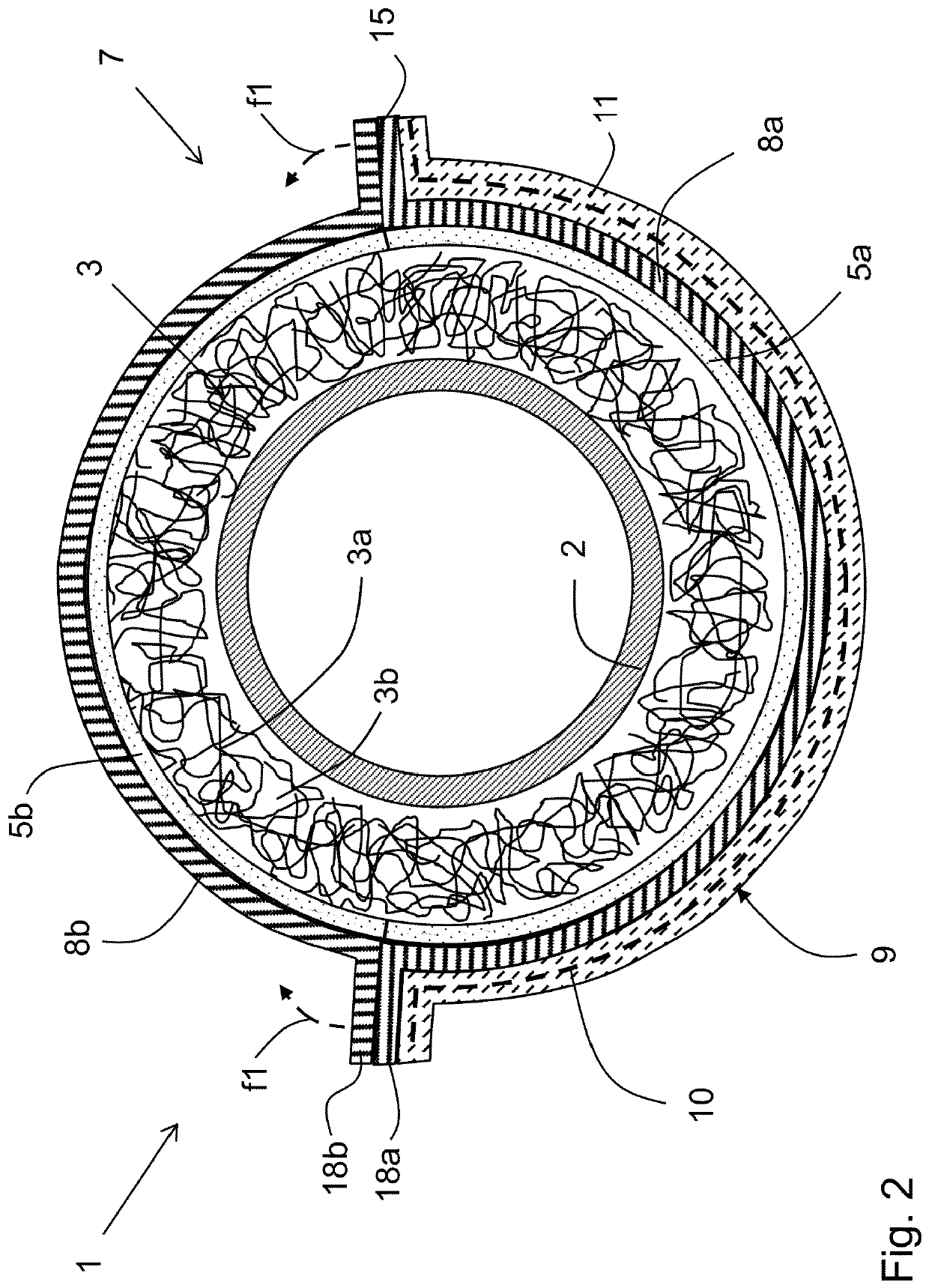 Figure 2
 Figure 3
AI summary
The invention relates to a pipe liner (1) for the rehabilitation of a sewer, particularly one laid underground, comprising at least one inner lining (2), a resin carrier layer (3) surrounding the inner lining (2), and a mechanically protective outer lining system (7). The outer lining system (7) comprises at least one outer lining (8; 8a, 8b) in the form of a single-layer or multi-layered film that absorbs and/or reflects UV radiation and short-wave visible light, containing in one or more polymer layers at least one short-wave visible light-absorbing and/or reflecting organic or inorganic color pigment or a corresponding dye, and at least one UV-absorbing and/or reflecting organic or inorganic compound. Furthermore, the outer lining system (7) comprises at least one mechanically stable reinforcing layer (9; 9a, 9b) that abuts the said outer lining (8; 8a, 8b).The outer film system (7) has a transmittance for visible light of at least 1% at at least one wavelength in the range of 550 nm to 800 nm. The invention also relates to a method for manufacturing such an outer film system (7) and to such an outer film system (7) itself.