

Washing group for laundry washing machines
Find Innovative SolutionsGenerate Solutions
Solution Overview
Problem
Current washing machine designs face issues with the rigidity of the mechanical coupling between the electric motor and the washing tub, particularly due to increased rotation speed and torque, leading to insufficient stability and longer assembly times.
Innovation Solution
The implementation of coupling pins with a frustoconical-shaped distal portion and an adjacent cylindrical-shaped mid portion, along with a stop surface, provides a more rigid and stable connection between the motor assembly and the washing tub, enhancing the mechanical coupling and assembly efficiency.
Engineering Contradictions & Design Principles
Engineering Contradiction Analysis
1Power
If the electric motor rotation speed and torque are increased, then the washing performance is improved, but the mechanical coupling rigidity between motor and washing tub becomes insufficient
Solution Approach 1:
The coupling pin features a frustoconical distal portion with increased axial length specifically at the connection interface with the connecting part, while the mid portion maintains a cylindrical shape. This localized geometric modification concentrates the rigidity enhancement exactly where the mechanical coupling requires it most, without unnecessarily increasing the overall pin complexity or other dimensions.
Solution Approach 2:
The frustoconical shape of the distal portion of the coupling pin introduces a curved, tapered geometry that provides better surface contact and stress distribution compared to a purely cylindrical design. This curved geometry enhances the mechanical interlocking between the coupling pin and the hollow seat of the connecting part, improving coupling rigidity under high torque conditions.
2Ease of manufacture
If traditional coupling pins with equal axial lengths are used, then the assembly process is simple, but the mechanical coupling rigidity is insufficient under high torque conditions
Solution Approach 1:
Rather than making the entire coupling pin more complex, the invention applies the frustoconical geometry only to the distal portion that interfaces with the connecting part. This localized modification maintains simplicity in the majority of the pin structure while providing enhanced coupling strength exactly where needed, preserving ease of manufacture and assembly.
3Stability of the object's composition
If additional fixing screws are used to enhance coupling rigidity, then the mechanical stability is improved, but the assembly time increases
Solution Approach 1:
The invention merges the functions of the coupling pin and the fixing mechanism into a single integrated component. The frustoconical distal portion of the coupling pin itself provides the rigid mechanical interlocking through its geometry and the hollow seat engagement, eliminating the need for separate fixing screws. This consolidation maintains coupling stability while significantly reducing assembly steps and time.
Solution Approach 2:
The coupling pin's frustoconical geometry enables it to self-lock within the hollow seat of the connecting part through the tapered interface. The geometric design inherently provides the rigid coupling needed for high torque applications without requiring additional fastening elements, allowing the component to serve its own fixing function.
Data Source
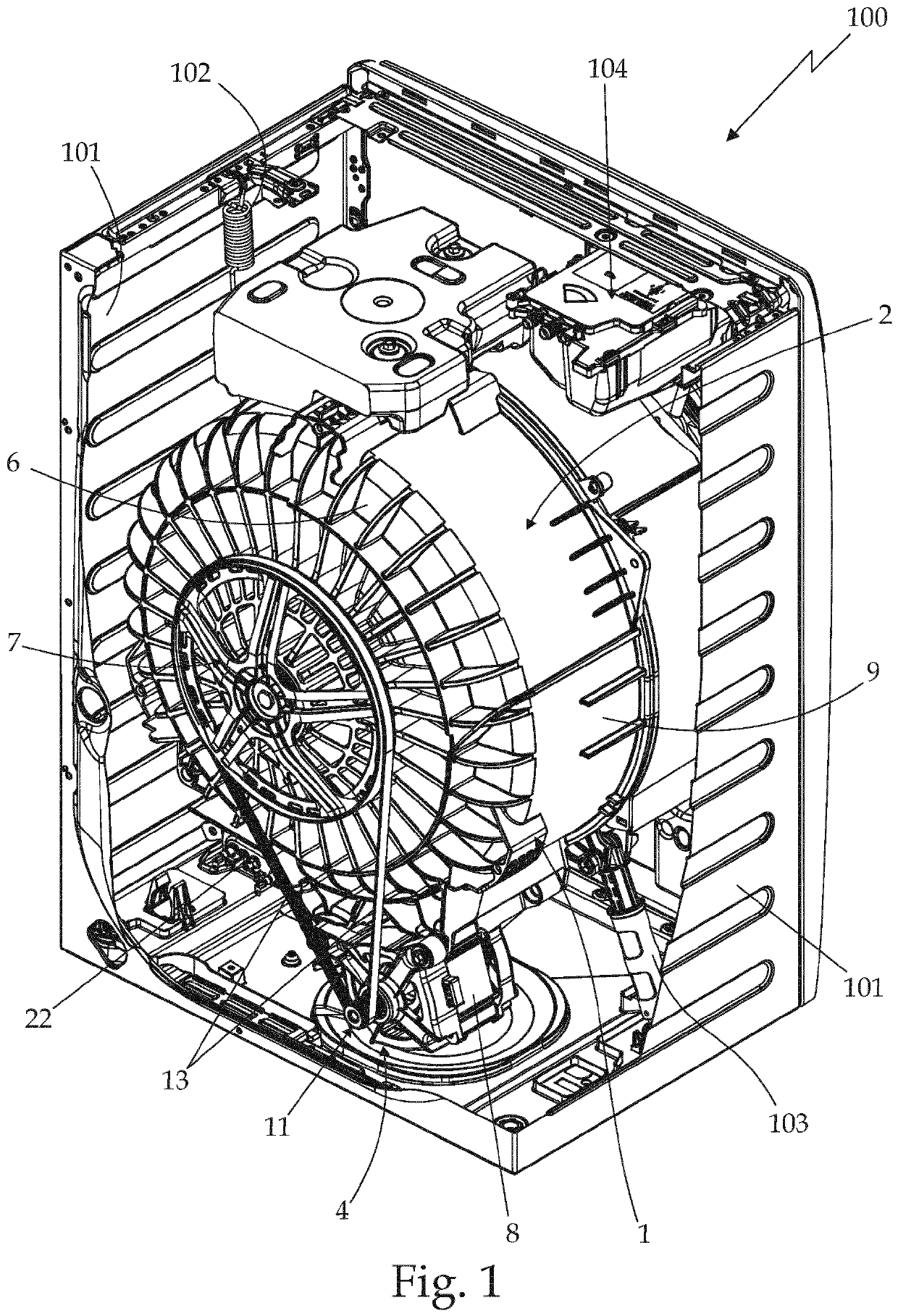 Figure 1
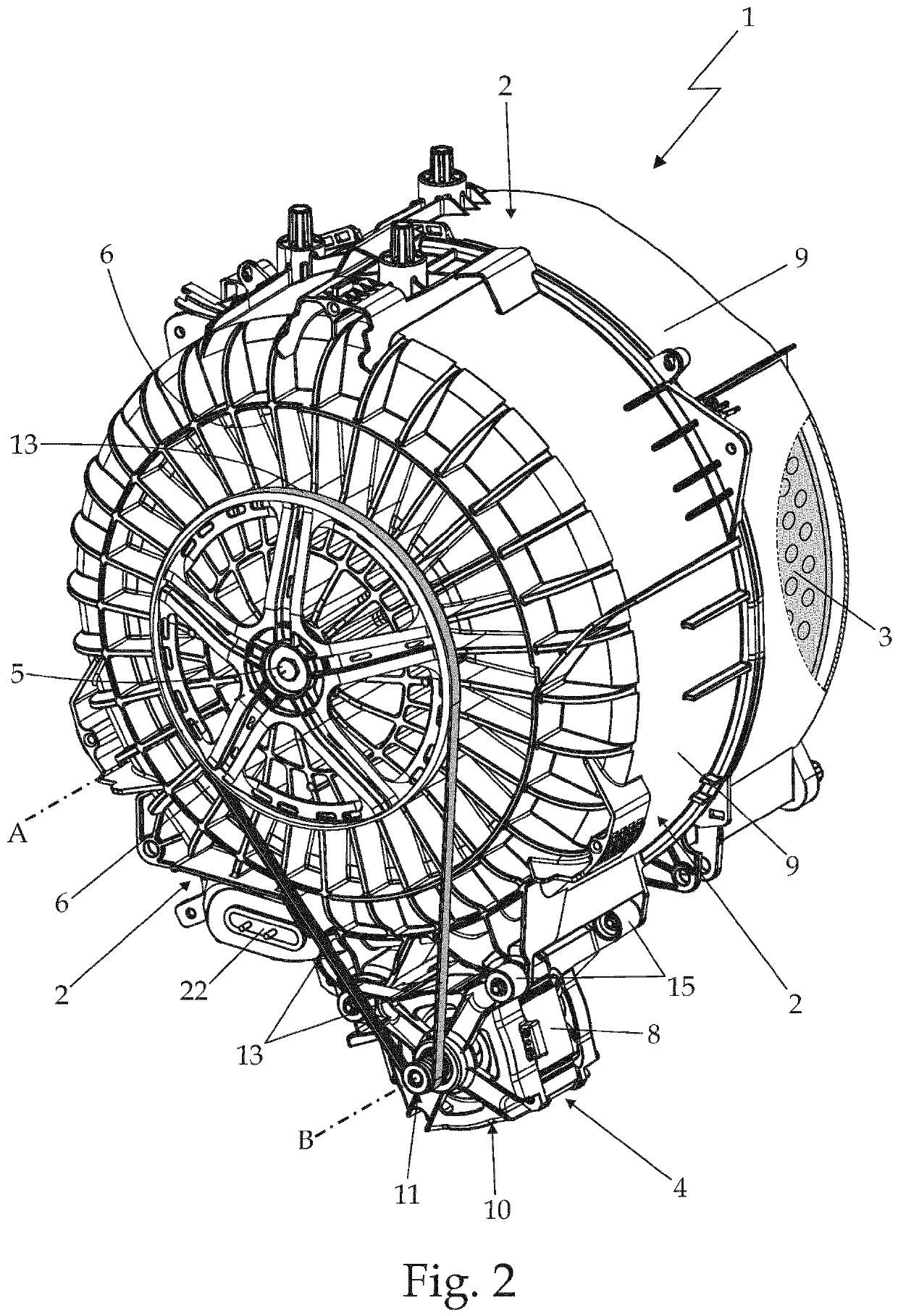 Figure 2
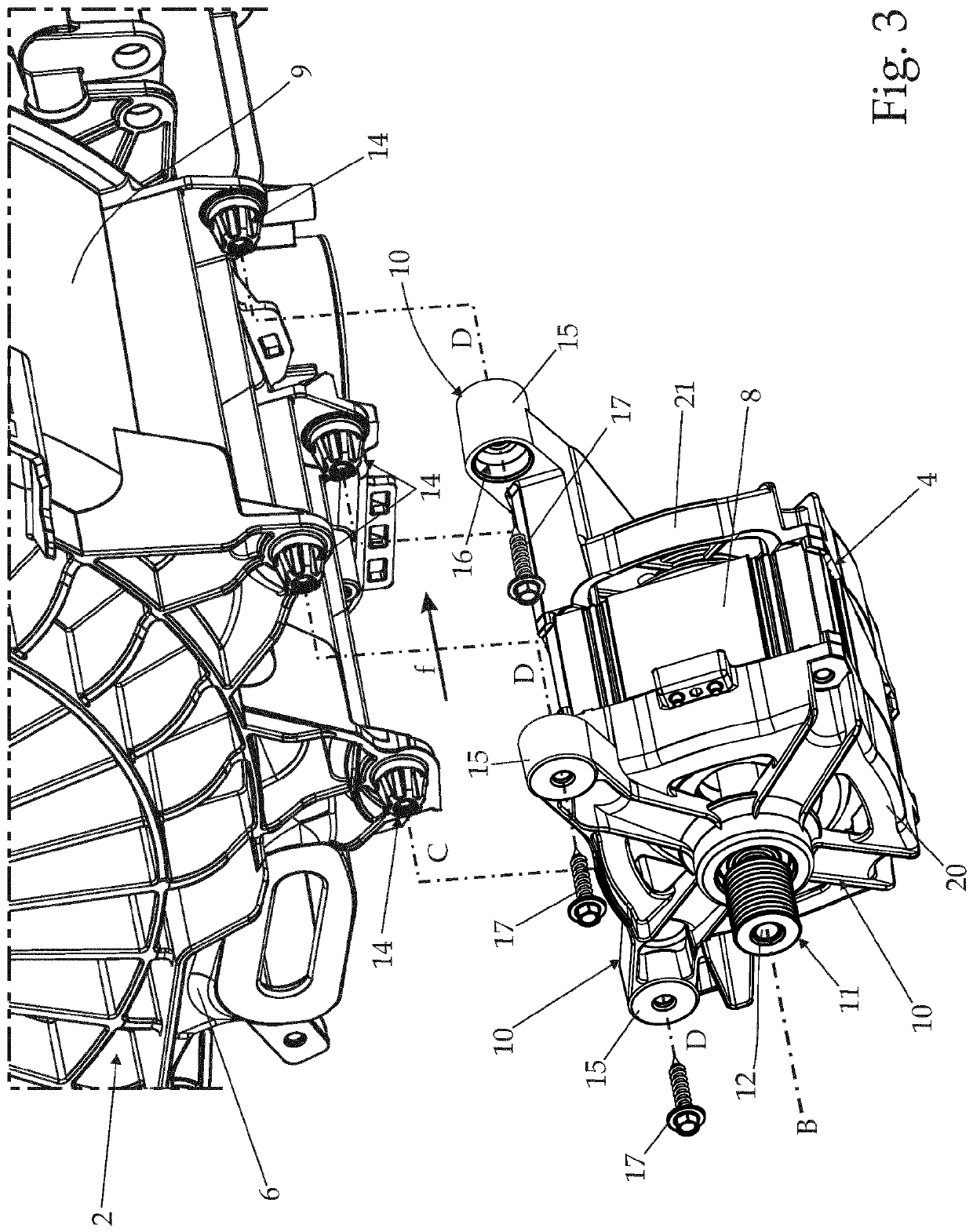 Figure 3
AI summary
Washing group (1) for laundry washing machines comprising a hollow washing tub (2), a revolving drum (3) fitted in axially rotatable manner inside the washing tub (2), and a motor assembly (4) which is rigidly attached outside the washing tub (2) and is capable of driving into rotation the revolving drum (3) inside the washing tub (2); the motor assembly (4) comprising a drive motor (8) and a supporting structure (10) provided with a number of connecting arms (15) each of which juts out from the drive motor (8) towards the peripheral wall (9) of washing tub (2), and has the distal end fitted onto a corresponding coupling pin (14) which cantilevered extends from the washing tub (2); each coupling pin (14) being substantially ogival-shaped and the distal end of each connecting arm (15) having a substantially ogival-shaped, hollow seat (16) which is substantially complementary in shape to that of the corresponding coupling pin (14) so as to be axially engaged by said coupling pin (14).