
WPAN Directional Discovery Protocol with Coordinated Channel Selection
Find Innovative SolutionsGenerate Solutions
Solution Overview
Problem
In ECMA-387 WPANs, devices face challenges in discovering each other efficiently due to directional transmissions and differing PHY modes, leading to delayed discovery and complexity in channel selection for data exchange.
Innovation Solution
A method and protocol using asynchronous contention-based medium access for transmitting discovery beacon blocks, enabling devices to scan and coordinate channel selection without requiring omni-directional antennas, maintaining directional transmission efficiency and allowing discovery across different types.
Engineering Contradictions & Design Principles
Engineering Contradiction Analysis
1Power
If directional transmission is used for discovery beacons, then transmission efficiency is improved, but device discovery time increases because potential partners may be listening in directions not facing the transmitter
Solution Approach 1:
Devices perform periodic scanning of discovery beacons in different directional sectors. The scanning process systematically cycles through multiple directional beams to cover all potential transmitter directions, ensuring that devices can discover each other despite using directional transmissions. This periodic scanning resolves the contradiction by maintaining directional transmission efficiency while periodically checking all directions for discovery beacons.
Solution Approach 2:
The system dynamically adjusts the scanning behavior based on device state and environmental conditions. Devices can change scanning frequency, sector coverage, and beamforming patterns adaptively to optimize discovery performance. This dynamic approach allows the system to maintain directional transmission benefits while adapting scanning strategies to minimize discovery time under varying conditions.
2Adaptability or versatility
If different PHY modes are used by different device types for discovery beacons, then device capability differentiation is improved, but discovery complexity increases making it harder for devices to find each other
Solution Approach 1:
A unified discovery beacon format serves as an intermediary that accommodates multiple PHY modes and device types. The beacon structure includes fields that can represent different device capabilities (Type A, B, or C) while maintaining a consistent format that all devices can parse. This intermediary format resolves the contradiction by enabling capability differentiation through standardized fields while keeping the discovery protocol simple and uniform across all device types.
Solution Approach 2:
The discovery beacon protocol is designed to be universal, supporting multiple PHY modes and device types within a single framework. The beacon format can carry information applicable to all device types while including optional capability indicators. This universal approach allows devices of different types to participate in the same discovery process without requiring type-specific protocols, thereby reducing overall complexity while maintaining adaptability.
3Reliability
If omni-directional antennas are used for discovery, then device discovery reliability is improved, but directional transmission efficiency is lost
Solution Approach 1:
The omnidirectional discovery function is segmented into multiple directional transmissions performed sequentially. Instead of using a single omnidirectional antenna, the system divides the 360-degree coverage into multiple directional sectors and transmits discovery beacons in each sector periodically. This segmentation resolves the contradiction by achieving omnidirectional coverage reliability through coordinated directional transmissions, thereby maintaining transmission efficiency in each direction while providing comprehensive coverage.
Data Source
 Figure 1~2
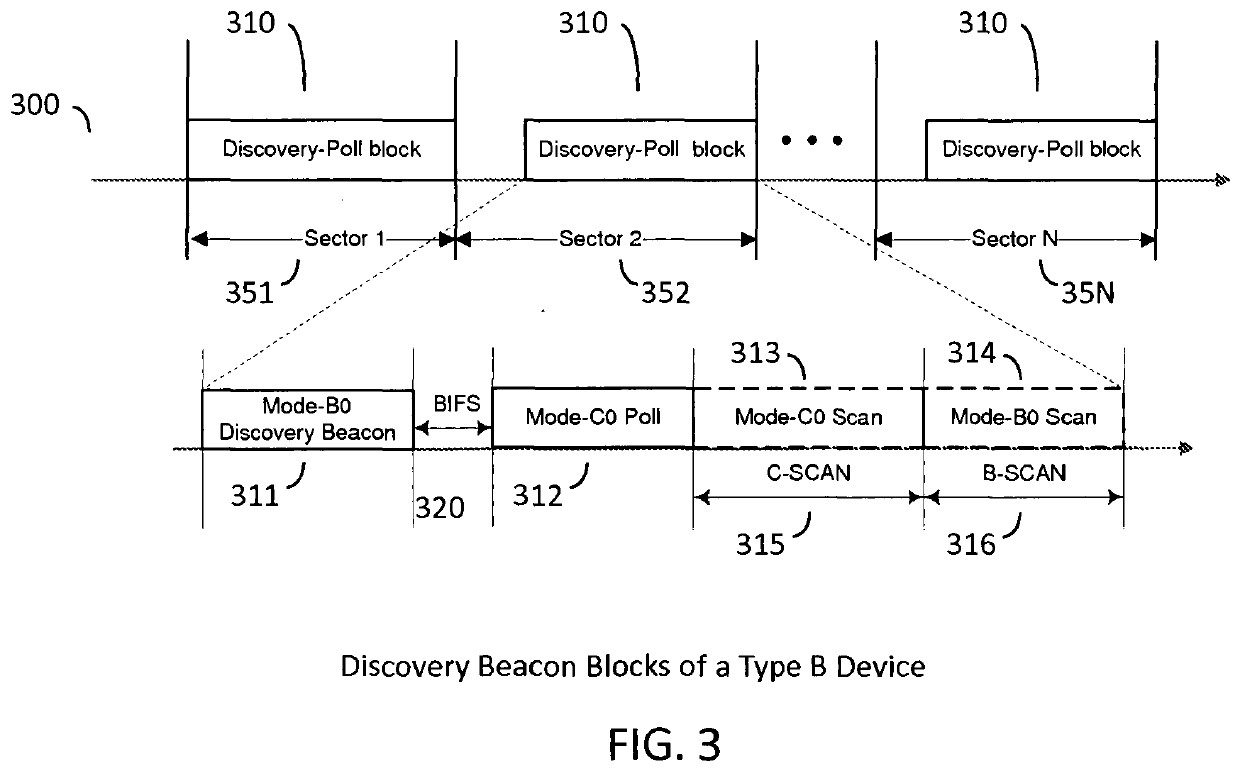 Figure 3
 Figure 4
AI summary
A method and system for communication device discovery and coordination of data channel selection between a first device and a second device in a Wireless Personal Area Network (WPAN). The method includes transmitting a set of discovery beacon blocks (101 ) by the first and second devices in a discovery channel (100) using an asynchronous contention based medium access mechanism; scanning the discovery channel (100) by the first and second devices; and coordinating between the first and second devices to select a data channel by exchanging channel selection command frames (600) in the discovery channel using the asynchronous contention based medium access mechanism.