Multi-objective optimization in petroleum product blending
JUN 19, 2025 |
The blending of petroleum products is a critical process in the oil and gas industry, aiming to create products with specific properties and performance characteristics. Multi-objective optimization (MOO) in this context involves balancing different objectives such as cost, quality, and environmental impact. This blog delves into the nuances of MOO in petroleum product blending, exploring its significance, challenges, and methodologies.
Understanding the Objectives
The primary objectives in petroleum product blending typically revolve around maximizing product quality, minimizing costs, and reducing environmental impact. Quality refers to meeting the desired specifications of the fuel, such as octane number for gasoline or cetane number for diesel. Cost considerations involve minimizing the expenses associated with raw materials and processing. Environmental objectives aim to reduce emissions and enhance sustainability. These objectives often conflict, requiring a careful balancing act.
Challenges in Multi-objective Optimization
One of the main challenges in MOO for petroleum blending is the inherent trade-offs between objectives. For instance, improving the quality of a blend might result in higher costs due to the use of premium additives. Additionally, stringent environmental regulations often necessitate the use of costly technologies or materials. This complexity is further compounded by the variability in raw material quality and market demands, necessitating adaptive and robust optimization strategies.
Methodologies for Optimization
Several methodologies are employed to tackle MOO in petroleum product blending:
1. Linear Programming (LP): LP is a straightforward method used to optimize a single objective function subject to a set of constraints. In blending, it's often used to minimize costs while meeting quality specifications. However, LP may not effectively handle conflicting objectives without modifications.
2. Non-linear Programming (NLP): NLP is suitable for problems where relationships between variables are non-linear. It allows for more accurate modeling of blending processes but can be computationally intensive.
3. Evolutionary Algorithms: Techniques like Genetic Algorithms (GAs) and Particle Swarm Optimization (PSO) are popular for solving MOO problems. They simulate natural evolutionary processes to explore a wide solution space, offering flexibility in handling multiple objectives.
4. Multi-objective Evolutionary Algorithms (MOEAs): These algorithms, such as NSGA-II and SPEA2, extend evolutionary algorithms to specifically address multi-objective problems. They generate a Pareto front of optimal solutions, giving decision-makers a range of trade-off options.
Case Studies and Applications
Real-world applications of MOO in petroleum blending demonstrate its practical benefits. For instance, refinery operations have successfully used MOO techniques to optimize gasoline blending, achieving significant cost savings while meeting stringent environmental regulations. In another case, the application of MOEAs allowed a refinery to develop diesel blends that balanced low sulfur content with high performance, addressing both regulatory and market demands.
Future Trends and Innovations
The future of MOO in petroleum product blending lies in the integration of advanced technologies such as artificial intelligence (AI) and machine learning (ML). These technologies offer the potential to enhance optimization processes by predicting market trends, improving decision-making speed, and enabling real-time adjustments. Additionally, the increasing emphasis on sustainability is driving innovations toward greener blending solutions, such as biofuel integration and carbon capture technologies.
Conclusion
Multi-objective optimization plays a pivotal role in the complex landscape of petroleum product blending. By addressing the competing demands of cost, quality, and environmental impact, MOO provides a framework for making informed decisions that drive efficiency and sustainability. As technology advances and global priorities shift toward greener energy practices, the importance of MOO will continue to grow, paving the way for innovative solutions in the industry.
Discover Patsnap Eureka: AI Agents Built for Scientific Innovation
Whether you're designing the next generation of refining technologies or analyzing catalysts and process flows, keeping up with rapidly evolving research and IP data in petroleum processing is no easy task.
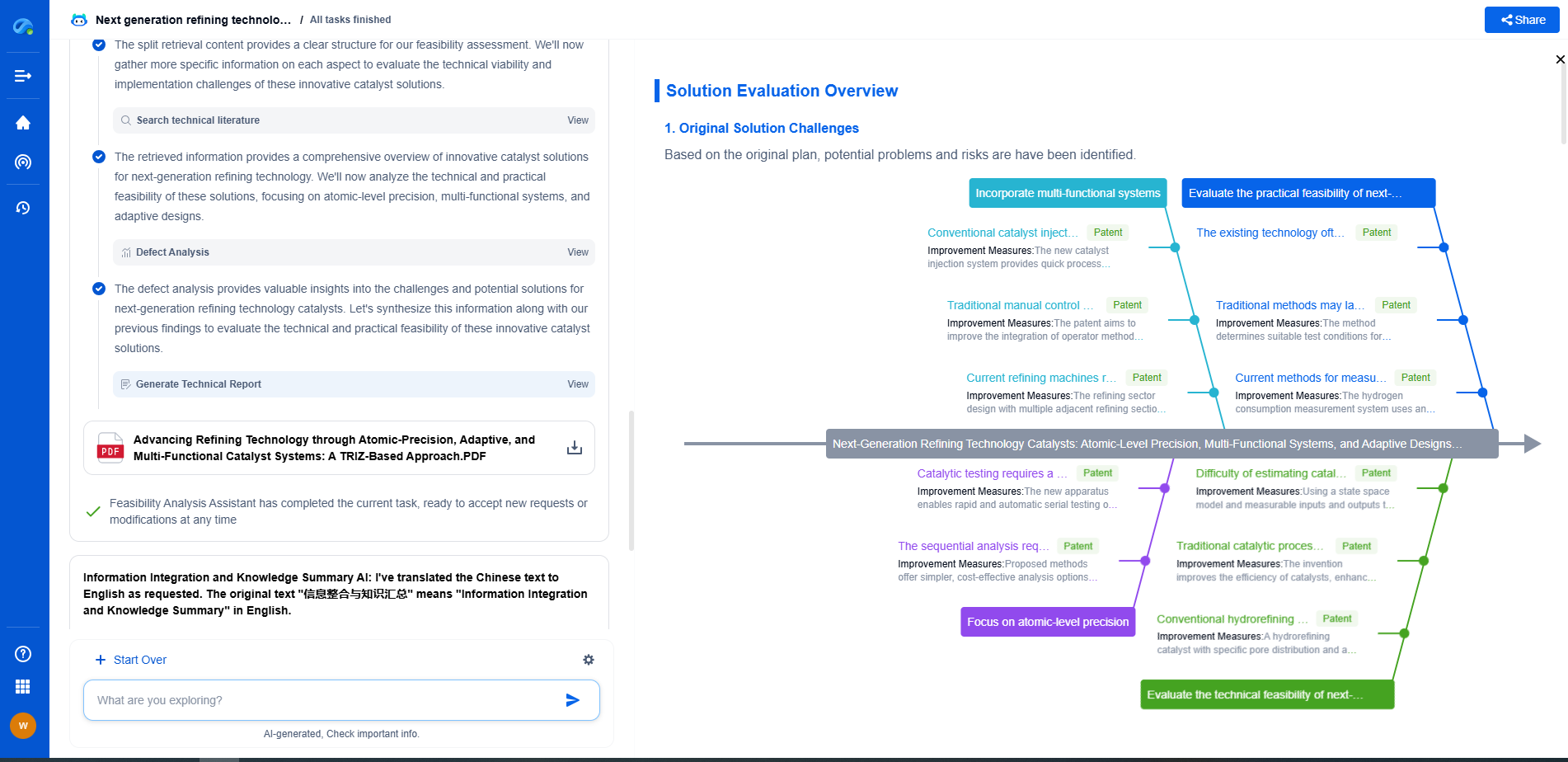
Patsnap Eureka, our intelligent AI assistant built for R&D professionals in high-tech sectors, empowers you with real-time expert-level analysis, technology roadmap exploration, and strategic mapping of core patents—all within a seamless, user-friendly interface.
Ready to accelerate your innovation process and make smarter, faster decisions? Discover Patsnap Eureka today and unlock the full power of confident, AI-driven innovation.

Features
- R&D
- Intellectual Property
- Life Sciences
- Materials
- Tech Scout
Why Patsnap Eureka
- Unparalleled Data Quality
- Higher Quality Content
- 60% Fewer Hallucinations
Social media
Patsnap Eureka Blog
Learn More Browse by: Latest US Patents, China's latest patents, Technical Efficacy Thesaurus, Application Domain, Technology Topic, Popular Technical Reports.
© 2025 PatSnap. All rights reserved.Legal|Privacy policy|Modern Slavery Act Transparency Statement|Sitemap|About US| Contact US: help@patsnap.com