Role of isomerization in gasoline blending strategies
JUN 19, 2025 |
In the complex world of fuel production, the quest for efficiency and environmental sustainability is relentless. Among the various strategies employed in refining processes, isomerization plays a pivotal role in enhancing gasoline quality. This process involves the structural rearrangement of hydrocarbons to improve octane ratings, which are crucial for engine performance and emissions control. Isomerization, therefore, is integral to modern gasoline blending strategies, ensuring that fuel is both energy-efficient and environmentally compliant.
Understanding Isomerization
Isomerization is a chemical process that transforms straight-chain hydrocarbons into their branched-chain isomers. These branched molecules provide higher octane ratings, which are essential for the smooth operation of modern engines. Octane ratings measure a fuel's ability to resist knocking — a common issue in combustion engines that can lead to inefficiency and damage.
The process primarily involves the conversion of normal paraffins, such as pentane and hexane, into isoparaffins like isopentane and isohexane. These isoparaffins are more stable and burn more evenly, reducing engine knock and improving overall performance.
The Role of Isomerization in Enhancing Octane Levels
One of the primary benefits of isomerization in gasoline blending is its ability to enhance octane levels without significantly increasing the aromatic content of the fuel. Aromatics, while also boosting octane ratings, can lead to higher emissions of pollutants. By focusing on isomerization, refineries can produce high-octane gasoline that is cleaner and meets regulatory standards for emissions.
Isomerization is particularly valuable in regions where environmental regulations are stringent. It allows refineries to produce fuel that complies with these regulations while maintaining performance standards. This balance is crucial as it aligns with global efforts to reduce vehicular emissions and promote sustainable energy solutions.
Technological Advancements in Isomerization
Advancements in catalytic technology have significantly improved the efficiency and effectiveness of the isomerization process. Modern catalysts enable more precise control over the isomerization reactions, leading to higher yields of desired isomers. These developments have made isomerization more cost-effective and scalable, allowing for its widespread adoption in refining operations.
Moreover, the integration of isomerization with other refining processes, such as catalytic reforming and alkylation, enhances the overall flexibility of gasoline production. This integration allows refineries to adjust their output to meet varying market demands and regulatory requirements efficiently.
Environmental and Economic Implications
The environmental benefits of isomerization are evident in its capacity to produce cleaner fuels with lower emissions profiles. By focusing on isomerization, refineries can reduce their reliance on additives that may have adverse environmental effects. This shift contributes to the reduction of greenhouse gas emissions and aligns with global environmental goals.
Economically, isomerization presents a cost-effective solution for refineries aiming to produce high-quality gasoline. The improved efficiency and yield of isomerization processes translate into lower production costs and higher profitability. As fuel standards continue to evolve, refineries that invest in isomerization technology are better positioned to adapt to market changes and regulatory pressures.
Future Prospects and Challenges
While isomerization offers numerous advantages, it is not without its challenges. The development of more advanced catalysts and the optimization of process conditions remain critical areas of research. Refineries must also address the logistical and operational challenges associated with the integration of isomerization into existing infrastructure.
Looking ahead, the role of isomerization in gasoline blending is likely to expand as the automotive industry transitions towards more fuel-efficient and environmentally friendly technologies. The continuing evolution of isomerization processes will be essential in meeting the dual demands of performance and sustainability.
Conclusion
Isomerization stands out as a crucial component of modern gasoline blending strategies, offering a pathway to cleaner, high-performance fuels. By focusing on the structural rearrangement of hydrocarbons to improve octane ratings, refineries can produce gasoline that meets both regulatory and consumer demands. As the energy sector continues to evolve, isomerization will undoubtedly play an increasingly important role in shaping the future of fuel production.
Discover Patsnap Eureka: AI Agents Built for Scientific Innovation
Whether you're designing the next generation of refining technologies or analyzing catalysts and process flows, keeping up with rapidly evolving research and IP data in petroleum processing is no easy task.
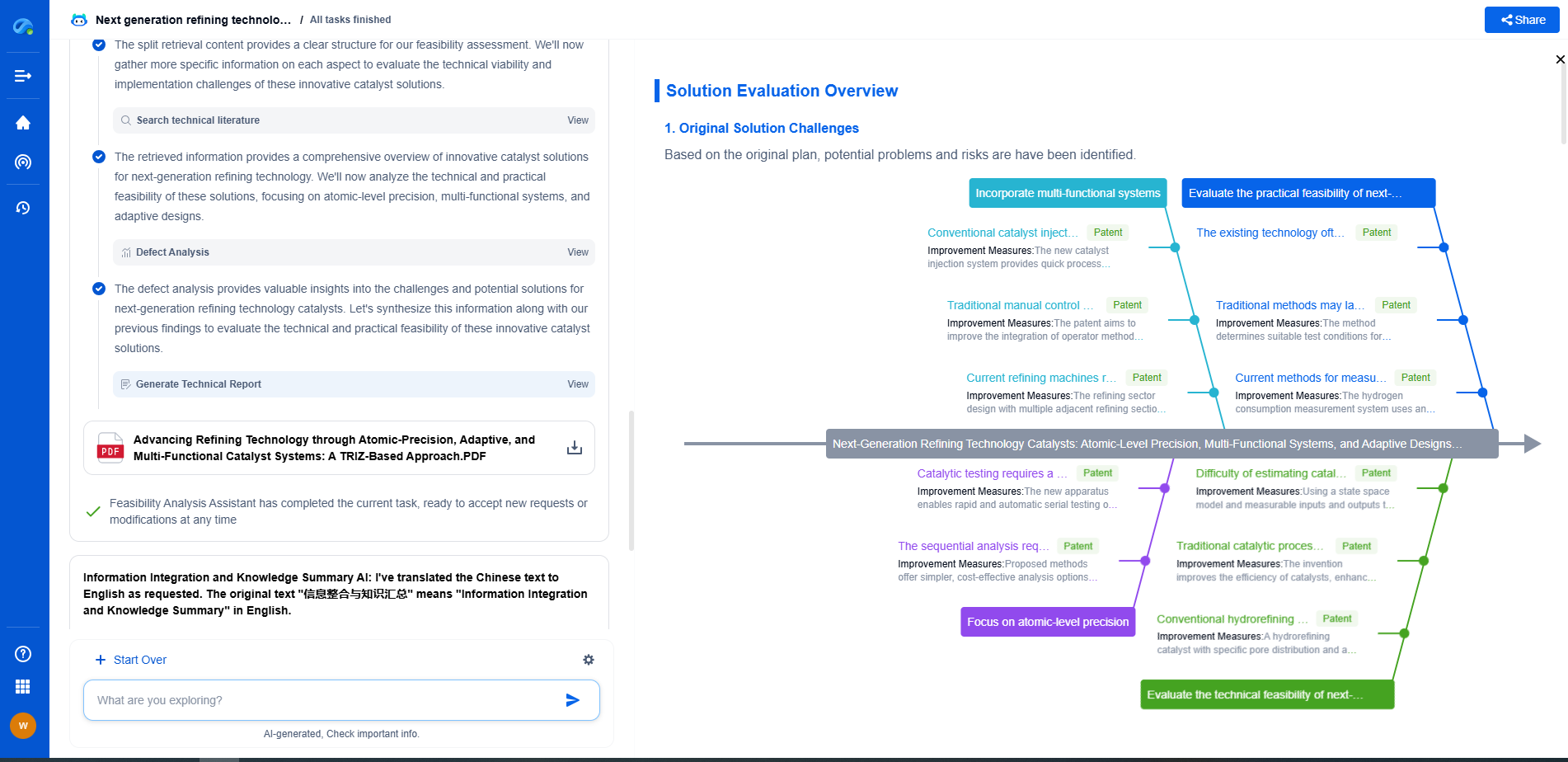
Patsnap Eureka, our intelligent AI assistant built for R&D professionals in high-tech sectors, empowers you with real-time expert-level analysis, technology roadmap exploration, and strategic mapping of core patents—all within a seamless, user-friendly interface.
Ready to accelerate your innovation process and make smarter, faster decisions? Discover Patsnap Eureka today and unlock the full power of confident, AI-driven innovation.

Features
- R&D
- Intellectual Property
- Life Sciences
- Materials
- Tech Scout
Why Patsnap Eureka
- Unparalleled Data Quality
- Higher Quality Content
- 60% Fewer Hallucinations
Social media
Patsnap Eureka Blog
Learn More Browse by: Latest US Patents, China's latest patents, Technical Efficacy Thesaurus, Application Domain, Technology Topic, Popular Technical Reports.
© 2025 PatSnap. All rights reserved.Legal|Privacy policy|Modern Slavery Act Transparency Statement|Sitemap|About US| Contact US: help@patsnap.com