


Batch processing allows organizations to efficiently handle large volumes of data in groups, rather than processing each data point individually. This method saves time and costs, making it ideal for tasks that don’t require immediate results. This article explores the concept, advantages, challenges, real-world applications, and recent advancements related to processing data in batches.
What is Batch Processing?
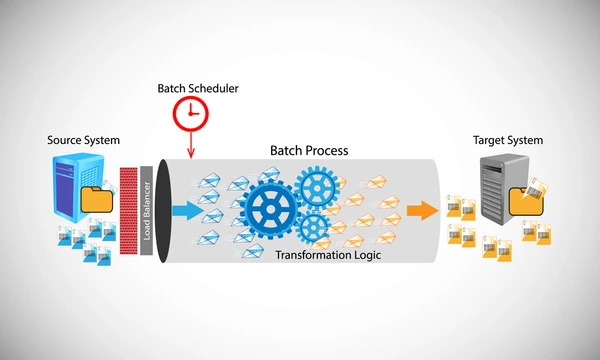
Batch operation involves grouping tasks or data into sets and processing them together at scheduled intervals. Unlike real-time systems, which operate immediately, batch systems run jobs in sequences. Businesses rely on this method for tasks that do not require instant results.
Benefits of Batch Processing
Batch operation offers several benefits, making it suitable for handling large-scale data efficiently.
1. Efficiency and Cost-Effectiveness
By processing data in bulk, businesses save time and optimize system resources. This method helps lower costs compared to handling each task individually.
2. Scalability
This approach adapts well to increasing data volumes. Whether dealing with thousands of transactions or large datasets, batch systems can scale accordingly to meet demands.
3. Error Handling and Recovery
Systems designed for Batch operation excel at managing errors. If an issue arises, they can pause, fix it, and resume processing, ensuring reliability without affecting other operations.
4. Improved Resource Allocation
Batch jobs often run during off-peak hours, making better use of system resources and preventing bottlenecks during peak times.
Challenges in Using Batch Systems
While Batch operation offers advantages, it also presents several challenges.
1. Latency Issues
Because batch jobs run at scheduled times, they introduce a delay between data input and processing, which may be problematic for time-sensitive tasks.
2. Complex Job Management
Managing multiple tasks in a batch can be complex, especially when dealing with hundreds or thousands of jobs. Efficient organization is essential for smooth execution.
3. Limited Flexibility
Once a batch job begins, users generally cannot interrupt or modify it. This lack of flexibility is a drawback compared to real-time processing.
4. High Setup Costs
Setting up and maintaining a Batch operation system often involves significant initial investment, especially for large, customized operations.
Real-World Applications of Batch Processing
Looking to explore the real-world applications of batch processing? Eureka Technical Q&A provides valuable insights on how batch processing optimizes workflows in industries like data analysis, manufacturing, and finance, helping you streamline operations and improve efficiency.

Batch operation is widely used across many industries for automating repetitive tasks and handling large data volumes.
1. Financial Services
Banks and financial institutions rely on this method to handle end-of-day tasks like transaction reconciliation, report generation, and account updates.
Example: Credit card companies often process transactions overnight, updating balances and generating statements for cardholders.
2. Payroll and Human Resources
In many organizations, payroll systems use batch processes to calculate employee pay, tax deductions, and other benefits at regular intervals.
Example: Large companies typically run payroll once a month, processing all employee data in a single job.
3. Data Warehousing and Analytics
Data aggregation for reporting and analysis also benefits from Batch operation, especially in the context of large data warehouses where speed is essential.
Example: Retailers use batch jobs to collect sales data across multiple stores, enabling comprehensive reporting on inventory levels and sales trends.
4. E-Commerce Operations
E-commerce platforms process customer orders and update inventory using batch operation to streamline operations and reduce delays.
Example: Online marketplaces use batch processing to update product listings and manage customer orders in bulk.
Application Cases
| Product/Project | Technical Outcomes | Application Scenarios |
|---|---|---|
| IBM Batch Job Predictor International Business Machines Corp. | Dynamically predicts and adjusts end times for batch jobs using aggregated predictive models and what-if analysis. | Resource optimization for large-scale batch processes like payroll and report generation. |
| Real-Time Batch Monitor Honeywell International Technologies Ltd. | Employs multi-scale signal processing and fuzzy classification for real-time quality assurance and performance classification. | Manufacturing processes in food, chemical, pharmaceutical, and composite industries. |
| VertiFlow Batch Reactor Applied Materials, Inc. | Improves gas flow and reduces contamination through downward-facing substrates and sloping support surfaces. | Semiconductor manufacturing, particularly for uniform gas delivery and particle contamination reduction. |
| IBM Data Integration Flow Enhancer International Business Machines Corp. | Enables parallel processing of data records and updating of accumulation objects, improving performance within memory constraints. | Large-scale data integration processes in enterprise environments. |
Comparing Batch and Real-Time Processing
The key difference between batch and real-time processing lies in how data is handled.
| Aspect | Batch Processing | Real-Time Processing |
|---|---|---|
| Processing Time | Processes data in groups at set times | Handles data immediately as it arrives |
| Latency | Introduces delays between input and output | Provides near-instant processing |
| Resource Usage | Uses resources more efficiently during off-peak hours | Requires continuous resource allocation |
| Best For | Large-scale, non-urgent tasks | Immediate, time-sensitive applications |
Recent Developments in Batch Processing
Advancements in technology continue to enhance batch operation.
1. Cloud-Based Solutions
Cloud platforms like AWS and Google Cloud now provide scalable batch operation services, allowing businesses to optimize resources and reduce infrastructure costs.
2. Big Data Technologies
With the rise of tools like Hadoop and Apache Spark, businesses can handle even larger datasets more efficiently. These technologies allow for distributed batch operation, improving scalability and speed.
3. Automation Tools
Modern scheduling tools like Apache Airflow and IBM Workload Scheduler help automate and monitor batch jobs, ensuring seamless execution.
Conclusion
Batch processing remains essential for industries that need to process large volumes of data. While it offers benefits such as efficiency and scalability, it also presents challenges like latency and complexity. With the help of cloud services, big data tools, and automation, businesses can enhance the performance and reliability of their batch operation systems.
FAQs
1. Is batch processing suitable for real-time applications?
Generally, batch processing is not ideal for time-sensitive tasks due to the inherent delays. However, some systems combine both batch and real-time methods to handle different needs.
2. What differentiates batch processing from stream processing?
Batch processing handles data in bulk at set times, while stream processing processes data continuously as it arrives.
3. What are some common challenges in batch processing?
Latency, complex job management, and limited flexibility are common challenges associated with batch systems.
4. How can businesses improve their batch processing efficiency?
Adopting cloud services, leveraging big data technologies, and using automated scheduling tools can significantly enhance the efficiency of batch jobs.
To get detailed scientific explanations of Batch Processing, try Patsnap Eureka.
