


What Is Ring Topology?
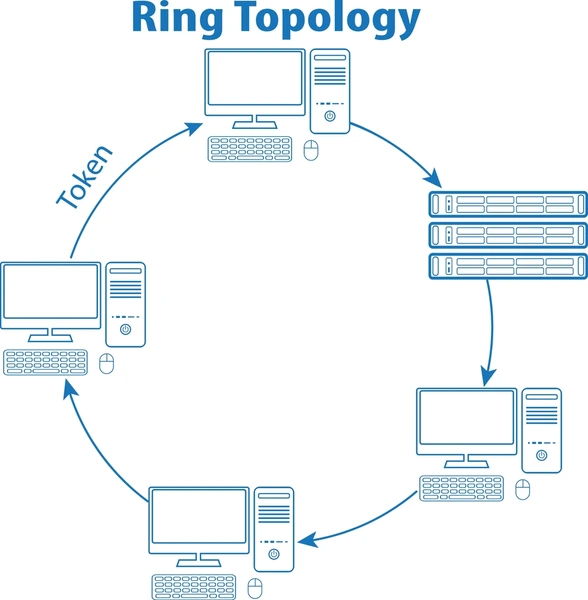
A ring topology is a network configuration where nodes are connected in a circular fashion, with each node having two and only two ports belonging to the ring. In a ring topology, data travels from node to node in a single continuous pathway, with each node handling and potentially forwarding the packets.
How Ring Topology Works
Ring networks employ loop avoidance techniques to prevent packets from circulating indefinitely. One common approach is to designate a ring protection link that remains blocked under normal conditions, but is reactivated when another link fails. This ensures that at any time, traffic flows on all but one link in the ring.
Data transmission in ring networks follows a ring protocol, which continuously monitors the state of the ring and controls node ports to detect failures and promptly change the communication route. Multicast communication, where one source node sends the same message to multiple destinations, is essential in many parallel applications.
Key Features of Ring Topology
- Circular arrangement: Nodes are arranged in a closed loop, with each node connected to two neighboring nodes.
- Dual ports: Each node has two dedicated ports, one for receiving data and one for transmitting data to the next node in the ring.
- Unidirectional data flow: Data packets travel in a single direction around the ring, either clockwise or counterclockwise.
- Loop avoidance: Mechanisms are implemented to prevent data from circulating indefinitely, such as using a ring protection link that is blocked under normal conditions.
Advantages of Ring Topology
- Reduced Cabling Cost: Ring topology networks require fewer cables compared to other topologies, such as mesh, as each node is only connected to two adjacent nodes. This results in lower installation and maintenance costs.
- Efficient Data Transmission: Data packets are transmitted in a single direction, eliminating the need for complex routing algorithms and reducing the risk of data collisions. This ensures efficient data transmission and minimizes network congestion.
- Fault Tolerance: Ring networks offer fault tolerance as there are two possible paths for data transmission between any two nodes. If one path fails, data can be rerouted through the alternative path, ensuring network continuity.
- Easy Scalability: Adding or removing nodes in a ring topology is relatively straightforward, as the new node only needs to be connected to the adjacent nodes in the ring. This allows for easy network expansion or contraction.
Disadvantages of Ring Topology
- Single Point of Failure: If a single node or cable fails, the entire network can be disrupted, as data cannot be transmitted through the ring. This can lead to network downtime and potential data loss.
- Performance Degradation: As the number of nodes in the ring increases, the overall network performance can degrade due to the sequential nature of data transmission. Each node must process and forward the data, introducing latency and potential bottlenecks.
- Difficult Troubleshooting: Identifying and isolating faults in a ring topology can be challenging, as the problem could be located anywhere along the ring. This can make troubleshooting and maintenance more complex.
- Limited Topology Flexibility: Ring topologies are inherently inflexible, as the network structure is fixed in a closed loop. This can limit the ability to adapt to changing network requirements or incorporate new technologies.
How to Set Up a Ring Topology
Constructing a Ring Topology
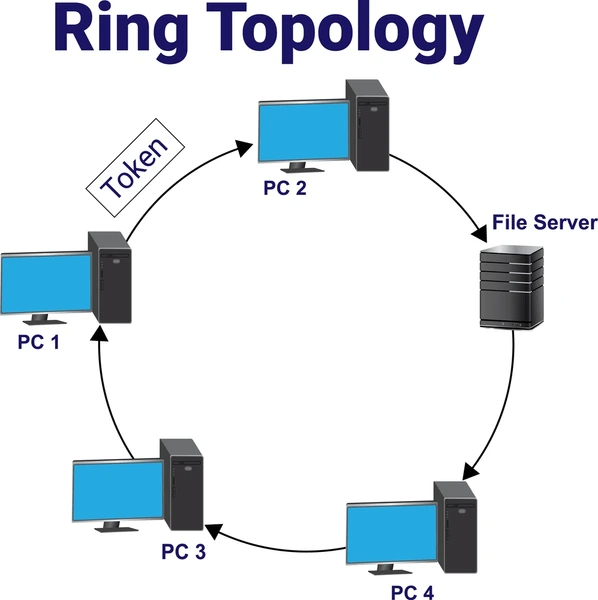
To construct a ring topology, each node needs to be assigned a unique ID. One node initiates the ring map construction by sending a ring topology frame with its own ID as the first entry. This frame circulates through the ring, with each subsequent node appending its ID. When the initiating node receives the frame with its ID as the first entry again, it inserts an END flag, completing the ring topology.
Handling Traffic Loops
Ring topologies are prone to Layer 2 traffic looping issues, where data frames can circulate indefinitely, overwhelming the network. To prevent loops, techniques like the Spanning Tree Protocol (STP) or Ring Protection Switching are employed, which block redundant paths while allowing failover mechanisms.
Interconnecting Rings
Multiple rings can be interconnected using shared bridges/nodes 367. Shared links assume the priority of the higher-priority ring, while ports connected to lower-priority rings are treated as customer ports. Interconnecting rings allows network growth but also introduces potential failure points.
Applications of Ring Topology
- Industrial Automation: Ring networks are widely used in industrial environments for motion control, modular multilevel converters, and power train or chassis control systems, where high-speed communication with low latency is crucial.
- Metropolitan Area Networks (MANs): Fiber-optic ring networks are commonly employed in MANs to interconnect local area networks (LANs) within a city or metropolitan area, providing high-bandwidth and reliable communication.
- Resilient Packet Ring (RPR): RPR is a standard for implementing ring topologies in metropolitan area networks, offering features like spatial reuse, fairness, and protection switching for enhanced performance and reliability.
- Distributed Control Systems: Ring topologies are utilized in distributed control systems, such as those found in power plants, chemical processing facilities, and manufacturing environments, where real-time data exchange and fault tolerance are critical.
Latest Technical Innovations in Ring Topology
Reconfigurable Ring Topologies
Dynamically reconfigurable ring topologies have been developed to optimize performance and reduce power consumption. In runtime, ring topologies are configured based on cycle decompositions of the network to minimize static power and packet latency for specific workloads. This enables adapting the ring topology to varying traffic patterns and application demands.
Neuromorphic Ring Network-on-Chip (NoC)
Ring topologies have been leveraged to build neuromorphic NoC architectures for energy-efficient computing. A ring-based NoC demonstrated 18% improved performance compared to mesh topologies when evaluated with spike-based datasets. Ring NoCs offer low-latency communication between nodes, making them suitable for neuromorphic computing devices.
Optical Ring Networks
Optical ring networks using technologies like SONET/SDH and WDM/DWDM have advanced to support high-speed data transport over fiber rings. These networks leverage the fast protection and restoration capabilities of ring topologies, enabling rapid recovery from failures.
Topology Control in Ring Networks
Techniques have been developed for centralized control of topology changes in ring networks. A central entity can determine affected data transfers, compute new paths, and update switching instructions for affected nodes when the ring topology changes. This enables dynamic adaptation and efficient resource utilization.
Ring Network Design for C-RAN
Novel design algorithms have been proposed for constructing ring-based access networks to support Centralized Radio Access Network (C-RAN) architectures. These algorithms optimize ring network design by minimizing cable length while adhering to practical constraints, reducing deployment costs.
Hierarchical Ring Architectures
Hierarchical ring-based network architectures (Hi-Ring) have been developed for data centers and short-range applications. These architectures leverage optical switching technologies while maintaining high connection granularity and enabling global synchronization of nodes in a ring topology.
Scalability and Router Microarchitecture
Research has focused on improving the scalability and router microarchitecture for on-chip ring networks. Lightweight router designs with minimal buffering have been proposed to approach ideal latency while simplifying switch allocation. However, bandwidth fragmentation for short packets can limit the scalability of wide ring channels.
FAQs
- What is the main benefit of ring topology?
It ensures equal access to the network for all devices and minimizes collisions through sequential data flow. - How does token passing prevent data collisions?
The token-passing protocol allows only one device to transmit data at a time, eliminating collisions. - Can a ring topology be fault-tolerant?
Yes, with the addition of redundancy, such as a dual-ring setup, the network can continue operating if one path fails. - What types of networks use ring topology?
Common in LANs, WANs, and legacy networks like IBM Token Ring and FDDI-based systems. - Is ring topology outdated in modern networking?
While less common in modern LANs, it is still relevant for specialized applications requiring predictable data flow.
To get detailed scientific explanations of ring topology, try Patsnap Eureka.
