


If you’ve been shopping for a smartphone, tablet, or high-end TV, you’ve probably come across the terms OLED vs. AMOLED. These display technologies offer stunning visuals with rich contrast, deep blacks, and vivid colors—but what sets them apart? This article explains the difference between OLED and AMOLED, covering their structure, performance, power efficiency, and applications so you can make an informed choice for your next screen.
OLED vs. AMOLED – What’s the real difference? Eureka Technical Q&A explains how both use self-emissive pixels, but AMOLED adds active matrix tech for faster response and better control—helping you choose the right display for clarity, speed, and performance.

What Is OLED?
OLED (Organic Light-Emitting Diode) is a display technology where each pixel emits its own light. Unlike LCDs, which require a backlight, OLED panels are self-emissive, allowing for thinner designs and deeper blacks.
Each pixel consists of organic materials that glow when electricity passes through them. Because the pixels can turn on and off individually, OLED displays offer infinite contrast ratios, excellent viewing angles, and high color accuracy.
Key Features of OLED:
- No need for a backlight
- Perfect black levels
- Ultra-thin panels
- High contrast and color accuracy
- Widely used in TVs, smartphones, and smartwatches

What Is AMOLED?
AMOLED (Active Matrix Organic Light-Emitting Diode) is a type of OLED display that includes an active matrix backplane. This active matrix uses thin-film transistors (TFTs) to control each individual pixel more efficiently and quickly.
The key improvement AMOLED brings is better refresh rate, responsiveness, and power efficiency, especially for larger and more dynamic displays.
Key Features of AMOLED:
- Uses an active matrix (TFT array)
- Faster pixel response
- Better suited for high-refresh-rate displays
- More power-efficient with darker content
- Common in premium smartphones and wearables
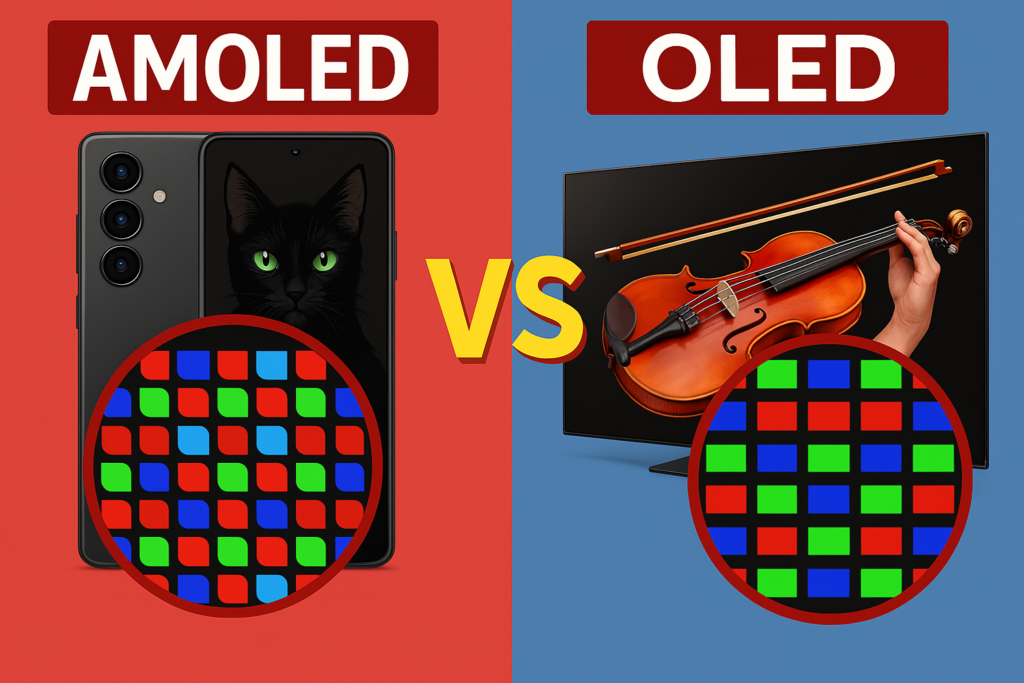
OLED vs. AMOLED: Side-by-Side Comparison
- Control Mechanism:
- OLED: Pixels are controlled by a simple matrix, which can lead to issues with uniformity and brightness.
- AMOLED: Each pixel is controlled by a TFT, allowing for better brightness and color management, resulting in improved uniformity and higher resolution.
- Power Efficiency:
- OLED: Can be less efficient due to the need for a constant current to all pixels.
- AMOLED: More efficient as only lit pixels consume power, leading to lower overall energy usage.
- Durability:
- OLED: Generally has a shorter lifespan due to higher power usage and heat generation.
- AMOLED: Longer lifespan due to lower power consumption and better thermal management.
- Applications:
- OLED: Suitable for smaller displays where thickness and weight are critical.
- AMOLED: Ideal for larger displays where high resolution and efficiency are important.
| Feature | OLED | AMOLED |
|---|---|---|
| Technology Type | Basic organic LED | OLED with active matrix control |
| Pixel Control | Passive matrix or simple control | Active matrix with TFT for each pixel |
| Refresh Rate | Moderate | Higher, better for animations/gaming |
| Color & Contrast | Excellent | Excellent (sometimes enhanced saturation) |
| Power Efficiency | Moderate | Better (especially with dark themes) |
| Flexibility | Limited | Often used in flexible/foldable displays |
| Typical Use Cases | TVs, monitors, small screens | Smartphones, wearables, foldable screens |
Performance Differences
Brightness and Contrast
Both technologies offer deep blacks and strong contrast, but AMOLED can sometimes appear more vivid due to software enhancements or calibration.
Motion Handling
AMOLED tends to handle motion better with faster refresh rates and response times, making it ideal for gaming and smooth scrolling in mobile devices.
Battery Life
Because AMOLED can turn off individual pixels, it often consumes less power than traditional OLED when displaying dark content. This makes it more efficient for mobile devices with always-on displays.
Applications and Use Cases
- OLED is frequently used in large-screen TVs from brands like LG and Sony, where ultra-high contrast and cinematic picture quality are priorities.
- AMOLED dominates the smartphone market, especially in Samsung Galaxy, OnePlus, and Google Pixel phones, thanks to its high refresh rates, touch sensitivity, and flexibility for curved or foldable screens.
Application Cases
| Product/Project | Technical Outcomes | Application Scenarios |
|---|---|---|
| AMOLED Display Panel TCL China Star Optoelectronics Technology Co., Ltd. | Light-absorbing layer covers metal layers of bottom-gate TFT, preventing ambient light irradiation and maintaining brightness | High-performance displays requiring extended panel lifetime and consistent brightness |
| AMOLED Display Module Wuhan China Star Optoelectronics Semicon Display Tech Co. | Uniformly arranged second conductive layer ensures consistent voltage and luminance across the panel | Large-scale displays requiring uniform brightness and improved overall performance |
| AMOLED Array Substrate BOE Technology Group Co., Ltd. | Filling layer prevents organic light-emitting layer from entering recess parts, improving display quality | High-resolution displays requiring precise pixel structure and enhanced image quality |
| Dual-Sided AMOLED Display Innolux Corp. | Controlled light emission in opposite directions for uniform brightness and efficient dual-sided light emission | Devices requiring displays visible from both sides, such as foldable smartphones or public information displays |
| Dual-Type OLED Display Samsung Display Co., Ltd. | Separate pixel electrodes for top and bottom emission types, addressing resistance issues and maintaining performance | High-end displays requiring both top and bottom emission capabilities, such as advanced smartphones or automotive displays |
FAQ
AMOLED is technically a more advanced form of OLED, offering better refresh rates and pixel control. However, both provide excellent image quality.
Yes, like all OLED-based screens, AMOLED can suffer from burn-in over time, especially with static images. Modern devices use software tricks to minimize this effect.
AMOLED displays are thinner, more responsive, and more energy-efficient than basic OLED, making them ideal for mobile devices.
AMOLED panels are often used in foldable devices due to their added flexibility, though they are still based on OLED technology.
OLED TVs typically offer better contrast, black levels, and viewing angles than LED TVs, but may be more expensive and susceptible to burn-in.
Conclusion
While both OLED and AMOLED deliver outstanding display quality, their differences lie in how pixels are controlled and how each performs under specific use cases. OLED is ideal for large displays where contrast and visual fidelity are key, while AMOLED is optimized for mobile devices that demand speed, flexibility, and power efficiency.
Choosing between the two depends on your device type and display needs—but either way, you’re getting one of the best visual experiences available today.
To get detailed scientific explanations of OLED vs. AMOLED, try Patsnap Eureka.
