


Introduction: What Are T568A and T568B?
T568A vs T568B are Ethernet wiring standards that define how the eight wires in a cable are arranged within an RJ45 connector. While the performance is identical, the difference lies in their color-coding schemes, with T568A commonly used in residential settings and T568B preferred in commercial environments.
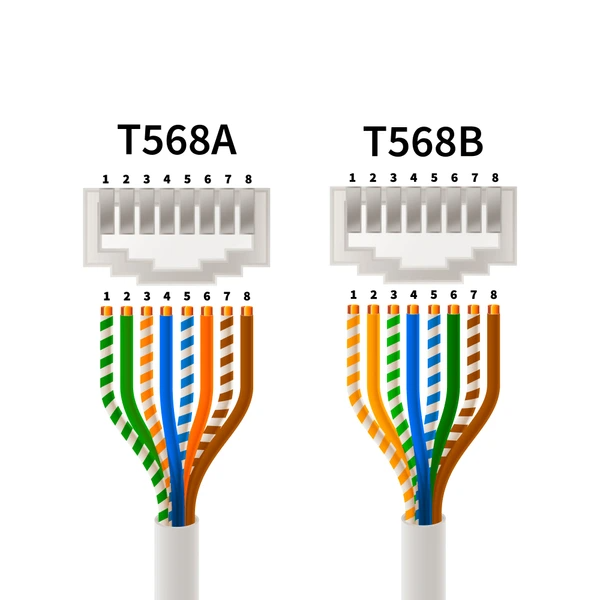
How T568A and T568B Work
Wiring Sequence and Color Codes
T568A and T568B standards define the arrangement of eight wires in an Ethernet cable within the RJ45 connector. The key difference lies in the placement of the green and orange wire pairs:
- T568A Wiring Order:
- Prioritizes the green wire pair as pins 1 and 2, followed by the orange pair.
- T568B Wiring Order:
- Places the orange wire pair as pins 1 and 2, swapping positions with the green pair.
Both standards maintain the same pin-to-pin configuration, ensuring compatibility in straight-through and crossover connections.
Purpose and Role in Ethernet Connections
The primary role of T568A and T568B is to ensure that signals are transmitted and received correctly. Ethernet communication relies on paired wires for signal transmission, specifically pairs 1-2 and pairs 3-6.
- Signal Matching:
- By adhering to a consistent wiring order, both ends of the cable match signal pairs correctly for smooth data flow.
- Whether using T568A or T568B, proper alignment avoids data loss or interference.
- Crosstalk Reduction:
- Twisted pairs within the cable minimize electromagnetic interference (EMI). The standards ensure the twisted pairs remain aligned with their designated pins, further reducing crosstalk and enhancing performance.
Key Differences Between T568A and T568B
Wire Pair Assignments and Color Coding
The primary distinction between T568A and T568B lies in the order of wire pair assignments and their corresponding color codes. T568A follows the sequence: white-green, green, white-orange, blue, white-blue, orange, white-brown, brown. In contrast, T568B adheres to the order: white-orange, orange, white-green, blue, white-blue, green, white-brown, brown.
Application and Compatibility
T568A is primarily used for crossover cables, facilitating direct connections between two computers or between a computer and a modem or hub. Conversely, T568B is employed for straight-through cables, enabling connections between computers and switches or hubs. Additionally, T568B exhibits backward compatibility, while T568A does not.
Cable Types and Configurations
Straight-through cables typically have the same wiring standard (T568A or T568B) on both ends. Crossover cables, on the other hand, feature T568A on one end and T568B on the other, effectively swapping the transmit and receive pairs. 1 This configuration allows for direct device-to-device connections without the need for a hub or switch.
Gigabit Ethernet Compatibility
Both T568A and T568B are compatible with Gigabit Ethernet systems, which require all eight wires of a Category 5 (CAT5) cable. However, for 100 Mbps Ethernet, only four wire pairs are utilized, and improved drivers eliminate the need for grounding the remaining four wires.
Automatic Cable Detection and Adaptation
Some advanced Ethernet systems can automatically detect the cable wiring standard and adapt accordingly, attempting communication over an initial subset of wires. If communication fails, the system selects a subsequent subset of wires, potentially switching between T568A and T568B configurations to establish a successful connection.
When to Use T568A vs T568B
T568A is typically used for direct connections between two devices, such as computer-to-computer or ADSL modem-to-hub connections. It is suitable for short-distance applications where backward compatibility is not a concern.
T568B is the preferred standard for connecting a computer or device to a network switch, hub, or router. It offers better crosstalk performance and is backward compatible with older Ethernet standards, making it more versatile for modern networking environments.
Both standards can be used for Gigabit Ethernet and faster Ethernet speeds, but T568B is generally recommended due to its compatibility and better crosstalk mitigation through twisted pair arrangements. The choice ultimately depends on the specific application and compatibility requirements.
Conclusion: Choosing Between T568A and T568B
T568A vs T568B comes down to your project’s needs. For residential or government installations, T568A is ideal. For commercial environments with existing legacy wiring, T568B is the better choice. Ensure consistency in wiring to maintain compatibility and reliable network performance.
FAQs
- What is the main difference between T568A and T568B?
The difference lies in the color coding of the green and orange wire pairs, which are swapped between the two standards. - Can I use T568A and T568B interchangeably?
Yes, but ensure both ends of the cable follow the same standard unless creating a crossover cable. - Which standard is better for home networks?
T568A is generally recommended for home networks due to its compatibility with older wiring standards. - Do T568A and T568B affect Ethernet performance?
No, the performance is the same as long as the wiring is consistent on both ends of the cable. - Why are there two standards for Ethernet wiring?
Two standards exist to accommodate different legacy wiring systems and regional preferences.
To get detailed scientific explanations of t568a vs t568b, try Patsnap Eureka.

Learn more
Multiplexor: Efficient Data Selector for Electronics
Understanding STP Cable: Shielded Twisted Pair Explained
Understanding Twisted Pair Cable: Basics, Benefits, and Uses
JFET 101: A Beginner’s Guide to Junction Field-Effect Transistors
HDMI vs. DisplayPort: Which is Best for Your Monitor?