


Introduction: ULED vs QLED
When comparing ULED vs QLED, both technologies promise stunning picture quality, vibrant colors, and advanced features. ULED, exclusive to Hisense, focuses on affordability and innovation, while QLED, led by Samsung, emphasizes brightness and premium performance. Let’s explore the differences to help you choose the perfect TV for your needs.
ULED vs. QLED – What’s the difference? Eureka Technical Q&A compares their display technologies, color accuracy, and brightness levels, helping you choose the best TV for your viewing experience.

What Is ULED?
ULED is not a widely recognized term in the display technology industry. It is possible that it might be a misspelling or a proprietary term used by a specific manufacturer. However, based on the context, it could be related to QLED technology or another advanced LED-based display technology.
What Is QLED?
QLED is a type of display technology that uses quantum dots as the light-emitting layer. Quantum dots are tiny crystals with sizes measured in nanometers, typically made from semiconductor materials like cadmium selenide (CdSe) or zinc sulfide (ZnS). When an electric current passes through the quantum dots, they emit light at specific wavelengths, which can be tuned by adjusting the size and composition of the quantum dots.
ULED vs QLED vs OLED: Key Differences
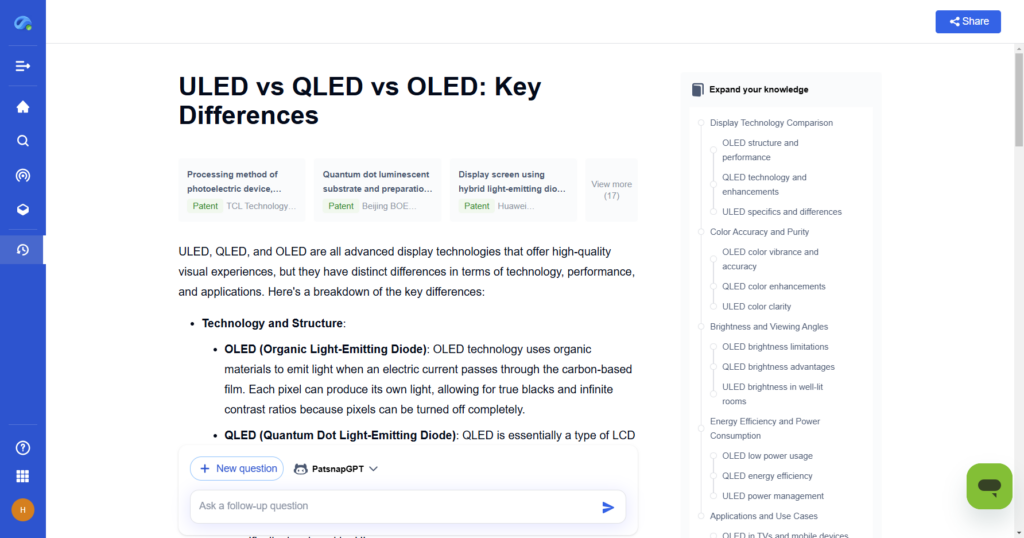
ULED vs. QLED vs. OLED – What are the key differences? Eureka Technical Q&A breaks down their display technologies, contrast levels, and color performance, helping you choose the best option for your viewing needs.
- Emission Layer: OLED uses organic materials, while QLED uses quantum dots.
- Color Accuracy and Purity: QLED generally offers higher color purity and a wider color gamut compared to OLED.
- Stability: QLED has better stability and longer lifespan due to the use of inorganic quantum dots.
- Power Efficiency: Both OLED and QLED are energy-efficient, but QLED might have a slight edge in this regard due to its better material stability.
- Manufacturing Process: QLEDs can be more cost-effective to produce on a large scale compared to OLEDs, thanks to the solution-processing capabilities of quantum dots.
Picture Quality Comparison
Brightness and Color Accuracy
- ULED: Offers high brightness levels and good color accuracy due to its advanced backlighting system. However, it may not match the color gamut and saturation of QLEDs.
- QLED: Provides superior color accuracy and a wider color gamut thanks to the quantum dots, which can display a broader range of colors with higher purity.
Contrast and Black Levels
- ULED: Can achieve good contrast ratios with its multi-zone backlighting, but it might not surpass the black levels that QLEDs can achieve.
- QLED: Typically offers better contrast and deeper blacks due to the precise control over light emission by quantum dots.
Viewing Angles
- Both technologies generally offer good viewing angles, but QLEDs might have a slight edge due to the consistent performance of quantum dots.
Color Reproduction
- ULED: Good color reproduction, but may not reach the same level as QLEDs in terms of color saturation and gamut.
- QLED: Superior color reproduction with the ability to achieve higher color purity and a wider range of colors.
Gaming and Motion Performance
Response Time
- Both ULED and QLED displays typically offer fast response times, which are crucial for smooth motion in gaming. However, QLEDs might have a slight advantage due to the inherent properties of quantum dots.
Input Lag
- Both technologies aim to minimize input lag, but QLEDs might have a slight edge due to the efficient electron transport properties of quantum dots.
Motion Blur
- Both ULED and QLED displays can reduce motion blur effectively, but QLEDs might perform better due to their fast response times and efficient light emission.
HDR Support
- Both technologies support HDR (High Dynamic Range) content, but QLEDs might offer better performance in displaying HDR content due to their superior color accuracy and contrast.
Price and Value
- Cost: ULEDs are often priced lower than QLEDs, making them a more affordable option for consumers looking for high-quality displays without the premium price tag.
- Performance: QLEDs offer superior performance in terms of color accuracy, brightness, and energy efficiency, which can be particularly valuable for applications requiring high-end display quality, such as professional graphics work or home theaters.
- Value: For gamers and users who prioritize motion performance and fast response times, QLEDs might offer better value despite their higher cost. However, ULEDs can still provide excellent gaming and motion performance at a lower price point, making them a good value for budget-conscious consumers.
Which Should You Choose?
When choosing between ULED and QLED, it largely depends on your budget, viewing environment, and specific needs. QLEDs offer superior picture quality, especially in terms of color accuracy and brightness, making them ideal for those who want the best possible display. ULEDs, on the other hand, provide a good balance of price and performance, making them a more affordable option for those who still want a high-quality viewing experience.
FAQs
- What’s the main difference between ULED and QLED?
ULED is a Hisense-specific technology combining multiple innovations, while QLED is a quantum dot technology led by Samsung, focusing on brightness and color. - Are ULED TVs as good as QLED TVs?
ULED TVs offer comparable features at a lower price point but may lack the brightness and brand-specific optimizations of QLED TVs. - Do both ULED and QLED use quantum dot technology?
Yes, both use quantum dots for enhanced color accuracy, but their implementations and supporting features differ. - Which is better for gaming: ULED or QLED?
Both are excellent for gaming, but QLED may have an edge with features like FreeSync and higher peak brightness for HDR gaming. - Are ULED TVs cheaper than QLED TVs?
Generally, ULED TVs are more budget-friendly, while QLED TVs are positioned as premium products.
To get detailed scientific explanations of uled vs. qled, try Patsnap Eureka.

Learn more
Multiplexor: Efficient Data Selector for Electronics
Understanding STP Cable: Shielded Twisted Pair Explained
Understanding Twisted Pair Cable: Basics, Benefits, and Uses
JFET 101: A Beginner’s Guide to Junction Field-Effect Transistors
HDMI vs. DisplayPort: Which is Best for Your Monitor?