


What Is IGMP?
IGMP (Internet Group Management Protocol) manages IP multicast group memberships. It allows hosts to join or leave multicast groups, helping routers determine which multicast traffic to forward to specific parts of the network. This ensures efficient network operation by avoiding unnecessary bandwidth usage. Multicast traffic is only sent to hosts that are interested in receiving it.
How IGMP Works?
- Host Membership Reports
When a host wants to receive a multicast stream, it sends an unsolicited membership report to the local router. The report notifies the router of the host’s interest in joining a particular multicast group. Alternatively, the host can send a report in response to a router’s query message. - Router Queries
Routers periodically send query messages to the all-hosts group address. These queries help routers determine the current multicast group memberships on the network. If no response is received within a set time frame, the router assumes no host is interested in the multicast group and stops forwarding its packets. - Leave Group Reports
IGMPv2 introduced leave group reports, which help routers quickly learn when a host is no longer interested in a multicast group. This feature enables routers to efficiently prune the multicast tree and save bandwidth.
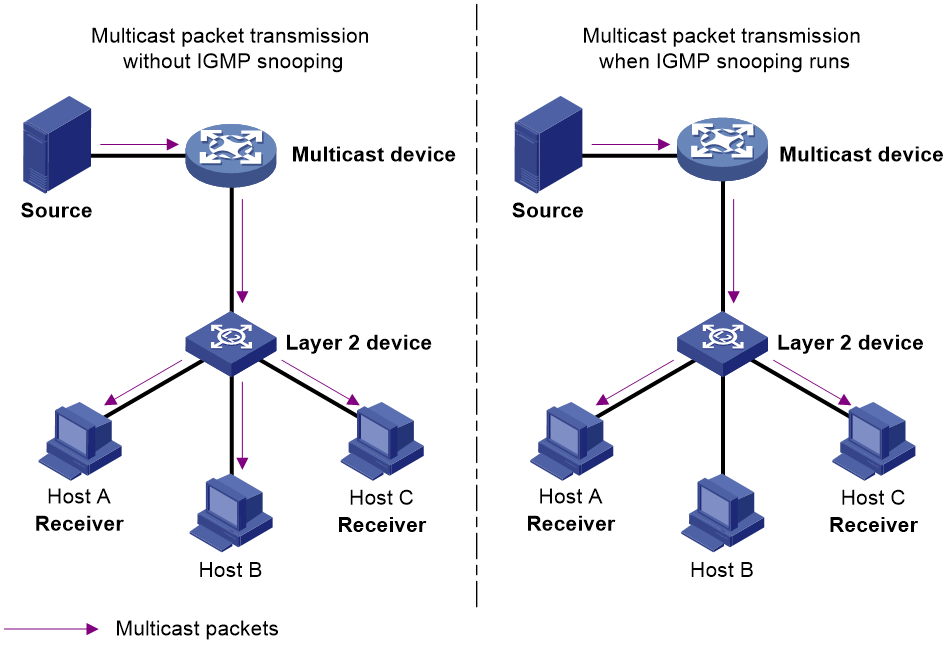
IGMP Versions: IGMPv1, IGMPv2, and IGMPv3
IGMPv1
Introduction: IGMPv1, defined in RFC 1112, is the original version of the protocol. It provides basic mechanisms for querying and reporting multicast group memberships.
Key Features:
- Query and Report Messages: IGMPv1 uses two main messages: Membership Query (sent by routers to discover group members) and Membership Report (sent by hosts to inform routers of their group memberships).
- No Leave Mechanism: There is no way for hosts to notify routers when they leave a multicast group. Routers detect member departures by the absence of report messages.
- Limitations: The lack of a leave mechanism can lead to unnecessary bandwidth usage and inefficient network resource management.
IGMPv2
Introduction: IGMPv2, defined in RFC 2236, addresses IGMPv1’s limitations by adding a leave group mechanism and enhancing the query process.
Key Features:
- Leave Group Message: IGMPv2 introduces the Leave Group message, allowing hosts to notify routers when leaving a multicast group. This helps routers update group memberships quickly and saves bandwidth.
- Querier Election: IGMPv2 includes a querier election mechanism, ensuring that only one router sends queries on a subnet, reducing redundant queries and improving network efficiency.
- Suppressing Reports: IGMPv2 can suppress duplicate reports from multiple hosts on the same subnet, further conserving network resources.
- Enhancements: These improvements make IGMPv2 more efficient and effective in managing multicast group memberships compared to IGMPv1.
IGMPv3
Introduction: IGMPv3, defined in RFC 3376, introduces source filtering, allowing hosts to specify which multicast sources they want to receive traffic from.
Key Features:
- Source Filtering: IGMPv3 supports two filter modes: INCLUDE and EXCLUDE. INCLUDE mode allows hosts to receive traffic from specific sources, while EXCLUDE mode blocks traffic from specified sources.
- Improved Report Messages: IGMPv3 report messages can include multiple group records, offering more granular control over multicast traffic.
- Backward Compatibility: IGMPv3 is backward compatible with IGMPv1 and IGMPv2, allowing routers to support clients running any of the three versions.
- Advantages: Source filtering improves security and network management by enabling hosts to block unwanted or malicious traffic, boosting multicast network efficiency and security.

Role of IGMP in Multicast Communication
Group Membership Management
The protocol helps IP hosts and neighboring multicast routers manage group memberships. When a host wants to join a multicast group, it reports its membership to nearby routers. This ensures multicast traffic is only sent to active members.
Query and Report Mechanism
The system operates on a query-report mechanism. Routers periodically send query messages to identify which groups have active members. In return, hosts send report messages to confirm their participation.
Multicast Communication Efficiency
By managing group memberships, the protocol optimizes multicast communication. Routers forward multicast traffic only to networks with active members, reducing bandwidth usage and improving network efficiency.
Key Applications of IGMP in Networking
Multicast Group Management
This protocol manages multicast group memberships between IP hosts and adjacent multicast routers. It allows hosts to report group memberships, ensuring efficient multicast traffic delivery.
Efficient Bandwidth Utilization
By managing memberships, it reduces unnecessary bandwidth usage. For example, in a network where multiple users watch the same video stream, traffic is sent only to relevant users, saving bandwidth.
Network Traffic Optimization
The protocol works with other protocols like PIM (Protocol Independent Multicast) to optimize network traffic. It helps routers decide whether to forward multicast packets to specific network segments.
Support for Multicast Applications
It is essential for applications like IPTV, online education, and IP conferencing. These applications efficiently deliver content to many recipients without overloading the network.
Security and Access Control
The latest version allows hosts to specify the sources of multicast traffic they want, adding a layer of security and access control.
Integration with Virtualized Environments
In virtualized cloud environments, the protocol ensures efficient multicast traffic delivery in Layer 2 networks, helping virtual setups run smoothly.
Resilience and Redundancy
It, along with protocols like IGMP Snooping, creates resilient and redundant network topologies. This ensures efficient traffic delivery even during network failures.
Support for Wireless Networks
In wireless networks, the protocol manages multicast memberships efficiently, despite challenges like time-variant fading and burst errors.
Application Cases
| Product/Project | Technical Outcomes | Application Scenarios |
|---|---|---|
| IGMP Proxy Thomson Licensing SAS | Efficiently tracks individual host status within multicast groups, reducing bandwidth loss and enabling precise membership management across different IGMP versions. | IP networks, especially for multicast applications like IPTV, where accurate per-host status tracking is required. |
| Multicast VLAN Solution Huawei Technologies Co., Ltd. | Selects a target VLAN among multiple multicast VLANs and replaces user VLAN tags, solving bandwidth waste when users order the same channel and achieving centralized multicast traffic transmission. | Multicast video delivery services like IPTV, where multiple users may request the same content. |
| IGMP Message Monitoring Huawei Technologies Co., Ltd. | Sets up a multicast protocol message monitoring device in the switch to dynamically learn router multicast protocol parameters, solving inconsistent port aging times between routers and switches. | Networks with multicast routing protocols like IGMP, where consistent configurations between routers and switches are critical. |
| IGMP Report Suppression Samsung Electronics Co., Ltd. | Processes the IGMP report suppression function in the packet sending/receiving unit and prioritizes channel usage customer query responses, improving response efficiency and system performance for channel changes. | IPTV systems, where efficient handling of IGMP reports and channel change requests is essential. |
| IGMP for L2 Virtual Networks Oracle International Corp. | Integrates Layer 2 VLANs within virtualized cloud environments, allowing for seamless migration of legacy applications by using NVDs to create an emulated Layer 2 switch and support IGMP, enhancing compatibility and flexibility. | Virtualized cloud environments, where legacy applications requiring Layer 2 capabilities and IGMP support need to be migrated. |
IGMP vs. Other Network Protocols
- Multicast Listener Discovery (MLD)
In IPv6 networks, MLD serves the same purpose as IGMP in IPv4. It manages multicast group memberships but is specifically designed for IPv6 environments. - Protocol Independent Multicast (PIM)
While IGMP handles group membership, PIM is a routing protocol that forwards multicast packets based on membership data provided by IGMP. It optimizes multicast traffic delivery. - Distance Vector Multicast Routing Protocol (DVMRP)
DVMRP, an older multicast routing protocol, also relies on IGMP for group membership information. It plays a role in multicast routing but is gradually being replaced by more modern solutions like PIM.
IGMP stands out as a fundamental protocol for multicast group management, with its versions progressively enhancing functionality, security, and efficiency. While it works in conjunction with other protocols like PIM and MLD to deliver multicast services, its primary role is to ensure that multicast traffic is sent only to interested recipients, thereby conserving network resources and improving overall network performance.
To get detailed scientific explanations of IGMP, try Patsnap Eureka.
