


Technical Background and Objectives
Background
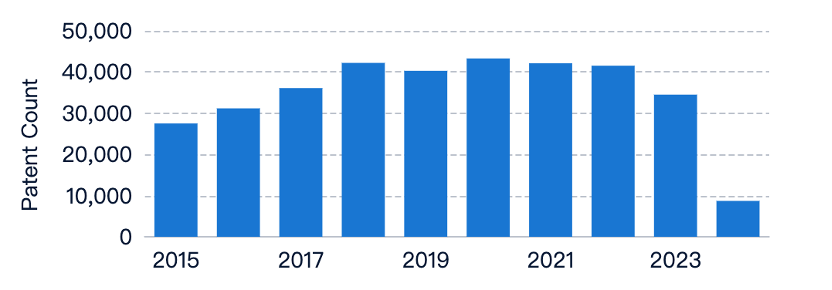
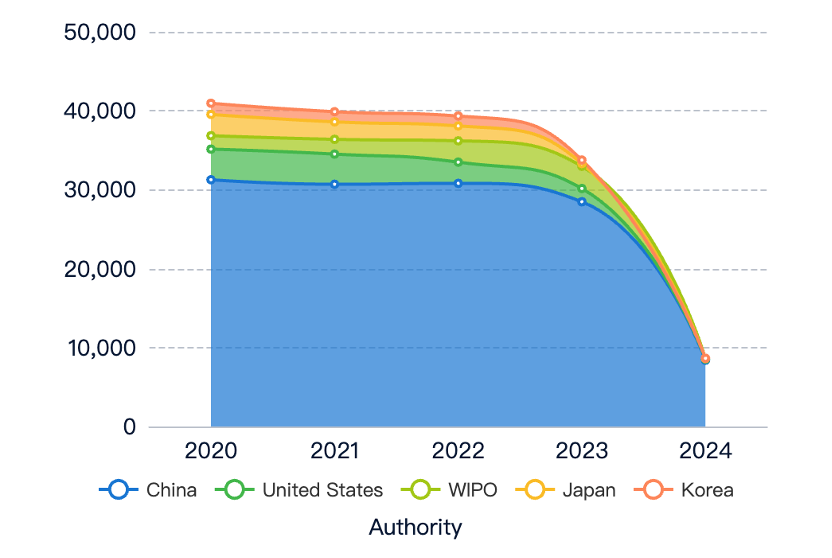
The field of resistance welding, particularly with a focus on achieving easy resistance welding, has witnessed a consistent upward trend in patent applications. This indicates technological innovations and advancements. However, the trend in related literature shows initial decline followed by stability, suggesting that while the industry actively pursues practical applications, academic research has not surged correspondingly. This divergence may be due to industry capitalizing on existing academic knowledge or resource constraints in academia.
Objectives
The primary objective is to develop innovative and efficient “Easy Resistance Welding” technology, simplifying the process, reducing operational complexities, and enhancing productivity and cost-effectiveness. This research aims to create a user-friendly resistance welding solution for various industries, promoting sustainable manufacturing practices and technological advancements.
To get a detailed scientific explanations of Resistance Welding, try Eureka.
Technical Current Status Analysis
Resistance Welding Overview
Resistance welding is widely used in automotive, aerospace, and electronics manufacturing, offering advantages like high production rates, low energy consumption, and the ability to join dissimilar materials.
Applications and Impact:
- Automotive: Joining body panels, frames, and other structural components.
- Aerospace: Joining aircraft components, including fuselage sections, wing panels, and engine parts.
- Electronics: Joining components in electronic devices like batteries, sensors, and connectors.
Technical Characteristics and Challenges:
- Material Properties: Electrical and thermal conductivity, melting point, and surface conditions impact the ease of welding.
- Joint Design: Geometry and fit-up affect heat generation, pressure distribution, and potential weld defects.
- Process Parameters: Welding current, weld time, electrode force, and geometry play crucial roles.
- Surface Conditions: Contaminants, oxides, or coatings on workpieces can interfere with conductivity and heat generation.
- Electrode Wear and Maintenance: Condition and maintenance of electrodes impact heat generation and weld quality.
Technological Paths:
- Advanced Material Characterization and Modeling: Develop material databases and predictive models for optimizing process parameters.
- Adaptive Control Systems: Implement real-time monitoring and adjustment of process parameters.
- Improved Electrode Design and Materials: Develop electrodes with better wear resistance and conductivity.
- Surface Engineering and Pretreatment Techniques: Explore advanced surface preparation techniques.
- Process Monitoring and Quality Control: Implement in-process monitoring and non-destructive testing methods.
- Simulation and Optimization: Use computational modeling for optimizing joint designs and process parameters.
Research Content
Research Objectives
Develop innovative techniques and methodologies to simplify resistance welding, enhance productivity, and ensure high-quality welds.
Research Direction and Focus
Materials and Alloy Development
- Develop advanced materials and alloy compositions tailored for resistance welding.
- Focus on materials with superior electrical and thermal conductivity, high melting points, and enhanced weldability.
Process Optimization and Automation
- Integrate advanced control systems, real-time monitoring, and automated adjustment mechanisms.
- Use AI, machine learning, and predictive analytics for intelligent welding systems.
Electrode Design and Lifecycle Management
- Explore innovative electrode designs and materials to enhance durability and performance.
- Develop strategies for effective electrode lifecycle management.
Energy Efficiency and Sustainability
- Reduce energy consumption by optimizing electrical parameters and implementing energy recovery systems.
- Minimize waste generation and promote material recycling.
User-Friendly Interface and Operator Training
- Develop intuitive control systems and graphical user interfaces.
- Create comprehensive training materials, simulations, and hands-on workshops.
Technical Development Roadmap
Key Areas of Advancement
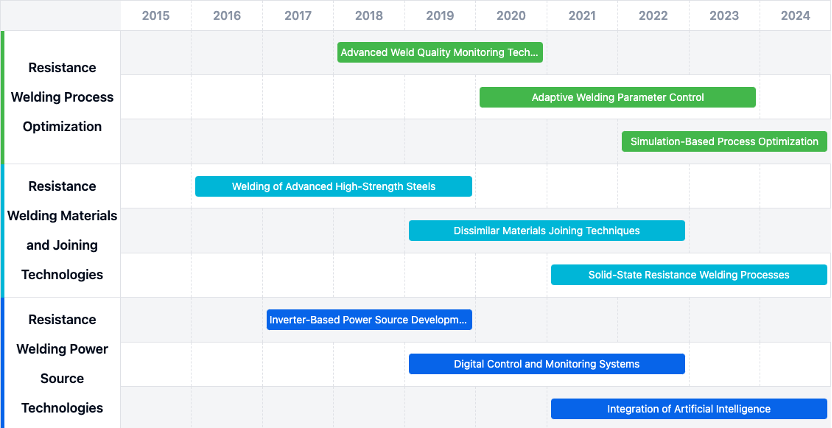
- Power Source Technologies: Development of inverter-based power sources, digital control, and monitoring systems.
- Process Optimization: Advanced weld quality monitoring, adaptive parameter control, and simulation-based optimization.
- Materials and Joining Technologies: Joining advanced high-strength steels and dissimilar materials, and exploring solid-state resistance welding processes.
Main Player Analysis
Key Players and Focus
- Matsushita Electronics Corp.: 5346 patents on process efficiency, joint quality, and automation.
- Osaka University: Research on finite element modeling, keyhole behavior analysis, and in-process monitoring techniques.
- Annamalai University: Research on mechanical properties of aluminum alloy joints and welding process optimization.
- Canon Inc.: 4052 patents on advanced welding techniques and equipment for electronics manufacturing.
- NIPPON STEEL CORP.: 5037 patents on welding techniques for steel and other metallic materials.
Current Technical Solution Overview
Resistance Welding Methods and Techniques
- Improving Weld Quality: Techniques for controlling welding parameters and real-time monitoring.
- Welding Specific Materials: Specialized methods for materials like aluminum alloys and dissimilar metals.
- Electrode Design and Configurations: Advanced designs for heat transfer and reduced wear.
- Process Monitoring and Control: Real-time control systems for consistent weld quality.
- Resistance Spot Welding: Techniques for joining sheet metal components.
Resistance Spot Welding of Dissimilar Materials
- Joining Dissimilar Metals: Methods for welding combinations like aluminum and steel.
- Specialized Equipment: Electrodes and components for dissimilar metals.
- Quality Control and Monitoring: Techniques for evaluating weld properties.
- Specific Material Combinations: Methods for combinations like aluminum-steel and titanium-aluminum.
Resistance Welding Control and Monitoring
- Control Systems: Techniques for adjusting welding parameters.
- Monitoring and Diagnostics: Methods for detecting and analyzing weld quality issues.
- Electrode Design and Materials: Innovations in electrode geometry and coatings.
- Process Optimization: Methods for achieving optimal weld quality.
Resistance Welding Electrodes and Materials
- Electrode Materials: Copper alloys, refractory metals, and composites for better performance.
- Coatings and Surface Treatments: Enhancements for wear resistance and conductivity.
- Electrode Designs: Optimized configurations for specific applications.
- Manufacturing Processes: Techniques like powder metallurgy and casting.
Resistance Welding Apparatus and Systems
- Control Systems: Monitoring and adjusting welding parameters.
- Quality Monitoring: Techniques for detecting weld defects.
- Power Supply and Control Circuits: Designs for optimal welding conditions.
- Methods for Specific Materials: Techniques for welding aluminum alloys, steel plates, and tubular parts.
Key Patent Interpretation
Patent Highlights
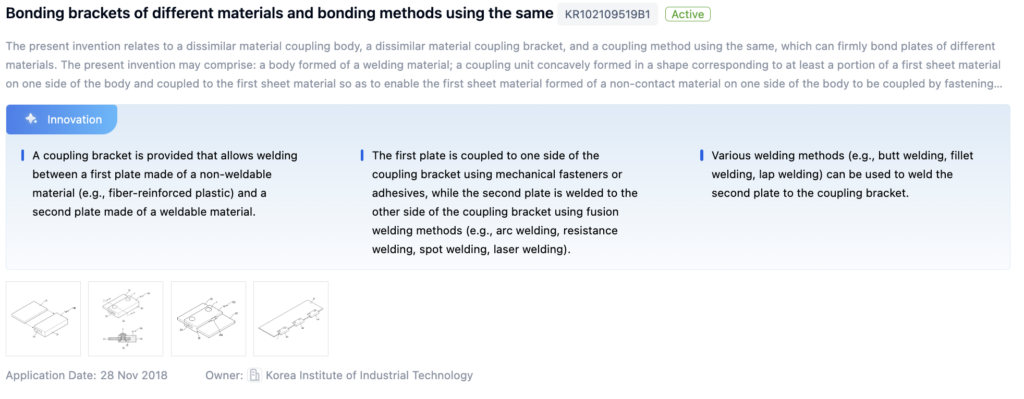
Patent 1: Bonding Brackets of Different Materials and Bonding Methods
- Core Invention Points:
- Allows welding between a non-weldable material (e.g., fiber-reinforced plastic) and a weldable material.
- The first plate is coupled using mechanical fasteners or adhesives, while the second plate is welded using various welding methods.
- Enables multiple welding methods like butt welding, fillet welding, and lap welding.
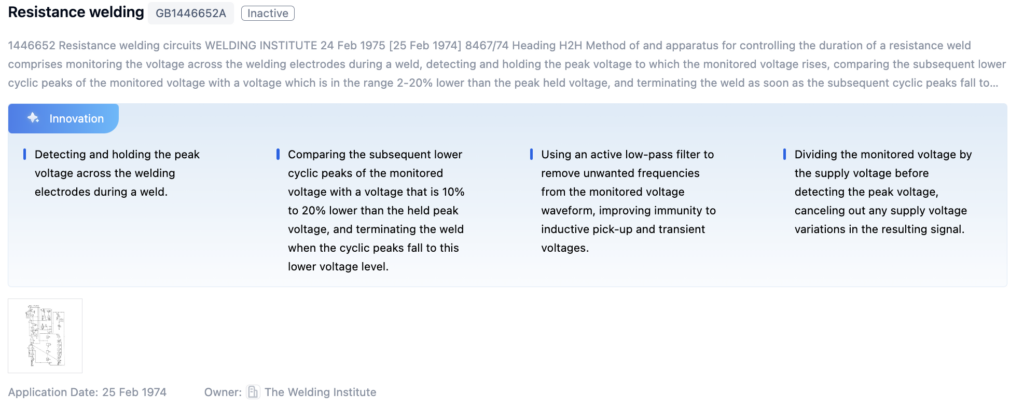
Patent 2: Resistance Welding Circuits
- Core Invention Points:
- Detects and holds peak voltage across welding electrodes during a weld.
- Compares subsequent lower cyclic peaks with a reduced peak voltage, terminating the weld when peaks fall to the lower level.
- Uses an active low-pass filter to improve immunity to inductive pick-up and transient voltages.
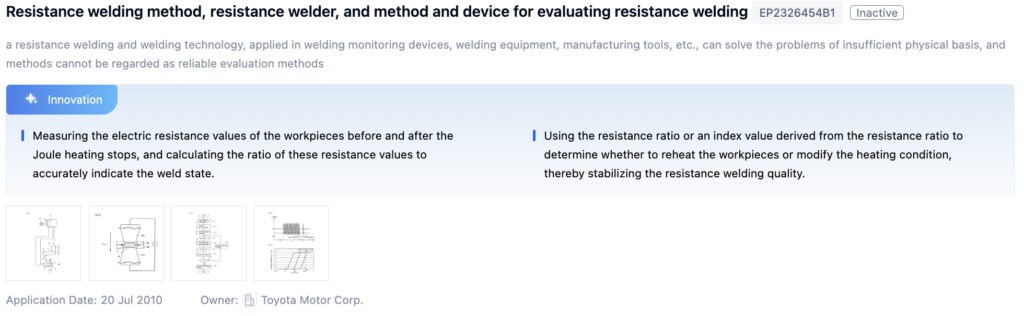
Patent 3: Resistance Welding Method and Evaluating Device
- Core Invention Points:
- Measures electric resistance values of workpieces before and after Joule heating.
- Uses the resistance ratio to indicate the weld state and adjust heating conditions.
- Stabilizes welding quality by controlling the welding process based on resistance measurements.
Possible Research Directions
- Techniques for Improved Weld Quality: Controlling welding parameters, monitoring weld formation, and optimizing electrode configurations.
- Methods for Dissimilar Materials: Tailored welding parameters, material coatings, and electrode designs.
- Spot Welding Techniques: Improving quality, efficiency, and versatility of spot welding.
- Control and Monitoring Systems: Real-time monitoring, adaptive control algorithms, and fault detection mechanisms.
- Electrode Designs and Configurations: Innovative designs and materials for better performance.
If you want an in-depth research or a technical report, you can always get what you want in Eureka Technical Research. Try now!
