Alkane, also referred to as paraffins, is saturated hydrocarbons composed solely of carbon and hydrogen atoms linked by single covalent bonds. They represent the most basic class of organic compounds, yet their role across modern chemistry, energy systems, and material science is anything but simple. Found abundantly in natural gas and petroleum, alkanes serve as fuels, solvents, chemical intermediates, lubricants, and structural backbones in numerous applications.
Their inherent stability, broad volatility range, and high energy density make them ideal for combustion, carrier media, and synthetic processing. As the global focus shifts toward sustainability and carbon neutrality, alkane research is evolving—exploring new catalytic transformations, renewable sourcing methods, and advanced functionalization pathways.
This blog takes a deep dive into the molecular characteristics, industrial applications, physicochemical properties, and future innovation trends of alkanes—while highlighting how AI-powered tools like PatSnap Eureka AI Agent are accelerating alkane-related R&D with unprecedented clarity and intelligence.
Ask Patsnap Eureka AI
Patsnap Eureka AI provides instant, trusted answers to any technical questions.
Molecular Composition and Structural Characteristics
Alkanes follow the empirical formula CₙH₂ₙ₊₂ for acyclic (open-chain) forms. They are divided into several structural types:
Linear (n-Alkanes):
Straight-chain molecules such as n-butane (C₄H₁₀) and n-decane (C₁₀H₂₂). These typically have predictable boiling points and crystallinity, important for fuel blending and wax production.
Branched Alkanes:
Isomeric variants like isooctane offer superior combustion characteristics due to increased volatility and reduced knocking—crucial in gasoline formulations.
Cycloalkanes:
Saturated ring structures such as cyclopentane and cyclohexane are essential in solvents, blowing agents, and polymer intermediates.
Gaseous to Solid State Transitions:
C1–C4: Gaseous at ambient conditions (e.g., methane, propane)
C5–C16: Liquids (used in fuels and solvents)
C17+: Solids (waxes, lubricants)
Material Grades and Commercial Forms
While not “graded” like engineered alloys or polymers, alkanes in commerce are specified by:
Carbon Range Fractions:
Used in petroleum refining and separation processes:
C5–C12: Gasoline blending
C13–C20: Diesel and kerosene
C21+: Lubricants and paraffin wax
Purity Specifications:
n-Hexane ≥ 99% (analytical reagent)
Isopentane technical grade (foam applications)
Specialty Blends:
Alkane solvent blends for chromatography or extraction
Isomer mixtures tailored for controlled volatility or flammability
People also embed Alkanesin polymer masterbatches, thermal fluids, and functional fluids such as Phase Change Materials (PCMs).
Physicochemical Properties of Alkanes
Property
Description
Thermal Stability
High resistance to decomposition under moderate heat
Combustion Energy
Excellent calorific value; basis of fossil fuel systems
Low Dielectric Constant
Favorable for use in insulating fluids
Chemical Inertness
Stable under most acidic or basic conditions
Hydrophobicity
Non-polar nature enables use as barriers, coatings, and oil phases
Controlled Volatility
Facilitates formulation of fuels, propellants, and blowing agents
Molecular weight and branching affect boiling points, flash points, viscosity, and solubility—key considerations in formulation science and safety engineering.
Application Domains
1. Energy and Fuel Infrastructure
C1–C4 Alkanes (methane, ethane, propane, butane) are vital as natural gas fuels, LNG feedstocks, and heat carriers.
C5–C12 Alkanes are refined into gasoline and aviation fuels, where volatility and ignition characteristics are optimized using isomeric control (e.g., octane rating).
Alkanes are central to Fischer–Tropsch synthesis, converting syngas to synthetic fuel under catalysis.
2. Chemical Manufacturing and Feedstocks
Oxidation, halogenation, and cracking of alkanes yield olefins, alcohols, aldehydes, and other intermediates.
Methane and ethane serve as precursors for hydrogen production (SMR) and methanol synthesis.
Alkanes are also involved in hydroformylation, dehydrogenation, and carbonylation processes.
3. Pharmaceutical & Personal Care
White mineral oil and petrolatum (semi-solid alkanes) are FDA-approved for medical, cosmetic, and food-grade uses.
Function as emollients, occlusive agents, and formulation vehicles for dermatological and oral products.
4. Refrigeration & Insulation
Cyclopentane is a low-global-warming-potential (GWP) alternative to HFCs, used in polyurethane insulation.
n-Pentane blends used in phase change thermal storage and expanded polystyrene.
5. Industrial Solvents and Carriers
Alkanes such as n-heptane are used in rubber compounding, asphalt formulations, and cleaning agents.
In electronics, high-purity cycloalkanes act as nonpolar rinse solvents and dielectric media.
Comparative Advantages and Limitations
✅ Advantages
Abundance & Cost-Efficiency: Readily extracted from crude oil or synthesized via syngas routes.
High Combustion Efficiency: Ideal energy carriers with clean-burning profiles under optimized conditions.
Inertness: Chemically stable, suitable as carriers or media in sensitive applications.
Physical Versatility: Gases, liquids, and solids covering wide temperature/pressure applications.
⚠️ Limitations
Environmental Concerns: Combustion generates CO₂ and methane contributes to global warming.
Low Reactivity: Requires activation (e.g., C–H bond functionalization) for further transformation.
Flammability Hazards: Especially for C1–C6 alkanes; stringent handling and storage regulations.
Limited Renewable Routes: Sustainable alkane production is still in early-stage development.
Emerging Trends in Alkane R&D
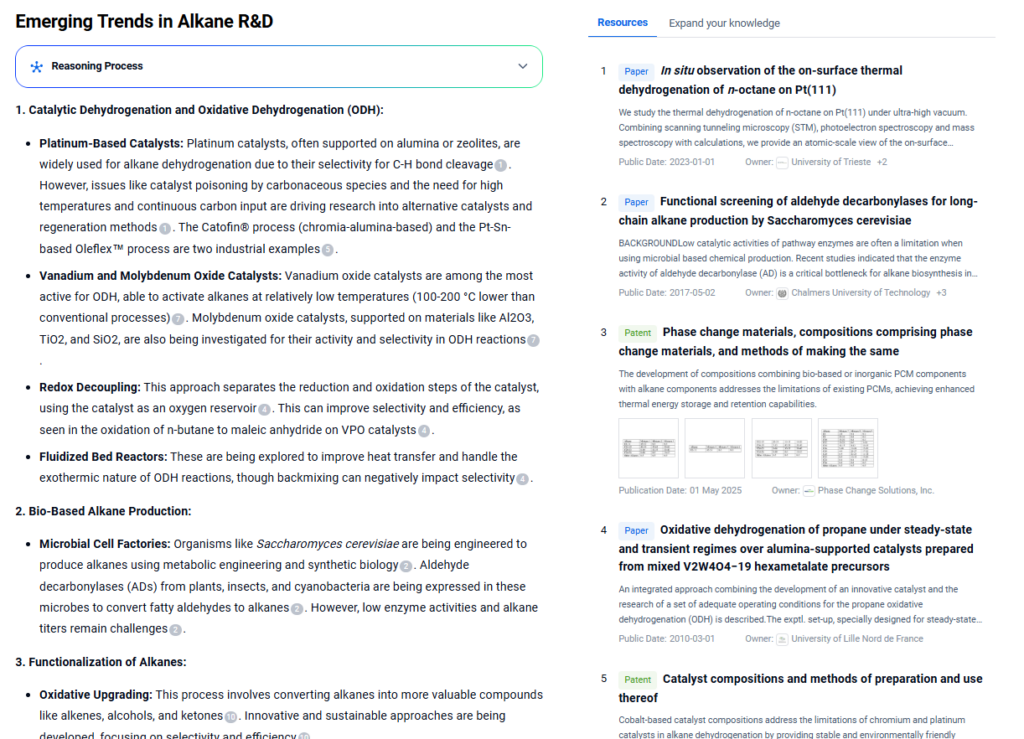
Innovations in alkane processing are focusing on green chemistry, AI-driven catalyst design, and bio-conversion technologies:
Current Innovation Hotspots:
Photocatalytic and Electrocatalytic Alkane Functionalization
Selective C–H Activation for Fine Chemical Synthesis
Methane-to-Methanol Conversion under Mild Conditions
Zeolite and MOF-based Alkane Isomerization
Bioengineered Alkane Metabolism using Synthetic Microbes
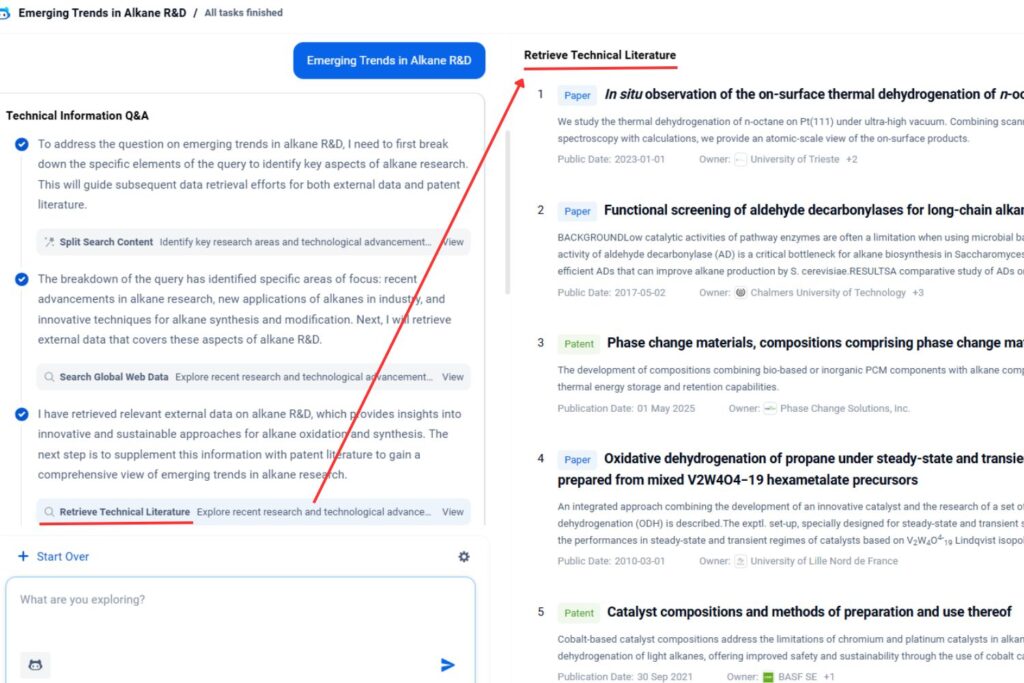
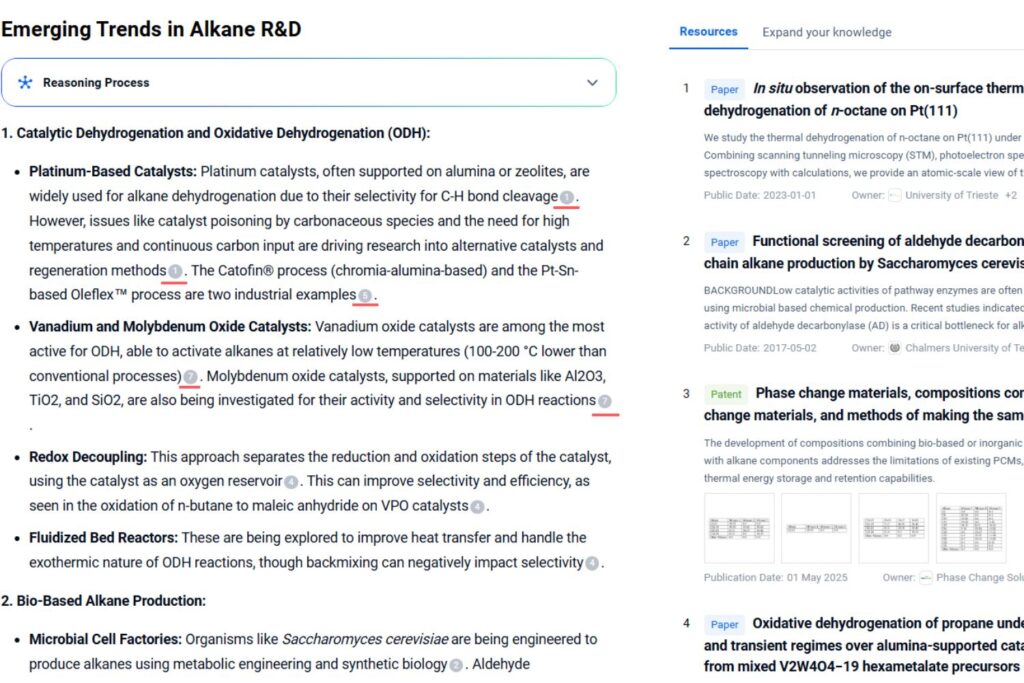
🔍 Tracking such technical trends across global patent filings, literature, and startups is increasingly complex. PatSnap Eureka AI Agent solves this by combining deep AI reasoning with massive IP databases to surface not just the “what,” but the “why” behind innovation. Eureka maps the evolution of alkane-based technologies, identifies key inventors and assignees, and visualizes patent trends by chemistry class, process condition, or application domain. Every insight is transparently backed by global patent literature — making it an indispensable tool for chemists, R&D leaders, and innovation strategists.
Future Prospects
The next frontier for alkanes lies in their decarbonized utilization and functionalized transformation. Key directions include:
Carbon capture integration in alkane reforming cycles
Advanced lifecycle modeling for alkane-based fuels and materials
As the pressure for carbon neutrality increases, inert molecules like alkanes are being reimagined as active participants in low-emission and circular material flows.
Conclusion
Alkanes are more than just hydrocarbons—they are scalable, adaptable, and now, increasingly intelligent components of modern industry. From synthetic fuels to smart packaging, their applications are deepening as new tools make it easier to unlock their full potential.
With PatSnap Eureka AI Agent, chemical innovators can explore alkane landscapes faster, trace patent-backed research more reliably, and design IP-aware strategies with full transparency.
FAQ: Alkanes in Chemistry and Innovation
What distinguishes alkanes from other hydrocarbons like alkenes or aromatics?
Alkanes are saturated hydrocarbons, containing only single C–C and C–H bonds, whereas alkenes and alkynes feature double or triple bonds, making them more reactive. Aromatics, such as benzene, have delocalized π-electron systems that enable electrophilic substitution reactions.
Why are branched alkanes preferred in gasoline?
Branched alkanes exhibit higher octane ratings and better combustion profiles compared to their linear counterparts, reducing engine knocking and improving fuel efficiency. For example, isooctane is a key reference molecule for high-octane fuel standards.
Can alkanes be produced from renewable sources?
Yes. Researchers are developing bio-alternative pathways using engineered microbes to convert biomass-derived syngas or volatile fatty acids into alkanes. Techniques such as photobiological methane generation and bio-catalytic alkane synthesis are under active development.
What is the biggest challenge in alkane functionalization?
The inertness of C–H bonds in alkanes makes selective activation difficult under mild conditions. Current R&D is focused on transition metal catalysts, photoredox systems, and electrocatalytic techniques for precise, energy-efficient C–H bond functionalization.
How does PatSnap Eureka AI Agent support alkane research?
PatSnap Eureka AI Agent enables researchers to: Analyze global IP trends in alkane catalysis and synthesis Visualize the reasoning path from query to result Identify leading assignees, inventors, and technologies in alkane innovation Access structured patent-backed insights across chemistry, materials, and energy sectors This AI-powered platform combines massive patent data with explainable logic to accelerate alkane-related discovery and R&D strategy.
Explore Eureka AI Agent for Alkane-Driven Innovation
🔗 Want to stay ahead of alkane innovation across fuels, chemicals, and materials? → Try PatSnap Eureka AI Agent — where explainable AI meets global IP intelligence.