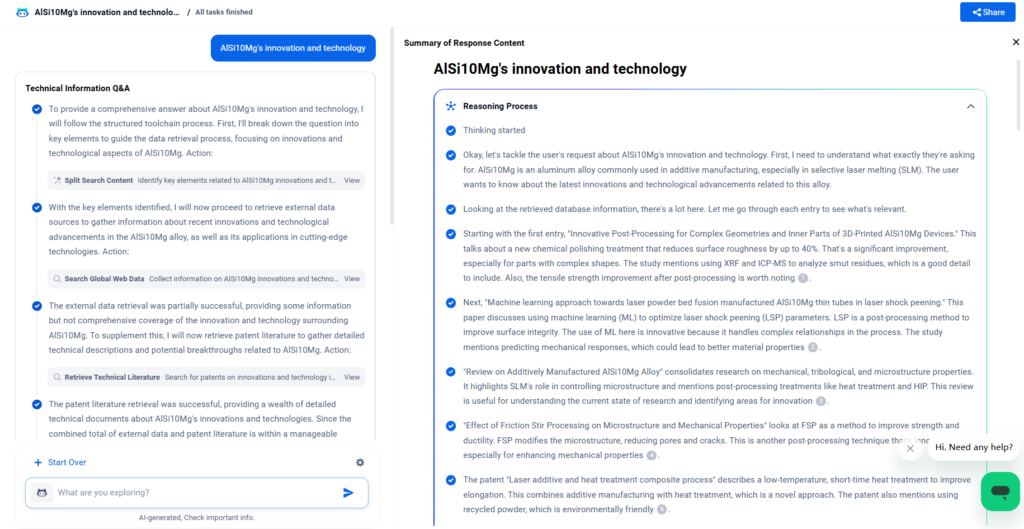
AlSi10Mg is a high-strength aluminum-silicon-magnesium alloy widely used in advanced manufacturing processes, particularly laser powder bed fusion (LPBF) and direct metal laser sintering (DMLS). Known for its excellent strength-to-weight ratio, corrosion resistance, and thermal stability, AlSi10Mg has become a leading material in aerospace, automotive, and medical device sectors.
This article provides an in-depth overview of AlSi10Mg, covering its composition, technical performance, industrial relevance, and how it supports the evolution of lightweight structural design and precision engineering through PatSnap Eureka AI Agent.

Material Composition & Standards
AlSi10Mg is defined by its controlled proportions of aluminum (Al), silicon (Si), and magnesium (Mg). Its typical chemical composition is:
| Element | Content (wt.%) |
|---|---|
| Aluminum (Al) | Balance |
| Silicon (Si) | 9.0 – 11.0% |
| Magnesium (Mg) | 0.20 – 0.45% |
| Iron (Fe) | ≤ 0.55% |
| Copper (Cu) | ≤ 0.05% |
| Zinc (Zn) | ≤ 0.10% |
| Manganese (Mn) | ≤ 0.45% |
| Nickel (Ni) | ≤ 0.05% |
| Titanium (Ti) | ≤ 0.15% |
Common Specifications:
- EN AC-43000 / A356.0 / AlSi10Mg(C)
- DIN EN 1706 / ASTM B179 / ISO 3522
These specifications ensure tight control over mechanical properties, making it highly reliable in performance-critical environments.
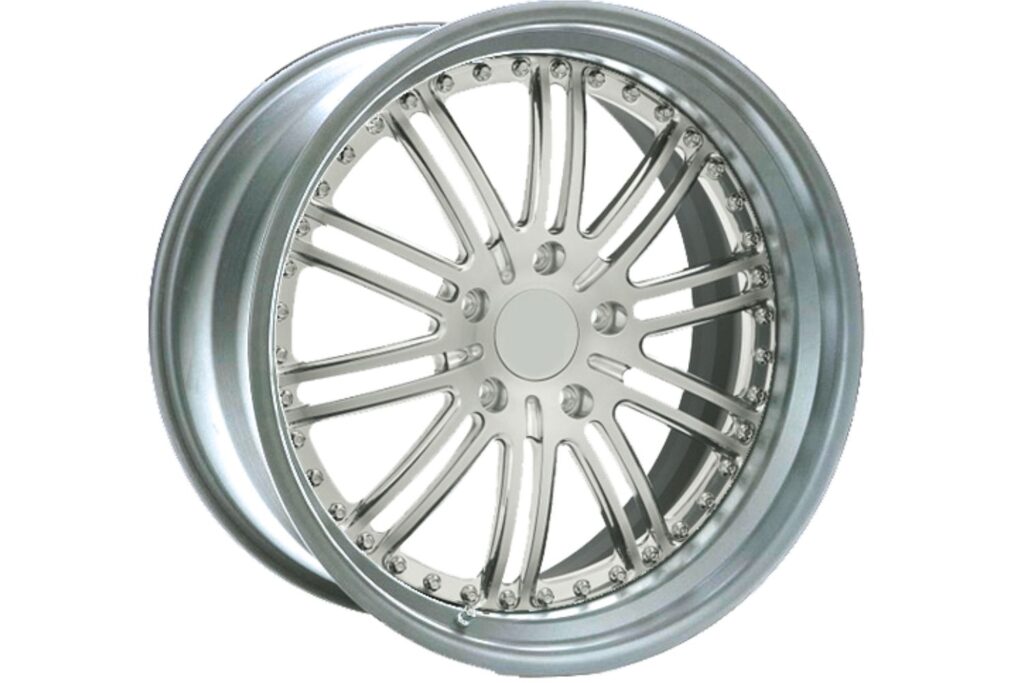
Core Applications Across Industries
AlSi10Mg’s superior mechanical properties and excellent processability through additive manufacturing make it an indispensable material across several high-performance industries. Below is an in-depth look at its strategic applications:
Aerospace Engineering
AlSi10Mg is extensively used in aircraft structural brackets, satellite component housings, and cabin interior assemblies. Its high strength-to-weight ratio, excellent fatigue resistance, and ability to be precision-manufactured via laser powder bed fusion (LPBF) allow aerospace engineers to reduce part count and optimize aerodynamics.
Automotive Powertrain & Chassis Systems
The alloy’s high rigidity, good thermal conductivity (~160 W/mK), and corrosion resistance make it ideal for lightweight engine components, heat exchangers, and suspension linkages. It enables part consolidation and reduces vehicle weight without compromising structural integrity.
Advanced Electronics & Mechatronics
In electronics, AlSi10Mg is used for high-performance heat sinks, sensor housings, and electromagnetic shielding enclosures. Its combination of thermal dissipation capability and dimensional stability supports compact device design, especially in embedded systems and robotics.
Industrial Manufacturing & Tooling
In tooling applications, AlSi10Mg enables rapid production of injection mold inserts, pressure die casting prototypes, and custom jigs and fixtures. Its wear resistance and post-processing compatibility (e.g., hard anodizing, shot peening) support high-precision applications under repetitive mechanical loads.
Medical Devices (Emerging)
While still exploratory, AlSi10Mg is being researched for orthopedic supports and dental frameworks, especially where biocompatibility standards can be met post-processing. The material’s lightweight profile and strength make it a candidate for temporary implants and surgical tooling.
Mechanical & Thermal Properties
| Property | Typical Value (As Built) |
|---|---|
| Tensile Strength | 400–480 MPa |
| Yield Strength (0.2%) | 250–300 MPa |
| Elongation at Break | 3–8% |
| Hardness | ~120–150 HV |
| Thermal Conductivity | ~155–170 W/m·K |
| Density | ~2.65 g/cm³ |
Post-processing (e.g., T6 heat treatment or hot isostatic pressing) further improves ductility and mechanical consistency.
Innovation & Technology
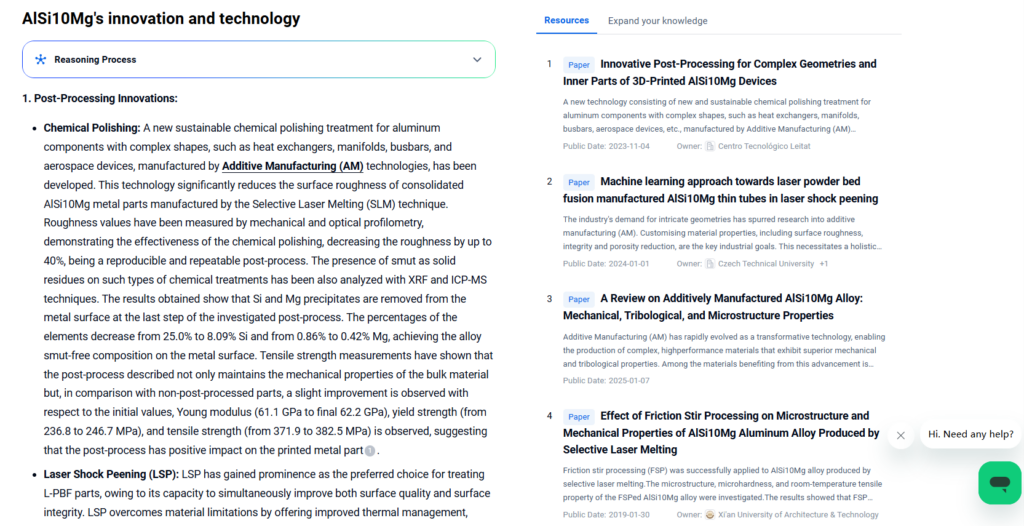
1. Post-Processing Innovations
- Chemical Polishing significantly reduces surface roughness (up to 40%) and removes Si/Mg residues while slightly improving mechanical strength.
- Laser Shock Peening (LSP) enhances fatigue life, surface integrity, and thermal resistance.
- Friction Stir Processing (FSP) improves microstructure through localized plastic deformation.
- Ultrasonic Peening Treatment (UPT) induces beneficial compressive stress, boosting fatigue resistance and hardness.
2. Material Composition Advances
- Alloying Elements like Mn, Fe, Cu, and Ni optimize mechanical and wear properties by refining phase distribution.
- Nanoparticle Reinforcement using CNTs and LaB₆ enhances strength, grain refinement, and isotropy in printed parts.
- Carbon Nanotubes (CNTs) improve stiffness and strength but require dispersion control due to wettability challenges.
- LaB₆ Nanoparticles facilitate fine, equiaxed grain structures, enhancing ductility and homogeneity.
3. Powder Production Improvements
- RF Plasma Spheroidization produces uniform, high-flowability spherical powders with controlled morphology.
- Vacuum Melting + Argon Atomization yields powders with high purity, low oxygen content, and good sphericity for AM systems.
- Crystal Seed Alloy Additives refine grains and improve strength and ductility in the final alloy.
4. Additive Manufacturing Techniques
- Selective Laser Melting (SLM) offers precise control of microstructure but may introduce residual stresses.
- Laser Powder Bed Fusion (L-PBF) is widely adopted for producing dense, complex components with good properties.
- Multi-Laser SLM Systems enhance throughput and build uniformity for industrial-scale parts.
- Wire and Arc Additive Manufacturing (WAAM) enables cost-effective, large-scale fabrication using metal wire feedstock.
5. Heat Treatment Innovations
- Low-Temp Short-Time Aging refines eutectic Si and Mg₂Si phases, improving strength via multiple strengthening mechanisms.
- Two-Stage T6 Treatment (535°C solution + 158°C aging) refines grains and improves oxidation resistance, though it may reduce hardness slightly due to recrystallization.
More detailed insights from PatSnap Eureka AI Agent
According to Eureka’s patent analytics, leading innovation clusters in AlSi10Mg include:
Advantages & Limitations
| Advantages | Limitations |
|---|---|
| High strength-to-weight ratio | Limited ductility in as-built condition |
| Excellent heat dissipation | Post-processing often required for performance |
| Corrosion resistance in complex environments | Costly compared to conventional die-cast alloys |
| Ideal for AM: low warping & good flowability | Powder degradation over recycling cycles |
| Easily machinable & polishable | Surface roughness requires secondary finishing |
Future Outlook
AlSi10Mg will continue to evolve through integration with topology optimization tools, recycling technologies, and AI-powered simulation software. Its role in EV battery cooling systems, wearable devices, and high-frequency RF shielding is expected to expand rapidly over the next 5 years.
FAQ
A: It’s used in aerospace, automotive, medical, and additive manufacturing for structural parts requiring strength, corrosion resistance, and low weight.
A: Yes. T6 heat treatment or HIP can enhance ductility and fatigue performance.
A: Yes, it is commonly used in medical and dental applications, especially via additive manufacturing.
A: LPBF (Laser Powder Bed Fusion), SLM (Selective Laser Melting), and DMLS (Direct Metal Laser Sintering) are widely used.
A: The powder can be recycled multiple times with proper sieving and quality control, aligning with circular manufacturing goals.
Conclusion
AlSi10Mg is more than just a lightweight aluminum alloy—it’s a cornerstone material for the digital manufacturing revolution. Whether in rocket fins, engine housings, or custom prosthetics, it enables next-generation design freedom, mechanical reliability, and process efficiency.
Ready to explore emerging applications with AlSi10Mg or benchmark your competitors’ IP strategy?
👉 Book a free demo with PatSnap Eureka AI Agent to uncover material insights, innovation trends, and white space opportunities.