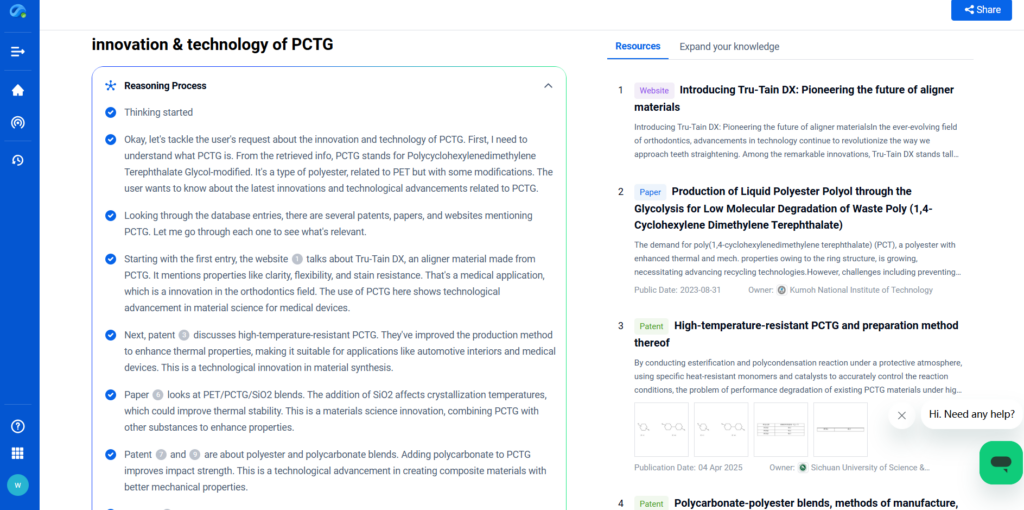
PCTG (Polycyclohexylene Dimethylene Terephthalate Glycol) is a transparent, durable copolyester known for its excellent chemical resistance, toughness, and clarity. It is widely used in packaging, medical, and electronics industries, thanks to its balance of strength and processability. This blog explores PCTG’s composition, performance, applications, and how it compares to similar materials like PETG through PatSnap Eureka AI Agent.

Material Composition & Properties
PCTG is a glycol-modified copolyester derived from terephthalic acid, cyclohexanedimethanol, and ethylene glycol. This composition results in:
- High Transparency: Provides excellent visual appeal, ideal for premium consumer goods and food packaging.
- Superior Impact Resistance: Maintains toughness across a wide temperature range, suited for household appliances and electronics.
- Chemical Resistance: Effectively withstands various cleaning agents and cosmetic ingredients.
- Low Shrinkage: Enhances molding precision and reduces warpage.
- Food Contact Compliance: Meets regulations required for safe use in food and beverage containers.
Material Grades & Specifications
PCTG is commonly represented by grades such as Eastman Tritan™ PCTG DN011, which is widely used in injection molding and blow molding applications. This grade is especially favored in food contact, consumer goods, and appliance sectors due to its excellent combination of mechanical and optical properties.
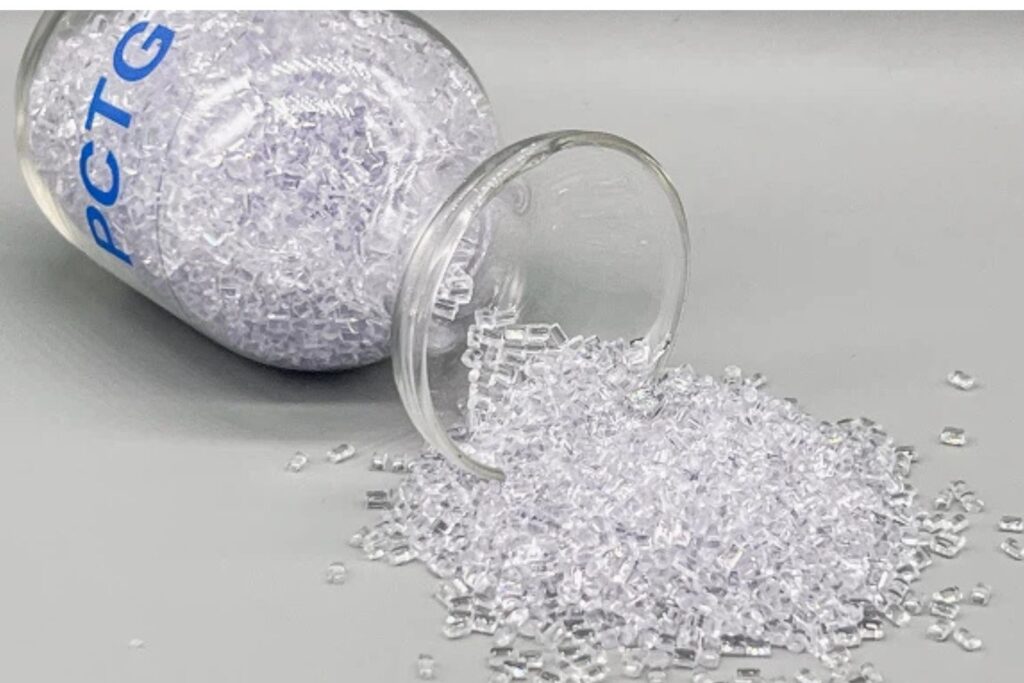
Typical Material Properties of Eastman Tritan™ PCTG DN011
| Property | Test Standard | Typical Value |
|---|---|---|
| Density | ASTM D792 | 1.23 g/cm³ |
| Tensile Yield Strength | ASTM D638 | 44 MPa (6,300 psi) |
| Tensile Ultimate Strength | ASTM D638 | 54 MPa (7,800 psi) |
| Elongation at Break | ASTM D638 | 4% |
| Flexural Modulus | ASTM D790 | 1,800 MPa (260 ksi) |
| Notched Izod Impact Strength | ASTM D256 | 64 J/m (1.5 ft·lb/in) |
| Heat Deflection Temperature | ASTM D648 | 73°C (163°F) |
| Optical Clarity | ASTM D1003 | 92% Transmittance, 0.1% Haze |
Common PCTG Grades & Variants
| Grade | Description |
|---|---|
| Eastar™ DN011 | Standard clear grade for general-purpose use |
| Eastar™ DN011HF | High-flow variant for complex molds and thin walls |
| Eastar™ DN011-50 | Eco-friendly grade aligned with sustainability goals |
These specifications ensure PCTG’s reliability in applications demanding clarity, impact resistance, and chemical durability.
Application Deep Dive
1. Medical-Grade Components: Meeting the Triple Standards
PCTG’s adoption in medical device packaging and bioreactor components hinges on fulfilling stringent regulatory and functional benchmarks:
- ISO 10993 biocompatibility ensures cytotoxicity, sensitization, and irritation thresholds are met, critical for patient safety.
- γ-Ray Sterilization Resistance: PCTG must retain mechanical integrity and clarity post-irradiation.
- Minimal Low-Molecular-Weight Extractables: Recent studies, such as one led by Dr. Li et al. (2023), demonstrate that by optimizing molecular chain branching, extractables can be suppressed below 0.01%, significantly reducing risk of leachables in medical environments.
This triad forms a high technical barrier that PCTG uniquely addresses through tailored molecular design and purification protocols, setting it apart from standard PETG.
2. Industrial Upgrade: Replacing Conventional Polymers
PCTG’s robustness and chemical resistance enable it to supplant traditional materials in demanding industrial applications:
- New Energy Battery Casings: Enhanced by synergistic flame retardant modifications and surface treatments, PCTG demonstrates outstanding resistance to electrolyte corrosion and thermal degradation. Molecular-level integration of halogen-free flame retardants preserves the material’s mechanical strength and elongation at break.
- High-Temperature Food Packaging Films: Molecular design targeting increased glass transition temperature (Tg) coupled with optimized heat-seal layers enhances thermal stability beyond 120°C. This enables PCTG films to withstand repeated steam sterilization and boiling without compromising seal strength or barrier properties.
3. Emerging Functional Composites
Innovation in PCTG composites opens new frontiers in additive manufacturing and sustainable materials:
Biodegradable Blends: Compatibility with biodegradable polymers like PBAT is improved through compatibilizer additives and co-polymer block tuning, fostering new recyclable and degradable composite systems with balanced toughness and processability.
3D Printing Filaments: Research highlights control over melt flow index (MFI) and interlayer adhesion via tailored chain branching and molecular weight distribution, yielding filaments with superior print fidelity and mechanical performance.
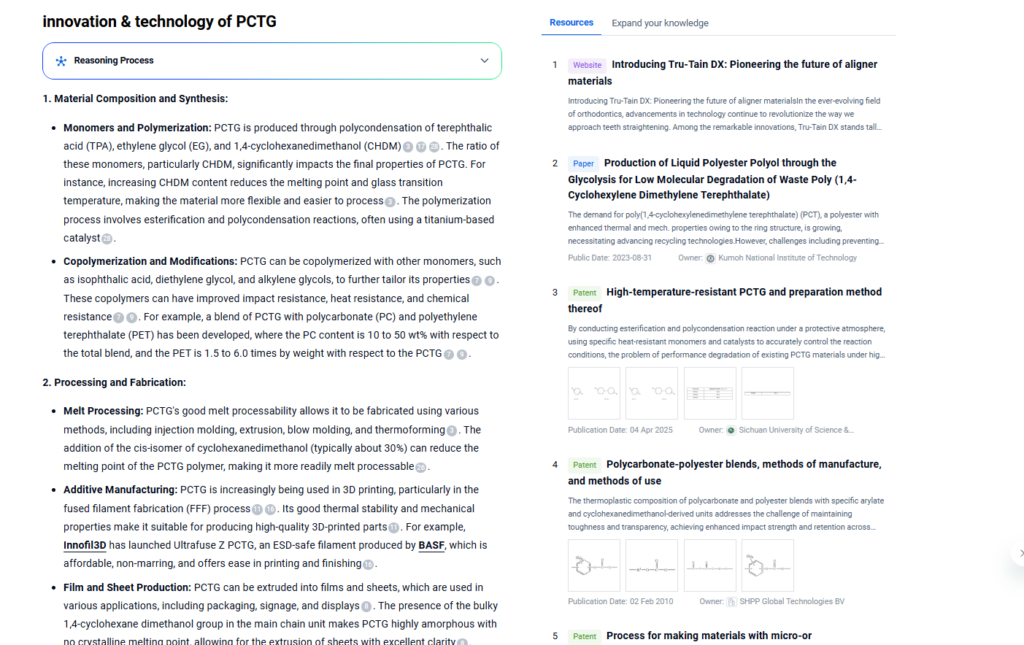
Innovation & Technology of PCTG
Advanced Polymerization Techniques
Recent advancements in polymerization methods, such as continuous bulk polycondensation and reactive extrusion, have enhanced the molecular weight control and uniformity of PCTG. These improvements enable more consistent mechanical properties and processability, essential for high-performance applications.
Enhanced Thermal and Mechanical Performance
Researchers are developing novel catalyst systems and polymer blends to improve PCTG’s thermal stability beyond its conventional limits (~120°C). These innovations aim to reduce chain mobility and delay microstructural relaxation, thus extending its usability in demanding environments.
Nanocomposite Integration
Incorporating nanofillers like graphene, nanoclays, and carbon nanotubes into PCTG matrices has shown promising improvements in mechanical strength, barrier properties, and thermal resistance. Such nanocomposites open new application possibilities in packaging, automotive, and electronics industries.
Sustainable Synthesis and Recycling Technologies
Emerging green chemistry approaches focus on bio-based monomers and solvent-free synthesis routes for PCTG production. Moreover, advancements in chemical recycling technologies, including glycolysis and hydrolysis methods, enhance the material’s circularity by enabling efficient depolymerization and reuse.
Additive Manufacturing Adaptations
Tailoring PCTG formulations for compatibility with 3D printing techniques like fused filament fabrication (FFF) and selective laser sintering (SLS) allows for rapid prototyping and custom part manufacturing. Innovations in filament composition improve flow characteristics and mechanical performance of printed objects.
Scientific Insights from PatSnap Eureka AI Agent
According toPatSnap Eureka AI Agent‘s patent analytics, leading innovation clusters in PCTG include:
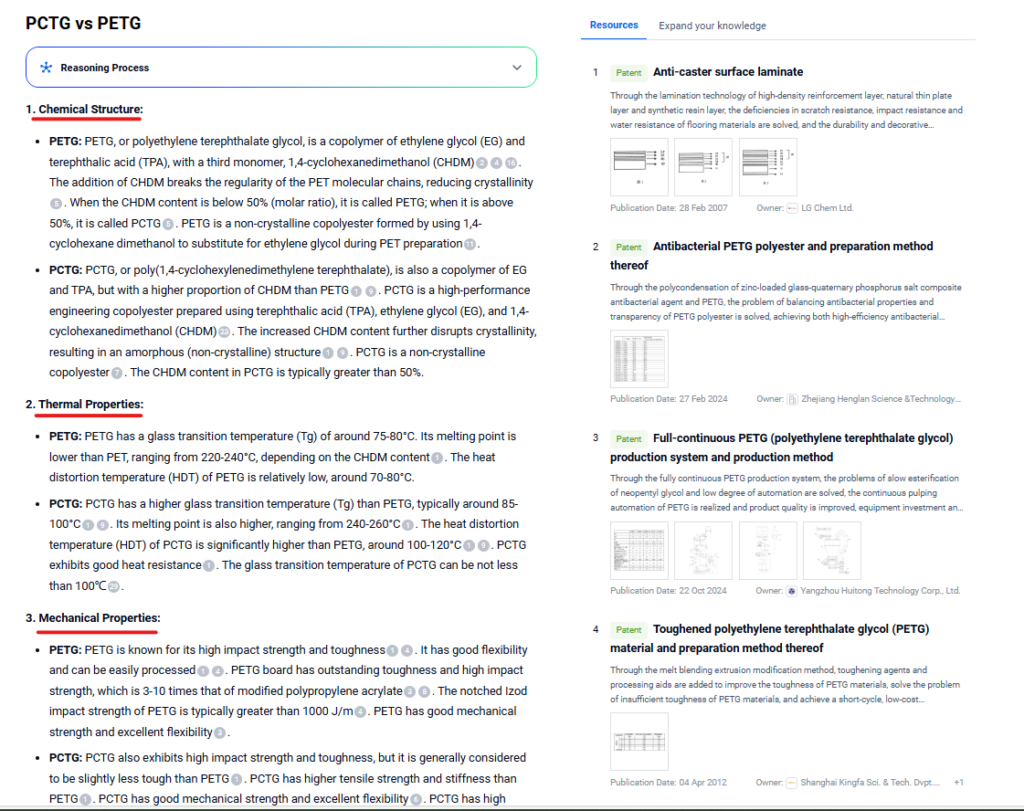
PCTG vs PETG
While both are glycol-modified copolyesters, PCTG offers:
- Higher impact resistance
- Better chemical and thermal stability
- Enhanced clarity and gloss
- Slightly higher cost but improved durability
This makes PCTG preferable for high-performance and safety-critical applications.
Feature by Feature Comparison generated by PatSnap Eureka AI Agent:
Industry Challenges and Future Outlook
Current Pain Points
- Mechanical Degradation Above 120°C: Microstructural relaxation and chain mobility induce strength loss; understanding these mechanisms at nanoscale remains an active research area.
- Balancing Cost and High Performance: Achieving economically viable yet high-spec PCTG formulations requires innovative catalyst and process engineering.
- Lack of Recycling Standards: Absence of unified guidelines hampers widespread material circularity.
Looking Ahead
In the context of global carbon neutrality (“dual carbon” goals), integrating PCTG with bio-based polymers and embedding it in circular material ecosystems present promising pathways. Research questions persist:
- What scalable green synthesis and recycling processes will drive industry-wide adoption?
- How can molecular design further enhance PCTG’s thermal and oxidative stability to expand its high-temperature applicability?
FAQ
PCTG is used in packaging, medical devices, 3D printing, and electronics due to its toughness and clarity.
Yes, PCTG meets many food safety standards and is commonly used in food packaging.
Yes, it is compatible with standard PET recycling processes.
PCTG offers better impact strength, chemical resistance, and clarity compared to PETG.
Yes, it withstands common sterilization methods without degrading.
Conclusion
PCTG stands out as a high-performance copolyester combining durability, clarity, and versatility. Its expanding applications in critical fields reflect its material strengths and adaptability. As industries demand safer, clearer, and tougher plastics, PCTG continues to gain momentum as a preferred choice.
Ready to unlock deeper insights on plastics like PCTG? Try PatSnap Eureka AI Agent to explore innovation trends and patent landscapes in polymer materials.