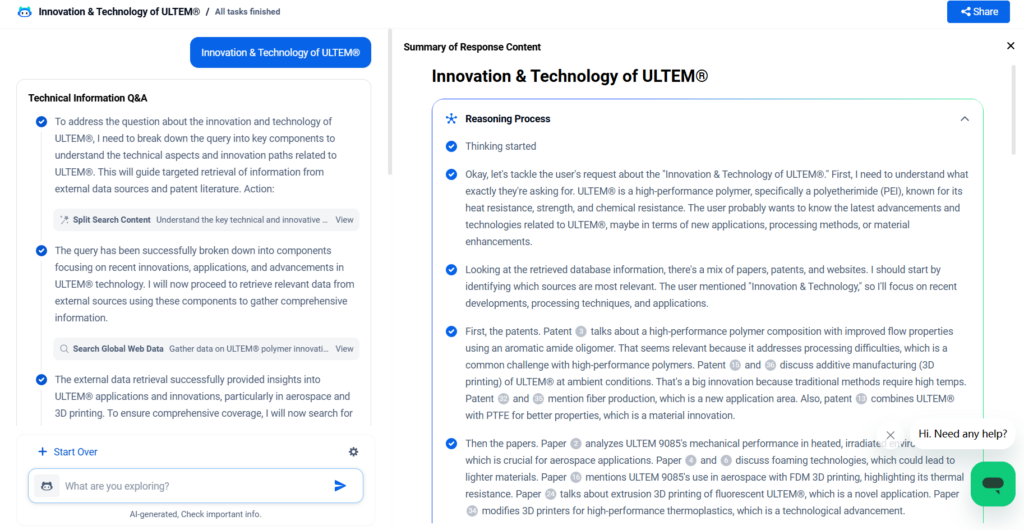
ULTEM ®, the trade name for polyetherimide (PEI), is a high-performance amorphous thermoplastic developed by General Electric Plastics (now SABIC). Known for its excellent mechanical properties, flame resistance, and thermal stability, ULTEM® is widely used in aerospace, automotive, medical, and electronics industries. This article explores ULTEM’s key performance attributes, commercial grades, industrial use cases, and emerging innovation frontiers through PatSnap Eureka AI Agent.

Material Composition & Performance Characteristics
- Base Polymer: Polyetherimide (PEI)
- Structure: Amorphous, transparent to amber-colored
- Thermal Resistance: Continuous use temperature up to 170–180 °C
- Mechanical Properties: High tensile and flexural strength
- Chemical Resistance: Resistant to hydrocarbons, alcohols, and weak acids
- Flame Retardancy: UL 94 V-0 without additives
- Dielectric Strength: Excellent electrical insulation properties
- Processing Methods: Injection molding, extrusion, thermoforming, 3D printing
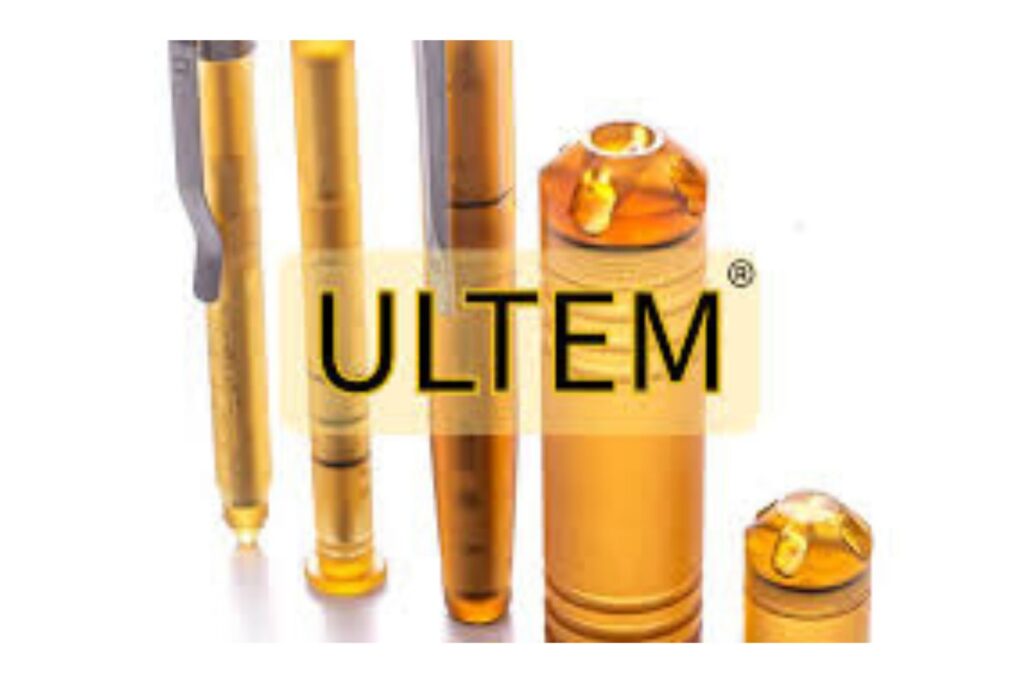
Grade Variants of ULTEM® (PEI)
SABIC provides multiple grades of ULTEM® tailored to specific applications:
| Grade Name | Description | Key Application Fields |
|---|---|---|
| ULTEM 1000 | Unfilled PEI with highest purity | Medical devices, electrical parts |
| ULTEM 1010 | Food-grade and autoclave-compatible | Medical trays, food contact parts |
| ULTEM 2300 | 30% glass fiber reinforced PEI | Aerospace, structural components |
| ULTEM 2310 | 10% glass fiber reinforced PEI | Semiconductor, industrial parts |
| ULTEM 9085 | Flame-retardant and aerospace-approved grade | FDM 3D printing, interior panels |
| ULTEM 5000 | High flow for thin-wall molding | Precision electronics, connectors |
Core Applications Across Industries
ULTEM’s superior glass transition temperature (~217°C), intrinsic flame retardancy, and exceptional dimensional stability make it a compelling choice across sectors that demand consistent performance under mechanical, thermal, and chemical stress. This section breaks down ULTEM’s industrial impact by performance tier, from aerospace to additive manufacturing.
1. Extreme Conditions: Aerospace Structural and Electrical Components
In aerospace applications, material selection hinges on a tight convergence of weight reduction, flame retardancy, thermal resistance, and chemical inertness. ULTEM, particularly in its glass-fiber-reinforced grades (e.g., ULTEM™ 2300, ULTEM™ 9085), is a validated solution in several flight-critical systems.
Key Technical Requirements:
- Flammability Compliance: UL94 V-0, FAR 25.853 for low smoke and toxicity
- Thermo-mechanical Stability: Operational range from −55°C to 170°C
- Corrosion Resistance: Inert to hydraulic fluids such as Skydrol and phosphate esters
- Long-term Aging Resistance: Maintains modulus and impact strength after thermal cycling
Application Cases:
- Cabin Interiors: ULTEM 2300 used for seat frames and paneling; achieves a 15% weight savings vs aluminum while maintaining high stiffness-to-weight ratio.
- Avionics Enclosures: Used in electronic packaging for satellites due to low dielectric loss and radiation tolerance.
- Wire Insulation & Connectors: ULTEM resins provide flame resistance and high dimensional precision, reducing failure risk in vibration-prone environments.
2. Precision & Biocompatibility: Medical Devices and Diagnostic Equipment
Medical device designers value ULTEM for its biocompatibility, chemical resistance, and sterilization resilience, especially in components that undergo repeated high-temperature steam cycles.
Key Technical Requirements:
- ISO 10993 Biocompatibility: Non-cytotoxic and non-irritant for skin/mucosal contact
- Autoclave Sterility Compatibility: Endures >100 cycles at 134°C, retaining tensile strength and modulus
- MRI Compatibility: Low magnetic susceptibility and radio-transparency
Application Cases:
- Surgical Instrument Handles: Glass-reinforced ULTEM allows ergonomic molding with slip-resistant finishes, tolerating repeated steam sterilization without warping.
- Dental Diagnostic Equipment: Used in intraoral scanners and housings due to its toughness and chemical resistance to disinfectants.
- MRI Machine Components: Housing covers made from ULTEM avoid ferromagnetic interference, ensuring patient safety and imaging clarity.
3. Advanced Manufacturing: 3D Printing & Structural Composites
As additive manufacturing (AM) transitions from prototyping to end-use production, ULTEM—especially AM9085F and ULTEM™ 1010—is gaining traction due to its high temperature resistance and interlayer fusion strength.
Key Technical Requirements:
- Melt Flow Control: Narrow MFR distribution for consistent extrusion
- Layer Adhesion: Strong fusion across z-axis layers under high heat
- Design for Post-Processing: Dimensional stability for CNC finishing or annealing
Application Cases:
- 3D Printed Aerospace Ducting: ULTEM 9085 meets flammability and heat resistance specs while reducing manufacturing costs by 30–40% compared to machined parts.
- Tooling & Jigs: High thermal resistance makes ULTEM ideal for molds and welding fixtures in electronics and metal processing.
- Embedded Electronics Housing: Enables printing of custom-fit, heat-resistant enclosures for smart devices or embedded sensors.
4. Emerging Hybrid Systems: High-Performance Composites
ULTEM’s processability and polarity make it a strong matrix candidate for composite systems with carbon, glass, basalt, or even high-performance thermoplastics like PEEK.
Key Technical Requirements:
- Matrix–Reinforcement Interfacial Adhesion: Critical for load transfer and impact resistance
- Thermal-Mechanical Match: Coefficient of thermal expansion (CTE) compatibility with fibers
- Radiation & UV Stability: Required for space or outdoor defense applications
Application Cases:
- ULTEM/Carbon Fiber Chopped Composites: Used in drone frames, aerospace brackets—offering high strength-to-weight ratio and machinability.
- ULTEM/PEEK Blends: Deliver balanced cost-performance profile for electronic housings or thermally stressed enclosures.
- ULTEM/Basalt Fiber Laminates: Emerging in space applications for their enhanced radiation shielding and creep resistance under extreme conditions.
Comparative Advantages & Limitations
| Strengths | Challenges |
|---|---|
| High thermal stability up to 180°C | Costlier than standard polymers |
| Intrinsic flame retardancy (UL94 V-0) | Limited chemical resistance to strong acids/bases |
| Dimensional stability under load | Requires high processing temperatures (340°C+) |
| Transparency and sterilizability | Moisture sensitivity prior to molding |
| Compatible with metal replacement designs | Recycling infrastructure still underdeveloped |
Innovation & Technology of ULTEM®
Additive Manufacturing Certified Grades
SABIC’s ULTEM 9085 and 1010 filaments are now compatible with certified industrial 3D printers (e.g., Stratasys Fortus systems), expanding usage in on-demand aerospace and medical part fabrication.
Smart Composite Integration
ULTEM is increasingly co-processed with carbon fiber or used as matrix material in advanced thermoplastic composites to reduce weight and improve crashworthiness in automotive and rail applications.
Electrification and E&E Innovation
Modified grades of ULTEM are being tailored to meet the higher voltages and thermal demands of next-gen electric vehicles and 5G communication devices.
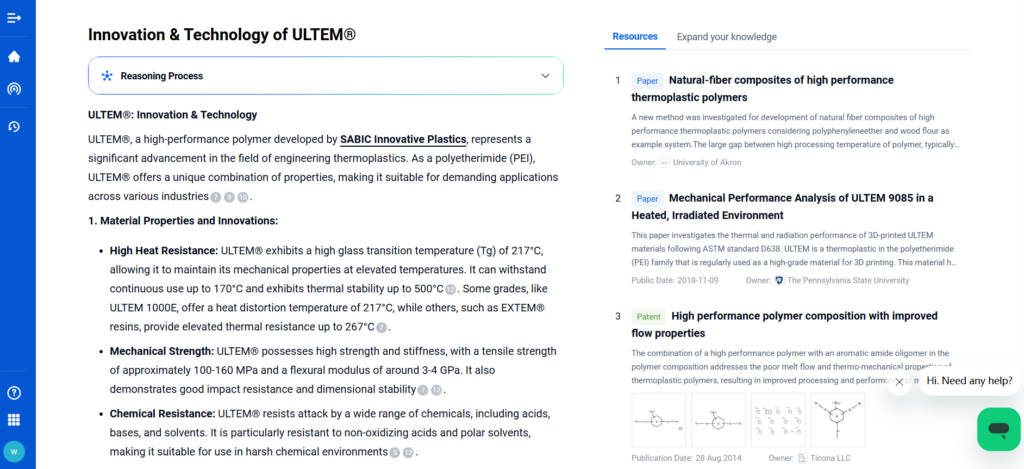
Insights from PatSnap Eureka AI Agent
According to Eureka’s patent analytics, leading innovation clusters in ULTEM include:
Industry Challenges & Future Outlook
Current Pain Points
- Processing Complexity: High molding temperatures require advanced tooling and drying protocols.
- Price Sensitivity: Premium performance comes with a high material cost.
- Environmental Resistance: While resistant to many chemicals, PEI is vulnerable to alkaline attack and UV degradation without stabilizers.
Looking Ahead
With sustainability targets tightening, manufacturers are exploring bio-based monomers and closed-loop recycling for ULTEM. Additionally, demand is rising for PEI composites with enhanced thermal conductivity and EMI shielding, especially in aerospace and EV battery enclosures.
Research Questions:
- Can PEI molecular design further extend its heat resistance and toughness trade-offs?
- What scalable, green synthesis routes could lower production costs and improve recyclability?
Conclusion
ULTEM® (PEI) remains a cornerstone in high-performance polymer engineering. Its unique balance of flame resistance, structural integrity, and dielectric properties positions it at the forefront of innovation in demanding industries. As composite integration and additive manufacturing mature, ULTEM is poised to redefine the possibilities of lightweight, high-reliability materials.
Explore with Eureka
Ready to discover how ULTEM® (PEI) fits into your innovation roadmap?
🔍 Use PatSnap Eureka AI Agent. to:
- Analyze ULTEM-related patents and technical benchmarks
- Explore white space opportunities in PEI applications
- Identify top innovators and grade evolution in high-temp thermoplastics