Polyphenylsulfone (PPSU) has emerged as a high-performance thermoplastic of choice in applications where extreme toughness, heat resistance, and chemical stability are essential. From medical devices to aerospace interiors, PPSU’s unique polymer backbone and amorphous structure make it an ideal solution for environments where conventional materials fail. This blog explores the material’s chemical composition, key properties, grade variants, real-world applications, innovation frontiers, and industry outlook through PatSnap Eureka AI Agent.

Material Composition and Grade Data
PPSU is an amorphous, high-heat-resistant thermoplastic based on polyphenylsulfone polymers. Its backbone consists of alternating phenyl and sulfone groups, contributing to excellent oxidative and hydrolytic stability.
Representative Grades and Suppliers:
- Radel® R-5000 (Solvay): Used extensively in reusable sterilizable medical devices. Offers heat deflection temperature (HDT) of ~207°C.
- Tecason P MT PPSU (Ensinger): Biocompatible grade suitable for medical tools and surgical handles.
- Ultrason® P 2010 (BASF): Designed for food contact and high-clarity applications with exceptional toughness.
These grades typically exhibit:
- Tg (Glass Transition Temperature): 220–230°C
- Tensile Strength: 55–75 MPa
- Flexural Modulus: 2000–2400 MPa
- Notched Izod Impact: No break (unparalleled impact resistance)
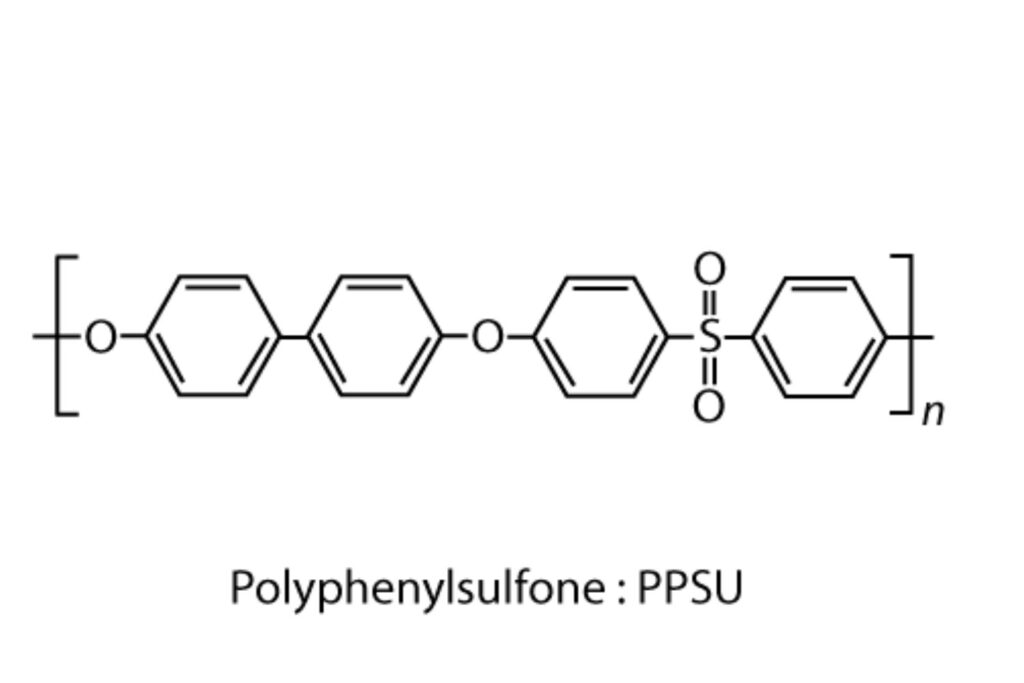
Key Performance Characteristics of PPSU
PPSU outperforms other thermoplastics like PSU and PEI in hydrolytic stability, toughness, and long-term durability. Key features include:
- Exceptional Hydrolysis Resistance: Tolerates over 1000 autoclave cycles without significant loss of mechanical strength.
- Broad Chemical Compatibility: Resistant to detergents, disinfectants, lipids, and sterilants.
- Dimensional Stability: Minimal creep and warping under high heat or pressure.
- Flame Resistance: UL 94 V-0 rated without additives.
Core Applications Across Industries
1. Medical and Healthcare
PPSU’s ability to endure repeated sterilization makes it ideal for:
- Surgical instrument handles
- Dental equipment
- Laparoscopic access ports
- Sterilization trays and caddies
- Blood filtration housings
In the healthcare industry, PPSU has become a preferred material for a wide range of reusable medical devices due to its exceptional resistance to repeated autoclaving and sterilization cycles. As an autoclavable plastic for surgery, it ensures that surgical instruments maintain structural integrity and dimensional stability after dozens of sterilization runs.
Its biocompatible thermoplastic nature makes it ideal for manufacturing surgical instrument handles, dental equipment components, and laparoscopic access ports. Additionally, PPSU is frequently used in sterilization trays, caddies, and blood filtration housings, where both mechanical strength and chemical resistance are vital. Medical device manufacturers often specify PPSU grades tailored for healthcare, ensuring compliance with ISO 10993 and USP Class VI standards.
2. Aerospace and Aviation
Used in aircraft interiors due to:
- FST compliance (Flame, Smoke, Toxicity)
- Dimensional precision in cabin parts
- Weight-saving potential versus metals
Thanks to its excellent Flame, Smoke, and Toxicity (FST) performance, PPSU meets stringent aerospace safety requirements, making it ideal for FST-rated plastic aerospace components. Its ability to retain mechanical precision and dimensional stability under thermal and mechanical stress gives it a competitive edge in cabin interiors.
Aircraft designers use PPSU to replace heavier metal components with lightweight thermoplastics for aircraft applications such as seat frames, ventilation system housings, and cabin paneling. As a high-heat aviation polymer, it supports long-term use in environments that require both thermal endurance and chemical resistance.
3. Food & Beverage Processing
PPSU is FDA-compliant and retains clarity and toughness at high temperatures:
- Reusable baby bottles
- High-heat beverage lines
- Milk dispensers and valves
PPSU is also widely recognized in the food contact industry. It is FDA-compliant, BPA-free, and heat resistant, making it especially suitable for baby bottles and food-grade high-temperature polymer systems. Its high clarity and toughness even at boiling temperatures make it one of the top materials for milk dispensers, valves, and reusable drinkware.
For parents concerned about endocrine disruptors, PPSU in baby bottles provides peace of mind by offering BPA-free heat-resistant plastic solutions that can withstand dishwasher cycles and repeated boiling without degradation.
4. Electronics and Industrial Applications
- Low ionics for semiconductor components
- Transparent housings for inspection tools
- High-strength plastic fasteners
In the electronics and industrial sectors, PPSU delivers low ionic contamination, which is crucial for semiconductor component manufacturing. Its toughness and transparency allow it to be used in clear housings for inspection tools, while its resistance to chemicals and high temperatures supports its role in precision plastic fasteners.
As device complexity increases, the demand for high-purity, thermally stable polymers like PPSU grows. This has led to its rising adoption in semiconductor fabrication environments, where low outgassing and electrical insulation are essential.
Comparative Advantages and Limitations of PPSU
| Property | PPSU | PSU | PEI (ULTEM) |
|---|---|---|---|
| Autoclavability | Excellent | Moderate | Good |
| Impact Resistance | Superior | Moderate | Good |
| Chemical Resistance | Broad | Narrower | Good |
| Transparency | Slight amber | Transparent | Amber |
| Price | High | Medium | High |
Limitations:
- High material cost compared to commodity plastics
- Processing requires higher temperatures (350–400°C)
- Slight amber hue may not suit all aesthetic needs
Industry Challenges and Future Outlook of of PPSU
Advancements in polyphenylsulfone (PPSU) are pushing the boundaries of performance, sustainability, and manufacturability. Below are key innovation areas transforming how PPSU is used across sectors:
1. Specialized PPSU Resin Grades
- Medical-grade PPSU (e.g., Radel® R-5000):
Offers superior hydrolytic stability and compliance with ISO 10993, ideal for biocompatible thermoplastics in surgical tools and sterilization trays. - Aerospace-grade PPSU (e.g., Radel® R-7159):
Provides FST-compliant properties and high optical clarity, supporting lightweight aerospace polymers used in cabin interiors and ducting systems.
2. High-Flow Formulations for Complex Designs
- Enables efficient injection molding of large or intricate parts.
- Reduces cycle time and improves dimensional accuracy—essential for precision laparoscopic components and fluidic connectors.
- Supports thinner wall sections without sacrificing durability or clarity.
3. Reinforced PPSU Composites
- Incorporation of glass fiber or carbon fiber boosts mechanical strength.
- Offers up to 60% weight savings over metal alternatives, ideal for industrial automation and aircraft systems.
- Enhances resistance to creep and fatigue in high-load environments.
4. Research in Bio-based and Sustainable PPSU
- Efforts are underway to develop autoclavable bioplastics using renewable feedstocks.
- Closed-loop recycling initiatives are emerging to improve PPSU lifecycle sustainability without compromising thermal or oxidative stability.
- Supports alignment with global “dual carbon” targets and eco-certification needs.
5. Transparent PPSU for Smart Applications
- Optimized formulations allow for sensor-compatible housings in medical diagnostics and lab automation.
- Maintains impact strength and optical clarity even after repeated autoclaving—crucial for next-gen medical and analytical devices.
6. Insights from PatSnap Eureka AI Agent
PatSnap Eureka AI Agent help you dive deeper into PPSU’s patent landscape, grade-level technical specs, and emerging innovations across medical, aerospace, and industrial sectors.
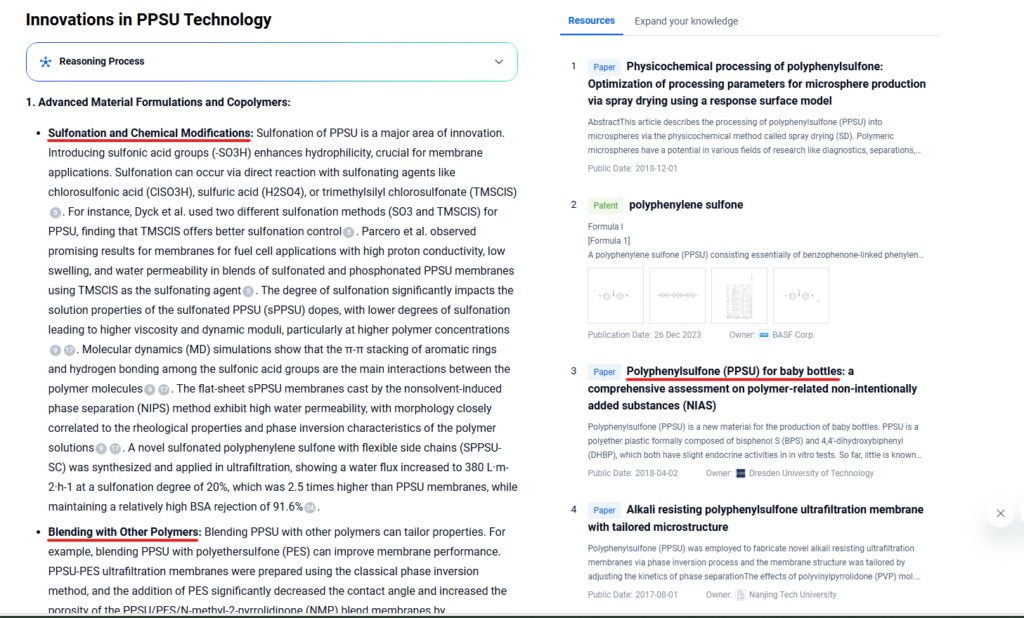
Future Outlook & Research Directions of PPSU
Looking forward, PPSU’s market trajectory is driven by the convergence of biocompatibility, thermal endurance, and regulatory compliance. Its role in the transition toward reusable, sterilizable medical devices aligns with global sustainability efforts to reduce hospital plastic waste.
In aerospace and defense, new lightweight PPSU composites are being developed for next-generation cabin systems and advanced ventilation control units, responding to increased demand for FST-compliant, low-weight alternatives to aluminum.
In the electronics field, as semiconductor geometries shrink, the material’s low ionic contamination and high dielectric stability will become even more critical. Researchers are also exploring recycling pathways for PPSU, although its high thermal processing window presents technical hurdles.
Key areas of ongoing exploration include:
- Biobased PPSU alternatives from renewable phenyl sources.
- Improved injection molding cycles with lower melt viscosities.
- Expanded transparent color palettes that maintain UV stability.
As PPSU continues to evolve, its versatility and performance profile will make it increasingly central in sectors that demand sterilizable, high-performance thermoplastics.
Conclusion
With unmatched performance under pressure and proven grade diversity, PPSU continues to gain traction across regulated and high-performance sectors. Leverage PatSnap Eureka AI Agent to explore real-time IP insights, uncover white spaces in PPSU formulations, and benchmark emerging competitors.