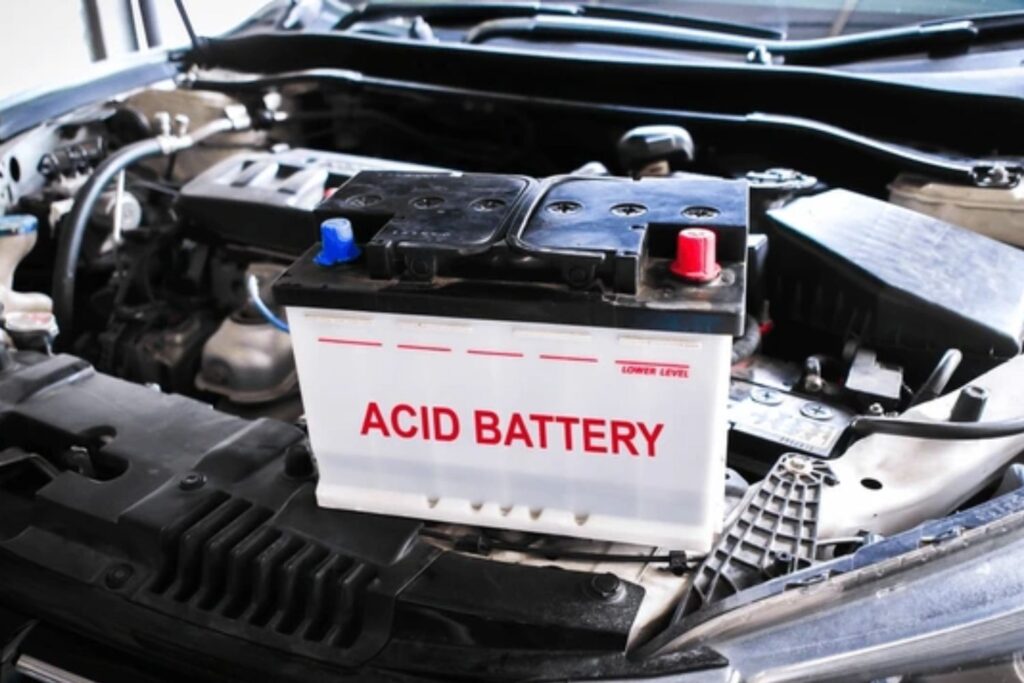
Battery acid is a fundamental component in the performance of lead-acid batteries, which power everything from vehicles to backup energy systems. While often seen as a commodity material, battery acid’s precise chemical makeup, purity levels, and acid concentration determine the efficiency, safety, and longevity of battery systems. Understanding battery acid from a materials science standpoint is essential for professionals in automotive, energy storage, electronics, and defense sectors.
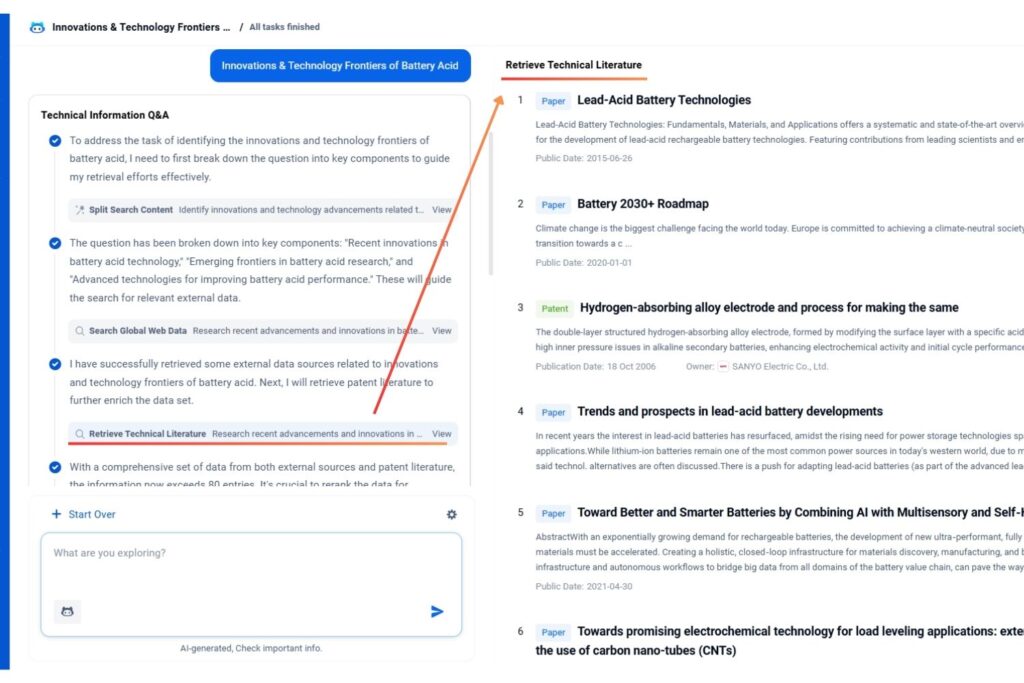
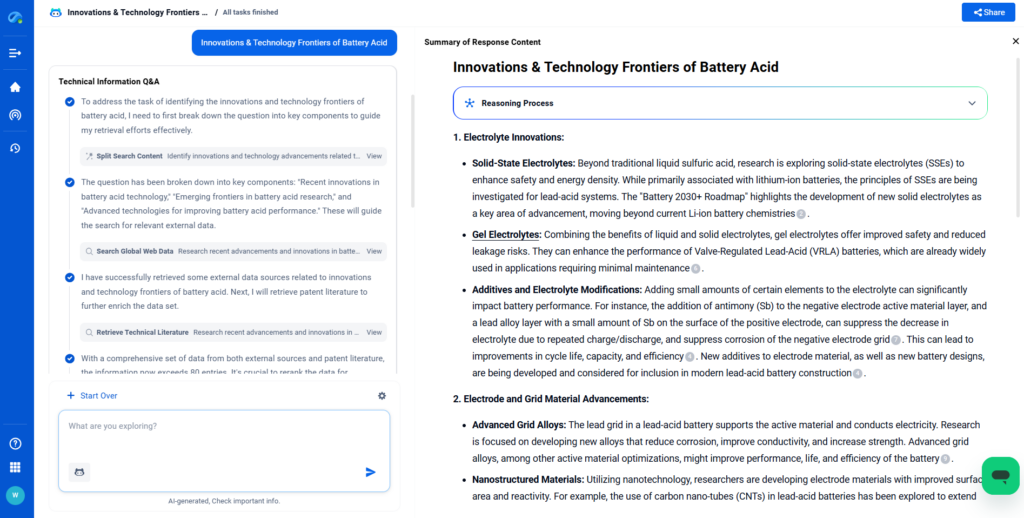
This blog explores its composition, grades, performance attributes, and how emerging technologies are transforming its formulation and usage across industries through PatSnap Eureka AI Agent.
Ask Patsnap Eureka AI
Patsnap Eureka AI provides instant, trusted answers to any technical questions.
Battery acid refers primarily to diluted sulfuric acid (H₂SO₄), typically at concentrations between 30–38% by weight, used as the electrolyte in lead-acid batteries. In these systems, the acid enables electrochemical reactions between the lead dioxide (PbO₂) cathode and the lead (Pb) anode, facilitating charge storage and discharge cycles.
The reliability of UPS systems, vehicle starting batteries (SLI), and even military-grade energy systems depends heavily on the quality, concentration, and purity of this electrolyte. Moreover, its recyclability and compatibility with other energy materials position it as a key substance in circular battery economies.
Material Composition and Grade Data
Battery acid is not a one-size-fits-all material—its formulation varies depending on use case, manufacturer, and safety standards. Key parameters include acid concentration, impurities (metal ion content), and stability.
Density is another critical performance metric, typically around 1.25–1.28 g/cm³ at 25°C.
Key Properties That Define Battery Acid
Battery acid exhibits several key physicochemical properties that directly impact battery design and efficiency:
High Ionic Conductivity: Enables fast charge/discharge rates
Thermal Stability (up to ~300°C decomposition): Critical for safety
Corrosivity: Requires robust containment and material compatibility (e.g., polypropylene casings)
Electrochemical Reactivity: Reacts predictably with Pb/PbO₂ electrodes
Reversibility: Supports deep discharge cycles, particularly in flooded cell systems
Core Applications Across Industries
Battery acid, primarily as sulfuric acid electrolyte, is indispensable in lead-acid battery systems used across diverse sectors. Its specific gravity, ionic conductivity, and electrochemical compatibility with lead-based electrodes make it uniquely positioned for applications demanding high reliability, cost-efficiency, and recyclability.
Battery acid (typically ~35% H₂SO₄) is central to SLI (starting, lighting, ignition) systems in automotive applications. Its ability to deliver high cold-cranking amps (CCA) in sub-zero conditions is why it remains dominant despite the rise of lithium-ion. Example: VARTA’s Black Dynamic 12V batteries employ standardized electrolyte formulations to ensure performance over 50,000 engine starts.
2. Industrial Equipment & Electric Material Handling
In forklifts, pallet jacks, and AGVs, traction batteries use higher-density battery acid (SG ≈ 1.280) to withstand deep discharge cycles and maintain power delivery across 8–12 hour shifts. Example: Crown Battery’s industrial cells integrate electrolyte circulation systems to avoid stratification, maintaining homogeneous acid distribution during high-load operations.
3. Renewable Energy Storage Systems
Remote or off-grid solar installations rely on sealed or flooded lead-acid batteries with carefully balanced sulfuric acid electrolytes to buffer charge cycles. Acid formulations are adjusted for minimal gassing and extended float service. Example: Trojan’s Solar Signature line uses proprietary Alpha Plus™ paste chemistry in conjunction with optimized electrolyte blends for grid-independent rural electrification projects.
4. Uninterruptible Power Supply (UPS) & Telecom Infrastructure
Battery acid is immobilized in Absorbent Glass Mat (AGM) or gel form in VRLA systems to enable sealed, low-maintenance UPS batteries with high reliability. Example: EnerSys PowerSafe SBS series employs silica-gelled sulfuric acid to minimize electrolyte evaporation and extend service life in mission-critical telecom installations.
5. Railway and Mass Transit Systems
Locomotive starter batteries and auxiliary systems in trains utilize high-durability acid-based batteries. The electrolyte must maintain ionic conductivity even under vibration and temperature variation. Example: Exide Railway cells use reinforced acid containment systems and ultra-pure electrolyte to meet EN 50155 safety requirements.
6. Military & Aerospace Auxiliary Power Units (APUs)
Defense platforms, such as mobile radar units and UGVs (unmanned ground vehicles), deploy lead-acid batteries filled with high-purity sulfuric acid to ensure electrochemical stability in harsh climates. Example: MIL-PRF-32143-compliant batteries utilize battery acid with <2 ppm metallic contamination to meet NATO environmental and durability standards.
7. Stationary Energy & Smart Grid Backup
For grid stabilization and peak-shaving applications, stationary VRLA battery banks use engineered sulfuric acid gels for minimal self-discharge and long calendar life. Example: FIAMM’s SoNick hybrid VRLA systems integrate acid with phase-change cooling and real-time electrolyte impedance monitoring for data center redundancy.
How Battery Acid Compares to Other Electrolytes
Property
Battery Acid (H₂SO₄)
Lithium-ion Electrolytes
Alkaline Electrolytes
Ionic Conductivity
High
Moderate
Moderate
Environmental Impact
Recyclable
Toxic solvent-based
Less corrosive
Operating Voltage
2.1V per cell
3.6–3.7V per cell
1.5V per cell
Cost per Wh
Low
High
Medium
Safety (Leak Risk)
Moderate
High (flammable)
Low
Battery acid is far more cost-effective and easier to recycle compared to lithium-based systems, making it ideal for circular economy applications.
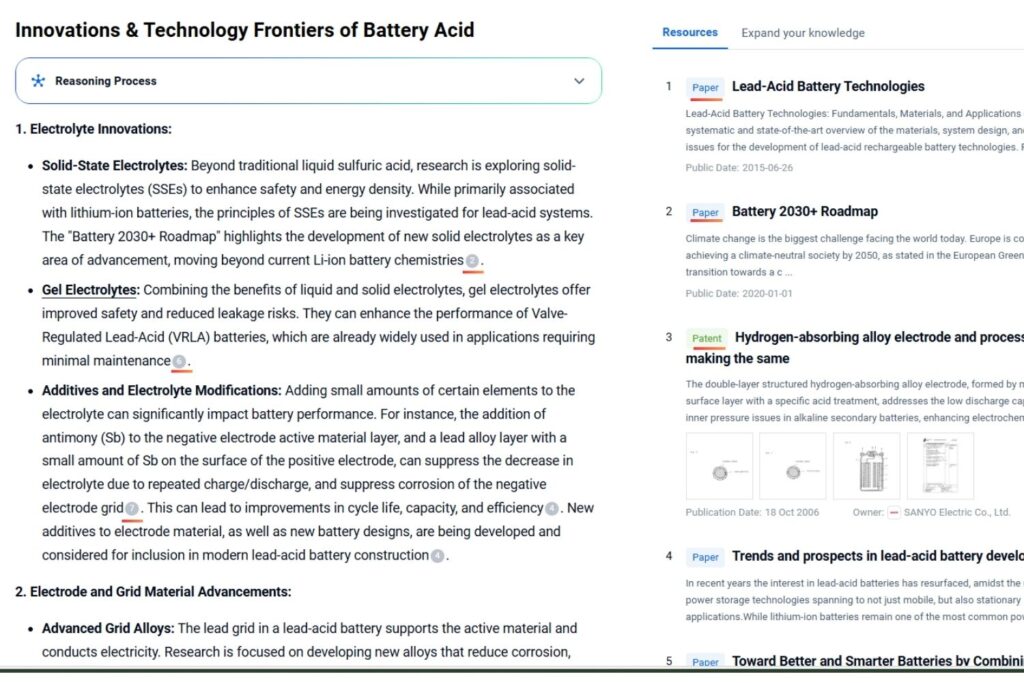
Innovations & Technology Frontiers
Recent innovations are pushing battery acid beyond traditional roles:
Electrolyte Additives: Tin, selenium, or carbon nanoparticles improve performance in industrial batteries.
Gel and AGM Electrolytes: Acid is immobilized to prevent leakage and enhance safety.
Bio-derived Sulfuric Acid: From sulfur recovery in waste treatment—reduces carbon footprint.
AI-Optimized Electrolyte Formulation: Predicts performance using ML on electrolyte composition data.
🔍 Power Your R&D with PatSnap Eureka AI Agent
Map innovation pathways of Battery acid
in synthetic lubricant and polymer sectors
Forecast material behavior across conditions
Challenges and What’s Next for Battery Acid
Despite its established use, battery acid faces technical and environmental challenges:
Key Limitations:
Corrosivity: Limits compatibility with lightweight casings or flexible batteries.
Temperature Sensitivity: Freezing or overheating can cause stratification or gassing.
Energy Density: ~35 Wh/kg vs. >150 Wh/kg for Li-ion.
Future Outlook:
Enhanced electrolyte monitoring systems to track acid degradation.
Development of hybrid battery systems combining acid and solid-state features.
Greater emphasis on recycling infrastructure to handle acid neutralization and regeneration.
Conclusion
Battery acid may be centuries old, but it remains a vital player in today’s evolving energy landscape. From automotive to industrial energy storage, its optimized formulations continue to deliver high performance at low cost. As innovation accelerates in both chemistry and monitoring technologies, battery acid is poised to remain relevant even in a lithium-dominated future.
FAQs
Q1: What is the specific gravity of standard battery acid?
A: Around 1.265 to 1.280 g/cm³, depending on application.
Q2: Can battery acid be reused or recycled?
A: Yes. Battery acid can be neutralized, reconditioned, or reused in regenerated batteries.
Q3: Is battery acid suitable for high-temperature applications?
A: Up to ~60°C in controlled environments. For extreme conditions, gel variants or cooling systems are used.
Q4: How is battery acid different from lab-grade sulfuric acid?
A: Battery acid is diluted and tailored for electrochemical use; lab-grade acid is more concentrated and purer for analytical applications.
Q5: Who are the major suppliers of battery-grade acid?
A: BASF, ReAgent UK, Sigma-Aldrich, Brenntag, and ChemTrade Logistics.
Want to explore electrolyte additives, acid grade suppliers, or emerging battery chemistry trends? 👉 Use PatSnap Eureka AI Agent to track patent filings, supplier specs, and innovation trends across battery technologies—efficiently and insightfully.