


In chemistry, understanding how atoms gain or lose electrons is key to predicting chemical behavior. One important property in this context is electron affinity (EA)—the amount of energy released or absorbed when an atom gains an electron. It plays a crucial role in explaining why certain elements form negative ions, how elements behave in reactions, and the overall trends in the periodic table.
This article explains what electron affinity(EA) is, how it works, why it varies among elements, and how it influences chemical bonding and reactivity.
What Is Electron Affinity (EA)?
What is Electron Affinity (EA)? Eureka Technical Q&A explains that it’s the energy change when an atom gains an electron, reflecting how strongly an atom attracts additional electrons—essential for understanding chemical bonding and reactivity trends.

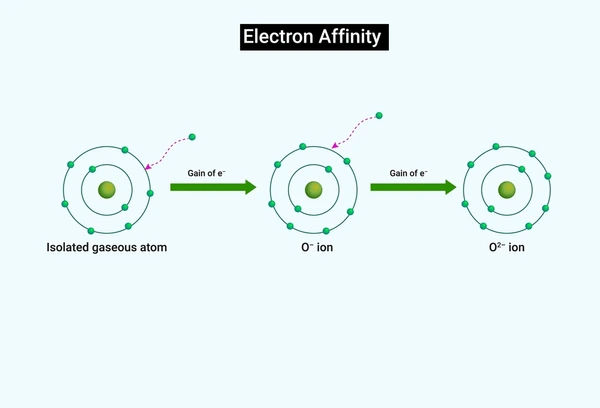
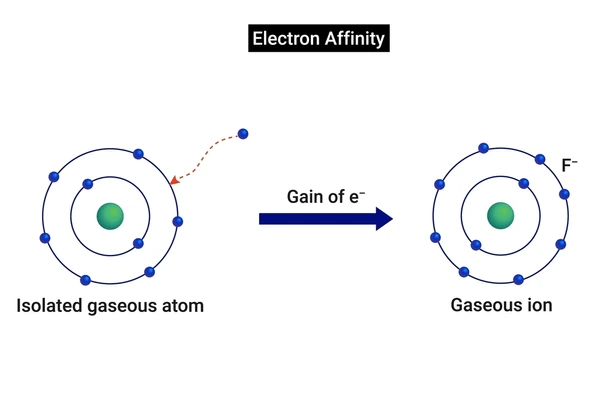
Electron affinity refers to the energy change that occurs when a neutral atom in the gaseous state gains an electron to form a negative ion. It is usually expressed in kilojoules per mole (kJ/mol).
If energy is released when the atom gains an electron, the EA is negative, indicating a favorable process. Most nonmetals have negative EA values, meaning they tend to accept electrons readily. On the other hand, if energy must be added to force the atom to accept an electron, the value is positive, indicating an unfavorable process.
Electron Affinity Example
Consider the chlorine atom:
Cl (g) + e⁻ → Cl⁻ (g) ΔE = –349 kJ/mol
This reaction releases energy, so chlorine has a high (more negative) electron affinity. This helps explain its strong tendency to form Cl⁻ ions in compounds.
Periodic Trends in Electron Affinity
EA follows general patterns in the periodic table:
Across a Period (Left to Right)
- EA becomes more negative.
- Atoms have more protons and greater nuclear charge, attracting electrons more strongly.
- Nonmetals like oxygen, fluorine, and chlorine exhibit high (negative) EA.
Down a Group (Top to Bottom)
- EA becomes less negative.
- Larger atomic size reduces the attraction between the nucleus and the added electron.
- For example, fluorine has a more negative EA than iodine.
However, some anomalies exist due to electron configurations. For example, nitrogen’s half-filled p orbitals make it less willing to accept an extra electron, so its EA is unexpectedly low.
Factors Affecting Electron Affinity
- Atomic Size: Smaller atoms attract electrons more easily, leading to more negative affinity.
- Nuclear Charge: A higher effective nuclear charge increases the atom’s pull on electrons.
- Electron Configuration: Stable configurations (e.g., noble gases or half-filled subshells) resist adding electrons, making their affinity less negative or even positive.
Electron Affinity vs. Electronegativity
While they sound similar, these are distinct concepts:
- Electron affinity is the energy change when an atom gains an electron.
- Electronegativity is a measure of how strongly an atom pulls electrons within a chemical bond.
Both properties generally increase across a period and decrease down a group, but electronegativity is a relative scale (like the Pauling scale), whereas EA is based on actual energy changes.
Applications and Importance
Electron affinity influences how materials gain or lose electrons, making it a critical property in advanced material design. Scientists across industries rely on this property to improve device performance, chemical synthesis, and emerging technologies.
Catalysis and Industrial Chemistry
Catalysts rely on their ability to attract electrons during chemical reactions. Chemists study this property to design better catalysts for producing fuels, chemicals, and pharmaceuticals. Optimized electron behavior helps increase reaction efficiency and reduce waste.
Biosensor Development
Biosensor engineers use this concept to enhance bonding between sensor surfaces and biological molecules. Stronger interactions improve sensitivity and accuracy in medical diagnostics and environmental monitoring devices.
Solar Energy Conversion
Photovoltaic researchers select materials based on their ability to accept electrons efficiently. This property directly impacts how solar cells convert sunlight into electricity. Materials with the right characteristics improve energy output and panel efficiency.
Field Emission Devices
Devices like cold cathodes and electron microscopes need materials that release electrons easily. Materials with specific energy characteristics support sharper imaging and more reliable electron emission in advanced displays and instruments.
Organic Electronics
Engineers developing OLEDs and OFETs adjust the electronic structure of organic materials for better performance. Tailoring how these materials accept electrons helps create flexible, lightweight devices with precise electrical behavior.
Chemical Stability and Material Design
Scientists use electron behavior to evaluate a material’s resistance to electronic changes. This trait, known as chemical hardness, helps predict a material’s stability and resistance to corrosion or reaction.
Designing Superhalogens
Chemists design superhalogens by maximizing a molecule’s electron attraction. These compounds offer potential in superconductors and high-energy materials for future energy storage and electronics.
Quantum Computing Materials
Quantum scientists explore electron behavior to design stable, reliable qubits. These properties help manage charge and spin, which are essential for building next-generation quantum processors.
Application Cases
| Product/Project | Technical Outcomes | Application Scenarios |
|---|---|---|
| OLED Materials Novaled GmbH | Achieved low-lying LUMO levels for efficient charge and energy transfer, resulting in thermally stable and conductive layers. | Organic electronic devices, particularly OLEDs with enhanced performance. |
| Molecular Doping Materials Novaled GmbH | Improved charge carrier injection, reduced operating voltage and production complexity in OLEDs. | Efficient and cost-effective OLED displays and lighting. |
| NEA Materials Peking University | Conduction band minimum higher than surface vacuum energy level, facilitating easier electron emission. | Cold cathodes, photoelectron emission devices, and secondary electron emission applications. |
| Plasmon-Driven Catalysis Platform Northwestern University | Controlled anion radical formation for bipyridyl complexes using gold nanoparticles and specific laser excitations. | Enhanced molecular-scale catalysis, improved biosensor design, and advanced solar energy capture systems. |
FAQs
Which element has the highest electron affinity?
Chlorine has the most negative electron affinity (–349 kJ/mol), even higher than fluorine due to repulsion effects in fluorine’s compact structure.
Do noble gases have electron affinity?
They have near-zero or slightly positive electron affinities because their full outer shells resist gaining more electrons.
Why is electron affinity negative for some elements?
Negative values indicate that the atom releases energy when gaining an electron—a favorable and exothermic process.
What’s the difference between first and second electron affinity?
First EA refers to the energy change when one electron is added. The second EA (adding a second electron to an already negative ion) is always positive due to repulsion.
Conclusion
Electron affinity is a key atomic property that reveals how atoms interact with electrons. By understanding how much energy is released or required during electron gain, chemists can predict reactivity, bond formation, and periodic trends. Although it varies across the periodic table, EA offers valuable insights into chemical behavior and bonding patterns, particularly in nonmetals and reactive elements.
Whether you’re analyzing halogen reactions or studying redox systems, grasping EA will enhance your understanding of atomic interactions and chemical energetics.
To get detailed scientific explanations of Electron Affinity, try Patsnap Eureka.
