


What Is NTP?
Network Time Protocol (NTP) is a critical networking protocol used to synchronize computer clocks across data networks. It ensures that participating systems stay in sync with Coordinated Universal Time (UTC) within just a few milliseconds. NTP operates as part of the TCP/IP protocol suite and functions at the application layer of the OSI model. This synchronization is vital for maintaining accurate timestamps, improving coordination, and supporting time-sensitive operations in modern networks. This article explores how NTP works, its importance, and its applications in various industries.
History and Development of NTP

Early Versions and Evolution
The first version of the protocol was introduced in 1980, followed by version 2 in the late 1980s and version 3 in 1993. These early versions established the groundwork for reliable time synchronization across the internet. In 1994, version 4 (NTPv4) became the standard, as outlined in RFC 5905. This update introduced significant improvements, including better accuracy and enhanced security features.
Key Features
- 1. Time Synchronization
The protocol ensures accurate synchronization by aligning the client’s clock with a server’s precise time. - 2. Hierarchical Architecture
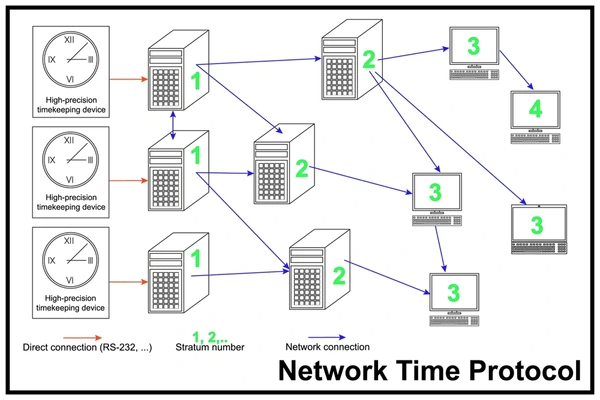
A hierarchical system minimizes error propagation, with primary servers (stratum 1) at the top and secondary servers (stratum 2 and above) ensuring consistent accuracy. - 3. Accurate Server Selection
The system selects the most accurate server from a pool, improving reliability and synchronization precision.
How NTP Works: Protocol and Mechanism
Basic Principle
Time synchronization aligns clocks on different devices by exchanging time data over a network. It uses a hierarchical structure to synchronize clocks, aiming to keep them accurate within a few milliseconds of Coordinated Universal Time (UTC).
Stratum Levels
Time synchronization operates across multiple stratum levels, starting with Stratum Zero at the top. Stratum Zero includes highly accurate atomic clocks maintained by government agencies, serving as the ultimate authority for timekeeping.
Mechanism of Synchronization
- Time Exchange Messages: Clients and servers exchange messages with timestamps to calculate the time difference and achieve accurate synchronization.
- UDP Transmission: Time data is sent over UDP ports, ensuring efficient and timely delivery of synchronization messages.
- Clock Adjustment Algorithms: Algorithms adjust local clocks using techniques like phase-locked loops and frequency correction to reduce errors.
Implementation Across Platforms
Time synchronization can be implemented on various platforms, including UNIX and Windows. It can also integrate with GPS systems to enhance accuracy and adapt to specific network environments.
Security Considerations
Secure time synchronization is critical for applications like network security and forensic analysis. Strong implementations protect against vulnerabilities, ensuring the integrity of time-sensitive operations.
NTP Stratum Levels and Hierarchical Structure
Stratum Levels
Time synchronization uses a hierarchical system called stratum levels, ranging from 0 to 16.
- Stratum 0: The highest level, including ultra-accurate time sources like atomic clocks or GPS receivers, which provide direct Coordinated Universal Time (UTC).
- Stratum 1: These are time servers directly synchronized with Stratum 0 sources, offering high accuracy within a few milliseconds.
- Stratum 2 and Above: These servers synchronize with Stratum 1 servers. While accuracy decreases with each level, it remains sufficient for most applications.
Hierarchical Structure
- Top Levels: Stratum 0 and 1 servers provide the most accurate time at the top of the hierarchy.
- Lower Levels: Clients typically connect to Stratum 2 or 3 servers, which sync with higher-level servers.
- Efficiency: This structure efficiently distributes time while minimizing network latency, ensuring reliable synchronization even for clients not directly linked to Stratum 0 or 1 sources.
Time Synchronization Process
- Request and Response: Clients send requests to servers, which respond with the current time. The client then calculates the time offset and round-trip delay.
- Continuous Adjustment: The system monitors and adjusts for clock drift or network conditions, maintaining accurate time over extended periods.
Implementing NTP: Client-Server Model
- Step 1: Set Up the Server
Install time synchronization software on a server machine and configure it to act as a reliable time source. Connect the server to a trusted external source, such as an atomic clock or GPS time server, to ensure accuracy. - Step 2: Configure the Clients
Set up client machines to synchronize their clocks with the server. Configure the clients to send time requests to the server and apply the received data for accurate synchronization. - Step 3: Test the Synchronization
Verify that client clocks align with the server clock within an acceptable error range. Regular testing ensures the system functions correctly and maintains precision.
Key Considerations for Implementation
- Reliable Time Source: Ensure the server connects to a high-quality source, such as an atomic clock or GPS, for accurate timekeeping.
- Security Measures: Protect the service by implementing encryption and authentication mechanisms to prevent unauthorized access or attacks.
- Network Design: Optimize the network topology to reduce latency and minimize synchronization errors across the infrastructure.

Applications and Benefits of NTP
Biomedical Applications
- Cancer Therapy: Non-thermal plasma shows promise in cancer treatment by inducing ferroptosis, a type of programmed cell death, in cancer cells.
- Wound Healing and Disinfection: It enhances blood clotting, promotes wound healing, and provides disinfection, with some applications already in clinical trials.
- Pain Management: Neurotropin, a drug derived from rabbit skin inoculated with vaccinia virus, effectively treats neuropathic pain like post-herpetic neuralgia and chronic low back pain.
Environmental Applications
- Pollutant Degradation: This technology efficiently breaks down hazardous pollutants, offering a sustainable solution for environmental protection.
- Food Preservation: Non-thermal plasma extends the shelf life of food by inactivating pathogens while preserving nutritional quality.
Industrial Applications
- Surface Treatment: It improves material properties in surface treatment and coating processes, enhancing durability and performance.
- Combustion Efficiency: Plasma-assisted combustion increases fuel efficiency and lowers emissions, making it a valuable tool in energy production.
Technological Applications
- Time Synchronization: Network time synchronization ensures precise clock alignment in computer systems, supporting accurate data and system operations.
Application Cases
| Product/Project | Technical Outcomes | Application Scenarios |
|---|---|---|
| NTP Device for Biological Studies Drexel University College of Medicine | Enables studying the impact of cell structure, viability, and enzymatic processes on NTP electrical properties, providing insights into the feedback loop between biological targets and NTP sources. | Investigating the interactions between biological targets and NTP sources for improved control of clinical NTP devices. |
| Nuclear Thermal Propulsion (NTP) Fuel Elements Marshall Space Flight Center | Refractory carbides like NbC and (ZrNbW)C have high melting points, low vapor pressures at elevated temperatures, and low thermal neutron cross-sections, making them promising materials for NTP fuel elements or protective coatings. | Nuclear thermal propulsion systems for interplanetary missions. |
| NTP for Spore Germination Studies The University of Tennessee at Martin | Real-time FTIR spectroscopy can probe biochemical changes in spores during germination and after NTP treatment, providing insights into the effect of NTP on spore structural components and germination kinetics. | Studying the impact of NTP on spore germination and inactivation for applications in food preservation and sterilization. |
| NTP for HCV Inactivation University of Diyala | NTP can reduce viral load in HCV infections by generating reactive oxygen species, but it also increases oxidative stress, which may lead to systemic oxidative damage. | Exploring the potential of NTP for inactivating HCV and studying its impact on oxidative stress in HCV patients. |
To get detailed scientific explanations of NTP, try Patsnap Eureka.
