
Data clustering-based robust scale invariant feature transform (SIFT) feature matching method
A feature matching and data clustering technology, which is applied in the direction of instruments, character and pattern recognition, computer components, etc., can solve the problems of reduced matching robustness and inability to solve the problem of SIFT feature noise sensitivity, so as to reduce the amount of data and improve Robustness, efficiency-enhancing effects
Patent Information
- Authority / Receiving Office
- CN · China
- Patent Type
- Patents(China)
- Current Assignee / Owner
- Publication Date
- 2013-04-24
- Estimated Expiration
- Not applicable · inactive patent
Smart Images
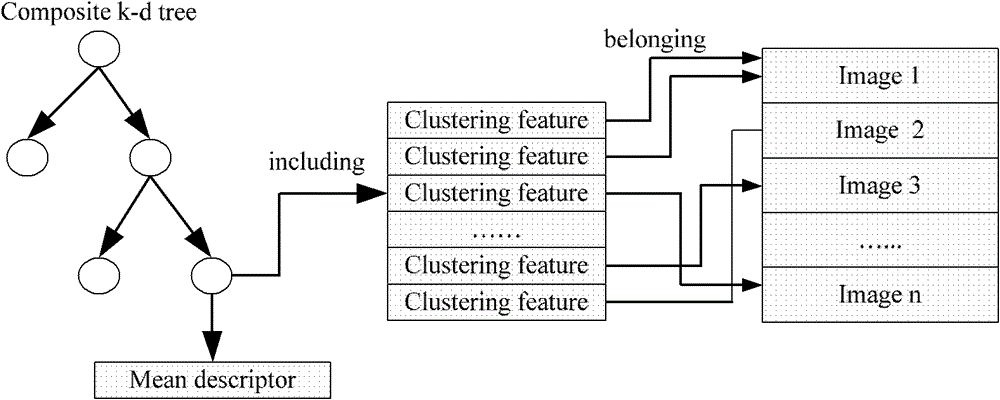
Figure 1 
Figure 2 
Figure 3
Abstract
Description
technical field
[0001] The invention belongs to the technical field of computer augmented reality, and specifically performs robust matching on a SIFT feature set under the condition of a large amount of data, eliminates the influence of noise in the matching process, and improves the robustness of feature matching. Background technique
[0002] SIFT feature matching technology is an important research content in computer image and vision, and has been widely used in many fields such as image retrieval, target recognition, 3D reconstruction and camera pose recovery.
[0003] By treating SIFT feature descriptors as Cartesian coordinates in high-dimensional Euclidean space and using Euclidean distance as a similarity measure, the SIFT feature matching problem can be transformed into a query problem of the nearest geometric points in Euclidean space. As one of the most important branch and bound methods, the k-d data structure can effectively realize spatial division and is wid...
Examples
Embodiment Construction
[0020] Table 1 has provided concrete steps of the present invention:
[0021]
[0022]
[0023] Table 1
[0024] 1. Synthetic k-d data structure construction and feature clustering in the offline stage
[0025] figure 1 A schematic diagram of the synthetic k-d data structure is given.
[0026] In the offline stage, the reference image SIFT feature set is obtained first, and all reference image SIFT feature sets are clustered. In the feature clustering method, common features are obtained directly from the image by the SIFT algorithm, which can be denoted as F s ={b i , d d}, where b i is the subordinate image, d d is a feature descriptor. The clustering feature is a collection of common features, denoted as F c ={F ss , d md}, where F ss is the general feature set, d md is the cluster average descriptor, its value is: where k is the number of common features included in the clustering feature, (d d ) i is the i-th common feature descriptor. This value i...