
Electronic view finder lens
An electronic viewfinder and lens technology, applied in instruments, optical components, optics, etc., can solve the problems of unclear image display details, limited diopter adjustment range, and unclear eyes, etc., to achieve improved color reproduction and geometric transfer The effect of improved function and high imaging definition
Patent Information
- Authority / Receiving Office
- CN · China
- Patent Type
- Applications(China)
- Current Assignee / Owner
- Publication Date
- 2016-05-25
Smart Images
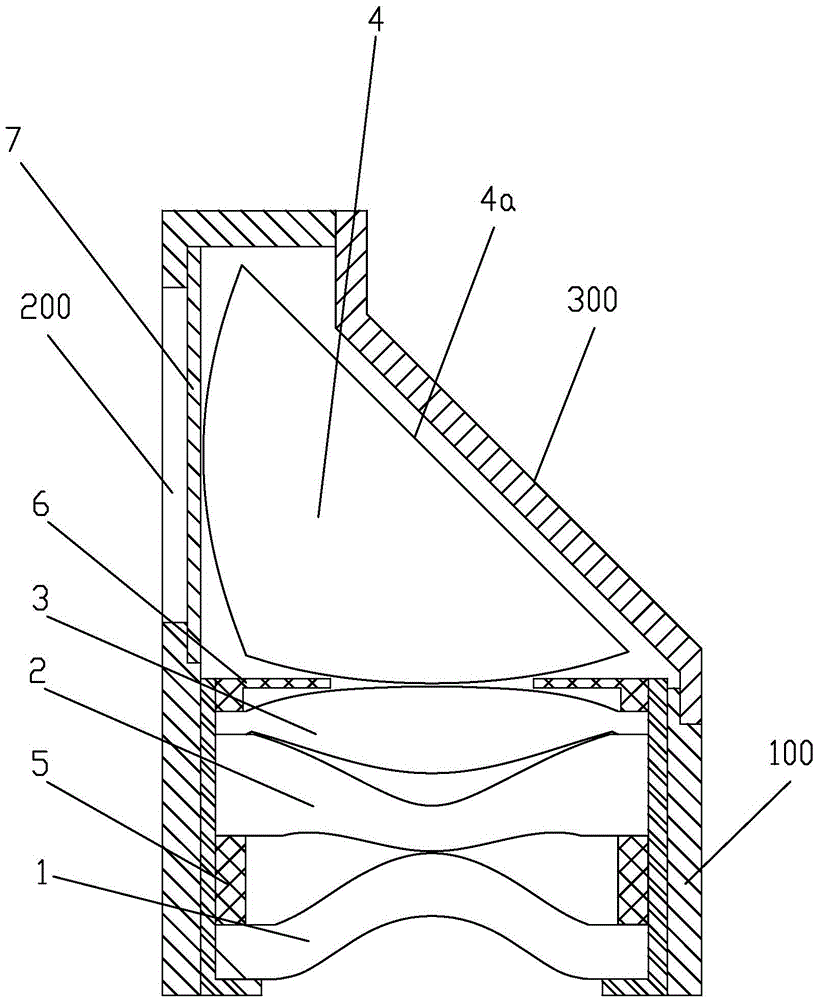
Figure 1 
Figure 2 
Figure 3
Abstract
Description
Technical field
[0001] The invention relates to an electronic viewfinder lens.
Background technique
[0002] The viewfinder is a camera component that is often overlooked but is actually very important. It is often used in the virtual viewfinder optical lens of digital cameras, and can also be used in the latest popular head-mounted high-definition smart mobile theaters. Equipping different types of viewfinders also determines The type of camera, and even the grade of the camera. Electronic viewfinders, popularized by the popularity of single-cameras, have their own unique structure and advantages and disadvantages. With the advancement of electronic technology, electronic viewfinders will become more and more common, and the performance of electronic viewfinders will gradually improve.
[0003] At present, the electronic viewfinder (EVF, Electronic Viewfinder) generally has such shortcomings: the field of view is relatively small, the details of the image display are ...
Examples
Embodiment Construction
[0026] The present invention will be further described below in conjunction with the accompanying drawings:
[0027] An electronic viewfinder lens includes a lens barrel 100, wherein a first lens 1, a second lens 2 and a third lens 3 are sequentially arranged in the lens barrel 100 from bottom to top, and the first lens 1 is a plastic positive lens. lens, the second lens 2 is a plastic negative lens, the third lens 3 is a plastic positive lens, and the lens barrel 100 is provided with a light-passing hole 200 for human observation. A prism 4 with a positive focal length is arranged between the hole 200 and the third lens 3. The surfaces of the prism 4 facing the third lens 3 and the light-passing hole 200 are all aspherical surfaces, and the prism 4 is used to reflect light. The surface 4a is a total reflection surface. The material of the first lens 1 is PMMA material, and its focal length is positive. The material of the second lens 2 is OKP4HT material, and its focal leng...