
A high-energy-efficiency resource multiplexing method for D2D communication in heterogeneous networks
A heterogeneous network and resource multiplexing technology, which is applied in the field of downlink RBs multiplexing for cell users, high energy efficiency time-frequency resource multiplexing, and can solve problems such as CUs cross-layer interference
Patent Information
- Authority / Receiving Office
- CN · China
- Patent Type
- Patents(China)
- Current Assignee / Owner
- Publication Date
- 2020-02-18
Smart Images
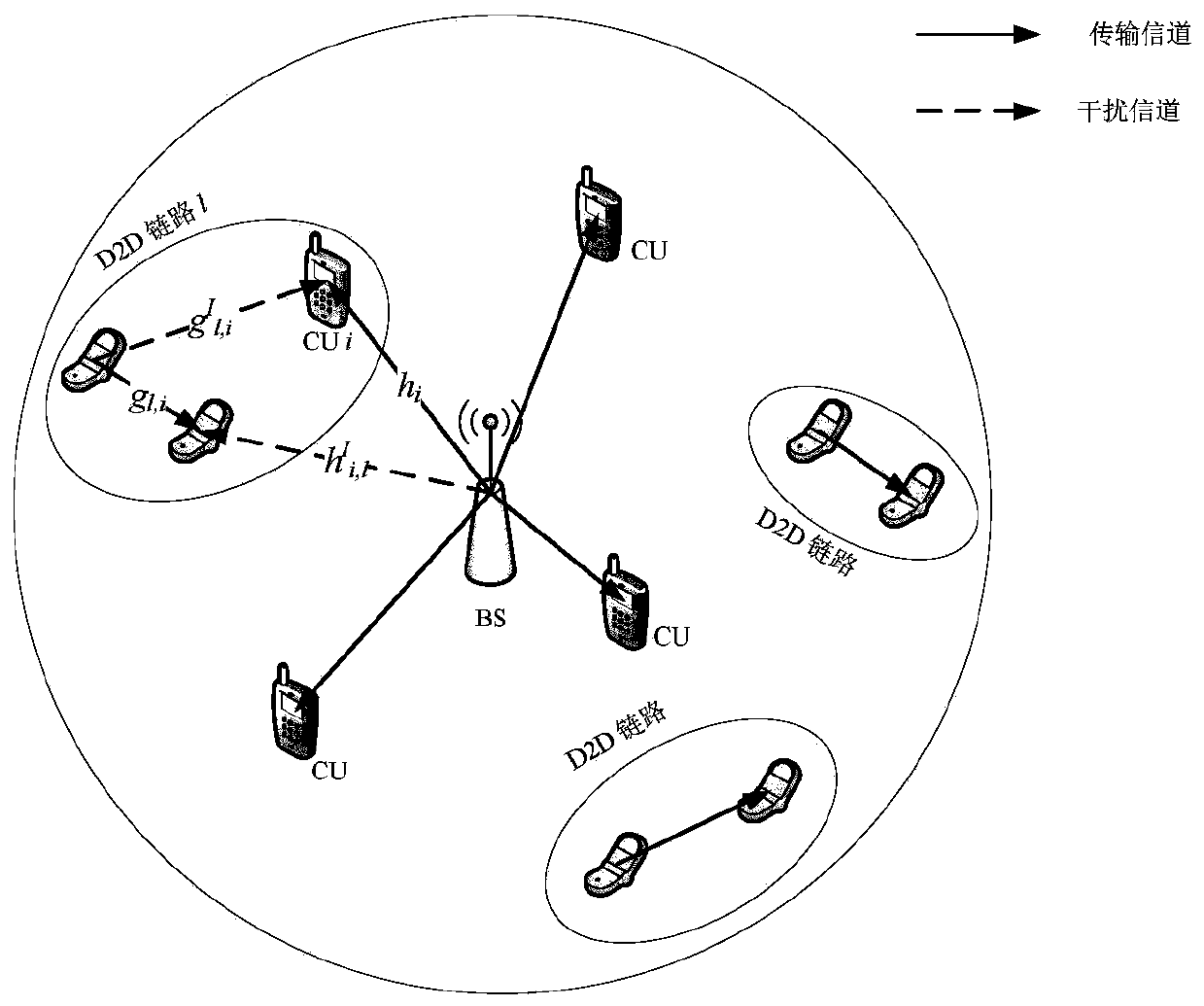
Figure 1 
Figure 2 
Figure 3
Abstract
Description
technical field
[0001] The invention belongs to the technical field of wireless communication, and relates to a time-frequency resource (time-frequency resource blocks, RBs) complex with high energy efficiency in a heterogeneous network deployed with an end-to-device (device-to-device, D2D) communication system. The method, more specifically, proposes a downlink RBs multiplexing method for cell users that can maximize the energy efficiency of the D2D communication system. Background technique
[0002] With the rapid development of wireless communication technology and the rapid growth of user demand, future wireless communication and network technologies are faced with dual constraints of resources and energy consumption. How to design the future mobile communication network and effectively utilize wireless resources has become a hot spot that the government and academic circles generally pay attention to.
[0003] D2D communication is a device-to-device short-distance dire...
Examples
Embodiment Construction
[0060] The technical solutions provided by the present invention will be described in detail below in conjunction with specific examples. It should be understood that the following specific embodiments are only used to illustrate the present invention and are not intended to limit the scope of the present invention.
[0061] The system model of this embodiment is as figure 1 As shown, a heterogeneous network with D2D links in a macro cell (for example, the cell radius is 500m, the bandwidth of each RB is 15kHz, the maximum transmit power of the base station and the D2D transmitter is 46dBm and 20dBm respectively, each D2D link The circuit power consumption is 50mW), and the D2D users communicate directly. In the downlink communication scenario, when the base station communicates with cell users, the transmitting end of the D2D link will cause cross-layer interference to the CU, and the transmitting power of the base station will also cause certain interference to the D2D recei...