
User activity space identification method based on mobile phone signaling
A technology for user activity and spatial recognition, applied in the directions of location-based services, service signaling, character and pattern recognition, etc., can solve problems such as large recognition errors, improve accuracy, accurate traffic demand prediction, and improve authenticity. and the effect of accuracy
Patent Information
- Authority / Receiving Office
- CN · China
- Patent Type
- Patents(China)
- Current Assignee / Owner
- Publication Date
- 2021-07-20
Smart Images
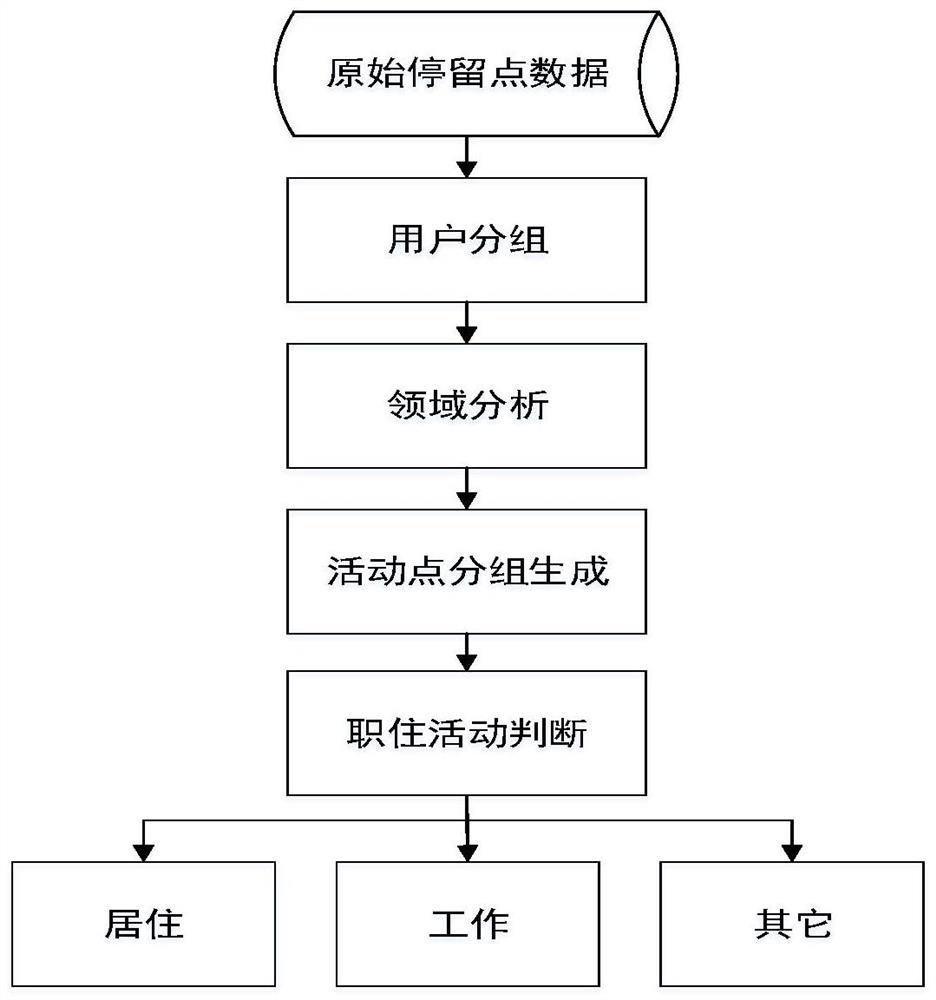
Figure 1
Abstract
Description
technical field
[0001] The invention relates to a user activity space identification method based on mobile phone signaling. Background technique
[0002] In the prior art, in the discovery of the user's occupation and residence, the mining of user activity rules based mainly on mobile phone signaling is currently mainly based on the fixed spatial unit boundaries (such as business districts, parks, and residential areas) to count the cumulative activity frequency of users in this area for many days. , Activity duration. At present, the commonly used clustering algorithm is to realize the clustering and grouping of data by finding the largest set of density-connected objects and finding the largest set of density-connected discrete space data in a certain space range.
[0003] In the existing user activity rule mining technology, it can only be identified for fixed time periods and fixed areas, and is affected by the size of the designated monitoring area and base station si...
Examples
Embodiment Construction
[0023] Such as figure 1 The shown mobile phone signaling-based user activity space identification method includes the following steps:
[0024] S1: Obtain the user's stay point information according to the mobile phone signaling data, and group the stay point information according to the user's unique identifier as a data source for user activity space identification; wherein, the user's stay point P j Including user number, stop point number, stop point location, stop point start and end time.
[0025] S2: Perform neighborhood analysis on the data source, and construct the user's stay point P j and all stay points P j The neighborhood set {P i}’s stay point relationship model; among them, the neighborhood set {P i} is the user’s stay point P j is a combination of the center of the circle and other stay point information within the radius r, and the radius r can be specifically set to 500m.
[0026] S3: Using a spatio-temporal clustering algorithm to calculate user activ...