
Hearing aid and a method of processing input signals in a hearing aid
a technology of input signal and hearing aid, which is applied in the field of hearing aids, can solve the problems of interference with the function of the directional controller, feedback may give rise to signal distortion, and unstable situation, and achieve the effect of improving feedback compensation
Patent Information
- Authority / Receiving Office
- US · United States
- Patent Type
- Patents(United States)
- Current Assignee / Owner
- Publication Date
- 2012-05-29
Smart Images
Figure 1 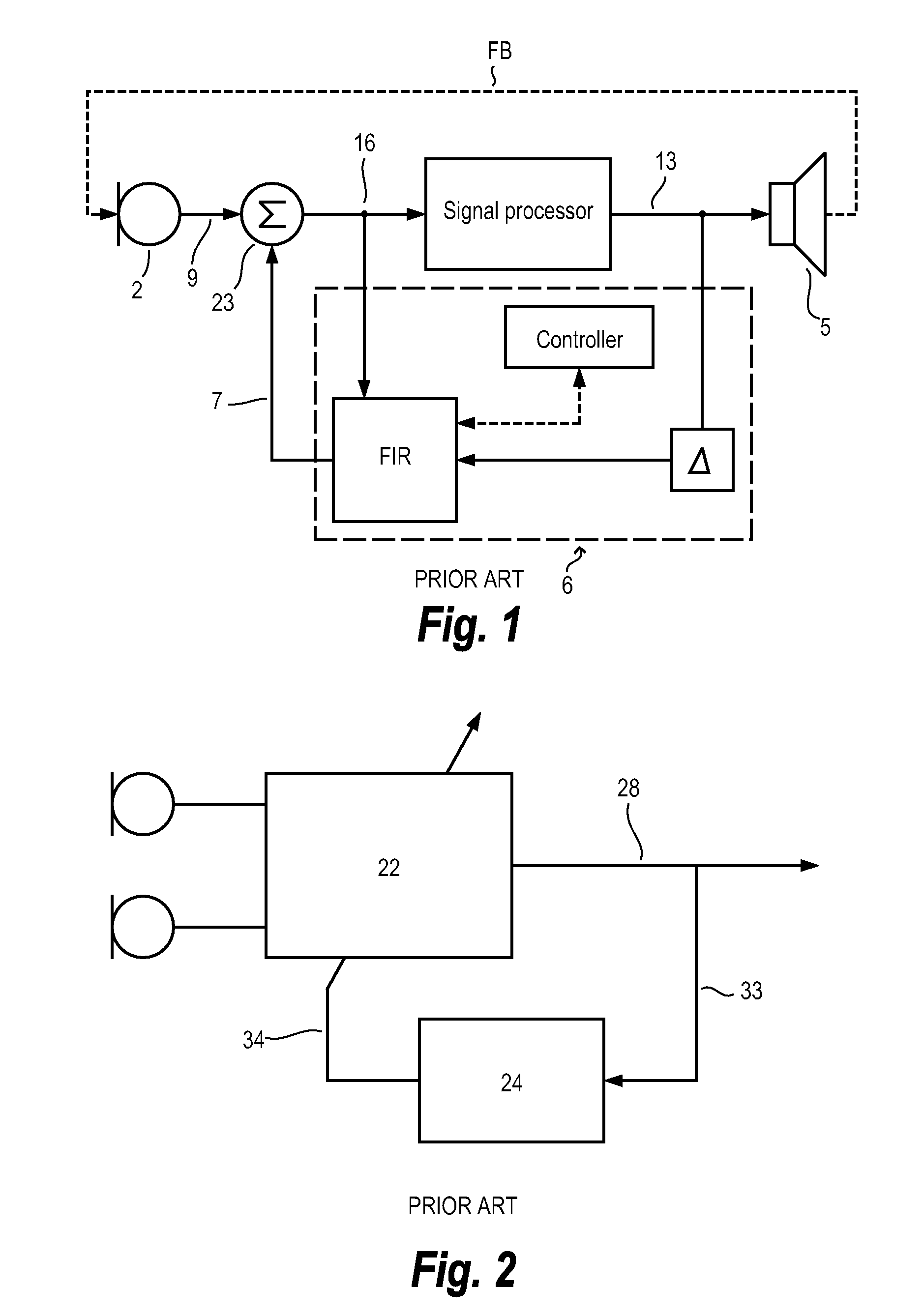
Figure 2 
Figure 3
Abstract
Description
RELATED APPLICATIONS
[0001] The present application is a continuation-in-part of application No. PCT / DK2005 / 000654; filed on 11 Oct. 2005, in Denmark and published as WO2007042025, the contents of which are incorporated hereinto by reference.BACKGROUND OF THE INVENTION
[0002] 1. Field of the Invention
[0003] The present invention relates to hearing aids. The invention further relates to methods of signal processing within a hearing aid. The invention more particularly relates to hearing aids with multiple input transducers and to methods of signal processing in hearing aids with multiple input transducers. The invention, still more particularly, relates to hearing aids with multiple input transducers adapted to provide an adjustable directivity pattern.
[0004] The invention, yet more specifically, relates to an input processor for processing of input transducer signals in a hearing aid, wherein input signals are processed in a directional controller and wherein feedback-compensating signals...
Examples
Embodiment Construction
[0042]Reference is first made to FIG. 1, which shows an example of a feedback compensating system, known from EP-A-1191814. In this system the feedback path through receiver 5, acoustic feedback path (FB) and microphone 2 is modelled by the feedback signal estimator 6, which outputs a feedback compensating signal 7 based on an estimator input signal. This is obtained by adaptively controlling the controllable filter in the feedback signal estimator 6 such that the correlation between the estimator input signal and the feedback compensated signal 16 is minimized—typically by implementing a minimizing LMS method in the adaptive controller. The generated feedback compensating signal 7 is then combined in adder 23 with the microphone signal 9 to generate the feedback compensated signal 16 which is used as the main signal processor input signal 11. The main signal processor input signal is processed in the main signal processor to form the main processor output signal 13 for the receiver...