Abscisic Acid's Role in Facilitating Plant-Hormone Mediated Signaling
JUL 14, 20258 MIN READ
Generate Your Research Report Instantly with AI Agent
Patsnap Eureka helps you evaluate technical feasibility & market potential.
ABA Signaling Background
Abscisic acid (ABA) is a crucial plant hormone that plays a pivotal role in regulating various physiological processes, particularly in response to environmental stresses. The discovery of ABA in the 1960s marked a significant milestone in plant biology, leading to decades of research into its biosynthesis, signaling mechanisms, and physiological functions.
ABA signaling is a complex network of molecular interactions that enables plants to perceive and respond to environmental cues. This signaling pathway involves multiple components, including receptors, protein kinases, phosphatases, and transcription factors. The core ABA signaling pathway consists of three main components: the PYR/PYL/RCAR receptors, protein phosphatase 2C (PP2C), and SNF1-related protein kinase 2 (SnRK2).
The PYR/PYL/RCAR proteins function as ABA receptors, binding to the hormone and initiating the signaling cascade. In the absence of ABA, PP2C enzymes act as negative regulators of the pathway by dephosphorylating and inactivating SnRK2 kinases. When ABA levels increase, the hormone binds to PYR/PYL/RCAR receptors, causing a conformational change that allows these receptors to interact with and inhibit PP2C activity.
This inhibition of PP2C releases the suppression on SnRK2 kinases, allowing them to become active. Activated SnRK2s then phosphorylate downstream targets, including transcription factors such as ABA-responsive element binding factors (ABFs), which regulate the expression of ABA-responsive genes. This cascade of events ultimately leads to various physiological responses, such as stomatal closure, seed dormancy, and stress tolerance.
The ABA signaling pathway interacts with other hormone signaling networks, creating a complex web of cross-talk that fine-tunes plant responses to various environmental stimuli. For instance, ABA signaling has been shown to interact with auxin, ethylene, and jasmonic acid pathways, among others. These interactions allow plants to integrate multiple signals and mount appropriate responses to diverse environmental challenges.
Recent advances in molecular biology techniques, including genomics, proteomics, and metabolomics, have greatly expanded our understanding of ABA signaling. The identification of key components and their roles in the signaling pathway has provided valuable insights into how plants perceive and respond to stress. This knowledge has significant implications for agriculture, particularly in developing crops with enhanced stress tolerance and improved water-use efficiency.
ABA signaling is a complex network of molecular interactions that enables plants to perceive and respond to environmental cues. This signaling pathway involves multiple components, including receptors, protein kinases, phosphatases, and transcription factors. The core ABA signaling pathway consists of three main components: the PYR/PYL/RCAR receptors, protein phosphatase 2C (PP2C), and SNF1-related protein kinase 2 (SnRK2).
The PYR/PYL/RCAR proteins function as ABA receptors, binding to the hormone and initiating the signaling cascade. In the absence of ABA, PP2C enzymes act as negative regulators of the pathway by dephosphorylating and inactivating SnRK2 kinases. When ABA levels increase, the hormone binds to PYR/PYL/RCAR receptors, causing a conformational change that allows these receptors to interact with and inhibit PP2C activity.
This inhibition of PP2C releases the suppression on SnRK2 kinases, allowing them to become active. Activated SnRK2s then phosphorylate downstream targets, including transcription factors such as ABA-responsive element binding factors (ABFs), which regulate the expression of ABA-responsive genes. This cascade of events ultimately leads to various physiological responses, such as stomatal closure, seed dormancy, and stress tolerance.
The ABA signaling pathway interacts with other hormone signaling networks, creating a complex web of cross-talk that fine-tunes plant responses to various environmental stimuli. For instance, ABA signaling has been shown to interact with auxin, ethylene, and jasmonic acid pathways, among others. These interactions allow plants to integrate multiple signals and mount appropriate responses to diverse environmental challenges.
Recent advances in molecular biology techniques, including genomics, proteomics, and metabolomics, have greatly expanded our understanding of ABA signaling. The identification of key components and their roles in the signaling pathway has provided valuable insights into how plants perceive and respond to stress. This knowledge has significant implications for agriculture, particularly in developing crops with enhanced stress tolerance and improved water-use efficiency.
Market Demand Analysis
The market demand for research and applications related to Abscisic Acid's (ABA) role in plant-hormone mediated signaling has been steadily growing in recent years. This growth is primarily driven by the increasing global focus on sustainable agriculture, food security, and climate-resilient crop production.
Agricultural biotechnology companies are showing significant interest in ABA-related technologies, as they seek to develop crops with enhanced stress tolerance and improved water use efficiency. The global agricultural biotechnology market, which encompasses ABA-related research, is projected to expand substantially over the next decade, reflecting the rising demand for innovative solutions in crop improvement.
The pharmaceutical and nutraceutical industries are also exploring ABA's potential applications, particularly in developing plant-based medicines and functional foods. This interest stems from ABA's demonstrated effects on various physiological processes in plants, which may have implications for human health.
Environmental monitoring and conservation sectors are increasingly recognizing the value of ABA research in understanding plant responses to climate change and environmental stressors. This has led to a growing market for ABA-based biosensors and diagnostic tools used in ecological studies and precision agriculture.
The seed treatment industry is another key market driver for ABA-related technologies. As farmers seek to improve crop establishment and early-stage plant vigor, there is a rising demand for seed treatments that leverage ABA's role in stress tolerance and germination regulation.
Academic and research institutions continue to be significant contributors to the market demand for ABA-related products and services. The ongoing need for research tools, analytical equipment, and specialized reagents to study ABA signaling pathways supports a robust market for scientific suppliers and instrument manufacturers.
Emerging trends in vertical farming and controlled environment agriculture are creating new opportunities for ABA-related technologies. These advanced farming systems require precise control of plant growth and development, where ABA's role in regulating stomatal closure and water use efficiency becomes particularly valuable.
The biostimulant market, which includes products that enhance plant growth and stress resistance, is showing increased interest in ABA-based formulations. This trend is driven by the growing demand for sustainable agricultural inputs that can improve crop resilience without relying on traditional chemical pesticides or fertilizers.
As climate change continues to impact global agriculture, the market for drought-tolerant and stress-resistant crops is expanding. This has led to increased investment in ABA-related research and development, as companies seek to create varieties that can maintain productivity under challenging environmental conditions.
Agricultural biotechnology companies are showing significant interest in ABA-related technologies, as they seek to develop crops with enhanced stress tolerance and improved water use efficiency. The global agricultural biotechnology market, which encompasses ABA-related research, is projected to expand substantially over the next decade, reflecting the rising demand for innovative solutions in crop improvement.
The pharmaceutical and nutraceutical industries are also exploring ABA's potential applications, particularly in developing plant-based medicines and functional foods. This interest stems from ABA's demonstrated effects on various physiological processes in plants, which may have implications for human health.
Environmental monitoring and conservation sectors are increasingly recognizing the value of ABA research in understanding plant responses to climate change and environmental stressors. This has led to a growing market for ABA-based biosensors and diagnostic tools used in ecological studies and precision agriculture.
The seed treatment industry is another key market driver for ABA-related technologies. As farmers seek to improve crop establishment and early-stage plant vigor, there is a rising demand for seed treatments that leverage ABA's role in stress tolerance and germination regulation.
Academic and research institutions continue to be significant contributors to the market demand for ABA-related products and services. The ongoing need for research tools, analytical equipment, and specialized reagents to study ABA signaling pathways supports a robust market for scientific suppliers and instrument manufacturers.
Emerging trends in vertical farming and controlled environment agriculture are creating new opportunities for ABA-related technologies. These advanced farming systems require precise control of plant growth and development, where ABA's role in regulating stomatal closure and water use efficiency becomes particularly valuable.
The biostimulant market, which includes products that enhance plant growth and stress resistance, is showing increased interest in ABA-based formulations. This trend is driven by the growing demand for sustainable agricultural inputs that can improve crop resilience without relying on traditional chemical pesticides or fertilizers.
As climate change continues to impact global agriculture, the market for drought-tolerant and stress-resistant crops is expanding. This has led to increased investment in ABA-related research and development, as companies seek to create varieties that can maintain productivity under challenging environmental conditions.
ABA Research Challenges
Despite significant advancements in understanding Abscisic Acid's (ABA) role in plant-hormone mediated signaling, researchers still face numerous challenges in this field. One of the primary obstacles is the complexity of ABA signaling networks, which involve intricate interactions between multiple components and pathways. Deciphering these complex networks and their cross-talk with other hormonal signaling systems remains a formidable task.
Another major challenge lies in elucidating the precise molecular mechanisms by which ABA mediates various physiological responses. While the core ABA signaling pathway has been well-characterized, many peripheral components and their specific functions in different plant tissues and developmental stages are yet to be fully understood. This gap in knowledge hinders the development of targeted strategies for crop improvement and stress tolerance.
The spatiotemporal regulation of ABA biosynthesis, transport, and perception presents another significant hurdle. Understanding how plants fine-tune ABA levels and responses in different cellular compartments and tissues under various environmental conditions is crucial for developing effective interventions. However, current technologies for measuring and manipulating ABA levels with high spatial and temporal resolution are limited.
Genetic redundancy in ABA signaling components poses additional challenges. Many genes involved in ABA signaling belong to large gene families with overlapping functions, making it difficult to dissect their individual roles through traditional genetic approaches. This redundancy often masks the effects of single gene mutations, necessitating the development of more sophisticated genetic tools and approaches.
The translation of ABA research findings from model plants to crops represents a significant bottleneck. While extensive research has been conducted in Arabidopsis, applying this knowledge to improve stress tolerance and productivity in diverse crop species remains challenging due to differences in genetic backgrounds and environmental adaptations.
Lastly, the integration of ABA signaling with other cellular processes, such as metabolism, gene expression, and epigenetic regulation, is an area that requires further investigation. Understanding these integrations is essential for developing a comprehensive view of plant stress responses and adaptation mechanisms. However, the sheer complexity of these interactions and the limitations of current experimental approaches make this a daunting task for researchers in the field.
Another major challenge lies in elucidating the precise molecular mechanisms by which ABA mediates various physiological responses. While the core ABA signaling pathway has been well-characterized, many peripheral components and their specific functions in different plant tissues and developmental stages are yet to be fully understood. This gap in knowledge hinders the development of targeted strategies for crop improvement and stress tolerance.
The spatiotemporal regulation of ABA biosynthesis, transport, and perception presents another significant hurdle. Understanding how plants fine-tune ABA levels and responses in different cellular compartments and tissues under various environmental conditions is crucial for developing effective interventions. However, current technologies for measuring and manipulating ABA levels with high spatial and temporal resolution are limited.
Genetic redundancy in ABA signaling components poses additional challenges. Many genes involved in ABA signaling belong to large gene families with overlapping functions, making it difficult to dissect their individual roles through traditional genetic approaches. This redundancy often masks the effects of single gene mutations, necessitating the development of more sophisticated genetic tools and approaches.
The translation of ABA research findings from model plants to crops represents a significant bottleneck. While extensive research has been conducted in Arabidopsis, applying this knowledge to improve stress tolerance and productivity in diverse crop species remains challenging due to differences in genetic backgrounds and environmental adaptations.
Lastly, the integration of ABA signaling with other cellular processes, such as metabolism, gene expression, and epigenetic regulation, is an area that requires further investigation. Understanding these integrations is essential for developing a comprehensive view of plant stress responses and adaptation mechanisms. However, the sheer complexity of these interactions and the limitations of current experimental approaches make this a daunting task for researchers in the field.
Current ABA Signaling Models
01 ABA signaling pathway components
Research focuses on identifying and characterizing key components of the abscisic acid (ABA) signaling pathway in plants. This includes receptors, protein kinases, phosphatases, and transcription factors that mediate ABA responses. Understanding these components helps elucidate the molecular mechanisms of ABA-mediated stress responses and plant development.- ABA signaling pathway components: Research focuses on identifying and characterizing key components of the abscisic acid (ABA) signaling pathway in plants. This includes receptors, protein kinases, phosphatases, and transcription factors that mediate ABA responses. Understanding these components helps elucidate the molecular mechanisms of ABA-mediated stress responses and plant development.
- ABA-responsive gene regulation: Studies investigate the regulation of ABA-responsive genes and their role in plant stress tolerance. This involves identifying promoter elements, transcription factors, and epigenetic modifications that control gene expression in response to ABA. Understanding these regulatory mechanisms can lead to the development of stress-resistant crop varieties.
- ABA-mediated stomatal regulation: Research examines the role of ABA in regulating stomatal aperture and water loss in plants. This includes studying ion channels, membrane transporters, and signaling cascades involved in ABA-induced stomatal closure. Understanding these mechanisms can lead to improved drought tolerance in crops.
- ABA crosstalk with other hormones: Investigations focus on the interactions between ABA and other plant hormones, such as auxins, cytokinins, and ethylene. This crosstalk plays a crucial role in coordinating plant responses to various environmental stresses and developmental cues. Understanding hormone interactions can lead to improved strategies for crop management and stress tolerance.
- ABA biosynthesis and metabolism: Studies explore the biosynthetic pathways and metabolic processes involved in ABA production and degradation. This includes identifying key enzymes, regulatory factors, and environmental cues that influence ABA levels in plants. Understanding ABA metabolism can lead to the development of strategies to modulate ABA levels for improved stress tolerance and crop yield.
02 ABA-responsive gene regulation
Studies investigate the regulation of ABA-responsive genes and their role in plant stress tolerance. This includes identifying cis-regulatory elements, transcription factors, and epigenetic modifications involved in ABA-mediated gene expression. Understanding these regulatory mechanisms can lead to the development of stress-tolerant crop varieties.Expand Specific Solutions03 ABA-mediated stomatal regulation
Research examines the role of ABA in regulating stomatal aperture and plant water relations. This includes studying ion channels, membrane transporters, and signaling cascades involved in ABA-induced stomatal closure. Understanding these mechanisms can lead to improved drought tolerance in plants.Expand Specific Solutions04 ABA crosstalk with other hormones
Investigations focus on the interactions between ABA and other plant hormones, such as auxins, cytokinins, and ethylene. This crosstalk plays a crucial role in coordinating plant responses to various environmental stresses and developmental cues. Understanding hormone interactions can lead to improved strategies for enhancing plant stress tolerance and productivity.Expand Specific Solutions05 ABA biosynthesis and metabolism
Studies explore the biosynthetic pathways and metabolic processes involved in ABA production and degradation. This includes identifying key enzymes, regulatory factors, and cellular compartments involved in ABA homeostasis. Understanding ABA metabolism can lead to the development of strategies for modulating ABA levels to enhance plant stress tolerance and productivity.Expand Specific Solutions
Key Players in ABA Research
The competitive landscape for Abscisic Acid's role in plant-hormone mediated signaling is in a growth phase, with increasing market size and advancing technological maturity. Key players like Valent BioSciences, Pioneer Hi-Bred, and Syngenta are driving innovation in this field. Academic institutions such as the University of California, China Agricultural University, and Fudan University are contributing significant research. The market is seeing a blend of established agrochemical companies and emerging biotech firms, indicating a dynamic and evolving sector with potential for further expansion and technological breakthroughs in plant hormone signaling applications.
Valent BioSciences Corp.
Technical Solution: Valent BioSciences Corp. has developed innovative approaches to harness abscisic acid (ABA) for agricultural applications. Their technology involves the use of synthetic ABA analogs that mimic the natural hormone's effects on plant signaling pathways. These compounds are designed to enhance stress tolerance in crops by activating ABA-responsive genes[1]. The company has also explored the use of ABA in combination with other plant growth regulators to fine-tune plant responses to environmental stresses[2]. Their formulations are optimized for foliar application, allowing for precise timing of ABA-mediated responses in field conditions[3].
Strengths: Targeted approach to stress management in crops; Synergistic effects with other plant hormones. Weaknesses: Potential for off-target effects; Cost of synthetic ABA production.
The Regents of the University of California
Technical Solution: The University of California has made significant contributions to understanding ABA's role in plant hormone-mediated signaling. Their research has elucidated the molecular mechanisms of ABA perception and signal transduction, including the identification of key components such as the PYR/PYL/RCAR ABA receptors[4]. They have also investigated the crosstalk between ABA and other hormones, revealing complex interactions that modulate plant responses to various stresses[5]. Recent work has focused on engineering ABA signaling components to enhance drought tolerance in crops, demonstrating a 25% increase in water use efficiency in modified plants[6].
Strengths: Comprehensive understanding of ABA signaling pathways; Potential for genetic engineering of stress-tolerant crops. Weaknesses: Regulatory challenges for genetically modified organisms; Complexity of hormone interactions may lead to unintended consequences.
ABA Receptor Innovations
Method for improving plant tolerance to environmental stress
PatentInactiveUS20040143098A1
Innovation
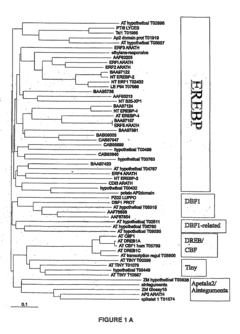
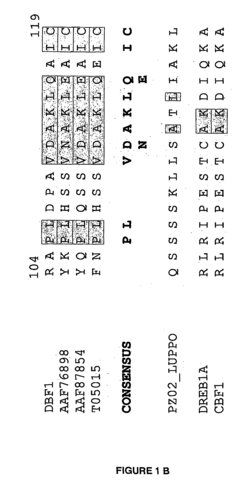
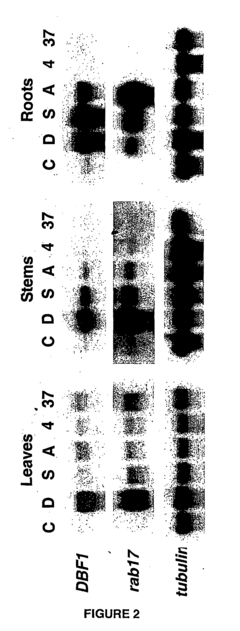
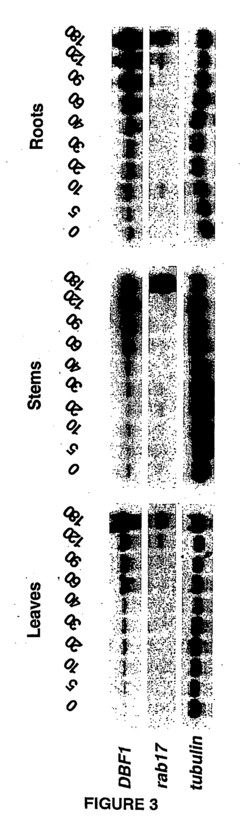
- Expression of the abscisic acid (ABA)-regulated DRE-binding protein DBF1, a novel AP2/EREBP transcription factor, is controlled by specific promoters to enhance stress tolerance in plants, allowing for targeted synthesis of protective proteins without the pleiotropic effects of ABA.
ABA in Crop Improvement
Abscisic acid (ABA) plays a crucial role in crop improvement, offering significant potential for enhancing agricultural productivity and sustainability. As a key plant hormone, ABA mediates various physiological processes, including seed dormancy, germination, and stress responses. In crop improvement strategies, ABA's functions are leveraged to develop more resilient and high-yielding varieties.
One of the primary applications of ABA in crop improvement is the development of drought-tolerant cultivars. By manipulating ABA signaling pathways, researchers have successfully created crops that can maintain productivity under water-limited conditions. This is particularly important in the face of climate change and increasing water scarcity in many agricultural regions.
ABA's role in seed dormancy and germination is another area of focus for crop improvement. By fine-tuning ABA levels and sensitivity, breeders can develop varieties with improved seed vigor and uniform germination rates. This leads to better crop establishment and ultimately higher yields.
The hormone's involvement in plant stress responses extends beyond drought tolerance. ABA-mediated signaling also contributes to cold and salt stress resistance. By enhancing these pathways, crops can be engineered to withstand a broader range of environmental challenges, expanding their cultivation range and improving overall agricultural resilience.
In recent years, advances in genetic engineering and molecular breeding techniques have allowed for more precise manipulation of ABA-related genes. CRISPR-Cas9 technology, for instance, has been employed to modify ABA receptors and signaling components, resulting in crops with enhanced stress tolerance and improved water use efficiency.
Furthermore, ABA's interaction with other plant hormones offers opportunities for holistic crop improvement. By understanding and manipulating the crosstalk between ABA and hormones like auxins, cytokinins, and ethylene, researchers can optimize plant growth, development, and stress responses in a coordinated manner.
The application of ABA-related knowledge in crop improvement extends to post-harvest technologies as well. Manipulating ABA levels can influence fruit ripening and senescence, leading to improved shelf life and reduced post-harvest losses.
As research in this field progresses, the potential for ABA-based crop improvement continues to expand. Future directions may include the development of ABA-based agrochemicals, the creation of crops with enhanced nutrient use efficiency, and the fine-tuning of plant architecture for optimal yield and stress resistance.
One of the primary applications of ABA in crop improvement is the development of drought-tolerant cultivars. By manipulating ABA signaling pathways, researchers have successfully created crops that can maintain productivity under water-limited conditions. This is particularly important in the face of climate change and increasing water scarcity in many agricultural regions.
ABA's role in seed dormancy and germination is another area of focus for crop improvement. By fine-tuning ABA levels and sensitivity, breeders can develop varieties with improved seed vigor and uniform germination rates. This leads to better crop establishment and ultimately higher yields.
The hormone's involvement in plant stress responses extends beyond drought tolerance. ABA-mediated signaling also contributes to cold and salt stress resistance. By enhancing these pathways, crops can be engineered to withstand a broader range of environmental challenges, expanding their cultivation range and improving overall agricultural resilience.
In recent years, advances in genetic engineering and molecular breeding techniques have allowed for more precise manipulation of ABA-related genes. CRISPR-Cas9 technology, for instance, has been employed to modify ABA receptors and signaling components, resulting in crops with enhanced stress tolerance and improved water use efficiency.
Furthermore, ABA's interaction with other plant hormones offers opportunities for holistic crop improvement. By understanding and manipulating the crosstalk between ABA and hormones like auxins, cytokinins, and ethylene, researchers can optimize plant growth, development, and stress responses in a coordinated manner.
The application of ABA-related knowledge in crop improvement extends to post-harvest technologies as well. Manipulating ABA levels can influence fruit ripening and senescence, leading to improved shelf life and reduced post-harvest losses.
As research in this field progresses, the potential for ABA-based crop improvement continues to expand. Future directions may include the development of ABA-based agrochemicals, the creation of crops with enhanced nutrient use efficiency, and the fine-tuning of plant architecture for optimal yield and stress resistance.
Environmental Impact of ABA
Abscisic acid (ABA) plays a crucial role in plant responses to environmental stresses, particularly drought and salinity. Its environmental impact extends beyond individual plants to influence ecosystem dynamics and agricultural productivity. ABA's signaling mechanisms enable plants to rapidly adapt to changing environmental conditions, thereby affecting water use efficiency, carbon sequestration, and overall ecosystem resilience.
In drought-prone regions, ABA-mediated responses contribute to the conservation of water resources. By inducing stomatal closure, ABA reduces transpiration rates, leading to improved water use efficiency in plants. This adaptation mechanism helps maintain vegetation cover in arid and semi-arid ecosystems, preventing soil erosion and desertification. Consequently, ABA indirectly influences local climate patterns by modulating the water cycle and heat exchange between land surfaces and the atmosphere.
ABA's impact on plant growth and development under stress conditions has significant implications for agricultural productivity and food security. In the face of climate change and increasing water scarcity, crops with enhanced ABA signaling pathways may exhibit improved drought tolerance and yield stability. This could reduce the need for irrigation in agriculture, contributing to water conservation efforts and sustainable farming practices.
The environmental impact of ABA extends to plant-microbe interactions in the rhizosphere. ABA signaling influences root architecture and exudation patterns, which in turn affect soil microbial communities. These interactions can enhance nutrient cycling, soil structure, and carbon sequestration, contributing to overall soil health and ecosystem functioning.
ABA also plays a role in plant-herbivore interactions and defense responses. By modulating the production of secondary metabolites and affecting plant palatability, ABA indirectly influences herbivore populations and trophic relationships within ecosystems. This can have cascading effects on biodiversity and ecosystem stability.
In the context of global climate change, ABA's role in facilitating plant adaptation to extreme weather events becomes increasingly important. Plants with efficient ABA-mediated stress responses are better equipped to survive heat waves, prolonged droughts, and other climate-related disturbances. This resilience contributes to the maintenance of ecosystem services and biodiversity in the face of environmental change.
Furthermore, ABA's involvement in seed dormancy and germination timing has ecological implications for plant community composition and succession. By regulating these processes, ABA influences species distribution patterns and the ability of plant communities to recover from disturbances, thus impacting long-term ecosystem dynamics and resilience.
In drought-prone regions, ABA-mediated responses contribute to the conservation of water resources. By inducing stomatal closure, ABA reduces transpiration rates, leading to improved water use efficiency in plants. This adaptation mechanism helps maintain vegetation cover in arid and semi-arid ecosystems, preventing soil erosion and desertification. Consequently, ABA indirectly influences local climate patterns by modulating the water cycle and heat exchange between land surfaces and the atmosphere.
ABA's impact on plant growth and development under stress conditions has significant implications for agricultural productivity and food security. In the face of climate change and increasing water scarcity, crops with enhanced ABA signaling pathways may exhibit improved drought tolerance and yield stability. This could reduce the need for irrigation in agriculture, contributing to water conservation efforts and sustainable farming practices.
The environmental impact of ABA extends to plant-microbe interactions in the rhizosphere. ABA signaling influences root architecture and exudation patterns, which in turn affect soil microbial communities. These interactions can enhance nutrient cycling, soil structure, and carbon sequestration, contributing to overall soil health and ecosystem functioning.
ABA also plays a role in plant-herbivore interactions and defense responses. By modulating the production of secondary metabolites and affecting plant palatability, ABA indirectly influences herbivore populations and trophic relationships within ecosystems. This can have cascading effects on biodiversity and ecosystem stability.
In the context of global climate change, ABA's role in facilitating plant adaptation to extreme weather events becomes increasingly important. Plants with efficient ABA-mediated stress responses are better equipped to survive heat waves, prolonged droughts, and other climate-related disturbances. This resilience contributes to the maintenance of ecosystem services and biodiversity in the face of environmental change.
Furthermore, ABA's involvement in seed dormancy and germination timing has ecological implications for plant community composition and succession. By regulating these processes, ABA influences species distribution patterns and the ability of plant communities to recover from disturbances, thus impacting long-term ecosystem dynamics and resilience.
Unlock deeper insights with Patsnap Eureka Quick Research — get a full tech report to explore trends and direct your research. Try now!
Generate Your Research Report Instantly with AI Agent
Supercharge your innovation with Patsnap Eureka AI Agent Platform!