
Access Control System Load Handling in Emergency Exits
FEB 27, 20269 MIN READ
Generate Your Research Report Instantly with AI Agent
Patsnap Eureka helps you evaluate technical feasibility & market potential.
Emergency Access Control System Background and Objectives
Emergency access control systems represent a critical intersection of building safety, security technology, and regulatory compliance. These systems have evolved from simple mechanical exit devices to sophisticated electronic solutions that must balance competing demands: maintaining secure perimeters during normal operations while ensuring rapid, unrestricted egress during emergency situations. The fundamental challenge lies in managing system loads when traditional access restrictions must be instantly overridden to accommodate mass evacuation scenarios.
The historical development of emergency access control began with basic panic bars and fire exit hardware in the early 20th century, driven primarily by tragic events such as the Triangle Shirtwaist Factory fire. As building codes evolved, so did the complexity of access control requirements. The integration of electronic systems in the 1980s and 1990s introduced new capabilities but also new challenges in load management, particularly as buildings grew larger and more complex.
Modern emergency access control systems must address multiple operational scenarios simultaneously. During normal operations, these systems maintain security protocols, authenticate users, and log access events. However, upon emergency activation through fire alarms, security alerts, or manual triggers, they must instantly transition to fail-safe modes that prioritize life safety over security concerns. This transition creates significant system load challenges as hundreds or thousands of access points may require simultaneous state changes.
The primary technical objectives center on achieving reliable fail-safe operation under extreme load conditions. Systems must process emergency signals, update access point configurations, maintain communication with central monitoring stations, and provide real-time status feedback to emergency responders. Additionally, they must accomplish these tasks while potentially operating on backup power systems with limited capacity.
Contemporary emergency access control systems also face increasing demands for integration with broader building management ecosystems. They must coordinate with fire suppression systems, elevator controls, public address networks, and emergency lighting systems. This integration multiplies the communication overhead and processing requirements during emergency scenarios, further complicating load management strategies.
The regulatory landscape continues to drive technological advancement in this field. Standards such as NFPA 101, IBC requirements, and ADA compliance mandates establish minimum performance criteria that systems must meet regardless of load conditions. These standards increasingly emphasize system reliability, response time consistency, and fail-safe operation, pushing manufacturers to develop more robust load handling capabilities that ensure consistent performance across all operational scenarios.
The historical development of emergency access control began with basic panic bars and fire exit hardware in the early 20th century, driven primarily by tragic events such as the Triangle Shirtwaist Factory fire. As building codes evolved, so did the complexity of access control requirements. The integration of electronic systems in the 1980s and 1990s introduced new capabilities but also new challenges in load management, particularly as buildings grew larger and more complex.
Modern emergency access control systems must address multiple operational scenarios simultaneously. During normal operations, these systems maintain security protocols, authenticate users, and log access events. However, upon emergency activation through fire alarms, security alerts, or manual triggers, they must instantly transition to fail-safe modes that prioritize life safety over security concerns. This transition creates significant system load challenges as hundreds or thousands of access points may require simultaneous state changes.
The primary technical objectives center on achieving reliable fail-safe operation under extreme load conditions. Systems must process emergency signals, update access point configurations, maintain communication with central monitoring stations, and provide real-time status feedback to emergency responders. Additionally, they must accomplish these tasks while potentially operating on backup power systems with limited capacity.
Contemporary emergency access control systems also face increasing demands for integration with broader building management ecosystems. They must coordinate with fire suppression systems, elevator controls, public address networks, and emergency lighting systems. This integration multiplies the communication overhead and processing requirements during emergency scenarios, further complicating load management strategies.
The regulatory landscape continues to drive technological advancement in this field. Standards such as NFPA 101, IBC requirements, and ADA compliance mandates establish minimum performance criteria that systems must meet regardless of load conditions. These standards increasingly emphasize system reliability, response time consistency, and fail-safe operation, pushing manufacturers to develop more robust load handling capabilities that ensure consistent performance across all operational scenarios.
Market Demand for Emergency Exit Load Management Systems
The global market for emergency exit load management systems is experiencing significant growth driven by increasingly stringent building safety regulations and heightened awareness of crowd safety management. Modern commercial buildings, transportation hubs, stadiums, and high-rise residential complexes require sophisticated access control systems capable of handling massive pedestrian flows during emergency evacuations while maintaining security protocols under normal operating conditions.
Regulatory frameworks across major markets are becoming more demanding regarding emergency egress capabilities. Building codes now mandate that access control systems must fail-safe during emergencies, allowing unrestricted exit while maintaining detailed logging capabilities for post-incident analysis. This regulatory pressure creates substantial demand for advanced load handling solutions that can process hundreds of simultaneous exit requests without system failure or significant delays.
The healthcare sector represents a particularly critical market segment, where emergency exit systems must accommodate patients with mobility limitations, medical equipment, and staff coordinating evacuations. Hospitals and medical facilities require access control systems with intelligent load balancing capabilities that can prioritize different user categories while maintaining comprehensive audit trails for compliance purposes.
Educational institutions constitute another major demand driver, especially following increased focus on campus security and emergency preparedness. Universities and schools need systems capable of managing large student populations during both planned evacuations and unexpected emergencies, while integrating with broader campus security infrastructure including fire alarm systems and emergency communication networks.
Transportation infrastructure presents unique challenges requiring specialized load management solutions. Airports, train stations, and subway systems must handle diverse user populations including international travelers unfamiliar with local emergency procedures. These environments demand multilingual interface capabilities and integration with public announcement systems to guide users during high-stress evacuation scenarios.
The commercial real estate sector increasingly views advanced emergency exit load management as a competitive differentiator and insurance risk mitigation tool. Property owners recognize that robust emergency systems reduce liability exposure while potentially lowering insurance premiums, creating strong economic incentives for system upgrades and new installations.
Emerging smart building trends are expanding market opportunities as building management systems become more integrated and data-driven. Modern emergency exit load management systems must interface with IoT sensors, occupancy monitoring systems, and predictive analytics platforms to optimize performance and provide real-time capacity management during both normal operations and emergency situations.
Regulatory frameworks across major markets are becoming more demanding regarding emergency egress capabilities. Building codes now mandate that access control systems must fail-safe during emergencies, allowing unrestricted exit while maintaining detailed logging capabilities for post-incident analysis. This regulatory pressure creates substantial demand for advanced load handling solutions that can process hundreds of simultaneous exit requests without system failure or significant delays.
The healthcare sector represents a particularly critical market segment, where emergency exit systems must accommodate patients with mobility limitations, medical equipment, and staff coordinating evacuations. Hospitals and medical facilities require access control systems with intelligent load balancing capabilities that can prioritize different user categories while maintaining comprehensive audit trails for compliance purposes.
Educational institutions constitute another major demand driver, especially following increased focus on campus security and emergency preparedness. Universities and schools need systems capable of managing large student populations during both planned evacuations and unexpected emergencies, while integrating with broader campus security infrastructure including fire alarm systems and emergency communication networks.
Transportation infrastructure presents unique challenges requiring specialized load management solutions. Airports, train stations, and subway systems must handle diverse user populations including international travelers unfamiliar with local emergency procedures. These environments demand multilingual interface capabilities and integration with public announcement systems to guide users during high-stress evacuation scenarios.
The commercial real estate sector increasingly views advanced emergency exit load management as a competitive differentiator and insurance risk mitigation tool. Property owners recognize that robust emergency systems reduce liability exposure while potentially lowering insurance premiums, creating strong economic incentives for system upgrades and new installations.
Emerging smart building trends are expanding market opportunities as building management systems become more integrated and data-driven. Modern emergency exit load management systems must interface with IoT sensors, occupancy monitoring systems, and predictive analytics platforms to optimize performance and provide real-time capacity management during both normal operations and emergency situations.
Current State and Challenges of Emergency Access Control
Emergency access control systems currently face significant operational challenges when managing high-volume traffic during crisis situations. Traditional access control infrastructure, originally designed for normal occupancy loads, struggles to accommodate the sudden surge of evacuees attempting to exit simultaneously. Most existing systems operate on single-point authentication mechanisms that create bottlenecks, with typical processing speeds of 1-2 seconds per person becoming critically inadequate during mass evacuations.
The predominant challenge lies in the fundamental conflict between security requirements and emergency egress needs. Current systems maintain strict authentication protocols even during emergencies, requiring individual credential verification that severely limits throughput capacity. Standard electromagnetic locks and card readers, while effective for routine access control, become liability factors when hundreds of occupants converge on exit points simultaneously.
Hardware limitations present another critical constraint. Most emergency exit access control systems rely on centralized processing units that cannot handle concurrent authentication requests exceeding 50-100 simultaneous users. Network congestion occurs rapidly as multiple access points attempt to communicate with central servers, leading to system timeouts and potential complete failures. Power supply dependencies further compound these issues, as emergency situations often involve electrical disruptions that can disable electronic access control components.
Integration challenges between fire safety systems and access control infrastructure create additional complications. Many facilities operate disparate systems that lack seamless communication protocols, resulting in delayed or failed automatic unlocking sequences during fire alarms or other emergency triggers. The absence of standardized emergency override mechanisms means that access control systems may continue enforcing security restrictions even when immediate evacuation is required.
Regulatory compliance adds another layer of complexity, as current systems must balance conflicting requirements from security standards and fire safety codes. Building codes mandate unimpeded egress during emergencies, while security protocols demand controlled access verification. This regulatory tension often results in compromised solutions that inadequately address both security and safety requirements.
Geographic distribution of technology adoption reveals significant disparities in emergency access control capabilities. Developed markets demonstrate advanced integration between access control and building management systems, while emerging markets often rely on basic mechanical solutions with limited electronic override capabilities. This technological gap creates inconsistent emergency response capabilities across different regions and facility types.
The predominant challenge lies in the fundamental conflict between security requirements and emergency egress needs. Current systems maintain strict authentication protocols even during emergencies, requiring individual credential verification that severely limits throughput capacity. Standard electromagnetic locks and card readers, while effective for routine access control, become liability factors when hundreds of occupants converge on exit points simultaneously.
Hardware limitations present another critical constraint. Most emergency exit access control systems rely on centralized processing units that cannot handle concurrent authentication requests exceeding 50-100 simultaneous users. Network congestion occurs rapidly as multiple access points attempt to communicate with central servers, leading to system timeouts and potential complete failures. Power supply dependencies further compound these issues, as emergency situations often involve electrical disruptions that can disable electronic access control components.
Integration challenges between fire safety systems and access control infrastructure create additional complications. Many facilities operate disparate systems that lack seamless communication protocols, resulting in delayed or failed automatic unlocking sequences during fire alarms or other emergency triggers. The absence of standardized emergency override mechanisms means that access control systems may continue enforcing security restrictions even when immediate evacuation is required.
Regulatory compliance adds another layer of complexity, as current systems must balance conflicting requirements from security standards and fire safety codes. Building codes mandate unimpeded egress during emergencies, while security protocols demand controlled access verification. This regulatory tension often results in compromised solutions that inadequately address both security and safety requirements.
Geographic distribution of technology adoption reveals significant disparities in emergency access control capabilities. Developed markets demonstrate advanced integration between access control and building management systems, while emerging markets often rely on basic mechanical solutions with limited electronic override capabilities. This technological gap creates inconsistent emergency response capabilities across different regions and facility types.
Existing Load Handling Solutions for Emergency Systems
01 Distributed load balancing in access control systems
Access control systems can implement distributed architectures to handle high loads by distributing authentication and authorization requests across multiple servers or nodes. This approach prevents system bottlenecks and ensures continuous operation even during peak usage periods. Load balancing algorithms can dynamically allocate requests based on server capacity, response times, and current workload to optimize system performance and maintain service availability.- Distributed load balancing in access control systems: Access control systems can implement distributed architectures to handle high loads by distributing authentication and authorization requests across multiple servers or nodes. This approach prevents system bottlenecks and ensures continuous operation even during peak usage periods. Load balancing algorithms can dynamically allocate requests based on server capacity, response times, and current workload to optimize system performance and maintain service availability.
- Queue management and request prioritization: Implementing intelligent queue management systems allows access control platforms to handle multiple simultaneous requests efficiently. Priority-based processing can be employed to ensure critical access requests are handled first, while less urgent requests are queued appropriately. This mechanism prevents system overload by controlling the flow of requests and maintaining orderly processing during high-traffic scenarios.
- Caching and session management optimization: Access control systems can reduce load by implementing caching mechanisms for frequently accessed credentials, permissions, and authentication tokens. Session management optimization techniques minimize redundant authentication processes and reduce database queries. These methods significantly decrease processing overhead and improve response times while maintaining security standards.
- Scalable database architecture for access control: Implementing scalable database solutions enables access control systems to handle growing numbers of users and access events. Database sharding, replication, and clustering techniques distribute data storage and retrieval operations across multiple systems. This architecture ensures that the backend infrastructure can scale horizontally to accommodate increased load without performance degradation.
- Asynchronous processing and event-driven architecture: Access control systems can employ asynchronous processing methods to handle non-critical operations without blocking primary authentication flows. Event-driven architectures allow systems to process access logs, audit trails, and notifications independently from real-time access decisions. This separation of concerns enables the system to maintain responsiveness under heavy load while ensuring all necessary operations are completed efficiently.
02 Queue management and request prioritization
Implementing intelligent queue management systems allows access control platforms to handle multiple simultaneous requests efficiently. Priority-based processing can be employed to ensure critical access requests are handled first, while less urgent requests are queued appropriately. This mechanism prevents system overload by controlling the flow of requests and maintaining orderly processing during high-traffic scenarios.Expand Specific Solutions03 Caching and session management optimization
Access control systems can reduce load by implementing efficient caching mechanisms that store frequently accessed authentication data and user credentials. Session management techniques allow the system to maintain active user sessions without repeatedly processing full authentication requests. These optimizations significantly reduce processing overhead and database queries, enabling the system to handle larger numbers of concurrent users.Expand Specific Solutions04 Scalable database architecture for access control
Implementing scalable database solutions with replication and partitioning strategies enables access control systems to manage large volumes of user data and access logs efficiently. Database optimization techniques including indexing, query optimization, and read-write separation help distribute the load across multiple database instances. This architecture ensures rapid data retrieval and storage operations even under heavy system load.Expand Specific Solutions05 Asynchronous processing and microservices architecture
Modern access control systems employ asynchronous processing techniques and microservices architecture to handle load more effectively. By breaking down the access control functionality into independent services, each component can scale independently based on demand. Asynchronous processing allows the system to handle time-consuming operations without blocking critical access control functions, improving overall system responsiveness and throughput.Expand Specific Solutions
Key Players in Emergency Access Control Industry
The access control system load handling in emergency exits market represents a mature yet evolving sector driven by stringent safety regulations and smart building integration demands. The industry is experiencing steady growth with increasing market size as organizations prioritize emergency preparedness and regulatory compliance. Technology maturity varies significantly across market players, with established companies like Kone Oyj and Inventio AG demonstrating advanced elevator and access control integration capabilities, while Lutron Technology Co. LLC and Schlage Lock Co. provide sophisticated control and security solutions. Traditional industrial players such as Mitsubishi Heavy Industries and Federal Signal Corp. contribute robust emergency systems expertise, whereas newer entrants focus on IoT-enabled smart access solutions. The competitive landscape shows consolidation around companies offering integrated building management systems that can handle high-capacity emergency scenarios while maintaining security protocols during normal operations.
NTT, Inc.
Technical Solution: NTT has developed IoT-based access control systems for emergency exits that leverage their telecommunications infrastructure and cloud computing capabilities. Their solution provides scalable load handling through cloud-based processing and edge computing nodes, ensuring rapid response during emergency situations. The system features AI-powered predictive analytics for maintenance, real-time monitoring through cellular and fiber networks, and integration with smart building platforms. NTT's technology includes automatic emergency protocols that override normal access restrictions while maintaining detailed audit logs and supporting remote monitoring capabilities. Their solution is designed to handle high-volume access requests during evacuations while providing building managers with comprehensive situational awareness through mobile applications and web-based dashboards.
Strengths: Advanced IoT integration, scalable cloud-based architecture, strong telecommunications infrastructure support. Weaknesses: Dependency on network connectivity, potential cybersecurity vulnerabilities, complexity in offline scenarios.
Federal Signal Corp.
Technical Solution: Federal Signal Corporation specializes in emergency communication and access control systems designed for critical infrastructure and emergency response scenarios. Their access control solutions for emergency exits incorporate advanced load handling capabilities through distributed processing and redundant system architecture. The technology features integration with emergency notification systems, automatic door control during crisis situations, and robust communication protocols that maintain functionality during adverse conditions. Their systems support high-capacity evacuation scenarios with real-time monitoring, automatic failover mechanisms, and compliance with emergency response standards. The solution includes wireless backup communication and solar-powered backup options for extended operation during power outages.
Strengths: Specialized expertise in emergency systems, robust communication capabilities, excellent reliability in adverse conditions. Weaknesses: Limited presence in commercial building markets, higher complexity for standard applications.
Core Technologies in High-Load Emergency Access Control
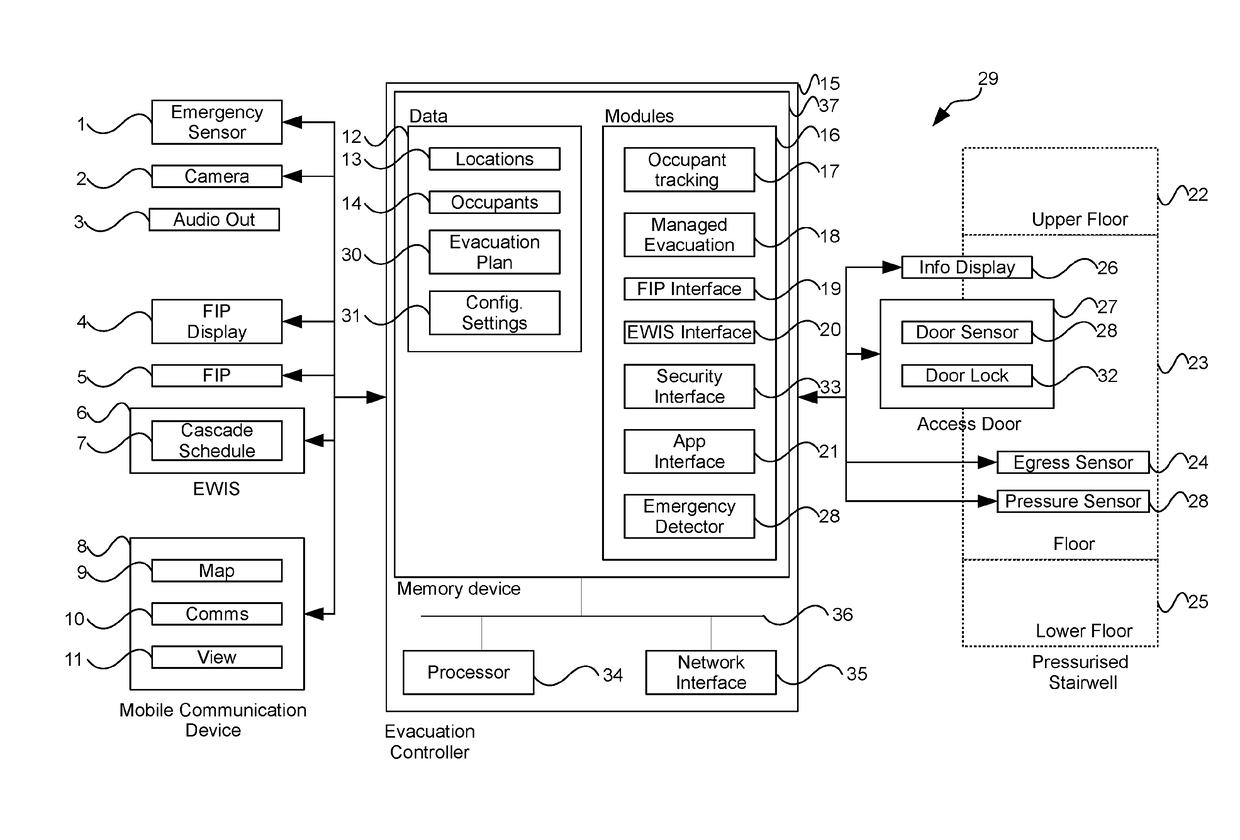
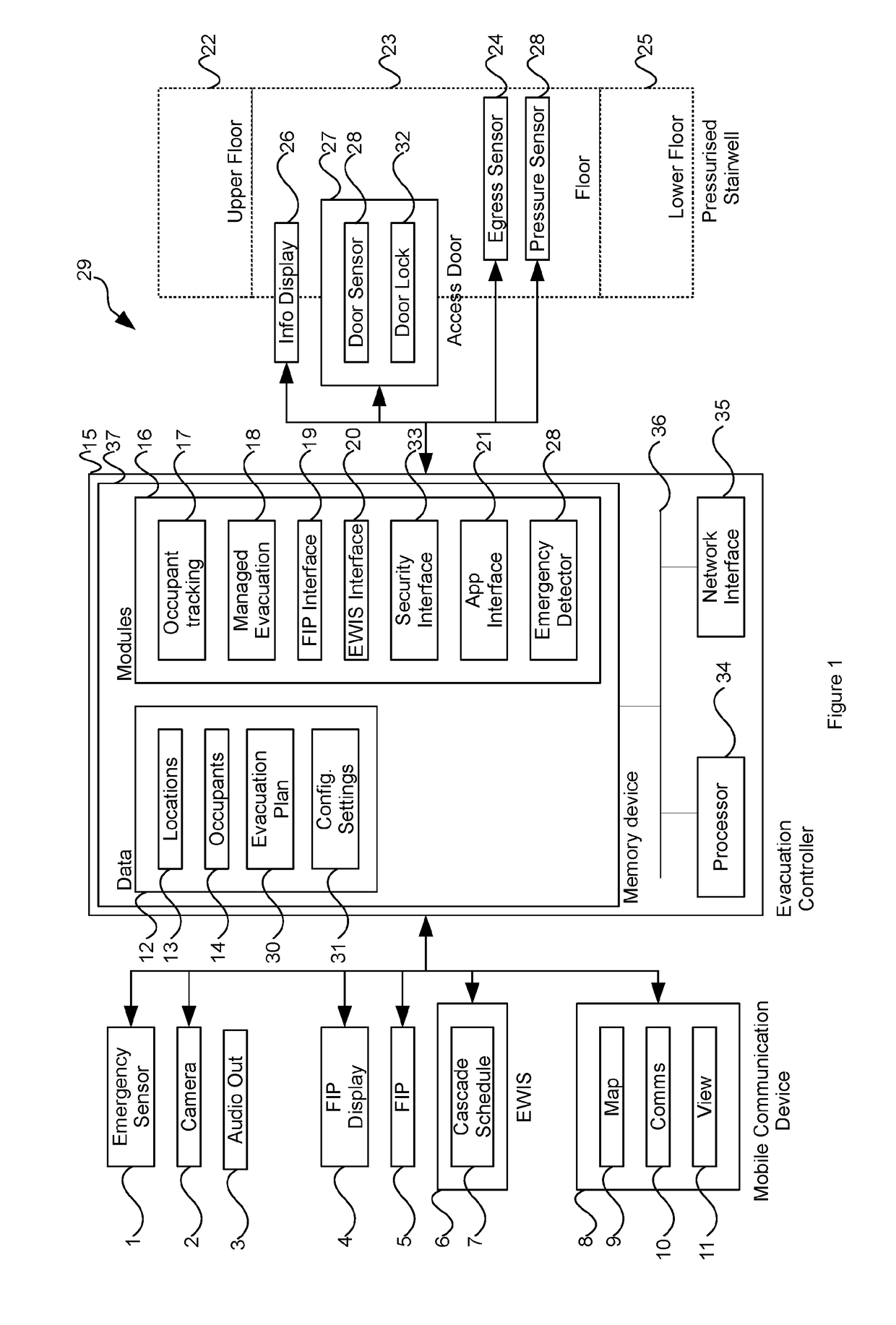
A control system for optimising emergency multi-storey building stairwell evacuation
PatentInactiveUS20180315150A1
Innovation
- A control system that includes an occupant tracking subsystem to monitor and calculate the number of occupants on each floor, dynamically configuring the evacuation plan to optimize stairwell access door control, ensuring orderly evacuation, maintaining pressurization, and preventing congestion.
Emergency evacuation control method
PatentActiveKR1020220151490A
Innovation
- A disaster evacuation control method that utilizes access control terminals and disaster detection sensors to transmit data to a central control server, which sets an optimal evacuation route considering occupancy and location information, guiding users through existing lighting and mobile apps without additional facilities.


Safety Standards and Compliance for Emergency Systems
Emergency access control systems must adhere to stringent safety standards and regulatory frameworks to ensure reliable operation during critical situations. The primary governing standards include NFPA 101 Life Safety Code, which establishes fundamental requirements for emergency egress systems, and NFPA 72 National Fire Alarm and Signaling Code, which addresses integration with fire safety systems. These standards mandate that access control systems must fail-safe during emergencies, automatically unlocking doors to facilitate rapid evacuation while maintaining security perimeters where necessary.
International compliance frameworks such as EN 12101 series in Europe and AS 1851 in Australia provide additional layers of regulatory oversight, particularly focusing on smoke and heat control systems integration with access control mechanisms. These standards emphasize the critical importance of system redundancy and backup power provisions to ensure continuous operation during power failures or system malfunctions.
Building codes across different jurisdictions typically require emergency access control systems to integrate seamlessly with fire alarm systems, enabling automatic door release upon fire detection or manual activation of emergency controls. The International Building Code (IBC) and local fire safety regulations mandate specific response times for door unlocking mechanisms, typically requiring activation within 15 seconds of emergency signal receipt.
Compliance verification involves rigorous testing protocols including monthly functional tests, annual comprehensive system evaluations, and periodic third-party inspections. Documentation requirements are extensive, encompassing installation certificates, maintenance records, and performance validation reports. These records must demonstrate consistent adherence to manufacturer specifications and regulatory standards.
Regular audits by certified fire safety professionals ensure ongoing compliance with evolving safety standards. System modifications or upgrades must undergo formal approval processes, including impact assessments on existing safety protocols and integration testing with connected emergency systems to maintain comprehensive safety coverage throughout the facility.
International compliance frameworks such as EN 12101 series in Europe and AS 1851 in Australia provide additional layers of regulatory oversight, particularly focusing on smoke and heat control systems integration with access control mechanisms. These standards emphasize the critical importance of system redundancy and backup power provisions to ensure continuous operation during power failures or system malfunctions.
Building codes across different jurisdictions typically require emergency access control systems to integrate seamlessly with fire alarm systems, enabling automatic door release upon fire detection or manual activation of emergency controls. The International Building Code (IBC) and local fire safety regulations mandate specific response times for door unlocking mechanisms, typically requiring activation within 15 seconds of emergency signal receipt.
Compliance verification involves rigorous testing protocols including monthly functional tests, annual comprehensive system evaluations, and periodic third-party inspections. Documentation requirements are extensive, encompassing installation certificates, maintenance records, and performance validation reports. These records must demonstrate consistent adherence to manufacturer specifications and regulatory standards.
Regular audits by certified fire safety professionals ensure ongoing compliance with evolving safety standards. System modifications or upgrades must undergo formal approval processes, including impact assessments on existing safety protocols and integration testing with connected emergency systems to maintain comprehensive safety coverage throughout the facility.
Fail-Safe Mechanisms in Emergency Access Control Design
Fail-safe mechanisms represent the cornerstone of emergency access control design, ensuring that systems default to a safe state when power failures, component malfunctions, or communication disruptions occur. These mechanisms are engineered to prioritize human safety over security concerns during emergency situations, automatically transitioning from secure access control to unrestricted egress when system integrity is compromised.
The fundamental principle underlying fail-safe design is the concept of "fail-open" operation for emergency exits, where any system failure results in immediate door unlocking and barrier removal. This approach contrasts sharply with standard access control systems that typically employ "fail-secure" mechanisms to maintain security during outages. Emergency access control systems incorporate redundant power supplies, including battery backup systems and emergency generators, to maintain controlled operation during primary power failures while ensuring doors can still be manually operated.
Hardware-level fail-safe mechanisms include electromagnetic lock designs that require continuous power to maintain engagement, automatically releasing when power is interrupted. Mechanical override systems provide manual unlocking capabilities through break-glass units, emergency push bars, and key-operated bypasses that function independently of electronic components. These mechanical systems serve as the ultimate fallback, ensuring egress availability even when all electronic systems fail simultaneously.
Software-based fail-safe protocols monitor system health continuously, detecting communication timeouts, sensor malfunctions, and processing errors. When anomalies are detected, these systems initiate predetermined emergency sequences that unlock doors, disable access restrictions, and activate visual or audible indicators. Advanced implementations incorporate distributed processing architectures where individual door controllers can operate autonomously when central system communication is lost.
Integration with building fire safety systems ensures coordinated emergency response, where fire alarm activation triggers immediate access control system transition to emergency mode. This integration extends to HVAC systems, elevator controls, and emergency lighting to provide comprehensive facility-wide emergency management while maintaining essential access control functions for security-sensitive areas that require controlled evacuation procedures.
The fundamental principle underlying fail-safe design is the concept of "fail-open" operation for emergency exits, where any system failure results in immediate door unlocking and barrier removal. This approach contrasts sharply with standard access control systems that typically employ "fail-secure" mechanisms to maintain security during outages. Emergency access control systems incorporate redundant power supplies, including battery backup systems and emergency generators, to maintain controlled operation during primary power failures while ensuring doors can still be manually operated.
Hardware-level fail-safe mechanisms include electromagnetic lock designs that require continuous power to maintain engagement, automatically releasing when power is interrupted. Mechanical override systems provide manual unlocking capabilities through break-glass units, emergency push bars, and key-operated bypasses that function independently of electronic components. These mechanical systems serve as the ultimate fallback, ensuring egress availability even when all electronic systems fail simultaneously.
Software-based fail-safe protocols monitor system health continuously, detecting communication timeouts, sensor malfunctions, and processing errors. When anomalies are detected, these systems initiate predetermined emergency sequences that unlock doors, disable access restrictions, and activate visual or audible indicators. Advanced implementations incorporate distributed processing architectures where individual door controllers can operate autonomously when central system communication is lost.
Integration with building fire safety systems ensures coordinated emergency response, where fire alarm activation triggers immediate access control system transition to emergency mode. This integration extends to HVAC systems, elevator controls, and emergency lighting to provide comprehensive facility-wide emergency management while maintaining essential access control functions for security-sensitive areas that require controlled evacuation procedures.
Unlock deeper insights with Patsnap Eureka Quick Research — get a full tech report to explore trends and direct your research. Try now!
Generate Your Research Report Instantly with AI Agent
Supercharge your innovation with Patsnap Eureka AI Agent Platform!