
Achieve Near Zero Backlash Using Planetary Gearbox Adjustments
MAY 25, 20269 MIN READ
Generate Your Research Report Instantly with AI Agent
Patsnap Eureka helps you evaluate technical feasibility & market potential.
Planetary Gearbox Backlash Background and Zero-Backlash Goals
Planetary gearboxes have been fundamental components in precision mechanical systems since their widespread adoption in the mid-20th century. Initially developed for aerospace applications where weight reduction and high torque density were critical, these systems evolved from simple gear trains to sophisticated multi-stage configurations. The inherent advantages of planetary designs, including compact form factors, high reduction ratios, and distributed load sharing among multiple planet gears, made them indispensable across industries ranging from robotics to renewable energy.
The evolution of planetary gearbox technology has been driven by increasingly demanding precision requirements. Early applications tolerated backlash levels of several arc-minutes, but modern applications in semiconductor manufacturing, medical devices, and advanced robotics require positioning accuracies measured in arc-seconds. This progression has necessitated fundamental advances in manufacturing tolerances, material science, and assembly techniques.
Backlash, defined as the angular play between meshing gear teeth when torque direction reverses, represents one of the most significant challenges in achieving precision motion control. In planetary systems, backlash accumulates from multiple sources: sun-to-planet mesh interfaces, planet-to-ring gear contacts, and bearing clearances. This cumulative effect can result in total system backlash that significantly exceeds individual component tolerances.
The primary technical objective in near-zero backlash planetary gearbox development centers on achieving total angular play below 1 arc-minute, with premium applications targeting sub-30 arc-second performance. These targets must be maintained across operational temperature ranges, load conditions, and throughout extended service life cycles. Additionally, the solution must preserve the inherent advantages of planetary configurations while minimizing complexity and manufacturing costs.
Contemporary zero-backlash goals extend beyond static positioning accuracy to encompass dynamic performance characteristics. Modern applications require consistent backlash control under varying load conditions, temperature fluctuations, and wear progression. The challenge involves developing adjustment mechanisms that can compensate for manufacturing tolerances while maintaining long-term stability and reliability in demanding operational environments.
The evolution of planetary gearbox technology has been driven by increasingly demanding precision requirements. Early applications tolerated backlash levels of several arc-minutes, but modern applications in semiconductor manufacturing, medical devices, and advanced robotics require positioning accuracies measured in arc-seconds. This progression has necessitated fundamental advances in manufacturing tolerances, material science, and assembly techniques.
Backlash, defined as the angular play between meshing gear teeth when torque direction reverses, represents one of the most significant challenges in achieving precision motion control. In planetary systems, backlash accumulates from multiple sources: sun-to-planet mesh interfaces, planet-to-ring gear contacts, and bearing clearances. This cumulative effect can result in total system backlash that significantly exceeds individual component tolerances.
The primary technical objective in near-zero backlash planetary gearbox development centers on achieving total angular play below 1 arc-minute, with premium applications targeting sub-30 arc-second performance. These targets must be maintained across operational temperature ranges, load conditions, and throughout extended service life cycles. Additionally, the solution must preserve the inherent advantages of planetary configurations while minimizing complexity and manufacturing costs.
Contemporary zero-backlash goals extend beyond static positioning accuracy to encompass dynamic performance characteristics. Modern applications require consistent backlash control under varying load conditions, temperature fluctuations, and wear progression. The challenge involves developing adjustment mechanisms that can compensate for manufacturing tolerances while maintaining long-term stability and reliability in demanding operational environments.
Market Demand for High-Precision Planetary Gearbox Systems
The global market for high-precision planetary gearbox systems is experiencing unprecedented growth driven by the increasing demand for automation and precision engineering across multiple industries. Manufacturing sectors, particularly automotive, aerospace, and industrial robotics, are pushing for enhanced accuracy and reliability in motion control systems. The automotive industry's shift toward electric vehicles has created substantial demand for precision gearboxes that can efficiently transfer power while maintaining minimal backlash for optimal performance and energy efficiency.
Robotics and automation applications represent the fastest-growing segment for high-precision planetary gearboxes. Industrial robots require exceptional positioning accuracy for assembly operations, welding, and material handling tasks. Collaborative robots, or cobots, working alongside human operators demand even higher precision standards to ensure safety and operational effectiveness. The semiconductor manufacturing industry has emerged as a critical market driver, where nanometer-level precision is essential for wafer handling and chip production equipment.
Aerospace and defense applications continue to fuel demand for ultra-precise planetary gearbox systems. Satellite positioning mechanisms, aircraft control surfaces, and missile guidance systems require gearboxes with virtually zero backlash to maintain operational integrity under extreme conditions. The space industry's expansion, including commercial satellite deployment and Mars exploration missions, has intensified requirements for reliable, high-precision mechanical systems.
Medical device manufacturing represents another significant growth area, particularly for surgical robotics and diagnostic equipment. Minimally invasive surgical procedures demand precise instrument positioning, where even microscopic backlash can compromise patient safety and surgical outcomes. Advanced imaging systems, including MRI and CT scanners, require smooth, precise motion control for accurate diagnostic results.
The renewable energy sector, especially wind power generation, has created substantial demand for precision gearboxes capable of handling variable loads while maintaining efficiency. Offshore wind installations require gearboxes that can operate reliably in harsh marine environments while delivering consistent performance over extended periods.
Market trends indicate increasing customer willingness to invest in premium gearbox solutions that offer superior precision and longevity. End-users are prioritizing total cost of ownership over initial purchase price, recognizing that high-precision gearboxes reduce maintenance requirements and improve overall system reliability. This shift in purchasing behavior has created opportunities for manufacturers developing advanced backlash elimination technologies.
Robotics and automation applications represent the fastest-growing segment for high-precision planetary gearboxes. Industrial robots require exceptional positioning accuracy for assembly operations, welding, and material handling tasks. Collaborative robots, or cobots, working alongside human operators demand even higher precision standards to ensure safety and operational effectiveness. The semiconductor manufacturing industry has emerged as a critical market driver, where nanometer-level precision is essential for wafer handling and chip production equipment.
Aerospace and defense applications continue to fuel demand for ultra-precise planetary gearbox systems. Satellite positioning mechanisms, aircraft control surfaces, and missile guidance systems require gearboxes with virtually zero backlash to maintain operational integrity under extreme conditions. The space industry's expansion, including commercial satellite deployment and Mars exploration missions, has intensified requirements for reliable, high-precision mechanical systems.
Medical device manufacturing represents another significant growth area, particularly for surgical robotics and diagnostic equipment. Minimally invasive surgical procedures demand precise instrument positioning, where even microscopic backlash can compromise patient safety and surgical outcomes. Advanced imaging systems, including MRI and CT scanners, require smooth, precise motion control for accurate diagnostic results.
The renewable energy sector, especially wind power generation, has created substantial demand for precision gearboxes capable of handling variable loads while maintaining efficiency. Offshore wind installations require gearboxes that can operate reliably in harsh marine environments while delivering consistent performance over extended periods.
Market trends indicate increasing customer willingness to invest in premium gearbox solutions that offer superior precision and longevity. End-users are prioritizing total cost of ownership over initial purchase price, recognizing that high-precision gearboxes reduce maintenance requirements and improve overall system reliability. This shift in purchasing behavior has created opportunities for manufacturers developing advanced backlash elimination technologies.
Current Backlash Issues and Challenges in Planetary Gearboxes
Planetary gearboxes face significant backlash challenges that directly impact precision applications across multiple industries. Backlash, defined as the angular play between meshing gear teeth when torque direction changes, typically ranges from 3-15 arcminutes in standard planetary systems. This inherent clearance creates positioning errors, reduces system stiffness, and generates unwanted vibrations during operation.
Manufacturing tolerances represent the primary source of backlash accumulation in planetary gearboxes. Each gear component contributes individual tolerances that compound throughout the gear train, including tooth profile deviations, pitch circle variations, and center distance errors. The multi-stage nature of planetary systems amplifies these tolerances, as backlash from the sun gear, planet gears, and ring gear collectively determine overall system backlash.
Thermal expansion presents another critical challenge affecting backlash consistency. Operating temperature variations cause differential expansion between gear materials, housing components, and bearing systems. Steel gears expanding at different rates than aluminum housings create dynamic backlash changes that compromise precision during extended operation cycles. This thermal instability particularly affects applications requiring consistent positioning accuracy across varying environmental conditions.
Wear progression significantly deteriorates backlash performance over operational lifetime. Contact stress concentrations at gear tooth interfaces gradually increase clearances through material removal and surface degradation. Planet gear bearing wear compounds this issue by allowing increased radial movement, further expanding effective backlash. The distributed load sharing among multiple planet gears creates uneven wear patterns that exacerbate backlash inconsistencies.
Load distribution irregularities among planet gears create additional backlash complications. Manufacturing variations prevent equal load sharing, causing some planet gears to carry disproportionate loads while others operate with excessive clearances. This uneven loading pattern results in non-uniform backlash characteristics that vary with rotational position and applied torque levels.
Assembly and adjustment limitations constrain backlash optimization capabilities in conventional planetary designs. Traditional fixed-center distance configurations provide minimal adjustment flexibility once manufacturing is complete. Achieving consistent backlash across all gear mesh interfaces requires precise coordination of multiple tolerance chains, making reliable backlash control extremely challenging with standard manufacturing and assembly processes.
Manufacturing tolerances represent the primary source of backlash accumulation in planetary gearboxes. Each gear component contributes individual tolerances that compound throughout the gear train, including tooth profile deviations, pitch circle variations, and center distance errors. The multi-stage nature of planetary systems amplifies these tolerances, as backlash from the sun gear, planet gears, and ring gear collectively determine overall system backlash.
Thermal expansion presents another critical challenge affecting backlash consistency. Operating temperature variations cause differential expansion between gear materials, housing components, and bearing systems. Steel gears expanding at different rates than aluminum housings create dynamic backlash changes that compromise precision during extended operation cycles. This thermal instability particularly affects applications requiring consistent positioning accuracy across varying environmental conditions.
Wear progression significantly deteriorates backlash performance over operational lifetime. Contact stress concentrations at gear tooth interfaces gradually increase clearances through material removal and surface degradation. Planet gear bearing wear compounds this issue by allowing increased radial movement, further expanding effective backlash. The distributed load sharing among multiple planet gears creates uneven wear patterns that exacerbate backlash inconsistencies.
Load distribution irregularities among planet gears create additional backlash complications. Manufacturing variations prevent equal load sharing, causing some planet gears to carry disproportionate loads while others operate with excessive clearances. This uneven loading pattern results in non-uniform backlash characteristics that vary with rotational position and applied torque levels.
Assembly and adjustment limitations constrain backlash optimization capabilities in conventional planetary designs. Traditional fixed-center distance configurations provide minimal adjustment flexibility once manufacturing is complete. Achieving consistent backlash across all gear mesh interfaces requires precise coordination of multiple tolerance chains, making reliable backlash control extremely challenging with standard manufacturing and assembly processes.
Existing Backlash Adjustment Solutions and Methods
01 Gear tooth profile optimization for backlash reduction
Advanced gear tooth profile designs and modifications can significantly reduce backlash in planetary gearboxes. These approaches include optimized involute profiles, modified tooth geometry, and precision manufacturing techniques that minimize clearances between meshing gear teeth. The optimization focuses on maintaining proper contact ratios while reducing the angular play between gears.- Gear tooth profile optimization for backlash reduction: Advanced gear tooth profile designs and modifications can significantly reduce backlash in planetary gearboxes. These techniques involve optimizing tooth geometry, including involute profiles, tooth thickness variations, and contact patterns to minimize clearances between meshing gears while maintaining smooth operation and load distribution.
- Preload mechanisms and spring-loaded systems: Implementation of preload mechanisms using springs, elastic elements, or hydraulic systems to eliminate backlash by maintaining constant contact between gear teeth. These systems apply controlled forces to keep gears engaged and compensate for wear and manufacturing tolerances over the operational lifetime of the gearbox.
- Split gear and anti-backlash gear arrangements: Utilization of split gear configurations where gears are divided into multiple segments that can be adjusted relative to each other to eliminate backlash. These arrangements often include adjustment mechanisms that allow fine-tuning of gear positioning to maintain zero backlash conditions throughout the gearbox operation.
- Precision manufacturing and tolerance control: Advanced manufacturing techniques and strict tolerance control methods to minimize backlash through precise gear cutting, grinding, and assembly processes. These approaches focus on reducing manufacturing variations and achieving tighter fits between components while maintaining proper lubrication and thermal expansion considerations.
- Electronic backlash compensation and control systems: Implementation of electronic control systems and sensors to monitor and compensate for backlash in real-time. These systems use feedback mechanisms, position sensors, and control algorithms to detect backlash conditions and apply corrective measures through motor control or mechanical adjustment systems.
02 Preload mechanisms and spring-loaded systems
Implementation of preload mechanisms using springs, elastic elements, or hydraulic systems to eliminate backlash by maintaining constant contact between gear teeth. These systems apply controlled forces to keep gears in continuous engagement, preventing free play and improving positioning accuracy in planetary gear arrangements.Expand Specific Solutions03 Split gear and anti-backlash gear configurations
Utilization of split gear designs where gears are divided into multiple segments that can be adjusted relative to each other to eliminate backlash. These configurations often include adjustment mechanisms that allow fine-tuning of gear positioning to compensate for wear and manufacturing tolerances over time.Expand Specific Solutions04 Electronic backlash compensation and control systems
Advanced control algorithms and electronic systems that monitor and compensate for backlash in real-time. These systems use sensors to detect gear position and apply corrective measures through motor control or actuator adjustments to minimize the effects of mechanical backlash on system performance.Expand Specific Solutions05 Manufacturing precision and assembly techniques
Enhanced manufacturing processes and assembly methods that achieve tighter tolerances and reduce inherent backlash in planetary gearboxes. These techniques include precision machining, selective assembly of components, and quality control measures that ensure optimal gear mesh characteristics and minimal clearances.Expand Specific Solutions
Key Players in Precision Planetary Gearbox Manufacturing
The planetary gearbox technology for achieving near-zero backlash represents a mature market in the growth stage, driven by increasing demand for precision motion control across robotics, aerospace, and industrial automation sectors. The global market demonstrates substantial scale, with established players like ZF Friedrichshafen AG, Sumitomo Heavy Industries, and Harmonic Drive Systems leading through decades of engineering expertise. Technology maturity varies significantly across the competitive landscape - while German manufacturers like Schaeffler Technologies and Siemens AG leverage advanced materials science and precision manufacturing, Japanese companies such as JTEKT Corp. and Oriental Motor focus on servo integration and miniaturization. Emerging players from China, including Chongqing Qingping Machinery and Newstart Planetary Gear Boxes, are rapidly advancing through strategic partnerships with research institutions like Chongqing University. Swiss precision specialist maxon motor AG and Taiwanese manufacturer HIWIN Technologies represent the high-end segment, emphasizing ultra-precise applications in medical and semiconductor equipment, indicating a highly segmented market with distinct technological approaches.
ZF Friedrichshafen AG
Technical Solution: ZF Friedrichshafen has developed advanced planetary gearbox systems with integrated backlash compensation mechanisms for automotive and industrial applications. Their approach combines precision manufacturing with active backlash adjustment systems that utilize spring-loaded planet carriers and adjustable ring gear positioning. The company's EcoLife transmission series incorporates micro-adjustment capabilities through hydraulically controlled preload systems that maintain optimal gear mesh engagement throughout the operational lifecycle. ZF's technology includes real-time monitoring systems that detect backlash changes and automatically compensate through controlled preload adjustments, achieving backlash reduction of up to 90% compared to conventional planetary systems. Their latest developments focus on electromechanical actuators for precise backlash control in electric vehicle drivetrains.
Strengths: Proven automotive-grade reliability, integrated monitoring systems, scalable for various applications. Weaknesses: Complex hydraulic systems increase maintenance requirements, higher initial investment costs.
Sumitomo Heavy Industries, Ltd.
Technical Solution: Sumitomo Heavy Industries has developed the Fine Cyclo series of planetary gearboxes featuring their proprietary cycloidal gear technology for near-zero backlash applications. Their system utilizes a unique cycloidal disc design with multiple engagement points that create a self-centering effect, minimizing backlash through geometric constraints rather than mechanical preloading. The technology incorporates precision-ground cycloidal profiles with tolerances within 2 micrometers, combined with adjustable eccentric bearings that allow fine-tuning of gear mesh engagement. Sumitomo's approach includes integrated torque limiters and vibration dampening systems that maintain consistent backlash performance under varying load conditions. Their latest F2C series achieves backlash levels below 0.5 arcminutes while providing high shock load resistance and extended service life in industrial automation applications.
Strengths: High shock load resistance, self-centering design reduces wear, excellent vibration dampening. Weaknesses: Complex manufacturing requirements, limited high-speed applications, requires specialized tooling for adjustments.
Core Patents in Zero-Backlash Planetary Gear Design
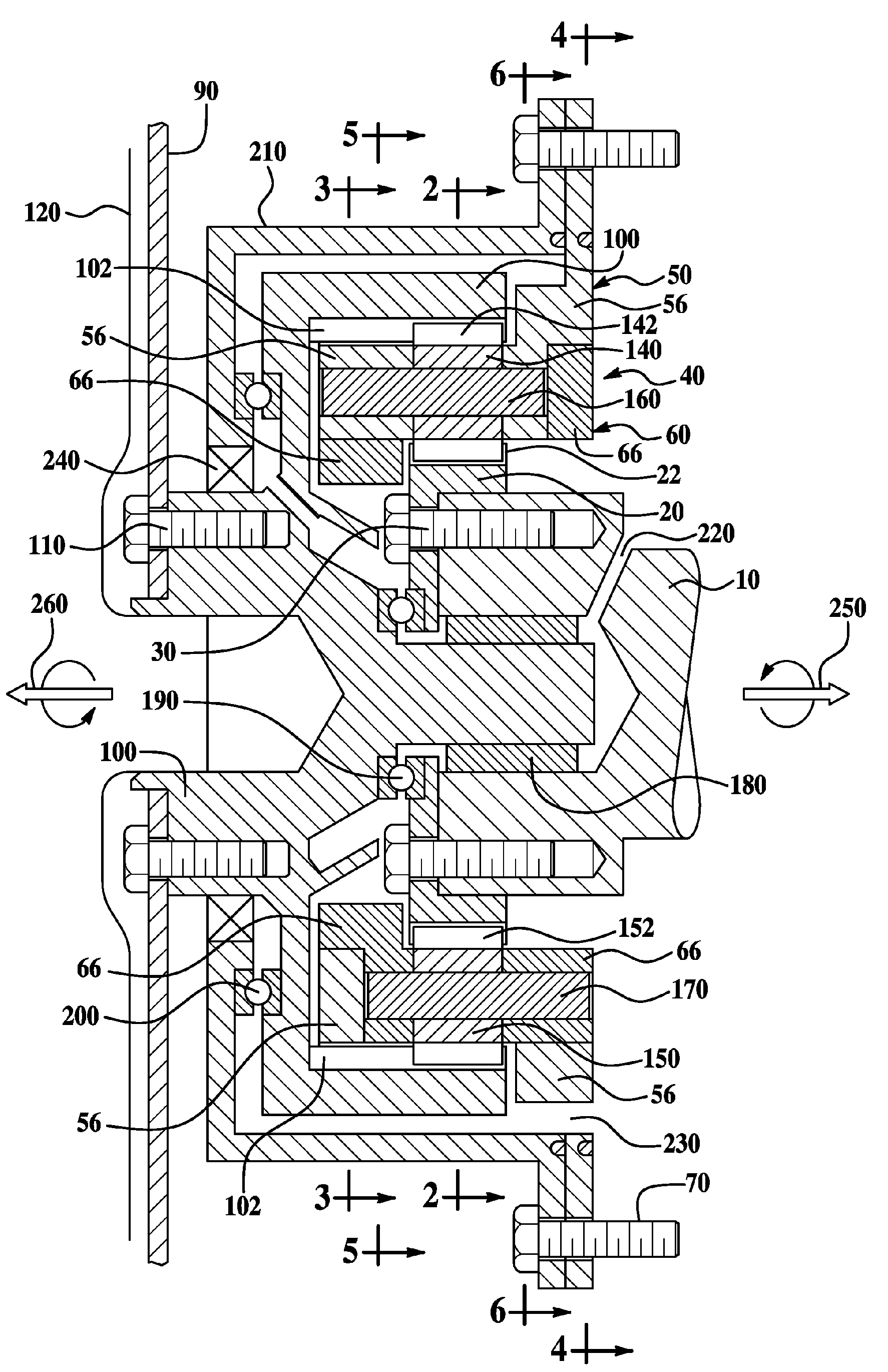
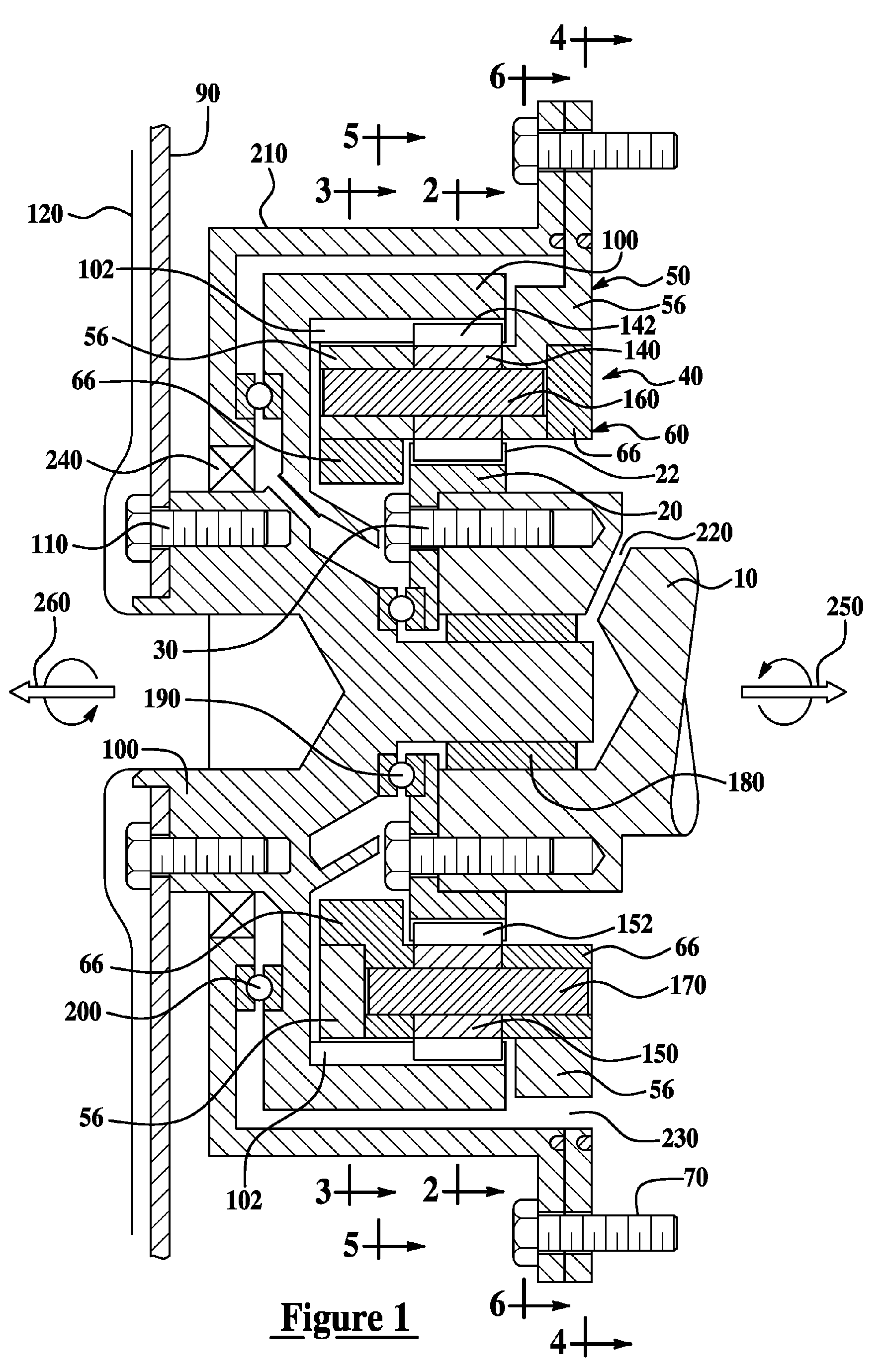
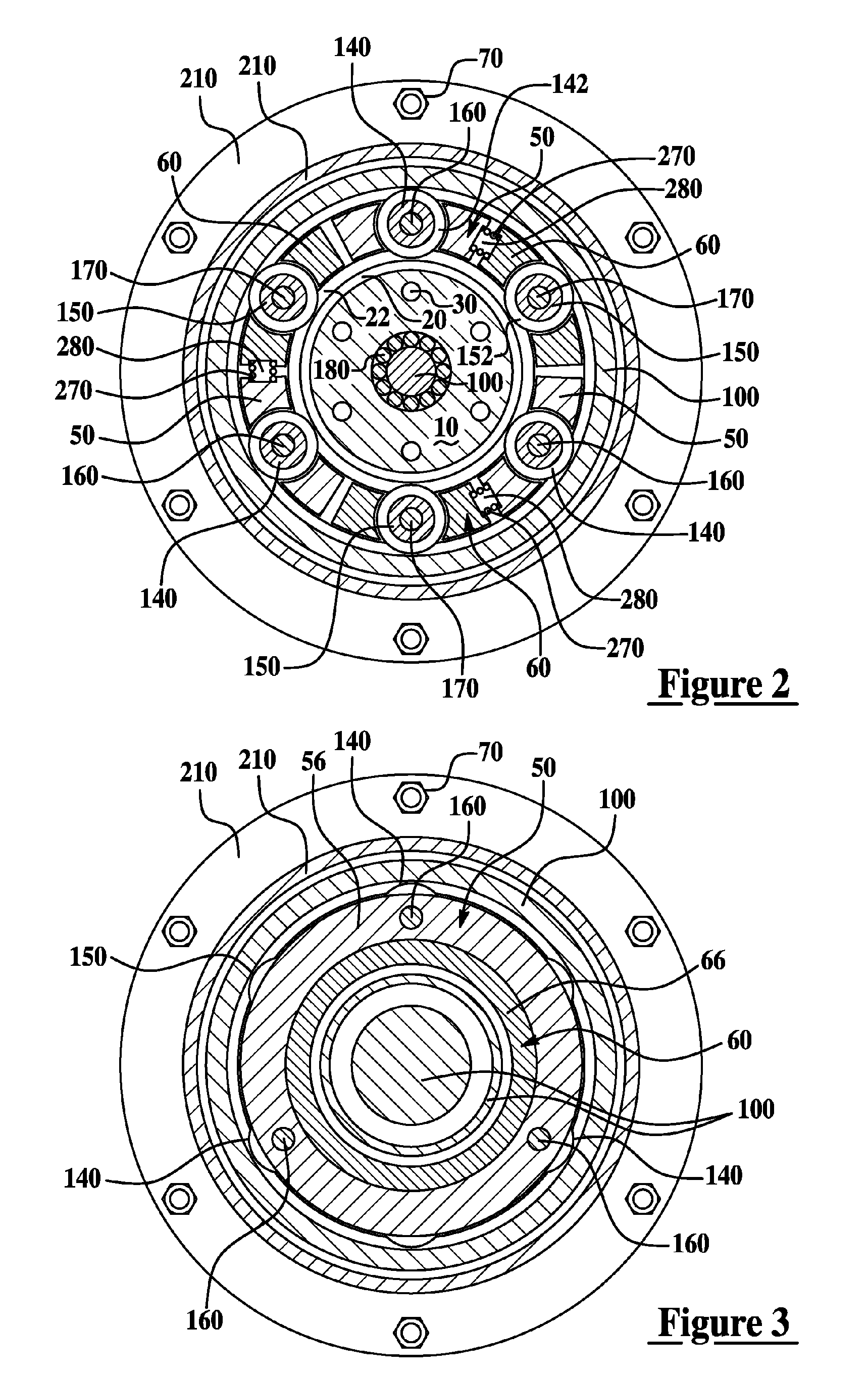
System and method for reducing backlash in a planetary gear set
PatentInactiveUS7261667B2
Innovation
- A two-part planet carrier system with a spring preload mechanism that automatically adjusts to eliminate backlash by ensuring simultaneous contact of gear teeth on both the drive and coast sides, maintaining proper alignment and preventing tight mesh conditions.

Zero-backlash planetary gear mechanism
PatentActiveTW201333347A
Innovation
- A zero-backlash planetary reduction mechanism with a planetary gear set and a buffer mechanism between double-layer planetary gears, utilizing an elastic body and stopper to automatically adjust and eliminate backlash, ensuring no backlash during forward and reverse rotation, and maintaining high rigidity.


Manufacturing Standards for Precision Gear Systems
Manufacturing standards for precision gear systems represent the cornerstone of achieving near-zero backlash in planetary gearbox applications. These standards encompass comprehensive specifications that govern dimensional tolerances, surface finish requirements, material properties, and assembly procedures critical for high-precision mechanical systems.
The ISO 1328 standard series provides fundamental guidelines for gear accuracy classification, establishing tolerance classes ranging from IT1 to IT12, with IT4 to IT6 typically required for precision planetary gearboxes targeting minimal backlash. These classifications define permissible deviations in tooth profile, lead angle, pitch accuracy, and runout characteristics that directly influence backlash performance.
AGMA 2015 standards complement ISO specifications by addressing American gear manufacturing practices, particularly focusing on tooth contact patterns and load distribution uniformity. The standard emphasizes the importance of controlled manufacturing processes including gear cutting, heat treatment, and finishing operations that maintain consistent tooth geometry across all planetary gear components.
DIN 3962 standards specifically address gear tolerance systems and provide detailed methodologies for measuring and verifying gear accuracy. These standards establish protocols for backlash measurement techniques, including the use of precision measuring instruments and statistical process control methods essential for maintaining consistent manufacturing quality.
Japanese JIS B 1702 standards contribute additional precision requirements particularly relevant to robotics and automation applications where near-zero backlash is critical. These standards emphasize advanced manufacturing techniques including profile grinding, honing, and lapping processes that achieve surface finishes below 0.2 Ra and dimensional accuracies within ±2 micrometers.
Quality assurance protocols mandated by these standards require comprehensive inspection procedures including coordinate measuring machine verification, gear rolling tests, and backlash measurement under controlled loading conditions. Statistical process control implementation ensures manufacturing consistency and enables predictive maintenance of production equipment to maintain precision standards throughout extended production runs.
The ISO 1328 standard series provides fundamental guidelines for gear accuracy classification, establishing tolerance classes ranging from IT1 to IT12, with IT4 to IT6 typically required for precision planetary gearboxes targeting minimal backlash. These classifications define permissible deviations in tooth profile, lead angle, pitch accuracy, and runout characteristics that directly influence backlash performance.
AGMA 2015 standards complement ISO specifications by addressing American gear manufacturing practices, particularly focusing on tooth contact patterns and load distribution uniformity. The standard emphasizes the importance of controlled manufacturing processes including gear cutting, heat treatment, and finishing operations that maintain consistent tooth geometry across all planetary gear components.
DIN 3962 standards specifically address gear tolerance systems and provide detailed methodologies for measuring and verifying gear accuracy. These standards establish protocols for backlash measurement techniques, including the use of precision measuring instruments and statistical process control methods essential for maintaining consistent manufacturing quality.
Japanese JIS B 1702 standards contribute additional precision requirements particularly relevant to robotics and automation applications where near-zero backlash is critical. These standards emphasize advanced manufacturing techniques including profile grinding, honing, and lapping processes that achieve surface finishes below 0.2 Ra and dimensional accuracies within ±2 micrometers.
Quality assurance protocols mandated by these standards require comprehensive inspection procedures including coordinate measuring machine verification, gear rolling tests, and backlash measurement under controlled loading conditions. Statistical process control implementation ensures manufacturing consistency and enables predictive maintenance of production equipment to maintain precision standards throughout extended production runs.
Cost-Benefit Analysis of Zero-Backlash Implementation
The implementation of near-zero backlash in planetary gearboxes presents a complex economic equation that requires careful evaluation of initial investments against long-term operational benefits. The upfront costs typically include precision manufacturing of gear components, advanced adjustment mechanisms, specialized tooling, and enhanced quality control systems. These initial expenditures can increase manufacturing costs by 15-30% compared to standard planetary gearbox configurations.
Manufacturing cost analysis reveals that achieving near-zero backlash requires tighter tolerances, premium materials, and sophisticated adjustment systems such as split-ring designs or preload mechanisms. The precision machining processes necessary for maintaining consistent gear tooth profiles and surface finishes contribute significantly to production expenses. Additionally, the implementation of real-time monitoring systems and automated adjustment capabilities further elevates the initial investment threshold.
However, the operational benefits demonstrate substantial long-term value propositions. Reduced backlash directly translates to improved positioning accuracy, decreased maintenance requirements, and extended equipment lifespan. Industries utilizing high-precision automation report productivity improvements of 8-12% following zero-backlash implementation, primarily due to reduced cycle times and enhanced repeatability in manufacturing processes.
The maintenance cost reduction represents another significant economic advantage. Traditional gearboxes with standard backlash tolerances typically require more frequent calibration and component replacement due to wear-induced positioning errors. Zero-backlash systems demonstrate 40-60% longer service intervals and reduced unplanned downtime, resulting in substantial operational savings over the equipment lifecycle.
Return on investment calculations indicate that the break-even point typically occurs within 18-24 months for high-utilization applications. Critical factors influencing this timeline include operational duty cycles, precision requirements, and the cost of production delays. Industries with stringent quality standards, such as semiconductor manufacturing and medical device production, often realize faster payback periods due to the high cost of precision errors and rework.
The total cost of ownership analysis must also consider the reduced risk of product defects and associated warranty claims. Enhanced positioning accuracy minimizes scrap rates and improves overall product quality, contributing to brand reputation and customer satisfaction metrics that extend beyond direct financial calculations.
Manufacturing cost analysis reveals that achieving near-zero backlash requires tighter tolerances, premium materials, and sophisticated adjustment systems such as split-ring designs or preload mechanisms. The precision machining processes necessary for maintaining consistent gear tooth profiles and surface finishes contribute significantly to production expenses. Additionally, the implementation of real-time monitoring systems and automated adjustment capabilities further elevates the initial investment threshold.
However, the operational benefits demonstrate substantial long-term value propositions. Reduced backlash directly translates to improved positioning accuracy, decreased maintenance requirements, and extended equipment lifespan. Industries utilizing high-precision automation report productivity improvements of 8-12% following zero-backlash implementation, primarily due to reduced cycle times and enhanced repeatability in manufacturing processes.
The maintenance cost reduction represents another significant economic advantage. Traditional gearboxes with standard backlash tolerances typically require more frequent calibration and component replacement due to wear-induced positioning errors. Zero-backlash systems demonstrate 40-60% longer service intervals and reduced unplanned downtime, resulting in substantial operational savings over the equipment lifecycle.
Return on investment calculations indicate that the break-even point typically occurs within 18-24 months for high-utilization applications. Critical factors influencing this timeline include operational duty cycles, precision requirements, and the cost of production delays. Industries with stringent quality standards, such as semiconductor manufacturing and medical device production, often realize faster payback periods due to the high cost of precision errors and rework.
The total cost of ownership analysis must also consider the reduced risk of product defects and associated warranty claims. Enhanced positioning accuracy minimizes scrap rates and improves overall product quality, contributing to brand reputation and customer satisfaction metrics that extend beyond direct financial calculations.
Unlock deeper insights with Patsnap Eureka Quick Research — get a full tech report to explore trends and direct your research. Try now!
Generate Your Research Report Instantly with AI Agent
Supercharge your innovation with Patsnap Eureka AI Agent Platform!