
Anode-Free Cells vs Solid-State Batteries: Performance Review
MAY 22, 20268 MIN READ
Generate Your Research Report Instantly with AI Agent
Patsnap Eureka helps you evaluate technical feasibility & market potential.
Anode-Free and Solid-State Battery Technology Background
The evolution of battery technology has been driven by the relentless pursuit of higher energy density, improved safety, and enhanced performance characteristics. Traditional lithium-ion batteries, while revolutionary in their time, face inherent limitations due to their reliance on graphite anodes and liquid electrolytes. These constraints have sparked intensive research into two promising technological pathways: anode-free cell architectures and solid-state battery systems.
Anode-free battery technology represents a paradigm shift in cell design by eliminating the traditional anode material entirely. Instead of using graphite or silicon-based anodes, these systems rely on direct lithium metal plating onto a current collector during charging. This approach theoretically maximizes energy density by removing the weight and volume associated with anode host materials. The concept emerged from research into lithium metal batteries in the 1970s but has gained renewed attention due to advances in electrolyte chemistry and cell engineering.
Solid-state batteries, conversely, maintain conventional cell architectures while replacing liquid electrolytes with solid ionic conductors. This technology addresses critical safety concerns associated with flammable organic electrolytes while potentially enabling the use of lithium metal anodes. The solid electrolyte serves as both an ionic conductor and a physical barrier, preventing dendrite formation that has historically plagued lithium metal systems.
Both technologies aim to overcome the energy density ceiling of approximately 300 Wh/kg that characterizes current lithium-ion systems. Anode-free cells target this limitation through material elimination, while solid-state batteries pursue it through enhanced safety margins that permit higher voltage operation and lithium metal utilization. The convergence of these approaches has created hybrid concepts where anode-free architectures are implemented within solid-state frameworks.
The technological objectives driving these innovations extend beyond energy density improvements. Enhanced cycle life, faster charging capabilities, wider operating temperature ranges, and simplified manufacturing processes represent additional motivations. These goals align with emerging applications in electric vehicles, grid storage, and portable electronics where current battery limitations constrain system performance and adoption rates.
Anode-free battery technology represents a paradigm shift in cell design by eliminating the traditional anode material entirely. Instead of using graphite or silicon-based anodes, these systems rely on direct lithium metal plating onto a current collector during charging. This approach theoretically maximizes energy density by removing the weight and volume associated with anode host materials. The concept emerged from research into lithium metal batteries in the 1970s but has gained renewed attention due to advances in electrolyte chemistry and cell engineering.
Solid-state batteries, conversely, maintain conventional cell architectures while replacing liquid electrolytes with solid ionic conductors. This technology addresses critical safety concerns associated with flammable organic electrolytes while potentially enabling the use of lithium metal anodes. The solid electrolyte serves as both an ionic conductor and a physical barrier, preventing dendrite formation that has historically plagued lithium metal systems.
Both technologies aim to overcome the energy density ceiling of approximately 300 Wh/kg that characterizes current lithium-ion systems. Anode-free cells target this limitation through material elimination, while solid-state batteries pursue it through enhanced safety margins that permit higher voltage operation and lithium metal utilization. The convergence of these approaches has created hybrid concepts where anode-free architectures are implemented within solid-state frameworks.
The technological objectives driving these innovations extend beyond energy density improvements. Enhanced cycle life, faster charging capabilities, wider operating temperature ranges, and simplified manufacturing processes represent additional motivations. These goals align with emerging applications in electric vehicles, grid storage, and portable electronics where current battery limitations constrain system performance and adoption rates.
Market Demand for Next-Generation Battery Technologies
The global battery market is experiencing unprecedented transformation driven by the urgent need for advanced energy storage solutions across multiple sectors. Electric vehicle adoption continues to accelerate worldwide, creating substantial demand for batteries that can deliver superior energy density, faster charging capabilities, and enhanced safety profiles. Traditional lithium-ion batteries, while successful in establishing the foundation of the electric mobility revolution, are approaching their theoretical performance limits, necessitating breakthrough technologies to meet evolving market expectations.
Consumer electronics manufacturers are simultaneously pushing for thinner, lighter devices with extended battery life, creating additional pressure for next-generation battery technologies. The proliferation of portable devices, wearables, and Internet of Things applications demands batteries that can operate reliably in diverse environmental conditions while maintaining compact form factors. Both anode-free cells and solid-state batteries present compelling solutions to address these stringent requirements through their potential for higher energy densities and improved safety characteristics.
Grid-scale energy storage represents another critical market driver, as renewable energy integration requires reliable, long-duration storage systems. Utility companies and energy developers are seeking battery technologies that can provide cost-effective storage solutions while maintaining performance over extended operational periods. The intermittent nature of solar and wind power generation creates substantial opportunities for advanced battery technologies that can efficiently store and dispatch energy when needed.
Aerospace and defense applications constitute specialized but high-value market segments demanding batteries with exceptional reliability and performance under extreme conditions. These sectors prioritize energy density, temperature tolerance, and safety features that align closely with the advantages offered by solid-state battery architectures and anode-free cell designs.
The convergence of these market demands is driving significant investment in next-generation battery research and development. Automotive manufacturers, technology companies, and battery producers are allocating substantial resources toward advancing both anode-free and solid-state battery technologies, recognizing their potential to capture emerging market opportunities and establish competitive advantages in rapidly evolving energy storage markets.
Consumer electronics manufacturers are simultaneously pushing for thinner, lighter devices with extended battery life, creating additional pressure for next-generation battery technologies. The proliferation of portable devices, wearables, and Internet of Things applications demands batteries that can operate reliably in diverse environmental conditions while maintaining compact form factors. Both anode-free cells and solid-state batteries present compelling solutions to address these stringent requirements through their potential for higher energy densities and improved safety characteristics.
Grid-scale energy storage represents another critical market driver, as renewable energy integration requires reliable, long-duration storage systems. Utility companies and energy developers are seeking battery technologies that can provide cost-effective storage solutions while maintaining performance over extended operational periods. The intermittent nature of solar and wind power generation creates substantial opportunities for advanced battery technologies that can efficiently store and dispatch energy when needed.
Aerospace and defense applications constitute specialized but high-value market segments demanding batteries with exceptional reliability and performance under extreme conditions. These sectors prioritize energy density, temperature tolerance, and safety features that align closely with the advantages offered by solid-state battery architectures and anode-free cell designs.
The convergence of these market demands is driving significant investment in next-generation battery research and development. Automotive manufacturers, technology companies, and battery producers are allocating substantial resources toward advancing both anode-free and solid-state battery technologies, recognizing their potential to capture emerging market opportunities and establish competitive advantages in rapidly evolving energy storage markets.
Current Performance Gaps in Anode-Free vs Solid-State Systems
Anode-free cells currently face significant challenges in achieving stable cycling performance compared to solid-state batteries. The primary performance gap lies in lithium plating uniformity, where anode-free systems struggle with dendrite formation and dead lithium accumulation during repeated charge-discharge cycles. This results in capacity fade rates of 15-25% after 100 cycles, substantially higher than the 5-10% degradation observed in advanced solid-state systems with ceramic electrolytes.
Energy density represents another critical performance disparity. While anode-free cells theoretically offer superior gravimetric energy density exceeding 400 Wh/kg, practical implementations achieve only 250-300 Wh/kg due to electrolyte decomposition and current collector corrosion. Solid-state batteries demonstrate more consistent energy density performance, maintaining 280-320 Wh/kg across extended cycling with minimal degradation.
Coulombic efficiency gaps further highlight system differences. Anode-free cells typically exhibit initial coulombic efficiencies of 85-92%, gradually improving to 98-99% after formation cycles. However, solid-state batteries achieve superior initial efficiencies of 95-98%, reaching stable performance more rapidly. This efficiency gap directly impacts calendar life and practical energy utilization.
Temperature sensitivity creates additional performance disparities. Anode-free systems show severe performance degradation below 0°C, with capacity retention dropping to 60-70% of room temperature values. Solid-state batteries, particularly those with sulfide electrolytes, maintain 80-85% capacity retention under similar conditions, demonstrating superior low-temperature operability.
Rate capability represents a fundamental challenge for both technologies, but with different limiting factors. Anode-free cells are constrained by lithium ion transport through the solid electrolyte interphase, limiting fast charging to 0.5-1C rates. Solid-state systems face ionic conductivity limitations in ceramic electrolytes, restricting practical charging rates to 0.2-0.5C, though recent polymer-ceramic composites show improvement potential.
Mechanical stability issues create distinct failure modes in each system. Anode-free cells experience current collector deformation and electrolyte leakage under volume expansion stress. Solid-state batteries face interfacial delamination and crack propagation in rigid electrolyte structures, leading to impedance growth and capacity loss through different mechanisms than their liquid electrolyte counterparts.
Energy density represents another critical performance disparity. While anode-free cells theoretically offer superior gravimetric energy density exceeding 400 Wh/kg, practical implementations achieve only 250-300 Wh/kg due to electrolyte decomposition and current collector corrosion. Solid-state batteries demonstrate more consistent energy density performance, maintaining 280-320 Wh/kg across extended cycling with minimal degradation.
Coulombic efficiency gaps further highlight system differences. Anode-free cells typically exhibit initial coulombic efficiencies of 85-92%, gradually improving to 98-99% after formation cycles. However, solid-state batteries achieve superior initial efficiencies of 95-98%, reaching stable performance more rapidly. This efficiency gap directly impacts calendar life and practical energy utilization.
Temperature sensitivity creates additional performance disparities. Anode-free systems show severe performance degradation below 0°C, with capacity retention dropping to 60-70% of room temperature values. Solid-state batteries, particularly those with sulfide electrolytes, maintain 80-85% capacity retention under similar conditions, demonstrating superior low-temperature operability.
Rate capability represents a fundamental challenge for both technologies, but with different limiting factors. Anode-free cells are constrained by lithium ion transport through the solid electrolyte interphase, limiting fast charging to 0.5-1C rates. Solid-state systems face ionic conductivity limitations in ceramic electrolytes, restricting practical charging rates to 0.2-0.5C, though recent polymer-ceramic composites show improvement potential.
Mechanical stability issues create distinct failure modes in each system. Anode-free cells experience current collector deformation and electrolyte leakage under volume expansion stress. Solid-state batteries face interfacial delamination and crack propagation in rigid electrolyte structures, leading to impedance growth and capacity loss through different mechanisms than their liquid electrolyte counterparts.
Current Performance Solutions for Advanced Battery Systems
01 Anode-free battery cell architecture and design
Anode-free battery cells eliminate the traditional anode material, allowing lithium metal to plate directly onto the current collector during charging. This architecture reduces cell weight and volume while potentially increasing energy density. The design focuses on optimizing current collector materials and surface treatments to enable stable lithium plating and stripping cycles.- Anode-free battery cell design and architecture: Anode-free battery cells eliminate the traditional anode material, allowing lithium metal to be deposited directly onto the current collector during charging. This design approach reduces cell weight and volume while potentially increasing energy density. The architecture requires specific current collector materials and surface treatments to ensure uniform lithium deposition and prevent dendrite formation.
- Solid-state electrolyte materials and interfaces: Solid-state batteries utilize solid electrolytes instead of liquid electrolytes to improve safety and energy density. Key challenges include developing electrolyte materials with high ionic conductivity and managing interfacial resistance between the electrolyte and electrodes. Various ceramic, polymer, and composite electrolyte systems are being developed to optimize performance and manufacturability.
- Lithium metal deposition and dendrite suppression: Controlling lithium metal deposition is critical for anode-free cell performance and safety. Techniques include surface modification of current collectors, electrolyte additives, and engineered interfaces to promote uniform lithium plating and stripping. Dendrite suppression strategies focus on creating stable solid electrolyte interfaces and managing lithium ion flux distribution.
- Battery performance optimization and cycling stability: Enhancing the cycling performance of anode-free and solid-state batteries involves optimizing charge-discharge protocols, temperature management, and cell design parameters. Key metrics include capacity retention, coulombic efficiency, and cycle life. Performance improvements are achieved through advanced materials engineering, interface optimization, and sophisticated battery management systems.
- Manufacturing processes and scalability: Commercial viability of anode-free and solid-state batteries depends on developing scalable manufacturing processes. This includes techniques for solid electrolyte processing, electrode fabrication, and cell assembly under controlled atmospheres. Manufacturing challenges involve maintaining material purity, achieving uniform layer deposition, and ensuring consistent interfacial contact throughout the production process.
02 Solid-state electrolyte materials and interfaces
Solid-state batteries utilize solid electrolytes instead of liquid electrolytes to improve safety and energy density. Key developments include ceramic, polymer, and composite electrolyte materials that provide high ionic conductivity and mechanical stability. Interface engineering between solid electrolytes and electrodes is critical for maintaining good contact and reducing interfacial resistance.Expand Specific Solutions03 Lithium metal plating and dendrite suppression
Managing lithium metal deposition is crucial for anode-free cell performance and safety. Techniques include surface modification of current collectors, electrolyte additives, and protective coatings to promote uniform lithium plating and prevent dendrite formation. These approaches aim to improve cycling stability and prevent short circuits caused by dendrite growth.Expand Specific Solutions04 Battery performance optimization and cycling stability
Enhancing the performance of anode-free and solid-state batteries involves optimizing charge-discharge protocols, temperature management, and cell design parameters. Focus areas include improving capacity retention, reducing capacity fade over multiple cycles, and maintaining stable performance under various operating conditions. Advanced battery management systems are developed to monitor and control these parameters.Expand Specific Solutions05 Manufacturing processes and scalability
Development of manufacturing techniques for anode-free and solid-state batteries addresses challenges in scalable production. This includes dry coating processes, solid electrolyte processing, stack assembly methods, and quality control measures. Manufacturing innovations focus on reducing production costs while maintaining consistent performance and reliability across large-scale production.Expand Specific Solutions
Key Players in Anode-Free and Solid-State Battery Industry
The anode-free cells versus solid-state batteries landscape represents an emerging technology sector in early commercialization stages, with significant market potential driven by electric vehicle adoption and energy storage demands. The competitive environment features diverse players ranging from established automotive manufacturers like Hyundai, Mercedes-Benz, Honda, and Nissan to specialized battery companies including LG Energy Solution, Samsung SDI, and TeraWatt Technology. Technology maturity varies considerably, with traditional automakers leveraging existing manufacturing capabilities while startups like EnergyX and Nextech Batteries focus on breakthrough innovations. Research institutions such as MIT, Georgia Tech Research Corp., and Chinese Academy of Science Institute of Chemistry contribute fundamental research, while companies like Wildcat Discovery Technologies accelerate materials development through high-throughput platforms, creating a dynamic ecosystem balancing established industry players with innovative newcomers.
GM Global Technology Operations LLC
Technical Solution: General Motors has invested heavily in both anode-free and solid-state battery technologies through partnerships and internal development. Their anode-free approach focuses on copper current collectors with specialized surface treatments to promote uniform lithium deposition and stripping. GM has demonstrated prototype cells achieving over 500 cycles with 80% capacity retention. For solid-state batteries, they are collaborating with LG Energy Solution on sulfide electrolyte systems targeting 60% cost reduction compared to current lithium-ion batteries while delivering 2x energy density improvements for electric vehicle applications.
Strengths: Strong automotive integration expertise, significant R&D investment, strategic partnerships with battery manufacturers. Weaknesses: Dependence on supplier partnerships, early-stage technology maturity, manufacturing scalability challenges.
LG Energy Solution Ltd.
Technical Solution: LG Energy Solution has developed advanced solid-state battery technology featuring ceramic electrolytes and lithium metal anodes. Their approach focuses on LLZO (Li7La3Zr2O12) garnet-type solid electrolytes combined with high-capacity cathode materials. The company has achieved energy densities exceeding 400 Wh/kg in laboratory conditions and is working on scaling production for automotive applications. They have also explored anode-free cell configurations using their solid electrolyte platform, demonstrating improved safety characteristics and reduced manufacturing complexity compared to conventional lithium-ion batteries.
Strengths: Strong manufacturing capabilities, proven automotive partnerships, advanced ceramic electrolyte technology. Weaknesses: High production costs, interface resistance challenges, limited commercial availability.
Core Innovations in Anode-Free and Solid-State Technologies
Anode-free solid-state batteries adaptable to volume expansion
PatentActiveJP2022533089A
Innovation
- Incorporating a porous, electrically conductive lithium ion buffer layer between the anode current collector and the solid electrolyte to store lithium ions during charging, reducing swelling by accommodating them within its porous structure.


Anode-free solid-state battery and method of battery fabrication
PatentActiveUS11824159B2
Innovation
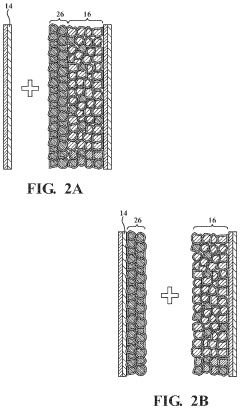
- An anode-free solid-state battery design that uses a cathode layer with transient anode elements, a bare current collector, and a gelled solid-state electrolyte layer to facilitate ionic conduction, eliminating the need for a permanent anode and simplifying the battery structure.



Safety Standards for Advanced Battery Technologies
The development of advanced battery technologies, particularly anode-free cells and solid-state batteries, has necessitated the establishment of comprehensive safety standards to address unique risks and operational characteristics. Current safety frameworks primarily rely on standards developed for conventional lithium-ion batteries, creating significant gaps in addressing the specific hazards associated with these emerging technologies.
Anode-free cell architectures present distinct safety challenges due to their reliance on lithium metal plating during charging cycles. The absence of a pre-formed anode increases the risk of dendrite formation, which can lead to internal short circuits and thermal runaway events. Existing safety standards lack specific protocols for evaluating dendrite growth patterns and their impact on cell integrity over extended cycling periods.
Solid-state batteries introduce different safety considerations, particularly regarding mechanical stress and interfacial stability. The rigid nature of solid electrolytes creates unique failure modes under mechanical deformation, requiring specialized testing protocols that current standards do not adequately address. Additionally, the high-temperature processing requirements for many solid-state systems necessitate updated thermal safety guidelines.
International standardization bodies, including IEC and UL, are actively developing new testing methodologies to address these technology-specific risks. Proposed standards focus on enhanced abuse testing protocols, including modified nail penetration tests for solid-state systems and specialized overcharge protection requirements for anode-free architectures. These emerging standards emphasize the need for technology-specific safety margins and failure prediction models.
The regulatory landscape is evolving to incorporate performance-based safety criteria rather than purely prescriptive approaches. This shift allows for more flexible evaluation of novel battery chemistries while maintaining rigorous safety requirements. Key areas of focus include improved thermal propagation testing, enhanced gas generation analysis, and standardized protocols for evaluating long-term stability under various environmental conditions.
Future safety standard development will likely emphasize predictive safety modeling and real-time monitoring capabilities, enabling proactive risk management for these advanced battery technologies in commercial applications.
Anode-free cell architectures present distinct safety challenges due to their reliance on lithium metal plating during charging cycles. The absence of a pre-formed anode increases the risk of dendrite formation, which can lead to internal short circuits and thermal runaway events. Existing safety standards lack specific protocols for evaluating dendrite growth patterns and their impact on cell integrity over extended cycling periods.
Solid-state batteries introduce different safety considerations, particularly regarding mechanical stress and interfacial stability. The rigid nature of solid electrolytes creates unique failure modes under mechanical deformation, requiring specialized testing protocols that current standards do not adequately address. Additionally, the high-temperature processing requirements for many solid-state systems necessitate updated thermal safety guidelines.
International standardization bodies, including IEC and UL, are actively developing new testing methodologies to address these technology-specific risks. Proposed standards focus on enhanced abuse testing protocols, including modified nail penetration tests for solid-state systems and specialized overcharge protection requirements for anode-free architectures. These emerging standards emphasize the need for technology-specific safety margins and failure prediction models.
The regulatory landscape is evolving to incorporate performance-based safety criteria rather than purely prescriptive approaches. This shift allows for more flexible evaluation of novel battery chemistries while maintaining rigorous safety requirements. Key areas of focus include improved thermal propagation testing, enhanced gas generation analysis, and standardized protocols for evaluating long-term stability under various environmental conditions.
Future safety standard development will likely emphasize predictive safety modeling and real-time monitoring capabilities, enabling proactive risk management for these advanced battery technologies in commercial applications.
Manufacturing Scalability Challenges
Manufacturing scalability represents one of the most significant barriers to widespread commercialization of both anode-free cells and solid-state batteries. While both technologies demonstrate promising laboratory performance, translating these achievements to industrial-scale production presents distinct challenges that fundamentally differ from conventional lithium-ion battery manufacturing processes.
Anode-free cell manufacturing faces unique challenges primarily related to lithium metal deposition control and current collector surface preparation. The absence of a pre-formed anode requires precise control over lithium plating uniformity during the first charge cycle, demanding extremely tight tolerances in cell assembly and electrolyte distribution. Current manufacturing equipment designed for conventional batteries requires substantial modifications to accommodate the specialized coating processes needed for current collector surface treatments that promote uniform lithium deposition.
Solid-state battery manufacturing encounters even more complex scalability hurdles, particularly in solid electrolyte production and interface engineering. The synthesis of ceramic electrolytes like LLZO or sulfide-based materials requires high-temperature processing and controlled atmospheres that significantly increase manufacturing complexity and energy consumption. Achieving consistent ionic conductivity across large-area solid electrolyte sheets remains technically challenging, with defects and grain boundaries critically affecting performance.
Interface formation between solid electrolytes and electrode materials presents another manufacturing bottleneck. Unlike liquid electrolyte systems that naturally conform to electrode surfaces, solid-solid interfaces require specialized processing techniques such as high-pressure lamination or co-sintering processes. These methods are difficult to scale while maintaining the intimate contact necessary for low interfacial resistance.
Quality control and yield optimization pose additional challenges for both technologies. Anode-free cells require sophisticated monitoring systems to detect lithium plating irregularities that could lead to dendrite formation. Solid-state batteries demand precise control over multiple material interfaces and processing parameters, making defect detection and process optimization significantly more complex than conventional battery manufacturing.
The capital investment required for dedicated manufacturing lines represents a substantial economic barrier. Both technologies necessitate specialized equipment, controlled environments, and extensive process development that significantly exceed the investment requirements for conventional lithium-ion battery production scaling.
Anode-free cell manufacturing faces unique challenges primarily related to lithium metal deposition control and current collector surface preparation. The absence of a pre-formed anode requires precise control over lithium plating uniformity during the first charge cycle, demanding extremely tight tolerances in cell assembly and electrolyte distribution. Current manufacturing equipment designed for conventional batteries requires substantial modifications to accommodate the specialized coating processes needed for current collector surface treatments that promote uniform lithium deposition.
Solid-state battery manufacturing encounters even more complex scalability hurdles, particularly in solid electrolyte production and interface engineering. The synthesis of ceramic electrolytes like LLZO or sulfide-based materials requires high-temperature processing and controlled atmospheres that significantly increase manufacturing complexity and energy consumption. Achieving consistent ionic conductivity across large-area solid electrolyte sheets remains technically challenging, with defects and grain boundaries critically affecting performance.
Interface formation between solid electrolytes and electrode materials presents another manufacturing bottleneck. Unlike liquid electrolyte systems that naturally conform to electrode surfaces, solid-solid interfaces require specialized processing techniques such as high-pressure lamination or co-sintering processes. These methods are difficult to scale while maintaining the intimate contact necessary for low interfacial resistance.
Quality control and yield optimization pose additional challenges for both technologies. Anode-free cells require sophisticated monitoring systems to detect lithium plating irregularities that could lead to dendrite formation. Solid-state batteries demand precise control over multiple material interfaces and processing parameters, making defect detection and process optimization significantly more complex than conventional battery manufacturing.
The capital investment required for dedicated manufacturing lines represents a substantial economic barrier. Both technologies necessitate specialized equipment, controlled environments, and extensive process development that significantly exceed the investment requirements for conventional lithium-ion battery production scaling.
Unlock deeper insights with Patsnap Eureka Quick Research — get a full tech report to explore trends and direct your research. Try now!
Generate Your Research Report Instantly with AI Agent
Supercharge your innovation with Patsnap Eureka AI Agent Platform!