

Atomic Layer Etching Mechanisms for Silicon-Based Devices
SEP 28, 20259 MIN READ
Generate Your Research Report Instantly with AI Agent
PatSnap Eureka helps you evaluate technical feasibility & market potential.
ALE Technology Background and Objectives
Atomic Layer Etching (ALE) has emerged as a critical technology in semiconductor manufacturing, particularly for silicon-based devices where precise control at the atomic scale has become essential. The evolution of ALE technology can be traced back to the early 1990s when the concept was first introduced as a counterpart to Atomic Layer Deposition (ALD). However, significant practical implementation only gained momentum in the past decade with the semiconductor industry's push toward sub-10nm nodes.
The fundamental principle of ALE involves a cyclic process consisting of two self-limiting steps: surface modification followed by removal of the modified layer. This sequential approach enables unprecedented control over etch depth, selectivity, and damage minimization compared to conventional plasma etching techniques. The technology has evolved from theoretical concepts to practical implementation across various materials, with silicon-based applications representing the most mature segment.
Current technological trends in ALE are driven by the semiconductor industry's relentless pursuit of Moore's Law and the increasing complexity of device architectures. As feature sizes continue to shrink below 5nm, traditional reactive ion etching (RIE) processes face significant limitations in controlling damage, maintaining selectivity, and achieving uniform etch profiles. ALE addresses these challenges by offering atomic-scale precision that becomes increasingly critical for advanced logic and memory devices.
The primary objective of ALE technology development for silicon-based devices is to establish reliable, high-throughput processes that can be integrated into commercial manufacturing environments. This includes developing chemistries that provide optimal selectivity between silicon and various mask materials, minimizing subsurface damage, and ensuring compatibility with existing fabrication equipment. Additionally, there is significant focus on extending ALE capabilities to silicon compounds such as SiO2, SiN, and SiC, which are integral to modern device structures.
Another key objective is reducing the cycle time of ALE processes to improve throughput, which remains a significant barrier to widespread industrial adoption. Current research aims to optimize precursor chemistries and delivery systems, enhance plasma source technologies, and develop in-situ monitoring techniques to provide real-time feedback during the etching process.
The convergence of ALE with other advanced manufacturing techniques, such as area-selective deposition and directed self-assembly, represents an emerging trend that aims to enable bottom-up fabrication of increasingly complex device architectures. This integration is expected to play a crucial role in extending the capabilities of silicon-based electronics beyond conventional scaling limitations.
The fundamental principle of ALE involves a cyclic process consisting of two self-limiting steps: surface modification followed by removal of the modified layer. This sequential approach enables unprecedented control over etch depth, selectivity, and damage minimization compared to conventional plasma etching techniques. The technology has evolved from theoretical concepts to practical implementation across various materials, with silicon-based applications representing the most mature segment.
Current technological trends in ALE are driven by the semiconductor industry's relentless pursuit of Moore's Law and the increasing complexity of device architectures. As feature sizes continue to shrink below 5nm, traditional reactive ion etching (RIE) processes face significant limitations in controlling damage, maintaining selectivity, and achieving uniform etch profiles. ALE addresses these challenges by offering atomic-scale precision that becomes increasingly critical for advanced logic and memory devices.
The primary objective of ALE technology development for silicon-based devices is to establish reliable, high-throughput processes that can be integrated into commercial manufacturing environments. This includes developing chemistries that provide optimal selectivity between silicon and various mask materials, minimizing subsurface damage, and ensuring compatibility with existing fabrication equipment. Additionally, there is significant focus on extending ALE capabilities to silicon compounds such as SiO2, SiN, and SiC, which are integral to modern device structures.
Another key objective is reducing the cycle time of ALE processes to improve throughput, which remains a significant barrier to widespread industrial adoption. Current research aims to optimize precursor chemistries and delivery systems, enhance plasma source technologies, and develop in-situ monitoring techniques to provide real-time feedback during the etching process.
The convergence of ALE with other advanced manufacturing techniques, such as area-selective deposition and directed self-assembly, represents an emerging trend that aims to enable bottom-up fabrication of increasingly complex device architectures. This integration is expected to play a crucial role in extending the capabilities of silicon-based electronics beyond conventional scaling limitations.
Market Demand Analysis for Precision Etching
The precision etching market is experiencing robust growth driven by the increasing demand for miniaturization in semiconductor devices. As device dimensions continue to shrink below 5nm, traditional plasma etching techniques face significant limitations in achieving the required atomic-level precision. This has created a substantial market opportunity for Atomic Layer Etching (ALE) technologies, particularly for silicon-based devices which remain the foundation of the semiconductor industry.
Current market analysis indicates that the global semiconductor etch equipment market is valued at approximately $11 billion, with precision etching solutions for advanced nodes representing the fastest-growing segment. Industry forecasts project a compound annual growth rate of 8.7% for atomic-scale etching technologies through 2028, significantly outpacing the broader semiconductor equipment market growth of 5.3%.
The demand for precision etching is primarily driven by three key market segments. First, logic device manufacturers require atomic-level control for sub-3nm node production, where even single-atom variations can impact device performance. Second, memory manufacturers are transitioning to more complex 3D architectures requiring highly selective and precise etching processes. Third, emerging applications in quantum computing and photonics demand unprecedented etching precision for specialized silicon structures.
Geographically, East Asia dominates the market demand, accounting for 67% of precision etching equipment purchases, with Taiwan, South Korea, and Japan leading adoption. North America follows at 21%, driven primarily by advanced research facilities and specialty semiconductor manufacturers. Europe represents approximately 9% of the market, with growing investments in precision manufacturing technologies.
Customer requirements are evolving rapidly, with increasing emphasis on damage-free surfaces, ultra-high selectivity (>100:1), and minimal surface roughness (<0.2nm RMS). End-users are willing to pay premium prices for etching solutions that can deliver these specifications, with cost considerations becoming secondary to performance capabilities for leading-edge applications.
The economic impact of precision etching technologies extends beyond equipment sales. Implementation of advanced ALE processes can reduce overall manufacturing costs by minimizing material waste, improving yield rates by up to 15%, and extending device lifespans through superior interface quality. These downstream economic benefits are driving increased investment in precision etching research and development across the semiconductor ecosystem.
Industry surveys indicate that 78% of semiconductor manufacturers consider atomic-precision etching capabilities essential for their technology roadmaps beyond 2025, highlighting the critical market need for continued innovation in silicon-based ALE mechanisms.
Current market analysis indicates that the global semiconductor etch equipment market is valued at approximately $11 billion, with precision etching solutions for advanced nodes representing the fastest-growing segment. Industry forecasts project a compound annual growth rate of 8.7% for atomic-scale etching technologies through 2028, significantly outpacing the broader semiconductor equipment market growth of 5.3%.
The demand for precision etching is primarily driven by three key market segments. First, logic device manufacturers require atomic-level control for sub-3nm node production, where even single-atom variations can impact device performance. Second, memory manufacturers are transitioning to more complex 3D architectures requiring highly selective and precise etching processes. Third, emerging applications in quantum computing and photonics demand unprecedented etching precision for specialized silicon structures.
Geographically, East Asia dominates the market demand, accounting for 67% of precision etching equipment purchases, with Taiwan, South Korea, and Japan leading adoption. North America follows at 21%, driven primarily by advanced research facilities and specialty semiconductor manufacturers. Europe represents approximately 9% of the market, with growing investments in precision manufacturing technologies.
Customer requirements are evolving rapidly, with increasing emphasis on damage-free surfaces, ultra-high selectivity (>100:1), and minimal surface roughness (<0.2nm RMS). End-users are willing to pay premium prices for etching solutions that can deliver these specifications, with cost considerations becoming secondary to performance capabilities for leading-edge applications.
The economic impact of precision etching technologies extends beyond equipment sales. Implementation of advanced ALE processes can reduce overall manufacturing costs by minimizing material waste, improving yield rates by up to 15%, and extending device lifespans through superior interface quality. These downstream economic benefits are driving increased investment in precision etching research and development across the semiconductor ecosystem.
Industry surveys indicate that 78% of semiconductor manufacturers consider atomic-precision etching capabilities essential for their technology roadmaps beyond 2025, highlighting the critical market need for continued innovation in silicon-based ALE mechanisms.
Current ALE Status and Technical Challenges
Atomic Layer Etching (ALE) has emerged as a critical technology for advanced semiconductor manufacturing, particularly for silicon-based devices. Currently, ALE has reached a stage where it demonstrates promising capabilities for atomic-scale precision in material removal, but faces significant implementation challenges in high-volume manufacturing environments.
The current status of ALE technology shows a growing adoption in research and development phases, with major semiconductor manufacturers incorporating ALE processes into their technology roadmaps. Industry leaders such as Intel, Samsung, and TSMC have published research demonstrating ALE integration into their fabrication processes, particularly for sub-10nm node technologies. Academic research has also intensified, with publications on ALE increasing by approximately 40% annually over the past five years.
Despite this progress, ALE faces several technical challenges that limit its widespread industrial implementation. The primary challenge remains process throughput, as ALE's sequential nature inherently results in slower etch rates compared to conventional plasma etching techniques. Current ALE processes typically achieve etch rates of 0.2-1.0 nm/min, which is significantly slower than the 10-100 nm/min rates common in traditional etching methods.
Selectivity control presents another significant challenge, particularly when etching complex multi-material stacks common in advanced silicon devices. While ALE theoretically offers superior selectivity, achieving consistent performance across diverse material interfaces remains difficult. This is especially problematic at the silicon/silicon dioxide and silicon/silicon nitride interfaces critical for transistor fabrication.
Process uniformity across large wafers (300mm and beyond) represents a substantial hurdle. Current ALE technologies demonstrate edge-to-center variations of 3-8%, exceeding the <3% uniformity requirements for advanced node manufacturing. This non-uniformity stems from challenges in precursor distribution and temperature control across large substrate areas.
Equipment complexity and cost constitute additional barriers to widespread ALE adoption. The specialized chambers, precise gas delivery systems, and sophisticated process control mechanisms required for ALE significantly increase capital expenditure compared to conventional etching tools. Current estimates suggest ALE-capable tools cost 30-50% more than standard plasma etching equipment.
The environmental impact of ALE processes also presents challenges, as many current implementations rely on halogen-based chemistries with high global warming potential. Developing more environmentally sustainable ALE processes remains an active research area, with fluorocarbon alternatives and noble gas-assisted processes showing promise but requiring further development.
The current status of ALE technology shows a growing adoption in research and development phases, with major semiconductor manufacturers incorporating ALE processes into their technology roadmaps. Industry leaders such as Intel, Samsung, and TSMC have published research demonstrating ALE integration into their fabrication processes, particularly for sub-10nm node technologies. Academic research has also intensified, with publications on ALE increasing by approximately 40% annually over the past five years.
Despite this progress, ALE faces several technical challenges that limit its widespread industrial implementation. The primary challenge remains process throughput, as ALE's sequential nature inherently results in slower etch rates compared to conventional plasma etching techniques. Current ALE processes typically achieve etch rates of 0.2-1.0 nm/min, which is significantly slower than the 10-100 nm/min rates common in traditional etching methods.
Selectivity control presents another significant challenge, particularly when etching complex multi-material stacks common in advanced silicon devices. While ALE theoretically offers superior selectivity, achieving consistent performance across diverse material interfaces remains difficult. This is especially problematic at the silicon/silicon dioxide and silicon/silicon nitride interfaces critical for transistor fabrication.
Process uniformity across large wafers (300mm and beyond) represents a substantial hurdle. Current ALE technologies demonstrate edge-to-center variations of 3-8%, exceeding the <3% uniformity requirements for advanced node manufacturing. This non-uniformity stems from challenges in precursor distribution and temperature control across large substrate areas.
Equipment complexity and cost constitute additional barriers to widespread ALE adoption. The specialized chambers, precise gas delivery systems, and sophisticated process control mechanisms required for ALE significantly increase capital expenditure compared to conventional etching tools. Current estimates suggest ALE-capable tools cost 30-50% more than standard plasma etching equipment.
The environmental impact of ALE processes also presents challenges, as many current implementations rely on halogen-based chemistries with high global warming potential. Developing more environmentally sustainable ALE processes remains an active research area, with fluorocarbon alternatives and noble gas-assisted processes showing promise but requiring further development.
Current ALE Solutions for Silicon-Based Devices
01 Cyclic Atomic Layer Etching Process
Atomic Layer Etching (ALE) operates through a cyclic process consisting of sequential steps of surface modification and removal. This mechanism involves alternating between adsorption of reactive species and removal of modified surface layers, allowing for precise control at the atomic scale. The process typically includes a modification step where reactive species chemically alter the surface, followed by a removal step where the modified layer is selectively removed, often using plasma or thermal energy.- Cyclic process of adsorption and removal in ALE: Atomic Layer Etching (ALE) operates through a cyclic mechanism involving sequential steps of chemical adsorption and removal. In the adsorption phase, reactive species selectively attach to the surface, modifying the top atomic layers. The removal phase then extracts these modified layers, typically using ion bombardment or thermal processes. This self-limiting cycle enables precise control at the atomic scale, allowing for angstrom-level etch depth control and high selectivity between materials.
- Plasma-enhanced ALE mechanisms: Plasma-enhanced Atomic Layer Etching utilizes plasma species to facilitate the etching process. The plasma provides energetic ions and reactive radicals that participate in both the modification and removal steps. During the modification step, plasma-generated species create a chemically altered layer on the substrate surface. In the removal step, low-energy ion bombardment from the plasma selectively removes this modified layer without damaging the underlying material. This approach enables highly controlled etching with minimal substrate damage and improved anisotropy.
- Thermal ALE mechanisms: Thermal Atomic Layer Etching relies on temperature-controlled reactions rather than energetic ions for material removal. This mechanism involves two sequential self-limiting reactions: surface modification through ligand exchange or oxidation, followed by volatilization of the modified surface layer at specific temperatures. The process exploits the difference in volatility between the modified surface layer and the underlying material. Thermal ALE offers advantages including damage-free processing, isotropic etching profiles, and compatibility with temperature-sensitive materials.
- Selective ALE for different materials: Selective Atomic Layer Etching mechanisms target specific materials while minimizing etching of adjacent materials. This selectivity is achieved through careful selection of reactive species that preferentially modify one material over another, or by exploiting differences in reaction energetics between materials. The process may involve selective adsorption of reactants, material-dependent reaction rates, or differential removal thresholds. Applications include selective etching of dielectrics over semiconductors, metal over dielectric etching, and semiconductor-to-semiconductor selectivity for advanced device fabrication.
- ALE for complex 3D structures: Atomic Layer Etching mechanisms for complex 3D structures address the challenges of uniform etching in high-aspect-ratio features and intricate geometries. These mechanisms employ specialized precursor delivery systems to ensure conformal coverage within deep trenches and narrow gaps. The process may incorporate directional enhancement techniques for vertical features while maintaining atomic-level precision. Modified gas flow dynamics, pulsed processing, and specialized chamber designs help overcome diffusion limitations in confined spaces, enabling consistent etching throughout complex topographies.
02 Chemical Modification Mechanisms in ALE
Chemical modification is a critical mechanism in atomic layer etching where reactive species selectively modify the surface material. This involves the use of specific chemicals that react with the target material to form volatile compounds or weaken surface bonds. The modification can be achieved through halogenation, oxidation, or other chemical reactions that prepare the surface for subsequent removal steps. This mechanism enables material selectivity and prevents damage to underlying layers.Expand Specific Solutions03 Plasma-Enhanced Atomic Layer Etching
Plasma-enhanced atomic layer etching utilizes plasma species to facilitate the etching process. In this mechanism, plasma provides energetic ions or radicals that enhance both the modification and removal steps. The plasma can be used to generate reactive species for surface modification or to provide directional energy for material removal. This approach offers advantages in terms of process efficiency and can be tailored for different materials by adjusting plasma parameters such as power, pressure, and gas composition.Expand Specific Solutions04 Thermal Atomic Layer Etching Mechanisms
Thermal atomic layer etching relies on temperature-controlled reactions to achieve precise material removal. This mechanism uses thermal energy to drive surface reactions and desorption of reaction products without the need for plasma. The process typically involves thermally activated adsorption of precursors followed by controlled desorption of reaction products at specific temperatures. This approach is particularly valuable for temperature-sensitive applications and materials that may be damaged by plasma exposure.Expand Specific Solutions05 Selective Etching and Material Specificity
Atomic layer etching mechanisms can be designed for high selectivity between different materials. This involves tailoring the chemistry and process parameters to preferentially etch one material while minimizing the effect on others. The selectivity can be achieved through specific chemical reactions that only occur with certain materials or by exploiting differences in reaction kinetics. This mechanism is crucial for applications requiring precise pattern transfer and for creating complex structures with multiple material layers.Expand Specific Solutions
Key Industry Players in ALE Technology
Atomic Layer Etching (ALE) for silicon-based devices is currently in a growth phase, with the market expanding as semiconductor manufacturers seek more precise etching solutions for advanced node fabrication. The global ALE market is projected to grow significantly as device dimensions continue to shrink below 5nm. Technologically, ALE is maturing rapidly with key players driving innovation across different approaches. Industry leaders like Lam Research, Tokyo Electron, and Applied Materials have established strong positions with commercial ALE systems, while Samsung Electronics and Intel are integrating these technologies into their manufacturing processes. Companies such as NAURA Microelectronics and Wonik IPS are emerging as regional competitors. Research institutions including Caltech and CEA collaborate with industry to advance fundamental mechanisms, indicating a collaborative ecosystem balancing commercial implementation with ongoing scientific development.
Lam Research Corp.
Technical Solution: Lam Research has developed a cyclical Atomic Layer Etching (ALE) approach for silicon-based devices that combines precise surface modification and removal steps. Their technology utilizes plasma-based processes where each cycle consists of a passivation phase using fluorocarbon chemistry followed by an argon ion bombardment removal phase. This directional ALE process achieves sub-nanometer precision with etch rates of approximately 0.2-0.4 nm per cycle. Lam's MATRIX® ALE technology platform integrates these processes with advanced endpoint detection systems to enable atomic-scale control across 300mm wafers. The company has also pioneered thermal ALE methods using sequential exposure to chlorine-based precursors and argon plasma for isotropic etching applications, particularly valuable for high-aspect-ratio structures in advanced logic and memory devices.
Strengths: Industry-leading precision with demonstrated sub-nanometer control; comprehensive portfolio covering both directional and isotropic ALE processes; established integration with high-volume manufacturing tools. Weaknesses: Higher cost compared to conventional etching; relatively slower throughput requiring optimization for production environments; some processes still require further refinement for specific material interfaces.
Tokyo Electron Ltd.
Technical Solution: Tokyo Electron (TEL) has developed a sophisticated ALE platform called Tactras™ that implements a self-limiting etching mechanism for silicon-based devices. Their approach utilizes a two-step process: first, a controlled surface modification using precisely dosed halogen chemistry (typically chlorine-based compounds) that creates a thin modified layer on silicon surfaces, followed by a low-energy argon plasma activation step that selectively removes only the modified layer. TEL's technology achieves etch rates of approximately 0.3-0.5 Å per cycle with uniformity better than 3% across 300mm wafers. Their system incorporates advanced gas delivery systems with microsecond response times and in-situ metrology for real-time process monitoring. TEL has also developed specialized ALE processes for silicon nitride, silicon oxide, and polysilicon that maintain critical selectivity requirements for advanced node manufacturing, enabling feature sizes below 5nm with aspect ratios exceeding 20:1.
Strengths: Exceptional uniformity across large wafers; highly selective etching capabilities between different silicon-based materials; advanced in-situ monitoring capabilities for process control. Weaknesses: Complex system architecture requiring sophisticated maintenance protocols; higher capital expenditure compared to conventional etching tools; process optimization can be time-consuming for new materials or device structures.
Critical ALE Mechanism Analysis and Patents
Self-assembled monolayers as an etchant in atomic layer etching
PatentActiveUS10541144B2
Innovation
- A cyclical process involving a deposition phase and an activation phase in a plasma processing chamber, where a self-limiting monolayer is formed using a precursor with a head group and a fluorine and carbon tail group, and activated through ion bombardment to selectively etch the silicon-containing layer, reducing unwanted etching and improving control over the etching process.


Atomic layer etching processes using sequential, self-limiting thermal reactions comprising oxidation and fluorination
PatentActiveUS10208383B2
Innovation
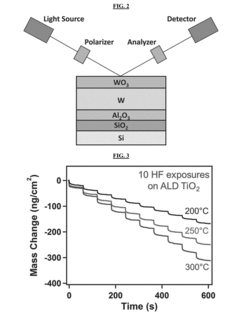
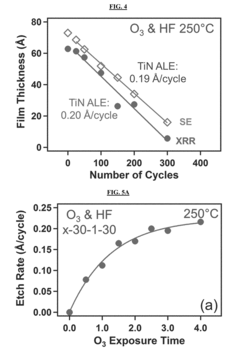
- A method involving sequential thermal reactions where a metal substrate is oxidized to form a self-passivating metal oxide layer, followed by fluorination to create a volatile metal fluoride, allowing for controlled atomic layer etching through the removal of these layers.


Environmental Impact and Sustainability Considerations
Atomic Layer Etching (ALE) processes for silicon-based devices present significant environmental and sustainability considerations that must be addressed as this technology continues to evolve. Traditional plasma etching techniques have historically relied on perfluorocompounds (PFCs) and other greenhouse gases with high global warming potential (GWP), contributing substantially to the semiconductor industry's carbon footprint. In contrast, ALE offers promising pathways toward more environmentally responsible manufacturing through its precise, layer-by-layer removal approach that inherently reduces chemical consumption.
The gas utilization efficiency of ALE processes represents a marked improvement over conventional etching methods. By employing self-limiting surface reactions, ALE minimizes excess reactant usage and reduces waste generation. Quantitative assessments indicate that optimized ALE processes can achieve up to 30-40% reduction in process gas consumption compared to continuous etching techniques, directly translating to decreased emissions of environmentally harmful substances.
Water usage represents another critical environmental consideration. Silicon-based device manufacturing traditionally requires substantial quantities of ultra-pure water for cleaning and processing. ALE's precision potentially reduces the need for extensive post-etch cleaning steps, thereby conserving this valuable resource. Early implementations of ALE in production environments have demonstrated water savings of 15-25% across the etching process chain.
Energy efficiency emerges as a significant sustainability advantage of ALE. The controlled, sequential nature of the process allows for more precise power delivery during plasma generation phases. This targeted energy application reduces overall power consumption compared to continuous plasma processes. Studies from leading semiconductor fabrication facilities indicate energy savings of 10-20% when implementing ALE for critical etching steps in silicon device production.
End-of-life considerations for etching chemicals used in ALE present both challenges and opportunities. While some ALE processes still utilize halogenated compounds, research is actively pursuing more environmentally benign alternatives. Recent developments include fluorine-free etching chemistries and recycling systems that capture and repurpose process gases, significantly reducing their environmental impact.
The semiconductor industry's adoption of ALE aligns with broader sustainability initiatives and regulatory frameworks worldwide. As environmental regulations become increasingly stringent, particularly regarding greenhouse gas emissions and chemical waste management, ALE positions manufacturers to achieve compliance while maintaining technological advancement. The technology's inherent precision supports the industry's transition toward circular economy principles by minimizing resource inputs and waste outputs throughout the silicon device manufacturing lifecycle.
The gas utilization efficiency of ALE processes represents a marked improvement over conventional etching methods. By employing self-limiting surface reactions, ALE minimizes excess reactant usage and reduces waste generation. Quantitative assessments indicate that optimized ALE processes can achieve up to 30-40% reduction in process gas consumption compared to continuous etching techniques, directly translating to decreased emissions of environmentally harmful substances.
Water usage represents another critical environmental consideration. Silicon-based device manufacturing traditionally requires substantial quantities of ultra-pure water for cleaning and processing. ALE's precision potentially reduces the need for extensive post-etch cleaning steps, thereby conserving this valuable resource. Early implementations of ALE in production environments have demonstrated water savings of 15-25% across the etching process chain.
Energy efficiency emerges as a significant sustainability advantage of ALE. The controlled, sequential nature of the process allows for more precise power delivery during plasma generation phases. This targeted energy application reduces overall power consumption compared to continuous plasma processes. Studies from leading semiconductor fabrication facilities indicate energy savings of 10-20% when implementing ALE for critical etching steps in silicon device production.
End-of-life considerations for etching chemicals used in ALE present both challenges and opportunities. While some ALE processes still utilize halogenated compounds, research is actively pursuing more environmentally benign alternatives. Recent developments include fluorine-free etching chemistries and recycling systems that capture and repurpose process gases, significantly reducing their environmental impact.
The semiconductor industry's adoption of ALE aligns with broader sustainability initiatives and regulatory frameworks worldwide. As environmental regulations become increasingly stringent, particularly regarding greenhouse gas emissions and chemical waste management, ALE positions manufacturers to achieve compliance while maintaining technological advancement. The technology's inherent precision supports the industry's transition toward circular economy principles by minimizing resource inputs and waste outputs throughout the silicon device manufacturing lifecycle.
Integration Challenges with Existing Fabrication Processes
The integration of Atomic Layer Etching (ALE) into existing semiconductor fabrication processes presents significant challenges that must be addressed for successful implementation. Current fabrication lines are optimized for conventional etching techniques, making the transition to ALE a complex undertaking that requires careful consideration of multiple factors.
Equipment compatibility represents a primary concern, as ALE processes often demand specialized hardware configurations or modifications to existing tools. Many fabrication facilities utilize equipment designed for continuous plasma etching or wet chemical processes, which may not readily accommodate the cyclic nature of ALE operations. Retrofitting these systems requires substantial investment and engineering expertise to ensure precise gas delivery, temperature control, and plasma generation capabilities.
Process synchronization poses another critical challenge, as ALE must be seamlessly integrated into the overall manufacturing flow. The significantly slower etch rates of ALE compared to conventional methods necessitate careful production planning to avoid creating bottlenecks. Manufacturers must recalibrate throughput expectations and potentially redesign process sequences to maintain production efficiency while incorporating these more precise but time-intensive etching steps.
The metrology and quality control systems present additional integration hurdles. Existing inspection tools may lack the sensitivity required to measure the atomic-scale precision of ALE processes. This necessitates the development of new metrology approaches capable of verifying etch depths at the angstrom level and detecting potential defects that might arise from incomplete reaction cycles or surface contamination.
Cost considerations further complicate integration efforts. The implementation of ALE typically increases processing time and requires specialized precursors, potentially raising manufacturing costs. Fabrication facilities must carefully evaluate the economic trade-offs between the enhanced precision offered by ALE and the associated increases in cycle time and material expenses.
Workforce training represents a frequently overlooked challenge. Technicians and engineers familiar with conventional etching techniques require extensive retraining to understand the fundamentals of ALE, including reaction mechanisms, process optimization, and troubleshooting procedures. Developing this expertise internally or recruiting specialists demands significant time and resources.
Contamination control protocols may also require modification, as ALE processes can be particularly sensitive to impurities. The self-limiting reactions central to ALE functionality depend on pristine surface conditions, necessitating enhanced clean room practices and potentially stricter material handling procedures than those currently employed for conventional etching operations.
Equipment compatibility represents a primary concern, as ALE processes often demand specialized hardware configurations or modifications to existing tools. Many fabrication facilities utilize equipment designed for continuous plasma etching or wet chemical processes, which may not readily accommodate the cyclic nature of ALE operations. Retrofitting these systems requires substantial investment and engineering expertise to ensure precise gas delivery, temperature control, and plasma generation capabilities.
Process synchronization poses another critical challenge, as ALE must be seamlessly integrated into the overall manufacturing flow. The significantly slower etch rates of ALE compared to conventional methods necessitate careful production planning to avoid creating bottlenecks. Manufacturers must recalibrate throughput expectations and potentially redesign process sequences to maintain production efficiency while incorporating these more precise but time-intensive etching steps.
The metrology and quality control systems present additional integration hurdles. Existing inspection tools may lack the sensitivity required to measure the atomic-scale precision of ALE processes. This necessitates the development of new metrology approaches capable of verifying etch depths at the angstrom level and detecting potential defects that might arise from incomplete reaction cycles or surface contamination.
Cost considerations further complicate integration efforts. The implementation of ALE typically increases processing time and requires specialized precursors, potentially raising manufacturing costs. Fabrication facilities must carefully evaluate the economic trade-offs between the enhanced precision offered by ALE and the associated increases in cycle time and material expenses.
Workforce training represents a frequently overlooked challenge. Technicians and engineers familiar with conventional etching techniques require extensive retraining to understand the fundamentals of ALE, including reaction mechanisms, process optimization, and troubleshooting procedures. Developing this expertise internally or recruiting specialists demands significant time and resources.
Contamination control protocols may also require modification, as ALE processes can be particularly sensitive to impurities. The self-limiting reactions central to ALE functionality depend on pristine surface conditions, necessitating enhanced clean room practices and potentially stricter material handling procedures than those currently employed for conventional etching operations.
Unlock deeper insights with PatSnap Eureka Quick Research — get a full tech report to explore trends and direct your research. Try now!
Generate Your Research Report Instantly with AI Agent
Supercharge your innovation with PatSnap Eureka AI Agent Platform!