Challenges in Scaling Reflectarray Antennas for Large Aperture Designs
MAY 12, 20269 MIN READ
Generate Your Research Report Instantly with AI Agent
PatSnap Eureka helps you evaluate technical feasibility & market potential.
Reflectarray Antenna Scaling Challenges and Objectives
Reflectarray antennas have emerged as a transformative technology in the evolution of modern antenna systems, representing a significant departure from traditional parabolic reflector designs. The fundamental concept originated in the 1960s as researchers sought to combine the advantages of phased arrays with the simplicity of reflector antennas. This hybrid approach eliminates the need for complex feed networks while maintaining beam steering capabilities through electronically controlled phase shifts at individual array elements.
The historical development of reflectarray technology has been marked by several critical milestones. Early implementations utilized simple dipole elements with varying lengths to achieve phase control, but these designs suffered from limited bandwidth and polarization constraints. The introduction of microstrip patch elements in the 1980s significantly improved performance characteristics, enabling dual-polarization operation and enhanced bandwidth capabilities. Subsequent advances in metamaterial structures and frequency selective surfaces have further expanded the design possibilities for reflectarray systems.
Current technological objectives focus on addressing the fundamental challenges that emerge when scaling reflectarray designs to large aperture configurations. The primary goal involves maintaining phase accuracy across extensive array surfaces while managing the increased complexity of element interactions and mutual coupling effects. As aperture sizes increase beyond several wavelengths, the cumulative phase errors can severely degrade antenna performance, necessitating advanced compensation techniques and precision manufacturing processes.
Another critical objective centers on achieving uniform illumination and minimizing amplitude tapering effects across large aperture designs. Traditional reflectarray configurations often exhibit significant amplitude variations due to the varying incidence angles from the feed horn to different array elements. This challenge becomes more pronounced in large-scale implementations where the geometric path differences create substantial amplitude disparities that can compromise radiation pattern quality and antenna efficiency.
The pursuit of broadband operation represents a fundamental design objective for large aperture reflectarrays. Conventional phase compensation techniques often exhibit frequency-dependent behavior that limits operational bandwidth. Advanced multi-layer configurations and novel element geometries are being developed to achieve achromatic phase response across wider frequency ranges, enabling versatile applications in communication and radar systems.
Manufacturing precision and cost-effectiveness constitute additional primary objectives in large aperture reflectarray development. The requirement for maintaining sub-wavelength tolerances across extensive surfaces presents significant fabrication challenges, particularly when considering the economic viability of large-scale production. Innovative manufacturing techniques and materials are being explored to achieve the necessary precision while maintaining reasonable production costs for commercial applications.
The historical development of reflectarray technology has been marked by several critical milestones. Early implementations utilized simple dipole elements with varying lengths to achieve phase control, but these designs suffered from limited bandwidth and polarization constraints. The introduction of microstrip patch elements in the 1980s significantly improved performance characteristics, enabling dual-polarization operation and enhanced bandwidth capabilities. Subsequent advances in metamaterial structures and frequency selective surfaces have further expanded the design possibilities for reflectarray systems.
Current technological objectives focus on addressing the fundamental challenges that emerge when scaling reflectarray designs to large aperture configurations. The primary goal involves maintaining phase accuracy across extensive array surfaces while managing the increased complexity of element interactions and mutual coupling effects. As aperture sizes increase beyond several wavelengths, the cumulative phase errors can severely degrade antenna performance, necessitating advanced compensation techniques and precision manufacturing processes.
Another critical objective centers on achieving uniform illumination and minimizing amplitude tapering effects across large aperture designs. Traditional reflectarray configurations often exhibit significant amplitude variations due to the varying incidence angles from the feed horn to different array elements. This challenge becomes more pronounced in large-scale implementations where the geometric path differences create substantial amplitude disparities that can compromise radiation pattern quality and antenna efficiency.
The pursuit of broadband operation represents a fundamental design objective for large aperture reflectarrays. Conventional phase compensation techniques often exhibit frequency-dependent behavior that limits operational bandwidth. Advanced multi-layer configurations and novel element geometries are being developed to achieve achromatic phase response across wider frequency ranges, enabling versatile applications in communication and radar systems.
Manufacturing precision and cost-effectiveness constitute additional primary objectives in large aperture reflectarray development. The requirement for maintaining sub-wavelength tolerances across extensive surfaces presents significant fabrication challenges, particularly when considering the economic viability of large-scale production. Innovative manufacturing techniques and materials are being explored to achieve the necessary precision while maintaining reasonable production costs for commercial applications.
Market Demand for Large Aperture Reflectarray Systems
The global satellite communications market continues to experience unprecedented growth, driven by increasing demand for high-throughput satellite systems, next-generation broadband services, and emerging applications in 5G backhaul networks. Large aperture reflectarray antennas have emerged as critical enablers for these applications, offering superior gain characteristics and beam-forming capabilities essential for modern satellite communication architectures.
Space-based applications represent the most significant market driver for large aperture reflectarray systems. Geostationary and low Earth orbit satellite constellations require high-gain antennas capable of supporting multi-gigabit data transmission rates. The deployment of mega-constellations for global internet coverage has intensified demand for lightweight, deployable antenna systems that can achieve large effective apertures while maintaining structural integrity in harsh space environments.
Ground-based satellite communication terminals constitute another substantial market segment. Earth stations supporting commercial satellite operations, military communications, and scientific missions increasingly require large aperture antennas to maximize link budgets and enable operation at higher frequency bands. The transition toward Ka-band and V-band frequencies has amplified the need for precision-engineered reflectarray systems capable of maintaining performance across wide bandwidths.
Emerging applications in automotive satellite communications and maritime connectivity are creating new market opportunities. Connected vehicle platforms and autonomous shipping systems demand high-performance antennas that can maintain reliable satellite links while operating in mobile environments. These applications require reflectarray systems that combine large aperture performance with mechanical robustness and environmental resilience.
The defense and aerospace sectors continue to drive significant demand for advanced reflectarray technologies. Military satellite communications, radar systems, and electronic warfare applications require large aperture antennas with enhanced beam-steering capabilities and reduced radar cross-sections. These specialized requirements often justify premium pricing and accelerated development timelines.
Market growth is further supported by increasing adoption of satellite-based Internet of Things networks and remote sensing applications. Agricultural monitoring, environmental surveillance, and asset tracking systems rely on satellite connectivity enabled by high-performance ground terminals equipped with large aperture antennas.
Space-based applications represent the most significant market driver for large aperture reflectarray systems. Geostationary and low Earth orbit satellite constellations require high-gain antennas capable of supporting multi-gigabit data transmission rates. The deployment of mega-constellations for global internet coverage has intensified demand for lightweight, deployable antenna systems that can achieve large effective apertures while maintaining structural integrity in harsh space environments.
Ground-based satellite communication terminals constitute another substantial market segment. Earth stations supporting commercial satellite operations, military communications, and scientific missions increasingly require large aperture antennas to maximize link budgets and enable operation at higher frequency bands. The transition toward Ka-band and V-band frequencies has amplified the need for precision-engineered reflectarray systems capable of maintaining performance across wide bandwidths.
Emerging applications in automotive satellite communications and maritime connectivity are creating new market opportunities. Connected vehicle platforms and autonomous shipping systems demand high-performance antennas that can maintain reliable satellite links while operating in mobile environments. These applications require reflectarray systems that combine large aperture performance with mechanical robustness and environmental resilience.
The defense and aerospace sectors continue to drive significant demand for advanced reflectarray technologies. Military satellite communications, radar systems, and electronic warfare applications require large aperture antennas with enhanced beam-steering capabilities and reduced radar cross-sections. These specialized requirements often justify premium pricing and accelerated development timelines.
Market growth is further supported by increasing adoption of satellite-based Internet of Things networks and remote sensing applications. Agricultural monitoring, environmental surveillance, and asset tracking systems rely on satellite connectivity enabled by high-performance ground terminals equipped with large aperture antennas.
Current State and Scaling Limitations of Reflectarray Technology
Reflectarray antennas have emerged as a promising alternative to traditional parabolic reflectors and phased arrays, combining the advantages of both technologies. These structures consist of an array of unit cells that provide phase compensation to transform an incident spherical wave from a feed antenna into a planar wave front. The technology has gained significant traction in satellite communications, radar systems, and wireless applications due to its low profile, lightweight design, and reduced manufacturing complexity compared to conventional phased arrays.
Current reflectarray implementations predominantly operate in frequency ranges from X-band to Ka-band, with most successful deployments featuring aperture sizes ranging from 0.5 to 2 meters. The unit cell designs have evolved from simple patch elements to more sophisticated structures including variable-sized patches, stub-loaded patches, and multi-layer configurations. These designs typically achieve bandwidth capabilities of 10-20% for single-band operations, with some dual-band configurations reaching operational frequencies spanning multiple gigahertz ranges.
Manufacturing techniques have advanced considerably, with printed circuit board fabrication being the dominant approach for smaller arrays. Larger implementations increasingly utilize advanced manufacturing processes including additive manufacturing and precision etching techniques. The integration of active components, such as varactor diodes and PIN diodes, has enabled electronically reconfigurable reflectarrays, though these remain limited to smaller aperture sizes due to complexity and cost considerations.
However, significant scaling limitations become apparent when attempting to develop large aperture designs exceeding 3-5 meters. The primary constraint stems from the cumulative phase errors that arise across the aperture, which become increasingly problematic as array dimensions increase. Manufacturing tolerances that are acceptable for smaller arrays translate into substantial phase deviations across large apertures, directly impacting antenna gain and beam quality.
Thermal expansion presents another critical scaling challenge, as temperature variations cause differential expansion across the aperture, leading to mechanical deformations that alter the electromagnetic performance. The structural integrity requirements for large apertures necessitate robust support mechanisms that can introduce unwanted electromagnetic interactions and increase overall system complexity.
Feed system design becomes increasingly complex for large apertures, as maintaining uniform illumination across extended surfaces requires sophisticated feed architectures. The conventional single-feed approach becomes inadequate, necessitating multi-feed configurations or advanced feed positioning systems that add mechanical complexity and potential failure points.
Bandwidth limitations become more pronounced in scaled implementations, as the inherent frequency-dependent nature of reflectarray phase compensation becomes more critical across larger apertures. The phase errors introduced by bandwidth limitations scale proportionally with aperture size, constraining the operational frequency range for large-scale deployments.
Current reflectarray implementations predominantly operate in frequency ranges from X-band to Ka-band, with most successful deployments featuring aperture sizes ranging from 0.5 to 2 meters. The unit cell designs have evolved from simple patch elements to more sophisticated structures including variable-sized patches, stub-loaded patches, and multi-layer configurations. These designs typically achieve bandwidth capabilities of 10-20% for single-band operations, with some dual-band configurations reaching operational frequencies spanning multiple gigahertz ranges.
Manufacturing techniques have advanced considerably, with printed circuit board fabrication being the dominant approach for smaller arrays. Larger implementations increasingly utilize advanced manufacturing processes including additive manufacturing and precision etching techniques. The integration of active components, such as varactor diodes and PIN diodes, has enabled electronically reconfigurable reflectarrays, though these remain limited to smaller aperture sizes due to complexity and cost considerations.
However, significant scaling limitations become apparent when attempting to develop large aperture designs exceeding 3-5 meters. The primary constraint stems from the cumulative phase errors that arise across the aperture, which become increasingly problematic as array dimensions increase. Manufacturing tolerances that are acceptable for smaller arrays translate into substantial phase deviations across large apertures, directly impacting antenna gain and beam quality.
Thermal expansion presents another critical scaling challenge, as temperature variations cause differential expansion across the aperture, leading to mechanical deformations that alter the electromagnetic performance. The structural integrity requirements for large apertures necessitate robust support mechanisms that can introduce unwanted electromagnetic interactions and increase overall system complexity.
Feed system design becomes increasingly complex for large apertures, as maintaining uniform illumination across extended surfaces requires sophisticated feed architectures. The conventional single-feed approach becomes inadequate, necessitating multi-feed configurations or advanced feed positioning systems that add mechanical complexity and potential failure points.
Bandwidth limitations become more pronounced in scaled implementations, as the inherent frequency-dependent nature of reflectarray phase compensation becomes more critical across larger apertures. The phase errors introduced by bandwidth limitations scale proportionally with aperture size, constraining the operational frequency range for large-scale deployments.
Existing Solutions for Large Scale Reflectarray Implementation
01 Large aperture reflectarray antenna design and configuration
Large aperture reflectarray antennas require specific design considerations for element arrangement, spacing, and overall configuration to achieve optimal performance. The design involves careful selection of unit cell dimensions, inter-element spacing, and aperture size to meet gain and beamforming requirements. Advanced computational methods are used to optimize the reflectarray geometry for large-scale implementations.- Large aperture reflectarray antenna design and configuration: Large aperture reflectarray antennas require specific design considerations for element arrangement, aperture size optimization, and overall antenna configuration. These designs focus on maximizing the effective aperture area while maintaining proper electromagnetic performance. The configuration involves careful planning of the reflective elements distribution across the large surface area to achieve desired radiation patterns and gain characteristics.
- Phase control and beam steering mechanisms for large aperture systems: Phase control techniques are essential for large aperture reflectarray antennas to achieve proper beam steering and focusing capabilities. These mechanisms involve sophisticated phase adjustment methods across the large array surface to maintain coherent signal reflection. The beam steering functionality allows for dynamic pointing and tracking applications while preserving the antenna's performance across the extended aperture.
- Element design and spacing optimization for large scale arrays: The design of individual reflective elements and their optimal spacing becomes critical in large aperture reflectarray systems. Element geometry, size, and inter-element spacing must be carefully optimized to prevent grating lobes and maintain uniform performance across the extended aperture. Advanced element designs enable better bandwidth and efficiency characteristics for large-scale implementations.
- Feed system integration and illumination techniques: Large aperture reflectarray antennas require specialized feed systems and illumination techniques to properly excite the extended array surface. The feed design must provide uniform illumination across the large aperture while minimizing spillover losses and maintaining proper polarization characteristics. Integration challenges include feed positioning, support structures, and electromagnetic coupling considerations for large-scale systems.
- Manufacturing and assembly methods for large aperture structures: The fabrication and assembly of large aperture reflectarray antennas present unique manufacturing challenges including substrate handling, element placement accuracy, and structural integrity. Manufacturing techniques must address the scalability issues while maintaining precise tolerances across the large surface area. Assembly methods include modular approaches, substrate segmentation, and alignment procedures for large-scale antenna construction.
02 Phase control and beam steering mechanisms
Phase control in large aperture reflectarrays is achieved through various techniques including variable-sized elements, rotating elements, or electronically controlled phase shifters. These mechanisms enable precise beam steering and pattern shaping across the aperture. The phase distribution across the large aperture must be carefully controlled to maintain beam quality and minimize side lobes.Expand Specific Solutions03 Multi-band and wideband operation capabilities
Large aperture reflectarrays can be designed to operate across multiple frequency bands or provide wideband performance. This involves implementing dual-polarized elements, multi-layer structures, or frequency-selective surfaces. The large aperture allows for better frequency selectivity and improved bandwidth characteristics compared to smaller arrays.Expand Specific Solutions04 Manufacturing and fabrication techniques for large structures
The fabrication of large aperture reflectarrays presents unique manufacturing challenges including substrate handling, element precision, and assembly tolerances. Advanced manufacturing techniques such as printed circuit board technology, additive manufacturing, and modular construction approaches are employed. Quality control and testing procedures are critical for maintaining performance across the large aperture.Expand Specific Solutions05 Feed system integration and illumination optimization
Large aperture reflectarrays require optimized feed systems to achieve uniform illumination across the aperture. Feed positioning, horn antenna design, and spillover control are critical factors. The feed system must be designed to minimize blockage effects while providing adequate illumination taper for optimal aperture efficiency and side lobe control.Expand Specific Solutions
Key Players in Reflectarray and Large Antenna Industry
The reflectarray antenna scaling challenge represents a rapidly evolving sector within the broader antenna technology market, currently in its growth phase with significant technological advancement opportunities. The market demonstrates substantial potential driven by increasing demand for large aperture applications in satellite communications, 5G networks, and aerospace systems. Technology maturity varies considerably across different players, with established aerospace giants like Thales SA, Boeing, and Lockheed Martin leading in practical implementations, while telecommunications leaders such as Huawei, Qualcomm, and Mitsubishi Electric drive innovation in commercial applications. Research institutions including Xidian University, UESTC, and Nanjing University of Science & Technology contribute fundamental breakthroughs in metamaterial design and beamforming algorithms. Emerging companies like Metawave and Gapwaves represent cutting-edge developments in adaptive antenna technologies, indicating a competitive landscape where traditional defense contractors, telecom manufacturers, and specialized antenna companies converge to address scaling challenges through advanced materials, manufacturing processes, and intelligent control systems.
Thales SA
Technical Solution: Thales has developed advanced reflectarray antenna solutions for large aperture satellite communications and radar systems. Their approach focuses on multi-layer printed circuit board (PCB) technology with variable-sized patch elements to achieve precise phase control across large surfaces. The company implements sophisticated feeding networks and employs advanced electromagnetic modeling techniques to optimize element spacing and minimize mutual coupling effects. Their designs incorporate temperature compensation mechanisms and use high-performance substrate materials to maintain phase accuracy across wide frequency bands. Thales has successfully demonstrated reflectarray antennas with apertures exceeding 2 meters for space applications, addressing beam shaping requirements and achieving high gain performance while maintaining structural integrity in harsh environments.
Strengths: Extensive space heritage and proven large-scale manufacturing capabilities, advanced modeling tools for complex electromagnetic analysis. Weaknesses: High development costs and longer design cycles compared to conventional antenna solutions.
Mitsubishi Electric Corp.
Technical Solution: Mitsubishi Electric has developed innovative reflectarray antenna technologies focusing on active and passive large aperture designs for satellite communications and automotive radar applications. Their solution utilizes advanced semiconductor integration with MEMS-based phase shifters embedded within reflectarray elements, enabling dynamic beam steering capabilities. The company's approach addresses scaling challenges through modular tile-based architectures, where individual subarrays can be manufactured separately and assembled into larger apertures. They employ sophisticated calibration algorithms to compensate for manufacturing tolerances and thermal variations across the array. Their designs incorporate low-loss dielectric materials and optimized metallization patterns to maintain efficiency at higher frequencies, particularly for 5G and beyond applications.
Strengths: Strong semiconductor integration capabilities and automotive industry experience with mass production techniques. Weaknesses: Limited space application heritage compared to dedicated aerospace companies, higher complexity in active designs.
Core Innovations in Scalable Reflectarray Element Design
Deployable reflectarray antenna system
PatentInactiveUS8289221B1
Innovation
- A deployable reflectarray antenna system is designed with a simple deployment mechanism, where a flat reflectarray antenna is subdivided into panels that stack and deploy using a hollow cylindrical mechanism with guide slots and a deployment ring, allowing for a compact stowed configuration and a larger operational area with reduced surface area requirements.
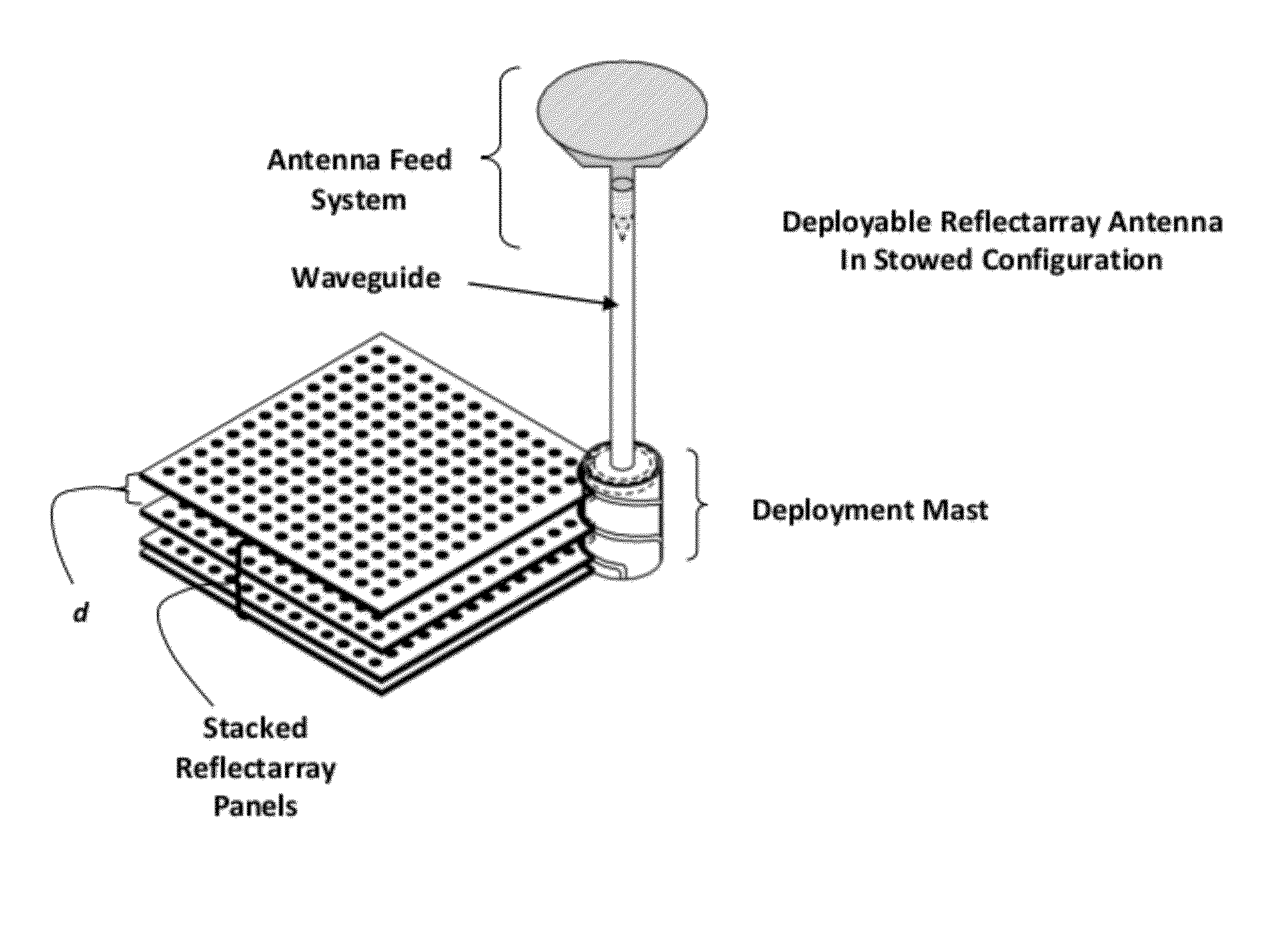
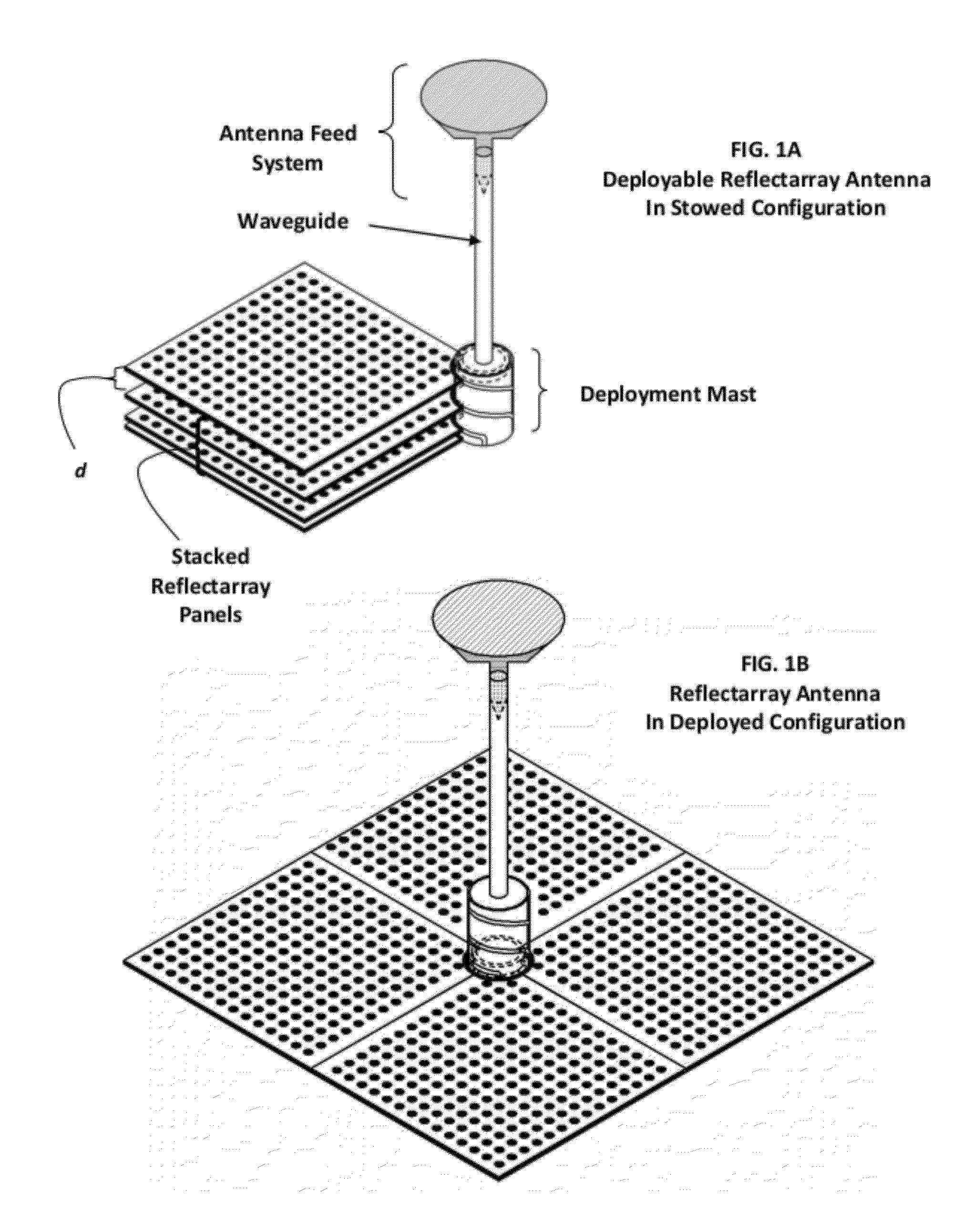
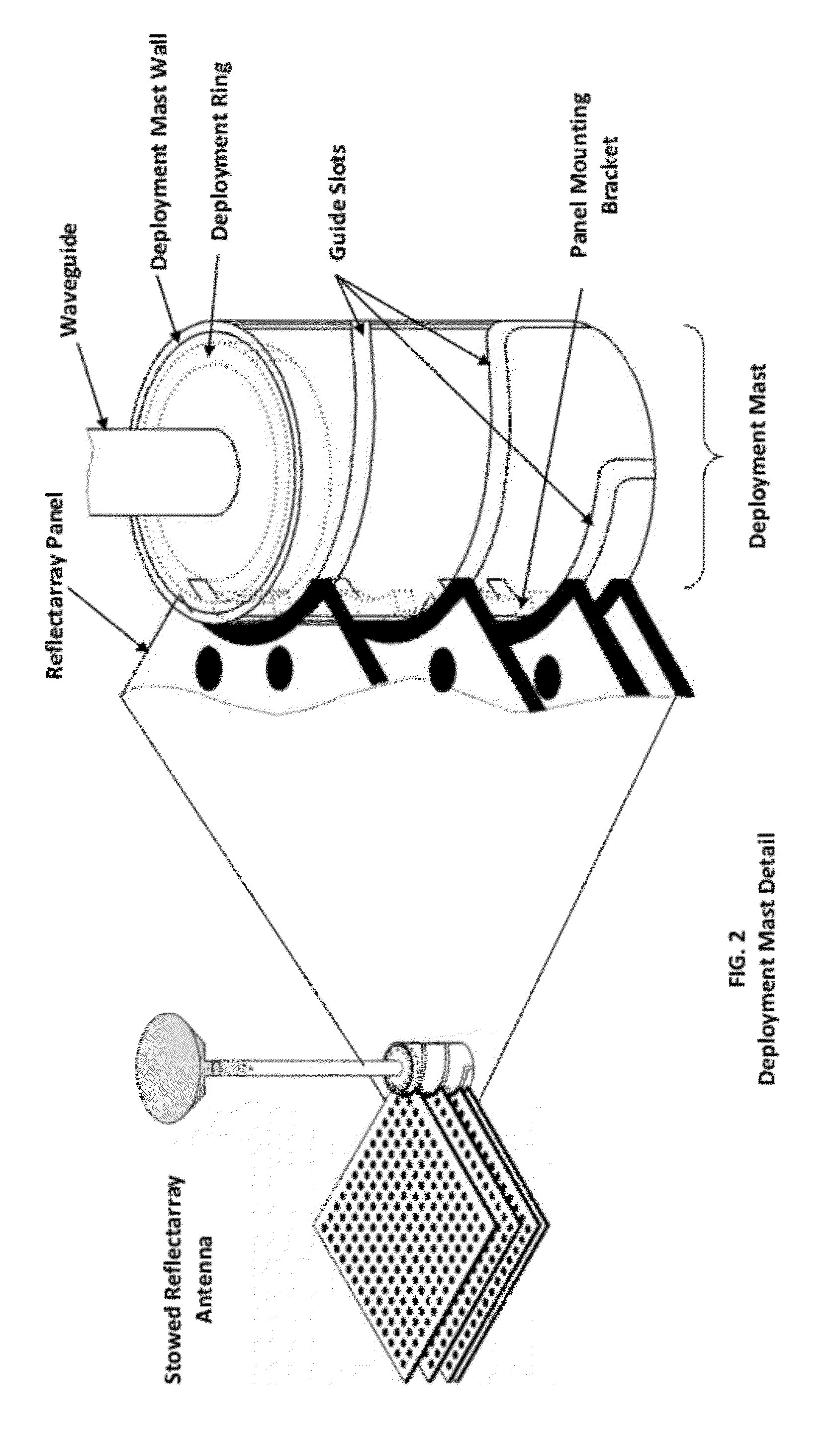

Large aperture deployable reflectarray antenna
PatentActiveUS11063356B2
Innovation
- A large-area deployable reflectarray antenna design using collapsible S-shaped springs and quartz-epoxy composite strips, which can be folded and wrapped for compact storage, providing a 1.5 m×1.5 m aperture with a robust and lightweight structure that maintains RF performance and planarity.


Manufacturing Constraints for Large Reflectarray Production
Manufacturing large-aperture reflectarray antennas presents significant constraints that fundamentally limit scalability and commercial viability. The primary challenge stems from substrate material limitations, where conventional printed circuit board (PCB) fabrication processes struggle to maintain dimensional accuracy across large surfaces. Standard PCB manufacturing equipment typically accommodates panels up to 24×18 inches, necessitating complex tiling approaches for larger apertures that introduce phase discontinuities and performance degradation.
Precision requirements for reflectarray elements become increasingly difficult to achieve as aperture size grows. Manufacturing tolerances that are acceptable for smaller arrays can cause substantial phase errors when scaled up, particularly affecting the array's radiation pattern and gain performance. The cumulative effect of small dimensional variations across thousands of elements in large arrays can result in significant beam pointing errors and increased side lobe levels.
Substrate warping and thermal expansion present critical manufacturing challenges for large reflectarray production. Large substrates are inherently more susceptible to mechanical deformation during fabrication and operation, leading to surface irregularities that disrupt the intended phase distribution. Temperature variations during manufacturing processes can cause differential expansion across the substrate, creating permanent distortions that compromise antenna performance.
Assembly and handling constraints become paramount when dealing with large reflectarray structures. Traditional pick-and-place equipment used for electronic component assembly lacks the precision and workspace capacity required for large-scale reflectarray fabrication. The mechanical support systems needed to maintain substrate flatness during manufacturing add complexity and cost to the production process.
Quality control and testing procedures face scalability limitations as aperture size increases. Conventional near-field measurement systems require scanning areas that may exceed available anechoic chamber dimensions for very large arrays. This necessitates alternative testing methodologies or segmented measurement approaches that may not fully capture the integrated array performance.
Cost considerations become prohibitive as manufacturing complexity scales with aperture size. The yield rates for large substrates are typically lower than smaller panels, and the specialized equipment required for handling and processing large reflectarrays represents significant capital investment. These factors collectively create economic barriers that limit the practical implementation of large-aperture reflectarray designs in commercial applications.
Precision requirements for reflectarray elements become increasingly difficult to achieve as aperture size grows. Manufacturing tolerances that are acceptable for smaller arrays can cause substantial phase errors when scaled up, particularly affecting the array's radiation pattern and gain performance. The cumulative effect of small dimensional variations across thousands of elements in large arrays can result in significant beam pointing errors and increased side lobe levels.
Substrate warping and thermal expansion present critical manufacturing challenges for large reflectarray production. Large substrates are inherently more susceptible to mechanical deformation during fabrication and operation, leading to surface irregularities that disrupt the intended phase distribution. Temperature variations during manufacturing processes can cause differential expansion across the substrate, creating permanent distortions that compromise antenna performance.
Assembly and handling constraints become paramount when dealing with large reflectarray structures. Traditional pick-and-place equipment used for electronic component assembly lacks the precision and workspace capacity required for large-scale reflectarray fabrication. The mechanical support systems needed to maintain substrate flatness during manufacturing add complexity and cost to the production process.
Quality control and testing procedures face scalability limitations as aperture size increases. Conventional near-field measurement systems require scanning areas that may exceed available anechoic chamber dimensions for very large arrays. This necessitates alternative testing methodologies or segmented measurement approaches that may not fully capture the integrated array performance.
Cost considerations become prohibitive as manufacturing complexity scales with aperture size. The yield rates for large substrates are typically lower than smaller panels, and the specialized equipment required for handling and processing large reflectarrays represents significant capital investment. These factors collectively create economic barriers that limit the practical implementation of large-aperture reflectarray designs in commercial applications.
Thermal Management in High-Power Large Reflectarray Systems
Thermal management emerges as a critical engineering challenge when scaling reflectarray antennas to large aperture configurations, particularly in high-power applications where significant heat generation occurs across the array surface. The fundamental issue stems from the concentrated electromagnetic energy and associated resistive losses in the array elements, which can reach temperatures exceeding operational limits if not properly managed.
The primary heat sources in large reflectarray systems include ohmic losses in the metallic patches and feed lines, dielectric losses in substrate materials, and power dissipation in active components such as phase shifters or amplifiers. As aperture size increases, the cumulative thermal load grows substantially, creating non-uniform temperature distributions that can severely impact antenna performance through thermal expansion, material property changes, and frequency drift.
Conventional cooling approaches face significant scalability limitations when applied to large reflectarray structures. Passive cooling methods, while simple and reliable, often prove insufficient for high-power density applications. The large surface area of scaled arrays creates challenges in maintaining uniform temperature distribution, as edge effects and varying environmental exposure across the aperture lead to thermal gradients that can exceed acceptable limits.
Active thermal management solutions present both opportunities and complexities for large reflectarray implementations. Liquid cooling systems offer superior heat removal capacity but introduce mechanical complexity, weight penalties, and potential reliability concerns. The integration of cooling channels or heat pipes within the array structure requires careful electromagnetic design to avoid interference with antenna performance while maintaining structural integrity.
Advanced thermal management strategies increasingly focus on integrated approaches that combine multiple cooling mechanisms. These include the use of thermally conductive substrates, strategic placement of thermal vias, and implementation of phase-change materials for thermal buffering. Additionally, adaptive thermal control systems that monitor temperature distribution and adjust cooling parameters in real-time show promise for maintaining optimal performance across varying operational conditions and power levels in large-scale reflectarray deployments.
The primary heat sources in large reflectarray systems include ohmic losses in the metallic patches and feed lines, dielectric losses in substrate materials, and power dissipation in active components such as phase shifters or amplifiers. As aperture size increases, the cumulative thermal load grows substantially, creating non-uniform temperature distributions that can severely impact antenna performance through thermal expansion, material property changes, and frequency drift.
Conventional cooling approaches face significant scalability limitations when applied to large reflectarray structures. Passive cooling methods, while simple and reliable, often prove insufficient for high-power density applications. The large surface area of scaled arrays creates challenges in maintaining uniform temperature distribution, as edge effects and varying environmental exposure across the aperture lead to thermal gradients that can exceed acceptable limits.
Active thermal management solutions present both opportunities and complexities for large reflectarray implementations. Liquid cooling systems offer superior heat removal capacity but introduce mechanical complexity, weight penalties, and potential reliability concerns. The integration of cooling channels or heat pipes within the array structure requires careful electromagnetic design to avoid interference with antenna performance while maintaining structural integrity.
Advanced thermal management strategies increasingly focus on integrated approaches that combine multiple cooling mechanisms. These include the use of thermally conductive substrates, strategic placement of thermal vias, and implementation of phase-change materials for thermal buffering. Additionally, adaptive thermal control systems that monitor temperature distribution and adjust cooling parameters in real-time show promise for maintaining optimal performance across varying operational conditions and power levels in large-scale reflectarray deployments.
Unlock deeper insights with PatSnap Eureka Quick Research — get a full tech report to explore trends and direct your research. Try now!
Generate Your Research Report Instantly with AI Agent
Supercharge your innovation with PatSnap Eureka AI Agent Platform!