Reflectarray Panels vs Holographic Antennas: Key Tradeoffs
MAY 12, 202610 MIN READ
Generate Your Research Report Instantly with AI Agent
PatSnap Eureka helps you evaluate technical feasibility & market potential.
Reflectarray and Holographic Antenna Technology Background
Reflectarray and holographic antenna technologies represent two distinct yet complementary approaches to advanced antenna design, both emerging from the fundamental need to overcome limitations of traditional antenna systems. These technologies have evolved from decades of research in electromagnetic wave manipulation and beam steering capabilities, addressing critical requirements in modern wireless communications, satellite systems, and radar applications.
The development trajectory of reflectarray technology began in the 1960s with early research into printed antenna elements, gaining significant momentum in the 1990s as microstrip technology matured. This evolution was driven by the demand for lightweight, low-profile antenna solutions that could replace bulky parabolic reflectors while maintaining comparable performance characteristics. The technology leverages the principle of phase compensation through carefully designed unit cells, each contributing to the overall beam formation and steering capabilities.
Holographic antenna technology emerged from a different scientific foundation, drawing inspiration from optical holography principles and applying them to radio frequency applications. The concept gained traction in the early 2000s as metamaterial research advanced, enabling the creation of artificial surfaces with precisely controlled electromagnetic properties. This approach focuses on encoding desired radiation patterns directly into the antenna structure through holographic interference patterns.
Both technologies share common objectives in addressing the limitations of conventional antenna systems, particularly in applications requiring beam steering, multiple beam formation, and adaptive radiation patterns. The driving forces behind their development include the increasing demand for satellite communications, 5G and beyond wireless networks, automotive radar systems, and space-based applications where size, weight, and power constraints are critical factors.
The technological evolution has been marked by significant milestones in computational electromagnetics, advanced manufacturing techniques, and materials science. Modern reflectarray designs benefit from sophisticated optimization algorithms and multi-layer structures, while holographic antennas leverage advances in metamaterial fabrication and real-time reconfiguration capabilities. These parallel development paths have created a rich landscape of antenna solutions, each offering unique advantages for specific application scenarios and performance requirements.
The development trajectory of reflectarray technology began in the 1960s with early research into printed antenna elements, gaining significant momentum in the 1990s as microstrip technology matured. This evolution was driven by the demand for lightweight, low-profile antenna solutions that could replace bulky parabolic reflectors while maintaining comparable performance characteristics. The technology leverages the principle of phase compensation through carefully designed unit cells, each contributing to the overall beam formation and steering capabilities.
Holographic antenna technology emerged from a different scientific foundation, drawing inspiration from optical holography principles and applying them to radio frequency applications. The concept gained traction in the early 2000s as metamaterial research advanced, enabling the creation of artificial surfaces with precisely controlled electromagnetic properties. This approach focuses on encoding desired radiation patterns directly into the antenna structure through holographic interference patterns.
Both technologies share common objectives in addressing the limitations of conventional antenna systems, particularly in applications requiring beam steering, multiple beam formation, and adaptive radiation patterns. The driving forces behind their development include the increasing demand for satellite communications, 5G and beyond wireless networks, automotive radar systems, and space-based applications where size, weight, and power constraints are critical factors.
The technological evolution has been marked by significant milestones in computational electromagnetics, advanced manufacturing techniques, and materials science. Modern reflectarray designs benefit from sophisticated optimization algorithms and multi-layer structures, while holographic antennas leverage advances in metamaterial fabrication and real-time reconfiguration capabilities. These parallel development paths have created a rich landscape of antenna solutions, each offering unique advantages for specific application scenarios and performance requirements.
Market Demand for Advanced Antenna Solutions
The global antenna market is experiencing unprecedented growth driven by the proliferation of wireless communication systems, satellite networks, and emerging technologies such as 5G, Internet of Things (IoT), and autonomous vehicles. Traditional antenna solutions are increasingly challenged by demands for higher performance, reduced size, and enhanced functionality, creating substantial market opportunities for advanced antenna technologies including reflectarray panels and holographic antennas.
Satellite communication represents one of the most significant demand drivers for advanced antenna solutions. The rapid expansion of Low Earth Orbit (LEO) satellite constellations for broadband internet services has created urgent requirements for electronically steerable antennas capable of tracking multiple satellites simultaneously. Ground terminals and mobile platforms require compact, lightweight antenna systems that can maintain reliable connections while in motion, positioning both reflectarray and holographic antenna technologies as viable solutions for this growing market segment.
The aerospace and defense sectors continue to drive substantial demand for sophisticated antenna systems. Military applications require antennas with rapid beam steering capabilities, low radar cross-sections, and resistance to electronic warfare threats. Commercial aviation increasingly demands high-throughput connectivity for passenger services and operational communications. These requirements favor advanced antenna technologies that can provide multiple simultaneous beams, frequency agility, and conformal installation capabilities.
Telecommunications infrastructure modernization presents another major market opportunity. The deployment of 5G networks and preparation for 6G technologies require antenna systems capable of handling massive MIMO configurations, beamforming, and millimeter-wave frequencies. Base station antennas must support increased capacity while maintaining cost-effectiveness and energy efficiency. Advanced antenna solutions offer potential advantages in terms of performance density and operational flexibility.
Automotive applications represent an emerging high-growth market segment. Connected and autonomous vehicles require multiple antenna systems for vehicle-to-everything communication, satellite navigation, and entertainment services. The automotive industry's emphasis on aesthetically pleasing designs and aerodynamic efficiency creates demand for low-profile, conformal antenna solutions that can be seamlessly integrated into vehicle structures.
The space industry's commercial expansion has generated new requirements for satellite-based antennas. Small satellites and CubeSats need lightweight, deployable antenna systems with high gain characteristics. Interplanetary missions and deep space exploration require antennas capable of maintaining communication links across vast distances while operating in harsh environmental conditions.
Market analysis indicates strong growth potential across multiple application domains, with particular emphasis on solutions that can address size, weight, and power constraints while delivering superior performance. The competitive landscape increasingly favors technologies that can provide multi-functional capabilities, reduced manufacturing complexity, and cost-effective scalability for mass production applications.
Satellite communication represents one of the most significant demand drivers for advanced antenna solutions. The rapid expansion of Low Earth Orbit (LEO) satellite constellations for broadband internet services has created urgent requirements for electronically steerable antennas capable of tracking multiple satellites simultaneously. Ground terminals and mobile platforms require compact, lightweight antenna systems that can maintain reliable connections while in motion, positioning both reflectarray and holographic antenna technologies as viable solutions for this growing market segment.
The aerospace and defense sectors continue to drive substantial demand for sophisticated antenna systems. Military applications require antennas with rapid beam steering capabilities, low radar cross-sections, and resistance to electronic warfare threats. Commercial aviation increasingly demands high-throughput connectivity for passenger services and operational communications. These requirements favor advanced antenna technologies that can provide multiple simultaneous beams, frequency agility, and conformal installation capabilities.
Telecommunications infrastructure modernization presents another major market opportunity. The deployment of 5G networks and preparation for 6G technologies require antenna systems capable of handling massive MIMO configurations, beamforming, and millimeter-wave frequencies. Base station antennas must support increased capacity while maintaining cost-effectiveness and energy efficiency. Advanced antenna solutions offer potential advantages in terms of performance density and operational flexibility.
Automotive applications represent an emerging high-growth market segment. Connected and autonomous vehicles require multiple antenna systems for vehicle-to-everything communication, satellite navigation, and entertainment services. The automotive industry's emphasis on aesthetically pleasing designs and aerodynamic efficiency creates demand for low-profile, conformal antenna solutions that can be seamlessly integrated into vehicle structures.
The space industry's commercial expansion has generated new requirements for satellite-based antennas. Small satellites and CubeSats need lightweight, deployable antenna systems with high gain characteristics. Interplanetary missions and deep space exploration require antennas capable of maintaining communication links across vast distances while operating in harsh environmental conditions.
Market analysis indicates strong growth potential across multiple application domains, with particular emphasis on solutions that can address size, weight, and power constraints while delivering superior performance. The competitive landscape increasingly favors technologies that can provide multi-functional capabilities, reduced manufacturing complexity, and cost-effective scalability for mass production applications.
Current State of Reflectarray vs Holographic Antenna Tech
Reflectarray technology has reached significant maturity in recent years, with numerous commercial implementations demonstrating its viability for satellite communications and radar applications. Current reflectarray panels utilize printed circuit board technology with variable-sized patches or phase-delay elements to achieve beam steering and shaping capabilities. Major aerospace companies have successfully deployed reflectarray systems in Ka-band and Ku-band satellite missions, achieving aperture efficiencies exceeding 55% and demonstrating reliable performance in space environments.
The manufacturing processes for reflectarrays have become increasingly standardized, leveraging conventional PCB fabrication techniques that enable cost-effective production at scale. Current designs typically incorporate multi-layer substrates with sophisticated element geometries, including Jerusalem crosses, split rings, and variable-size patches. These configurations allow for precise phase control across the aperture, enabling beam steering ranges of ±30 degrees with acceptable gain degradation.
Holographic antenna technology represents a more nascent but rapidly advancing field, with several breakthrough demonstrations emerging from research institutions and startup companies. The current state involves metamaterial-based approaches that utilize electronically reconfigurable surfaces to create dynamic holographic patterns. Recent prototypes have achieved impressive beam steering capabilities with sub-millisecond switching times, significantly outperforming traditional phased arrays in terms of speed and power consumption.
Leading holographic antenna implementations employ liquid crystal or varactor-based tuning elements integrated into metamaterial unit cells. These systems demonstrate the ability to generate multiple simultaneous beams and perform complex beam shaping operations that would be challenging for conventional antenna technologies. Current prototypes operate primarily in X-band and Ku-band frequencies, with ongoing research extending capabilities to millimeter-wave applications.
The technological readiness levels differ substantially between these approaches. Reflectarrays have achieved Technology Readiness Level 8-9 for space applications, with proven flight heritage and established supply chains. Holographic antennas currently operate at TRL 4-6, with laboratory demonstrations showing promising results but requiring further development for commercial deployment.
Manufacturing scalability presents distinct challenges for each technology. Reflectarray production benefits from mature PCB industry infrastructure, enabling rapid scaling and cost reduction through volume manufacturing. Holographic antennas face more complex fabrication requirements, particularly in achieving precise metamaterial geometries and integrating active tuning elements, though recent advances in nanofabrication techniques are addressing these limitations.
The manufacturing processes for reflectarrays have become increasingly standardized, leveraging conventional PCB fabrication techniques that enable cost-effective production at scale. Current designs typically incorporate multi-layer substrates with sophisticated element geometries, including Jerusalem crosses, split rings, and variable-size patches. These configurations allow for precise phase control across the aperture, enabling beam steering ranges of ±30 degrees with acceptable gain degradation.
Holographic antenna technology represents a more nascent but rapidly advancing field, with several breakthrough demonstrations emerging from research institutions and startup companies. The current state involves metamaterial-based approaches that utilize electronically reconfigurable surfaces to create dynamic holographic patterns. Recent prototypes have achieved impressive beam steering capabilities with sub-millisecond switching times, significantly outperforming traditional phased arrays in terms of speed and power consumption.
Leading holographic antenna implementations employ liquid crystal or varactor-based tuning elements integrated into metamaterial unit cells. These systems demonstrate the ability to generate multiple simultaneous beams and perform complex beam shaping operations that would be challenging for conventional antenna technologies. Current prototypes operate primarily in X-band and Ku-band frequencies, with ongoing research extending capabilities to millimeter-wave applications.
The technological readiness levels differ substantially between these approaches. Reflectarrays have achieved Technology Readiness Level 8-9 for space applications, with proven flight heritage and established supply chains. Holographic antennas currently operate at TRL 4-6, with laboratory demonstrations showing promising results but requiring further development for commercial deployment.
Manufacturing scalability presents distinct challenges for each technology. Reflectarray production benefits from mature PCB industry infrastructure, enabling rapid scaling and cost reduction through volume manufacturing. Holographic antennas face more complex fabrication requirements, particularly in achieving precise metamaterial geometries and integrating active tuning elements, though recent advances in nanofabrication techniques are addressing these limitations.
Existing Reflectarray and Holographic Design Solutions
01 Reflectarray element design and configuration optimization
Reflectarray panels utilize various element designs and configurations to achieve desired beam steering and radiation patterns. The optimization involves selecting appropriate element geometries, spacing, and arrangement to balance performance parameters such as gain, bandwidth, and beam steering capabilities. Different element types including patches, rings, and variable-size elements are employed to meet specific application requirements.- Reflectarray element design and configuration optimization: Reflectarray panels utilize various element designs and configurations to achieve desired beam steering and radiation patterns. The optimization involves selecting appropriate element geometries, spacing, and arrangement to balance performance parameters such as gain, bandwidth, and beam accuracy. Different element types including patch elements, ring elements, and variable-size elements are employed to meet specific application requirements.
- Holographic antenna beam forming and pattern control: Holographic antennas employ holographic principles to create complex radiation patterns and enable advanced beam forming capabilities. The technology focuses on controlling electromagnetic wave propagation through specially designed surface structures that can manipulate phase and amplitude distributions. This approach allows for multiple beam generation, pattern shaping, and adaptive beam steering with reduced complexity compared to traditional phased arrays.
- Frequency bandwidth and multi-band operation considerations: Both reflectarray and holographic antenna systems face challenges in achieving wide bandwidth operation and multi-band functionality. The design tradeoffs involve balancing frequency response, element coupling effects, and maintaining stable radiation characteristics across the operating frequency range. Techniques for bandwidth enhancement include multi-layer structures, frequency selective surfaces, and adaptive element designs.
- Manufacturing complexity and cost optimization: The practical implementation of reflectarray panels and holographic antennas involves significant manufacturing considerations that impact cost and performance. Design tradeoffs include fabrication tolerances, material selection, assembly complexity, and scalability for mass production. The choice between different manufacturing approaches affects the final system performance, reliability, and economic viability for various applications.
- System integration and feed network optimization: The integration of reflectarray and holographic antenna systems requires careful consideration of feed network design, control systems, and interface requirements. Key tradeoffs involve feed complexity, power distribution efficiency, control signal routing, and overall system architecture. The optimization process balances performance requirements with practical implementation constraints including size, weight, power consumption, and thermal management.
02 Holographic antenna beam forming and pattern control
Holographic antennas employ holographic principles to create complex radiation patterns and enable advanced beam forming capabilities. The technology allows for precise control of amplitude and phase distributions across the antenna aperture, enabling multiple beam generation and adaptive pattern shaping. Key considerations include hologram recording techniques, reconstruction fidelity, and the tradeoff between pattern complexity and implementation feasibility.Expand Specific Solutions03 Bandwidth and frequency response characteristics
Both reflectarray and holographic antenna systems face significant challenges in achieving wideband operation while maintaining performance stability. The frequency-dependent nature of phase compensation elements and holographic structures limits operational bandwidth. Design approaches focus on multi-resonant elements, frequency-selective surfaces, and broadband holographic recording techniques to extend usable bandwidth while managing gain variations and beam pointing errors across the frequency range.Expand Specific Solutions04 Manufacturing complexity and cost considerations
The fabrication of reflectarray panels and holographic antennas involves complex manufacturing processes that significantly impact cost and scalability. Reflectarrays require precise element placement and substrate processing, while holographic antennas demand sophisticated recording and reconstruction systems. Manufacturing tolerances, material selection, and production yield directly affect performance consistency and commercial viability, creating important tradeoffs between performance specifications and economic feasibility.Expand Specific Solutions05 Size, weight, and power efficiency tradeoffs
System designers must balance antenna aperture size, overall weight, and power consumption requirements against performance objectives. Larger apertures provide higher gain and better resolution but increase weight and complexity. Power efficiency considerations include losses in phase shifting elements, control circuitry power consumption, and thermal management requirements. These factors are particularly critical for mobile, aerospace, and satellite applications where size, weight, and power constraints are stringent.Expand Specific Solutions
Key Players in Advanced Antenna Manufacturing
The reflectarray panels versus holographic antennas competition represents an emerging market in advanced antenna technologies, currently in the early-to-mid development stage with significant growth potential driven by 5G, satellite communications, and autonomous vehicle applications. The market exhibits moderate fragmentation with established defense contractors like Raytheon, Northrop Grumman, and Thales leading traditional reflectarray development, while innovative companies such as Metawave and technology giants like Huawei and Amazon Technologies drive holographic antenna advancement. Technology maturity varies considerably, with reflectarrays demonstrating proven performance in aerospace applications through organizations like NASA and ESA, whereas holographic antennas remain largely in research phases at institutions including Xidian University, Southeast University, and Johns Hopkins University, though showing promising potential for next-generation beamforming capabilities.
HRL Laboratories LLC
Technical Solution: HRL Laboratories has developed cutting-edge holographic antenna technology that utilizes advanced metamaterial structures for creating complex radiation patterns through holographic principles. Their approach employs digitally controlled metamaterial elements that can reconstruct electromagnetic wavefronts with high fidelity, enabling unprecedented beam shaping capabilities. The technology incorporates machine learning algorithms for optimizing holographic patterns and real-time adaptation to changing operational requirements. HRL's holographic antennas demonstrate superior pattern flexibility and multi-functionality compared to traditional reflectarrays, capable of simultaneously generating multiple independent beams with different characteristics. Their research focuses on overcoming bandwidth limitations inherent in holographic approaches while maintaining the superior pattern control that distinguishes holographic antennas from reflectarray solutions.
Strengths: Advanced pattern synthesis capabilities, multi-beam functionality, strong research foundation. Weaknesses: Higher complexity and manufacturing costs, potential bandwidth limitations in holographic reconstruction.
Raytheon Co.
Technical Solution: Raytheon has extensive experience in both reflectarray and holographic antenna technologies for defense and aerospace applications. Their reflectarray solutions utilize advanced printed circuit techniques with variable impedance elements to achieve precise phase control across large apertures. The company's approach emphasizes robust performance in harsh environments while maintaining cost-effectiveness for large-scale deployments. Raytheon's technology demonstrates excellent performance in satellite communications and radar systems, where reliability and proven performance are critical. Their reflectarray designs offer significant advantages in terms of manufacturing scalability and field maintenance compared to more complex holographic systems. The company continues to invest in hybrid approaches that combine the reliability of reflectarray technology with selective holographic enhancement for specific applications requiring advanced pattern synthesis.
Strengths: Proven reliability in defense applications, scalable manufacturing, robust environmental performance. Weaknesses: Limited pattern flexibility compared to holographic solutions, conventional design approaches may lag in innovation.
Core Patents in Reflectarray vs Holographic Innovations
Deployable reflectarray antenna system
PatentInactiveUS8289221B1
Innovation
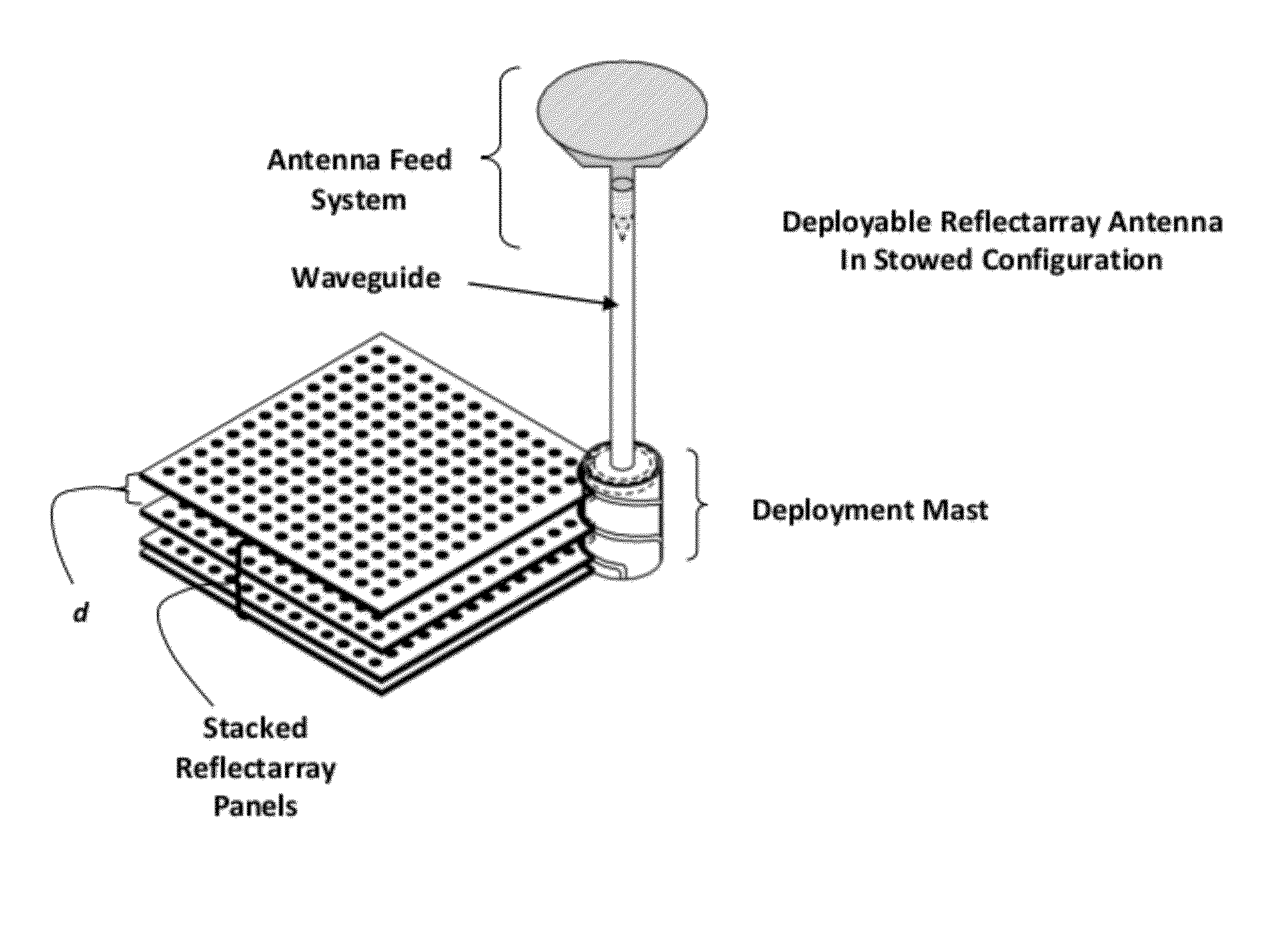
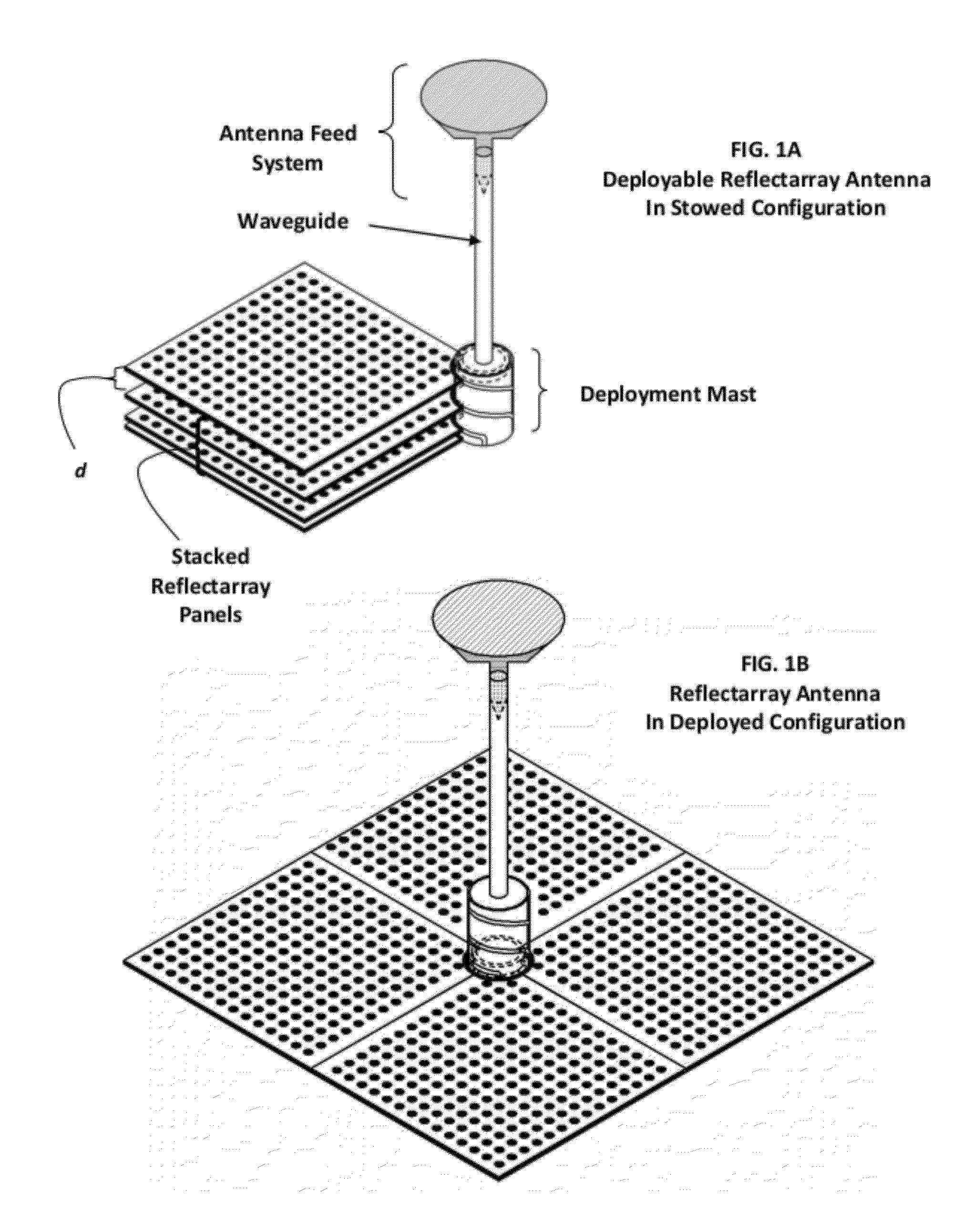
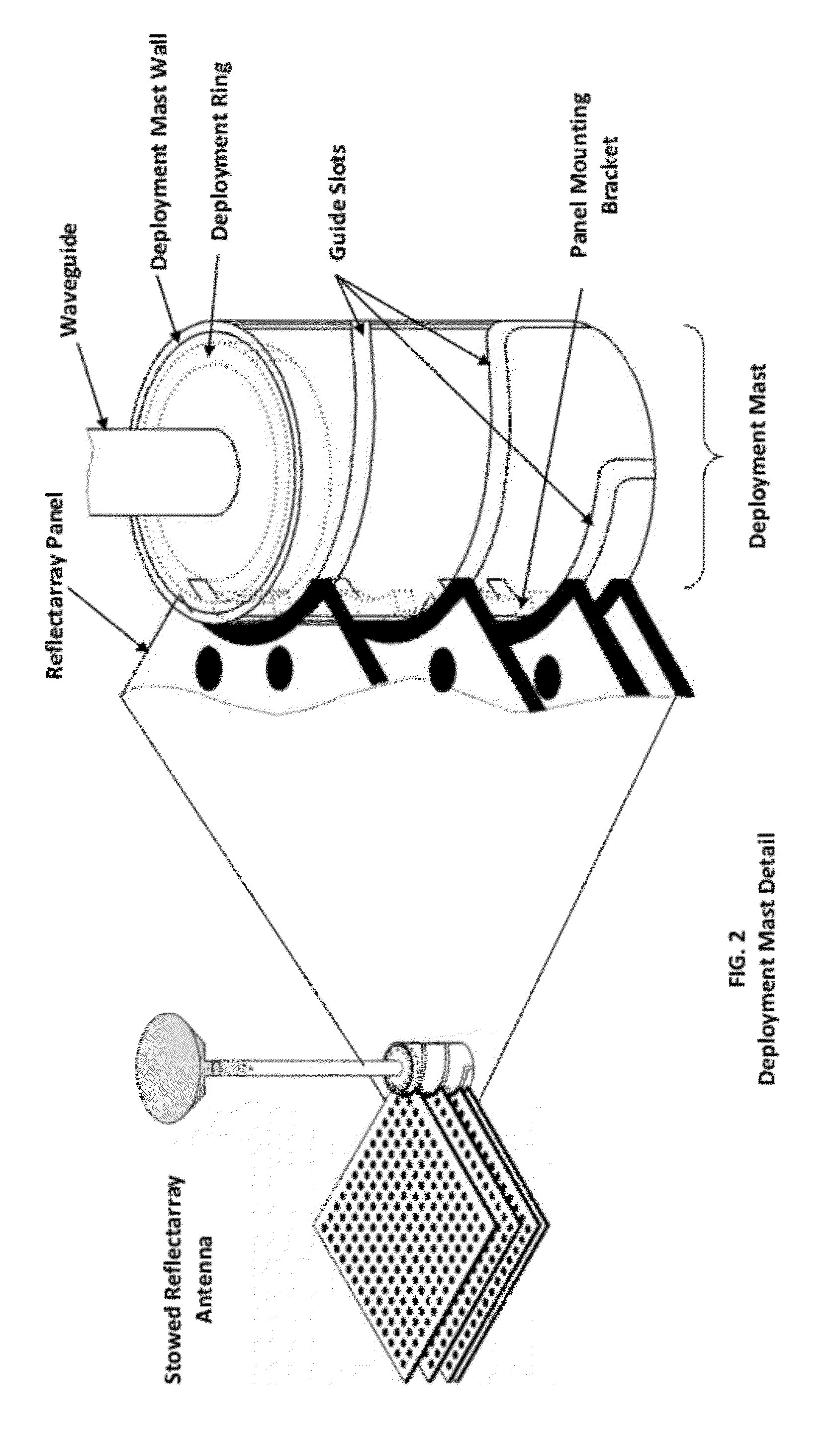
- A deployable reflectarray antenna system is designed with a simple deployment mechanism, where a flat reflectarray antenna is subdivided into panels that stack and deploy using a hollow cylindrical mechanism with guide slots and a deployment ring, allowing for a compact stowed configuration and a larger operational area with reduced surface area requirements.

Passive reflectarray panel for enhanced wireless communication in near field coverage area and methods of designing the same
PatentPendingUS20250023254A1
Innovation
- The use of reflectarray antennas, which are arrays of cells with conductive printed elements that reflect incident RF signals into focused, directional beams, optimized for specific frequency-dependent phase distribution and geometrical configurations to enhance wireless communication coverage in various environments.


Spectrum Regulation Impact on Antenna Design
Spectrum regulation frameworks significantly influence the design parameters and operational characteristics of both reflectarray panels and holographic antennas, creating distinct compliance challenges for each technology. Regulatory bodies worldwide, including the FCC, ETSI, and ITU, establish stringent requirements for frequency allocation, power density limits, and spurious emission standards that directly impact antenna architecture decisions.
Reflectarray panels face particular regulatory scrutiny due to their inherently broadband scattering characteristics. The passive nature of reflectarray elements can generate unwanted reflections across multiple frequency bands, potentially violating out-of-band emission regulations. This necessitates careful element design with frequency-selective surfaces and absorptive materials to ensure compliance with spectral mask requirements. Additionally, the large aperture sizes typical of reflectarray systems must meet specific radiation pattern envelope standards to minimize interference with adjacent satellite systems.
Holographic antennas encounter different regulatory challenges primarily related to their active beamforming capabilities. The dynamic nature of holographic beam steering requires compliance with adaptive power control regulations, particularly in shared spectrum environments. Regulatory frameworks increasingly demand real-time spectrum sensing and cognitive radio capabilities, which holographic antennas can more readily accommodate through their software-defined architecture.
Frequency coordination requirements present varying complexity levels for both technologies. Reflectarray panels, with their fixed beam characteristics, typically require simpler coordination procedures but face limitations in congested spectrum environments. Holographic antennas benefit from their ability to implement dynamic frequency selection and interference avoidance algorithms, aligning with emerging regulatory trends toward more flexible spectrum management.
International harmonization efforts, such as the World Radiocommunication Conference decisions, increasingly favor technologies capable of spectrum sharing and interference mitigation. This regulatory evolution tends to favor holographic antennas' adaptive capabilities over reflectarray panels' static characteristics, particularly in commercial satellite communications and 5G applications where spectrum efficiency is paramount.
Compliance certification processes also differ significantly between the two technologies. Reflectarray panels require extensive pattern measurements across all operational frequencies, while holographic antennas necessitate software validation and algorithm verification procedures that align with emerging software-defined radio certification frameworks.
Reflectarray panels face particular regulatory scrutiny due to their inherently broadband scattering characteristics. The passive nature of reflectarray elements can generate unwanted reflections across multiple frequency bands, potentially violating out-of-band emission regulations. This necessitates careful element design with frequency-selective surfaces and absorptive materials to ensure compliance with spectral mask requirements. Additionally, the large aperture sizes typical of reflectarray systems must meet specific radiation pattern envelope standards to minimize interference with adjacent satellite systems.
Holographic antennas encounter different regulatory challenges primarily related to their active beamforming capabilities. The dynamic nature of holographic beam steering requires compliance with adaptive power control regulations, particularly in shared spectrum environments. Regulatory frameworks increasingly demand real-time spectrum sensing and cognitive radio capabilities, which holographic antennas can more readily accommodate through their software-defined architecture.
Frequency coordination requirements present varying complexity levels for both technologies. Reflectarray panels, with their fixed beam characteristics, typically require simpler coordination procedures but face limitations in congested spectrum environments. Holographic antennas benefit from their ability to implement dynamic frequency selection and interference avoidance algorithms, aligning with emerging regulatory trends toward more flexible spectrum management.
International harmonization efforts, such as the World Radiocommunication Conference decisions, increasingly favor technologies capable of spectrum sharing and interference mitigation. This regulatory evolution tends to favor holographic antennas' adaptive capabilities over reflectarray panels' static characteristics, particularly in commercial satellite communications and 5G applications where spectrum efficiency is paramount.
Compliance certification processes also differ significantly between the two technologies. Reflectarray panels require extensive pattern measurements across all operational frequencies, while holographic antennas necessitate software validation and algorithm verification procedures that align with emerging software-defined radio certification frameworks.
Manufacturing Cost Analysis for Antenna Technologies
Manufacturing costs represent a critical differentiator between reflectarray panels and holographic antennas, significantly influencing their commercial viability and market adoption. The cost structures of these technologies vary substantially due to fundamental differences in fabrication processes, material requirements, and production scalability.
Reflectarray panels demonstrate inherently lower manufacturing costs due to their relatively straightforward fabrication process. These systems utilize conventional printed circuit board (PCB) manufacturing techniques, leveraging established photolithographic processes and standard substrate materials such as Rogers or Taconic laminates. The manufacturing workflow involves standard etching, drilling, and metallization processes that are widely available across global electronics manufacturing facilities. This accessibility to existing production infrastructure significantly reduces capital investment requirements and enables rapid scaling without specialized equipment procurement.
The material costs for reflectarray panels remain moderate, primarily consisting of dielectric substrates, copper conductors, and standard electronic components. Volume production benefits from economies of scale in PCB manufacturing, where cost per unit decreases substantially as production quantities increase. Typical manufacturing costs range from $50-200 per square meter for standard configurations, depending on substrate specifications and element complexity.
Holographic antennas present significantly higher manufacturing costs due to their sophisticated fabrication requirements. These systems demand precision holographic recording processes, specialized photosensitive materials, and controlled environmental conditions during production. The manufacturing process requires laser interference systems, high-resolution recording media, and post-processing treatments that necessitate specialized facilities and equipment. Initial capital investments for holographic antenna production facilities can exceed $10-50 million, creating substantial barriers to entry.
Material costs for holographic antennas are considerably higher, involving specialized photopolymers, silver halide emulsions, or advanced metamaterial substrates. These materials often require custom formulations and precise handling protocols, limiting supplier options and increasing procurement costs. Manufacturing costs typically range from $500-2000 per square meter, representing a 5-10x premium over reflectarray alternatives.
Production scalability differs markedly between technologies. Reflectarray manufacturing benefits from mature PCB industry infrastructure, enabling rapid capacity expansion and global production distribution. Conversely, holographic antenna production remains constrained by specialized facility requirements and limited supplier ecosystems, restricting scalability and maintaining elevated unit costs even at higher volumes.
Quality control and yield considerations further impact cost structures. Reflectarray panels achieve high manufacturing yields using proven PCB processes, while holographic antennas face yield challenges related to recording precision and material consistency, potentially increasing effective production costs through waste and rework requirements.
Reflectarray panels demonstrate inherently lower manufacturing costs due to their relatively straightforward fabrication process. These systems utilize conventional printed circuit board (PCB) manufacturing techniques, leveraging established photolithographic processes and standard substrate materials such as Rogers or Taconic laminates. The manufacturing workflow involves standard etching, drilling, and metallization processes that are widely available across global electronics manufacturing facilities. This accessibility to existing production infrastructure significantly reduces capital investment requirements and enables rapid scaling without specialized equipment procurement.
The material costs for reflectarray panels remain moderate, primarily consisting of dielectric substrates, copper conductors, and standard electronic components. Volume production benefits from economies of scale in PCB manufacturing, where cost per unit decreases substantially as production quantities increase. Typical manufacturing costs range from $50-200 per square meter for standard configurations, depending on substrate specifications and element complexity.
Holographic antennas present significantly higher manufacturing costs due to their sophisticated fabrication requirements. These systems demand precision holographic recording processes, specialized photosensitive materials, and controlled environmental conditions during production. The manufacturing process requires laser interference systems, high-resolution recording media, and post-processing treatments that necessitate specialized facilities and equipment. Initial capital investments for holographic antenna production facilities can exceed $10-50 million, creating substantial barriers to entry.
Material costs for holographic antennas are considerably higher, involving specialized photopolymers, silver halide emulsions, or advanced metamaterial substrates. These materials often require custom formulations and precise handling protocols, limiting supplier options and increasing procurement costs. Manufacturing costs typically range from $500-2000 per square meter, representing a 5-10x premium over reflectarray alternatives.
Production scalability differs markedly between technologies. Reflectarray manufacturing benefits from mature PCB industry infrastructure, enabling rapid capacity expansion and global production distribution. Conversely, holographic antenna production remains constrained by specialized facility requirements and limited supplier ecosystems, restricting scalability and maintaining elevated unit costs even at higher volumes.
Quality control and yield considerations further impact cost structures. Reflectarray panels achieve high manufacturing yields using proven PCB processes, while holographic antennas face yield challenges related to recording precision and material consistency, potentially increasing effective production costs through waste and rework requirements.
Unlock deeper insights with PatSnap Eureka Quick Research — get a full tech report to explore trends and direct your research. Try now!
Generate Your Research Report Instantly with AI Agent
Supercharge your innovation with PatSnap Eureka AI Agent Platform!