Chrome Plating vs Electrostatic Painting: Process Efficiency
APR 8, 20269 MIN READ
Generate Your Research Report Instantly with AI Agent
Patsnap Eureka helps you evaluate technical feasibility & market potential.
Chrome Plating vs Electrostatic Painting Background and Objectives
Chrome plating and electrostatic painting represent two fundamentally different surface finishing technologies that have evolved to address diverse industrial coating requirements. Chrome plating, developed in the early 20th century, utilizes electrochemical processes to deposit chromium layers onto substrate materials, providing exceptional hardness, corrosion resistance, and aesthetic appeal. This wet chemical process has been extensively employed in automotive, aerospace, and decorative applications for nearly a century.
Electrostatic painting emerged as a revolutionary dry coating technology in the mid-20th century, leveraging electrostatic charge principles to achieve superior paint adhesion and transfer efficiency. This process involves charging paint particles and attracting them to grounded workpieces, resulting in uniform coating distribution and reduced material waste. The technology gained significant traction due to its environmental advantages and operational efficiency improvements over conventional spray painting methods.
The historical development of both technologies reflects evolving industrial demands for enhanced surface protection, aesthetic quality, and manufacturing efficiency. Chrome plating initially dominated applications requiring superior durability and corrosion resistance, particularly in harsh operating environments. However, increasing environmental regulations and cost considerations have prompted industries to explore alternative coating solutions, positioning electrostatic painting as a viable competitor in many applications.
Process efficiency comparison between these technologies has become increasingly critical as manufacturers seek to optimize production costs, environmental compliance, and quality outcomes. Chrome plating processes typically involve multiple chemical treatment stages, including cleaning, etching, and electrodeposition, requiring substantial infrastructure investments and waste management systems. The process demands precise control of bath chemistry, temperature, and current density to achieve consistent coating quality.
Electrostatic painting offers distinct efficiency advantages through simplified process workflows, reduced material consumption, and faster production cycles. The technology eliminates many wet chemical processing steps while achieving excellent coating uniformity and adhesion properties. Additionally, overspray recovery systems enable paint recycling, further enhancing material utilization efficiency.
The primary objective of this comparative analysis focuses on quantifying process efficiency metrics across both technologies, including material utilization rates, energy consumption, production throughput, and total cost of ownership. Understanding these efficiency parameters enables informed decision-making for specific application requirements and operational constraints.
Secondary objectives encompass evaluating environmental impact considerations, quality performance characteristics, and scalability factors that influence technology selection. This comprehensive assessment aims to provide strategic insights for manufacturers considering coating technology investments or process optimization initiatives in contemporary industrial environments.
Electrostatic painting emerged as a revolutionary dry coating technology in the mid-20th century, leveraging electrostatic charge principles to achieve superior paint adhesion and transfer efficiency. This process involves charging paint particles and attracting them to grounded workpieces, resulting in uniform coating distribution and reduced material waste. The technology gained significant traction due to its environmental advantages and operational efficiency improvements over conventional spray painting methods.
The historical development of both technologies reflects evolving industrial demands for enhanced surface protection, aesthetic quality, and manufacturing efficiency. Chrome plating initially dominated applications requiring superior durability and corrosion resistance, particularly in harsh operating environments. However, increasing environmental regulations and cost considerations have prompted industries to explore alternative coating solutions, positioning electrostatic painting as a viable competitor in many applications.
Process efficiency comparison between these technologies has become increasingly critical as manufacturers seek to optimize production costs, environmental compliance, and quality outcomes. Chrome plating processes typically involve multiple chemical treatment stages, including cleaning, etching, and electrodeposition, requiring substantial infrastructure investments and waste management systems. The process demands precise control of bath chemistry, temperature, and current density to achieve consistent coating quality.
Electrostatic painting offers distinct efficiency advantages through simplified process workflows, reduced material consumption, and faster production cycles. The technology eliminates many wet chemical processing steps while achieving excellent coating uniformity and adhesion properties. Additionally, overspray recovery systems enable paint recycling, further enhancing material utilization efficiency.
The primary objective of this comparative analysis focuses on quantifying process efficiency metrics across both technologies, including material utilization rates, energy consumption, production throughput, and total cost of ownership. Understanding these efficiency parameters enables informed decision-making for specific application requirements and operational constraints.
Secondary objectives encompass evaluating environmental impact considerations, quality performance characteristics, and scalability factors that influence technology selection. This comprehensive assessment aims to provide strategic insights for manufacturers considering coating technology investments or process optimization initiatives in contemporary industrial environments.
Market Demand for Surface Coating Process Efficiency
The global surface coating industry is experiencing unprecedented demand for enhanced process efficiency, driven by stringent environmental regulations and escalating operational costs. Manufacturing sectors, particularly automotive, aerospace, and industrial equipment, are actively seeking coating solutions that deliver superior performance while minimizing resource consumption and environmental impact. This shift represents a fundamental transformation in how industries approach surface treatment technologies.
Automotive manufacturers constitute the largest market segment demanding efficient coating processes, as they face mounting pressure to reduce production costs while maintaining quality standards. The industry's transition toward electric vehicles has intensified this demand, as manufacturers require coating processes that can handle diverse material compositions and complex geometries with consistent efficiency. Traditional chrome plating operations are increasingly scrutinized due to their environmental footprint and regulatory compliance costs.
Aerospace and defense sectors demonstrate particularly acute sensitivity to process efficiency metrics, where coating performance directly impacts operational safety and lifecycle costs. These industries require coating solutions that optimize material utilization while ensuring consistent quality across complex component geometries. The growing emphasis on lightweight materials and advanced alloys has created additional complexity in coating process selection.
Industrial equipment manufacturers are driving demand for coating processes that can accommodate high-volume production while maintaining cost-effectiveness. The rise of automation and Industry 4.0 initiatives has created opportunities for coating technologies that integrate seamlessly with digital manufacturing systems. Process efficiency has become a critical differentiator in competitive bidding scenarios.
Environmental compliance costs are reshaping market preferences toward coating technologies with reduced waste generation and lower energy consumption. Regulatory frameworks across major manufacturing regions are tightening restrictions on hazardous waste disposal and emissions, making process efficiency a compliance necessity rather than merely an operational optimization.
The market is witnessing increased investment in coating process optimization technologies, including advanced monitoring systems, automated material handling, and waste reduction solutions. Companies are prioritizing coating processes that demonstrate measurable improvements in material utilization rates, energy consumption, and throughput capacity while maintaining or enhancing final product quality standards.
Automotive manufacturers constitute the largest market segment demanding efficient coating processes, as they face mounting pressure to reduce production costs while maintaining quality standards. The industry's transition toward electric vehicles has intensified this demand, as manufacturers require coating processes that can handle diverse material compositions and complex geometries with consistent efficiency. Traditional chrome plating operations are increasingly scrutinized due to their environmental footprint and regulatory compliance costs.
Aerospace and defense sectors demonstrate particularly acute sensitivity to process efficiency metrics, where coating performance directly impacts operational safety and lifecycle costs. These industries require coating solutions that optimize material utilization while ensuring consistent quality across complex component geometries. The growing emphasis on lightweight materials and advanced alloys has created additional complexity in coating process selection.
Industrial equipment manufacturers are driving demand for coating processes that can accommodate high-volume production while maintaining cost-effectiveness. The rise of automation and Industry 4.0 initiatives has created opportunities for coating technologies that integrate seamlessly with digital manufacturing systems. Process efficiency has become a critical differentiator in competitive bidding scenarios.
Environmental compliance costs are reshaping market preferences toward coating technologies with reduced waste generation and lower energy consumption. Regulatory frameworks across major manufacturing regions are tightening restrictions on hazardous waste disposal and emissions, making process efficiency a compliance necessity rather than merely an operational optimization.
The market is witnessing increased investment in coating process optimization technologies, including advanced monitoring systems, automated material handling, and waste reduction solutions. Companies are prioritizing coating processes that demonstrate measurable improvements in material utilization rates, energy consumption, and throughput capacity while maintaining or enhancing final product quality standards.
Current State and Challenges in Coating Technologies
Chrome plating and electrostatic painting represent two fundamentally different approaches to surface coating, each with distinct technological foundations and operational characteristics. Chrome plating, an electrochemical process dating back to the early 20th century, involves the electrodeposition of chromium onto substrate materials through immersion in chromic acid solutions. This wet chemical process requires precise control of current density, temperature, and solution composition to achieve desired coating thickness and quality.
Electrostatic painting, developed in the 1960s, utilizes electrostatic charge principles to attract powder or liquid paint particles to grounded workpieces. This dry application method has evolved significantly with advances in powder formulations, spray gun technology, and curing systems. Modern electrostatic systems achieve transfer efficiencies exceeding 95% compared to conventional spray methods.
Current chrome plating operations face substantial regulatory pressures due to hexavalent chromium's carcinogenic properties. The European Union's REACH regulation and similar legislation worldwide have imposed strict limitations on chromium use, forcing manufacturers to seek alternative processes or implement costly containment systems. Traditional chrome plating facilities require extensive ventilation, wastewater treatment, and worker protection measures, significantly increasing operational costs.
Electrostatic painting confronts different challenges, primarily related to coating uniformity on complex geometries and Faraday cage effects in recessed areas. While powder coating systems offer excellent material utilization rates, achieving consistent film thickness on intricate parts remains problematic. Additionally, color change operations in electrostatic systems require thorough cleaning procedures, limiting production flexibility compared to liquid coating alternatives.
Process efficiency comparisons reveal significant disparities between these technologies. Chrome plating typically requires multiple processing steps including cleaning, activation, plating, and post-treatment, with cycle times ranging from 30 minutes to several hours depending on coating thickness requirements. Energy consumption is substantial due to rectifier systems and heating requirements for plating baths.
Electrostatic painting demonstrates superior throughput capabilities with automated powder application systems achieving coating rates of 200-500 parts per hour for standard components. Curing processes, while energy-intensive, can be optimized through infrared or convection systems with cycle times under 20 minutes for most applications.
Quality control presents distinct challenges for each technology. Chrome plating requires continuous monitoring of bath chemistry, current density distribution, and solution contamination levels. Coating thickness variations and defects such as burning or poor adhesion can result from process parameter deviations. Electrostatic painting quality depends heavily on powder flow characteristics, gun settings, and environmental conditions including humidity and temperature control.
The technological landscape continues evolving with trivalent chromium alternatives gaining acceptance for decorative applications, though functional chrome plating for wear resistance remains largely unchanged. Electrostatic painting advances focus on improved powder formulations, enhanced transfer efficiency equipment, and integrated quality monitoring systems utilizing real-time thickness measurement and defect detection capabilities.
Electrostatic painting, developed in the 1960s, utilizes electrostatic charge principles to attract powder or liquid paint particles to grounded workpieces. This dry application method has evolved significantly with advances in powder formulations, spray gun technology, and curing systems. Modern electrostatic systems achieve transfer efficiencies exceeding 95% compared to conventional spray methods.
Current chrome plating operations face substantial regulatory pressures due to hexavalent chromium's carcinogenic properties. The European Union's REACH regulation and similar legislation worldwide have imposed strict limitations on chromium use, forcing manufacturers to seek alternative processes or implement costly containment systems. Traditional chrome plating facilities require extensive ventilation, wastewater treatment, and worker protection measures, significantly increasing operational costs.
Electrostatic painting confronts different challenges, primarily related to coating uniformity on complex geometries and Faraday cage effects in recessed areas. While powder coating systems offer excellent material utilization rates, achieving consistent film thickness on intricate parts remains problematic. Additionally, color change operations in electrostatic systems require thorough cleaning procedures, limiting production flexibility compared to liquid coating alternatives.
Process efficiency comparisons reveal significant disparities between these technologies. Chrome plating typically requires multiple processing steps including cleaning, activation, plating, and post-treatment, with cycle times ranging from 30 minutes to several hours depending on coating thickness requirements. Energy consumption is substantial due to rectifier systems and heating requirements for plating baths.
Electrostatic painting demonstrates superior throughput capabilities with automated powder application systems achieving coating rates of 200-500 parts per hour for standard components. Curing processes, while energy-intensive, can be optimized through infrared or convection systems with cycle times under 20 minutes for most applications.
Quality control presents distinct challenges for each technology. Chrome plating requires continuous monitoring of bath chemistry, current density distribution, and solution contamination levels. Coating thickness variations and defects such as burning or poor adhesion can result from process parameter deviations. Electrostatic painting quality depends heavily on powder flow characteristics, gun settings, and environmental conditions including humidity and temperature control.
The technological landscape continues evolving with trivalent chromium alternatives gaining acceptance for decorative applications, though functional chrome plating for wear resistance remains largely unchanged. Electrostatic painting advances focus on improved powder formulations, enhanced transfer efficiency equipment, and integrated quality monitoring systems utilizing real-time thickness measurement and defect detection capabilities.
Current Chrome Plating and Electrostatic Solutions
01 Chrome plating process optimization and efficiency improvements
Various methods and apparatus have been developed to optimize chrome plating processes, focusing on improving deposition rates, reducing processing time, and enhancing overall efficiency. These improvements include advanced electrolyte compositions, optimized current density control, and automated plating systems that minimize waste and energy consumption while maintaining high-quality chrome finishes.- Chrome plating process optimization and efficiency improvements: Various methods and apparatus have been developed to optimize chrome plating processes, focusing on improving deposition rates, reducing processing time, and enhancing overall efficiency. These improvements include advanced electrolyte compositions, controlled current density applications, and automated plating systems that minimize waste and energy consumption while maintaining high-quality chrome finishes.
- Electrostatic painting equipment and application techniques: Electrostatic painting systems utilize charged particles to improve paint transfer efficiency and coating uniformity. Advanced equipment designs incorporate optimized electrode configurations, voltage control systems, and spray nozzle arrangements that maximize paint utilization while reducing overspray. These systems demonstrate superior material efficiency compared to conventional painting methods.
- Comparative coating quality and durability assessment: Studies comparing chrome plating and electrostatic painting evaluate coating thickness uniformity, adhesion strength, corrosion resistance, and long-term durability. Chrome plating typically provides superior hardness and wear resistance, while electrostatic painting offers advantages in coverage of complex geometries and environmental compliance. Performance metrics include salt spray testing, abrasion resistance, and appearance retention.
- Environmental impact and waste reduction strategies: Environmental considerations distinguish these coating processes significantly. Chrome plating involves hazardous hexavalent chromium compounds requiring extensive waste treatment, while electrostatic painting reduces volatile organic compound emissions and achieves higher transfer efficiency with less material waste. Modern systems incorporate recycling mechanisms, closed-loop water systems, and emission control technologies to minimize environmental footprint.
- Cost analysis and production throughput optimization: Economic efficiency comparisons examine equipment investment, operational costs, labor requirements, and production speed. Electrostatic painting generally offers faster application rates and lower material costs due to higher transfer efficiency, while chrome plating requires more complex infrastructure and waste management. Automation technologies for both processes aim to reduce labor costs and increase throughput while maintaining consistent quality standards.
02 Electrostatic painting equipment and application techniques
Electrostatic painting systems utilize charged particles to improve paint transfer efficiency and coating uniformity. Advanced equipment designs incorporate optimized spray guns, voltage control systems, and particle charging mechanisms that enhance paint adhesion and reduce overspray. These systems demonstrate superior material utilization rates compared to conventional painting methods.Expand Specific Solutions03 Comparative coating quality and durability assessment
Studies have evaluated the performance characteristics of different coating methods, examining factors such as corrosion resistance, adhesion strength, surface finish quality, and long-term durability. The assessments consider environmental exposure, wear resistance, and maintenance requirements to determine the most suitable coating method for specific applications.Expand Specific Solutions04 Environmental and safety considerations in coating processes
Modern coating technologies address environmental concerns by reducing hazardous waste generation, minimizing volatile organic compound emissions, and improving worker safety. Innovations include closed-loop systems, waste recovery mechanisms, and alternative chemistries that reduce the environmental impact while maintaining process efficiency and coating performance.Expand Specific Solutions05 Cost-effectiveness and production throughput analysis
Economic evaluations compare the operational costs, equipment investment, maintenance requirements, and production rates of different coating methods. Analysis includes factors such as material consumption, energy usage, labor requirements, and processing speed to determine the most cost-effective solution for various manufacturing scenarios and production volumes.Expand Specific Solutions
Key Players in Surface Coating Industry
The chrome plating versus electrostatic painting technology landscape represents a mature industrial finishing sector experiencing significant transformation driven by environmental regulations and efficiency demands. The market, valued in billions globally, spans automotive, aerospace, and industrial applications. Technology maturity varies considerably across players: automotive giants like Toyota Motor Corp., Honda Motor Co., and AUDI AG have extensively adopted both technologies with sophisticated implementation capabilities, while specialized equipment manufacturers such as ANEST IWATA Corp., Trinity Industrial Corp., and Taikisha Ltd. drive innovation in application systems. Chemical companies including BASF Corp. and Merck Patent GmbH focus on advanced coating formulations, whereas aerospace players like Hamilton Sundstrand Corp. and Messier-Bugatti SA emphasize precision applications. The competitive landscape shows established players optimizing existing technologies while emerging companies like Zhejiang Mingquan Industrial Coating Co. Ltd. introduce cost-effective solutions, indicating an industry balancing proven reliability with innovative efficiency improvements.
Toyota Motor Corp.
Technical Solution: Toyota has developed lean manufacturing approaches for automotive coating processes that optimize both chrome plating and electrostatic painting operations. Their production systems integrate electrostatic painting with just-in-time material delivery and automated quality inspection, achieving coating cycle times 35-50% faster than traditional batch processes. The company's continuous improvement methodologies focus on eliminating waste in material usage, reducing changeover times, and optimizing equipment utilization rates. Their integrated approach combines advanced robotics with real-time process monitoring to maintain consistent quality while maximizing throughput efficiency in high-volume production environments.
Strengths: Proven lean manufacturing expertise, excellent quality control systems, high-volume production optimization. Weaknesses: Solutions primarily optimized for automotive applications, limited technology transfer to other industries.
ANEST IWATA Corp.
Technical Solution: ANEST IWATA specializes in advanced electrostatic painting systems that utilize high-voltage electrostatic fields to attract paint particles to grounded substrates. Their technology achieves transfer efficiency rates of 85-95% compared to conventional spray methods at 30-50%. The company's rotary bell atomizers and electrostatic guns provide precise paint application with reduced overspray, enabling faster coating cycles and lower material consumption. Their automated systems integrate with robotic painting lines to optimize process parameters in real-time, significantly reducing coating time while maintaining superior finish quality.
Strengths: Industry-leading transfer efficiency, reduced material waste, faster application speeds. Weaknesses: High initial equipment investment, requires specialized training for operators.
Core Technologies in Efficient Coating Processes
Method of chrome plating magnesium and magnesium alloys
PatentInactiveUS8152985B2
Innovation
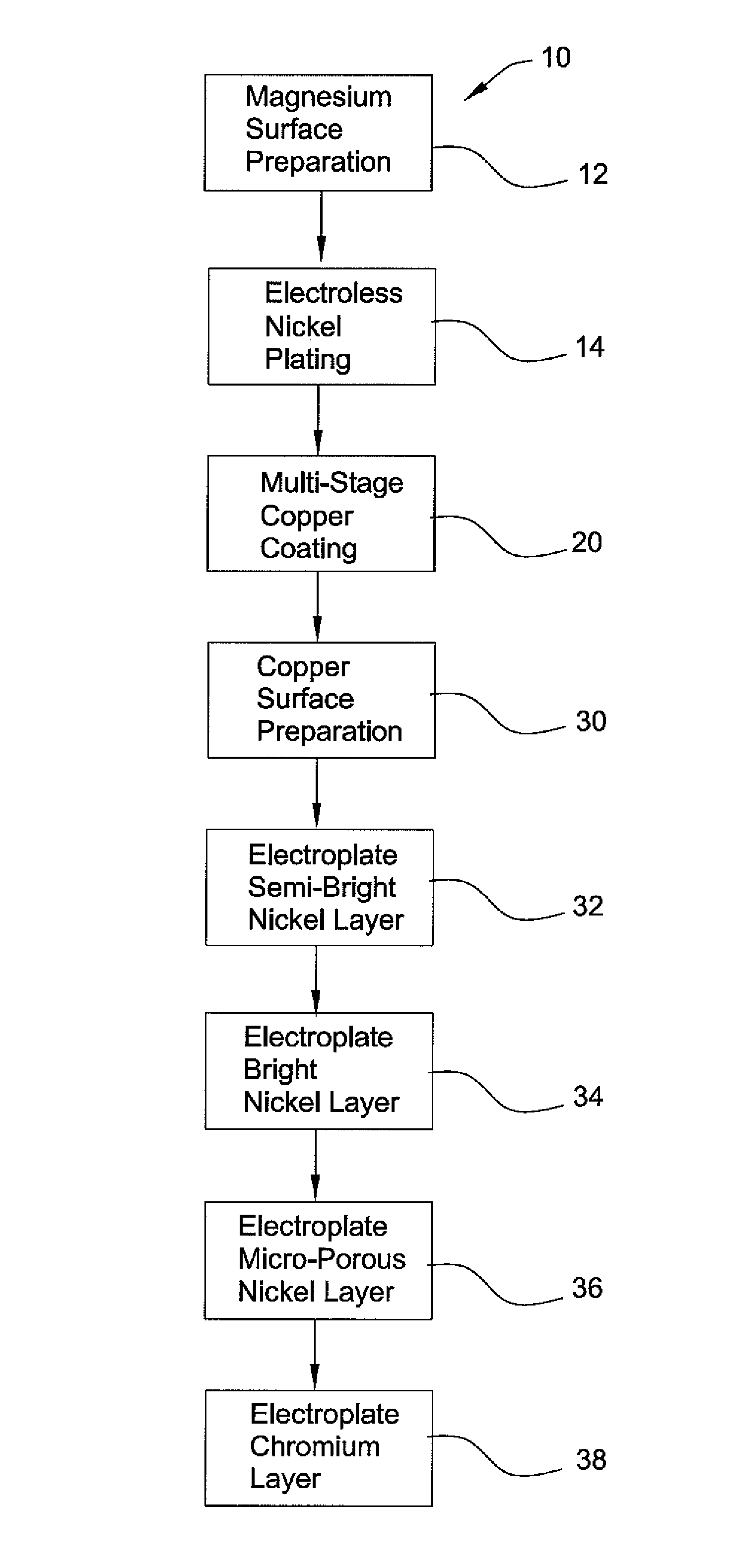
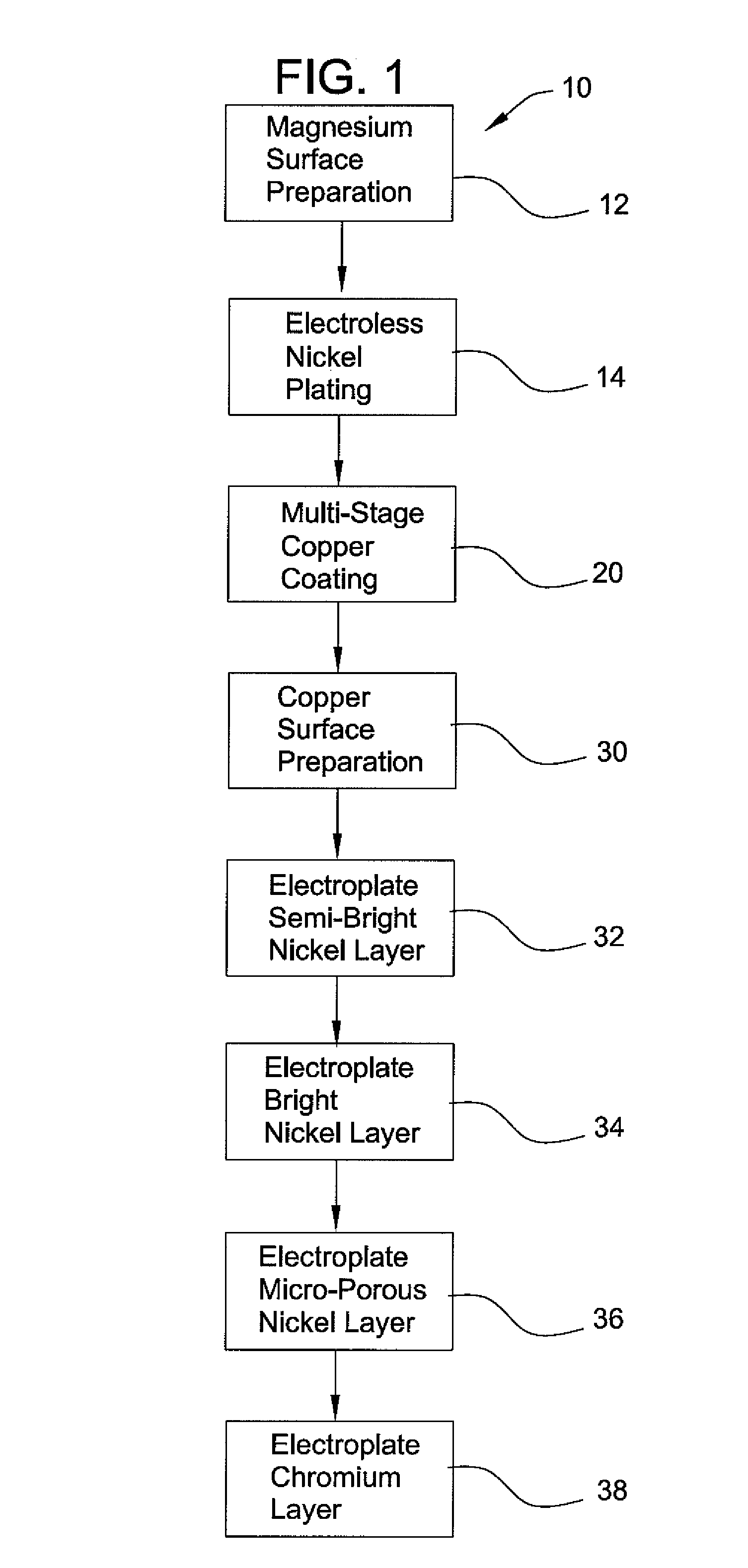
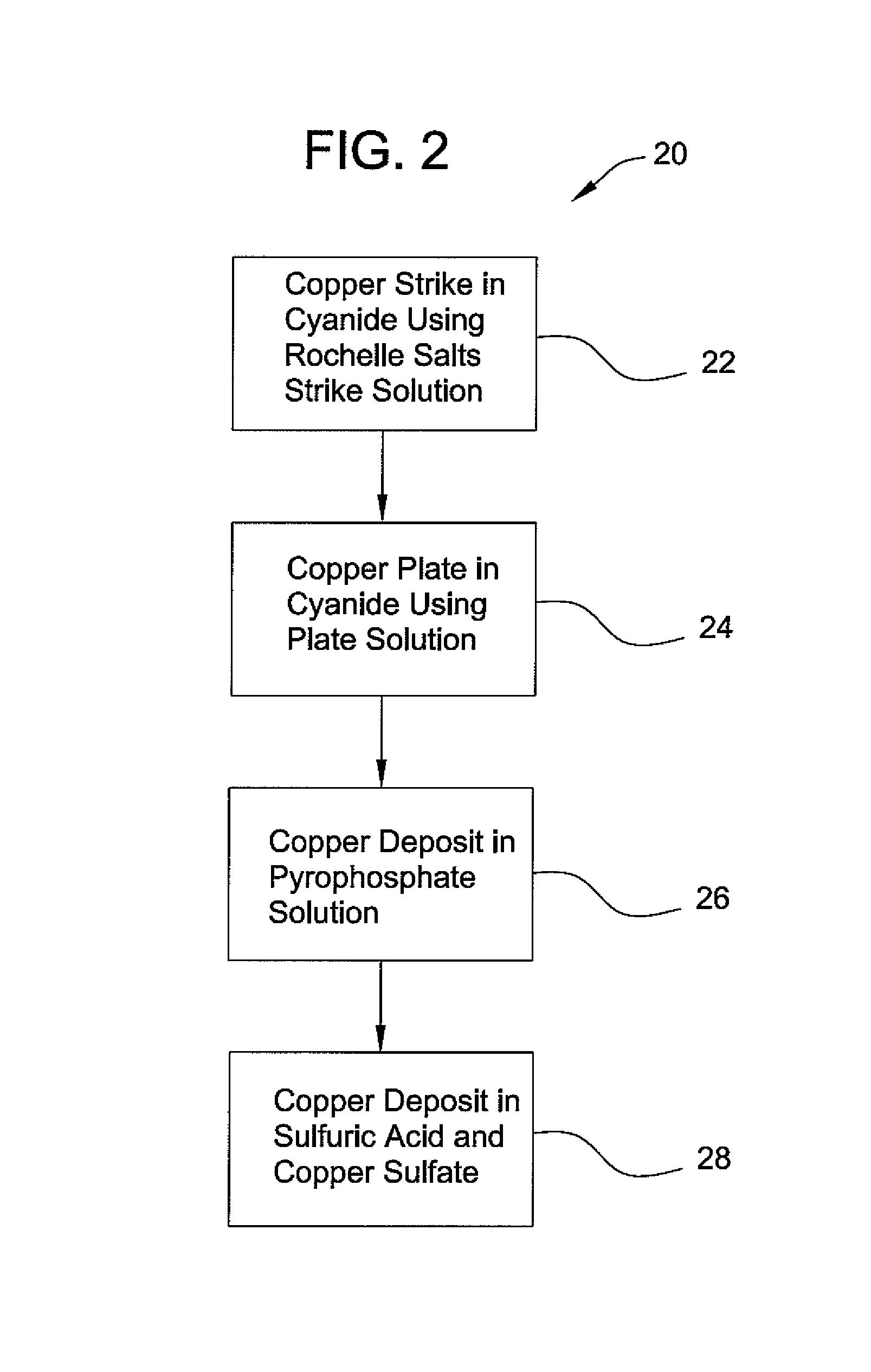
- A process involving electroless nickel plating, a multi-stage copper coating transition zone, and multiple layers of electrodeposited nickel to create a corrosion-resistant system suitable for direct chromium over plating, ensuring interlayer adherence and impermeability.

Chrome plated parts and chrome plating method
PatentInactiveUSRE40386E1
Innovation
- A chrome plating method that forms a crack-free chrome layer with compressive residual stress of 100 MPa or more and a crystal grain size of 9 nm to 16 nm, using a two-step plating process with pulse and direct currents in a chrome plating bath containing organic sulfonic acid, and optionally includes intermediate layers or an oxide film for enhanced corrosion resistance.


Environmental Regulations for Coating Processes
Environmental regulations governing coating processes have become increasingly stringent worldwide, fundamentally reshaping the competitive landscape between chrome plating and electrostatic painting technologies. The regulatory framework primarily focuses on controlling hazardous air pollutants, wastewater discharge standards, and worker safety protocols, with chrome plating facing significantly more restrictive oversight due to its use of hexavalent chromium compounds.
The United States Environmental Protection Agency has implemented the National Emission Standards for Hazardous Air Pollutants for Chrome Electroplating and Anodizing Operations, requiring facilities to achieve specific emission limits and implement continuous monitoring systems. These regulations mandate the installation of advanced air pollution control equipment, including high-efficiency particulate air filters and chemical scrubbers, substantially increasing operational costs for chrome plating facilities.
European Union directives, particularly the Registration, Evaluation, Authorization and Restriction of Chemicals regulation, have severely restricted the use of chromium compounds in industrial applications. The Restriction of Hazardous Substances directive further limits hexavalent chromium content in finished products, creating additional compliance burdens for manufacturers utilizing chrome plating processes.
Wastewater discharge regulations present another critical compliance challenge for chrome plating operations. The technology generates effluent containing heavy metals, requiring sophisticated treatment systems to meet increasingly strict discharge limits. Treatment costs can represent up to fifteen percent of total operational expenses, significantly impacting process economics compared to electrostatic painting alternatives.
Electrostatic painting benefits from more favorable regulatory positioning, particularly with water-based and powder coating formulations that eliminate volatile organic compound emissions. Recent regulatory trends favor low-emission coating technologies, with many jurisdictions offering expedited permitting processes and reduced monitoring requirements for electrostatic painting facilities.
Occupational safety regulations impose additional compliance costs on chrome plating operations, requiring specialized ventilation systems, personal protective equipment, and comprehensive worker health monitoring programs. These requirements create ongoing operational complexity and liability exposure that electrostatic painting processes largely avoid through inherently safer chemical compositions and application methods.
The United States Environmental Protection Agency has implemented the National Emission Standards for Hazardous Air Pollutants for Chrome Electroplating and Anodizing Operations, requiring facilities to achieve specific emission limits and implement continuous monitoring systems. These regulations mandate the installation of advanced air pollution control equipment, including high-efficiency particulate air filters and chemical scrubbers, substantially increasing operational costs for chrome plating facilities.
European Union directives, particularly the Registration, Evaluation, Authorization and Restriction of Chemicals regulation, have severely restricted the use of chromium compounds in industrial applications. The Restriction of Hazardous Substances directive further limits hexavalent chromium content in finished products, creating additional compliance burdens for manufacturers utilizing chrome plating processes.
Wastewater discharge regulations present another critical compliance challenge for chrome plating operations. The technology generates effluent containing heavy metals, requiring sophisticated treatment systems to meet increasingly strict discharge limits. Treatment costs can represent up to fifteen percent of total operational expenses, significantly impacting process economics compared to electrostatic painting alternatives.
Electrostatic painting benefits from more favorable regulatory positioning, particularly with water-based and powder coating formulations that eliminate volatile organic compound emissions. Recent regulatory trends favor low-emission coating technologies, with many jurisdictions offering expedited permitting processes and reduced monitoring requirements for electrostatic painting facilities.
Occupational safety regulations impose additional compliance costs on chrome plating operations, requiring specialized ventilation systems, personal protective equipment, and comprehensive worker health monitoring programs. These requirements create ongoing operational complexity and liability exposure that electrostatic painting processes largely avoid through inherently safer chemical compositions and application methods.
Cost-Benefit Analysis of Coating Technologies
The economic evaluation of chrome plating versus electrostatic painting reveals significant differences in both initial investment requirements and long-term operational costs. Chrome plating typically demands higher capital expenditure due to specialized equipment needs, including rectifiers, filtration systems, and extensive ventilation infrastructure. The process requires substantial investment in waste treatment facilities to handle hexavalent chromium compounds, with compliance costs reaching 15-25% of total operational expenses.
Electrostatic painting demonstrates superior cost efficiency through reduced material waste, achieving transfer efficiency rates of 85-95% compared to chrome plating's 60-70% material utilization. This efficiency translates to immediate cost savings in raw materials, with powder coating systems showing 30-40% lower material costs per unit area covered. Additionally, electrostatic systems require minimal solvent usage, eliminating associated procurement and disposal expenses.
Labor cost analysis favors electrostatic painting due to simplified process requirements and reduced safety protocols. Chrome plating operations necessitate specialized training for handling hazardous chemicals, increasing personnel costs by approximately 20-30%. The automated nature of electrostatic systems reduces manual intervention requirements, enabling higher throughput with fewer operators.
Environmental compliance costs represent a critical differentiator between technologies. Chrome plating facilities face escalating regulatory expenses, including wastewater treatment, air emission controls, and hazardous waste disposal. These compliance costs average $50,000-$150,000 annually for medium-scale operations. Electrostatic painting systems generate minimal environmental impact, reducing compliance expenses by 70-80%.
Energy consumption patterns show electrostatic painting consuming 40-50% less energy per unit processed, primarily due to lower curing temperature requirements and elimination of extensive drying processes. Maintenance costs also favor electrostatic systems, with simplified equipment design reducing downtime and component replacement frequencies.
Return on investment calculations indicate electrostatic painting systems typically achieve payback periods of 18-24 months, while chrome plating investments require 36-48 months for cost recovery, primarily due to higher operational expenses and regulatory compliance requirements.
Electrostatic painting demonstrates superior cost efficiency through reduced material waste, achieving transfer efficiency rates of 85-95% compared to chrome plating's 60-70% material utilization. This efficiency translates to immediate cost savings in raw materials, with powder coating systems showing 30-40% lower material costs per unit area covered. Additionally, electrostatic systems require minimal solvent usage, eliminating associated procurement and disposal expenses.
Labor cost analysis favors electrostatic painting due to simplified process requirements and reduced safety protocols. Chrome plating operations necessitate specialized training for handling hazardous chemicals, increasing personnel costs by approximately 20-30%. The automated nature of electrostatic systems reduces manual intervention requirements, enabling higher throughput with fewer operators.
Environmental compliance costs represent a critical differentiator between technologies. Chrome plating facilities face escalating regulatory expenses, including wastewater treatment, air emission controls, and hazardous waste disposal. These compliance costs average $50,000-$150,000 annually for medium-scale operations. Electrostatic painting systems generate minimal environmental impact, reducing compliance expenses by 70-80%.
Energy consumption patterns show electrostatic painting consuming 40-50% less energy per unit processed, primarily due to lower curing temperature requirements and elimination of extensive drying processes. Maintenance costs also favor electrostatic systems, with simplified equipment design reducing downtime and component replacement frequencies.
Return on investment calculations indicate electrostatic painting systems typically achieve payback periods of 18-24 months, while chrome plating investments require 36-48 months for cost recovery, primarily due to higher operational expenses and regulatory compliance requirements.
Unlock deeper insights with Patsnap Eureka Quick Research — get a full tech report to explore trends and direct your research. Try now!
Generate Your Research Report Instantly with AI Agent
Supercharge your innovation with Patsnap Eureka AI Agent Platform!