
Comparative Analysis Between Conventional and Advanced Ionic Liquid Lubricants Designs
OCT 13, 202510 MIN READ
Generate Your Research Report Instantly with AI Agent
Patsnap Eureka helps you evaluate technical feasibility & market potential.
Ionic Liquid Lubricants Background and Objectives
Ionic liquids (ILs) represent a revolutionary class of materials that have emerged as promising alternatives to conventional lubricants over the past three decades. These molten salts, composed entirely of ions and liquid at room temperature, were first recognized for their potential in tribological applications in the early 1990s. The evolution of IL lubricants has been marked by significant advancements in their molecular design, synthesis methodologies, and application-specific formulations.
Traditional petroleum-based lubricants have dominated industrial applications for over a century, providing essential friction reduction and wear protection. However, these conventional lubricants face inherent limitations including volatility, flammability, and environmental persistence. The growing demands for higher performance under extreme conditions, coupled with increasing environmental regulations, have accelerated the search for alternative lubricant technologies.
Ionic liquids emerged as promising candidates due to their unique physicochemical properties: negligible vapor pressure, high thermal stability, non-flammability, and remarkable structural tunability. The ability to design ILs through careful selection of cation-anion combinations offers unprecedented opportunities to tailor lubricant properties for specific applications, from aerospace to microelectronics.
The technical evolution of IL lubricants has progressed through several distinct phases. The first generation focused primarily on imidazolium-based ILs with fluorinated anions, demonstrating superior tribological performance but facing challenges related to hydrolytic stability and cost. The second generation expanded to include phosphonium and ammonium-based ILs, addressing some of the earlier limitations while improving compatibility with conventional materials.
Current research objectives in the field center on developing third-generation IL lubricants that combine enhanced performance with improved sustainability profiles. Key technical goals include: reducing friction coefficients below 0.01 under boundary lubrication conditions; extending operational temperature ranges from -50°C to over 300°C; minimizing corrosive interactions with metallic surfaces; and developing biodegradable formulations with reduced environmental impact.
The comparative analysis between conventional and advanced IL lubricants represents a critical step in evaluating the practical viability of these novel materials for widespread industrial adoption. This analysis aims to establish quantitative performance benchmarks, identify application-specific advantages, and highlight areas where further development is needed to overcome existing limitations in both technical performance and economic feasibility.
Traditional petroleum-based lubricants have dominated industrial applications for over a century, providing essential friction reduction and wear protection. However, these conventional lubricants face inherent limitations including volatility, flammability, and environmental persistence. The growing demands for higher performance under extreme conditions, coupled with increasing environmental regulations, have accelerated the search for alternative lubricant technologies.
Ionic liquids emerged as promising candidates due to their unique physicochemical properties: negligible vapor pressure, high thermal stability, non-flammability, and remarkable structural tunability. The ability to design ILs through careful selection of cation-anion combinations offers unprecedented opportunities to tailor lubricant properties for specific applications, from aerospace to microelectronics.
The technical evolution of IL lubricants has progressed through several distinct phases. The first generation focused primarily on imidazolium-based ILs with fluorinated anions, demonstrating superior tribological performance but facing challenges related to hydrolytic stability and cost. The second generation expanded to include phosphonium and ammonium-based ILs, addressing some of the earlier limitations while improving compatibility with conventional materials.
Current research objectives in the field center on developing third-generation IL lubricants that combine enhanced performance with improved sustainability profiles. Key technical goals include: reducing friction coefficients below 0.01 under boundary lubrication conditions; extending operational temperature ranges from -50°C to over 300°C; minimizing corrosive interactions with metallic surfaces; and developing biodegradable formulations with reduced environmental impact.
The comparative analysis between conventional and advanced IL lubricants represents a critical step in evaluating the practical viability of these novel materials for widespread industrial adoption. This analysis aims to establish quantitative performance benchmarks, identify application-specific advantages, and highlight areas where further development is needed to overcome existing limitations in both technical performance and economic feasibility.
Market Demand Analysis for Advanced Lubricant Technologies
The global lubricants market is experiencing a significant shift towards advanced lubricant technologies, particularly ionic liquid-based formulations. Current market analysis indicates that the conventional lubricants sector, dominated by mineral oil-based products, represents approximately 85% of the global market share. However, this dominance is gradually eroding as industries seek more sustainable and efficient alternatives.
The demand for advanced ionic liquid lubricants is primarily driven by stringent environmental regulations across major industrial economies. The European Union's REACH regulations and similar frameworks in North America and Asia have created substantial pressure on industries to adopt greener lubricant solutions with reduced environmental footprints. This regulatory landscape has accelerated market interest in ionic liquid lubricants, which offer biodegradability advantages over conventional petroleum-based products.
Industrial sectors including automotive, aerospace, manufacturing, and energy production represent the largest potential markets for advanced ionic liquid lubricants. The automotive industry alone consumes nearly 40% of all lubricants globally and is actively seeking solutions that can improve fuel efficiency and reduce emissions. Similarly, the aerospace sector demands lubricants capable of performing under extreme conditions while meeting increasingly strict environmental standards.
Performance requirements are evolving rapidly across these industries. End-users now prioritize lubricants with extended service life, reduced friction coefficients, and enhanced thermal stability. Market research indicates that customers are willing to pay premium prices for lubricants that demonstrably reduce maintenance costs and equipment downtime. Ionic liquid lubricants, with their superior tribological properties and thermal stability, directly address these evolving needs.
Economic factors also influence market demand patterns. While advanced ionic liquid lubricants currently command higher price points than conventional alternatives, total cost of ownership calculations often favor these advanced formulations when considering extended drain intervals and reduced equipment wear. The price sensitivity varies significantly by sector, with high-precision manufacturing and aerospace demonstrating greater willingness to adopt premium solutions.
Regional market analysis reveals varying adoption rates for advanced lubricant technologies. North America and Western Europe lead in early adoption, driven by stricter environmental regulations and higher technological readiness. The Asia-Pacific region, particularly China and India, represents the fastest-growing market segment, with industrial modernization creating substantial opportunities for advanced lubricant technologies.
Market forecasts project the advanced lubricants segment, including ionic liquid formulations, to grow at a compound annual rate of 8.3% through 2030, significantly outpacing the conventional lubricants market's projected growth of 1.2%. This accelerated growth trajectory reflects the convergence of environmental pressures, performance requirements, and long-term economic benefits driving the transition toward advanced lubricant technologies.
The demand for advanced ionic liquid lubricants is primarily driven by stringent environmental regulations across major industrial economies. The European Union's REACH regulations and similar frameworks in North America and Asia have created substantial pressure on industries to adopt greener lubricant solutions with reduced environmental footprints. This regulatory landscape has accelerated market interest in ionic liquid lubricants, which offer biodegradability advantages over conventional petroleum-based products.
Industrial sectors including automotive, aerospace, manufacturing, and energy production represent the largest potential markets for advanced ionic liquid lubricants. The automotive industry alone consumes nearly 40% of all lubricants globally and is actively seeking solutions that can improve fuel efficiency and reduce emissions. Similarly, the aerospace sector demands lubricants capable of performing under extreme conditions while meeting increasingly strict environmental standards.
Performance requirements are evolving rapidly across these industries. End-users now prioritize lubricants with extended service life, reduced friction coefficients, and enhanced thermal stability. Market research indicates that customers are willing to pay premium prices for lubricants that demonstrably reduce maintenance costs and equipment downtime. Ionic liquid lubricants, with their superior tribological properties and thermal stability, directly address these evolving needs.
Economic factors also influence market demand patterns. While advanced ionic liquid lubricants currently command higher price points than conventional alternatives, total cost of ownership calculations often favor these advanced formulations when considering extended drain intervals and reduced equipment wear. The price sensitivity varies significantly by sector, with high-precision manufacturing and aerospace demonstrating greater willingness to adopt premium solutions.
Regional market analysis reveals varying adoption rates for advanced lubricant technologies. North America and Western Europe lead in early adoption, driven by stricter environmental regulations and higher technological readiness. The Asia-Pacific region, particularly China and India, represents the fastest-growing market segment, with industrial modernization creating substantial opportunities for advanced lubricant technologies.
Market forecasts project the advanced lubricants segment, including ionic liquid formulations, to grow at a compound annual rate of 8.3% through 2030, significantly outpacing the conventional lubricants market's projected growth of 1.2%. This accelerated growth trajectory reflects the convergence of environmental pressures, performance requirements, and long-term economic benefits driving the transition toward advanced lubricant technologies.
Current Status and Challenges in Ionic Liquid Lubrication
The field of ionic liquid lubrication has witnessed significant advancements globally, with research institutions and industrial entities actively exploring their potential as next-generation lubricants. Currently, ionic liquids (ILs) demonstrate superior tribological properties compared to conventional lubricants, including excellent thermal stability, negligible volatility, and remarkable anti-wear capabilities. These characteristics position ILs as promising candidates for extreme operating conditions where traditional lubricants fail.
Despite these advantages, several critical challenges impede the widespread adoption of ionic liquid lubricants. Cost remains a primary barrier, with ILs typically costing 5-20 times more than conventional lubricants, limiting their commercial viability. Additionally, many ILs exhibit corrosive behavior toward certain metal surfaces, particularly aluminum and its alloys, which restricts their application in aerospace and automotive industries where these materials are prevalent.
Compatibility issues with standard lubricant additives present another significant hurdle. The unique chemical structure of ILs often results in unpredictable interactions with conventional additives, necessitating the development of specialized additive packages specifically designed for IL-based lubrication systems. This requirement further increases development costs and complexity.
From a geographical perspective, research leadership in ionic liquid lubrication technology shows distinct patterns. European institutions, particularly in Germany and the United Kingdom, lead in fundamental research on IL synthesis and characterization. Asian countries, notably China and Japan, dominate in application-oriented research and patent filings for specific industrial implementations. North American entities focus primarily on high-performance applications in aerospace and defense sectors.
Environmental concerns also pose challenges to IL implementation. While ILs offer reduced volatility compared to conventional lubricants, some contain fluorinated anions that present potential environmental hazards and biodegradability issues. Regulatory frameworks worldwide are increasingly scrutinizing these aspects, potentially limiting certain IL formulations in environmentally sensitive applications.
Technical standardization represents another obstacle. Unlike conventional lubricants with well-established testing protocols and performance standards, ILs lack comprehensive standardization frameworks. This absence creates uncertainty in performance evaluation and complicates quality assurance processes for manufacturers considering IL adoption.
Recent technological breakthroughs have addressed some of these challenges through the development of bio-derived ILs with enhanced biodegradability and reduced toxicity. Additionally, dual-function ILs that simultaneously provide lubrication and corrosion protection show promise in overcoming material compatibility limitations. However, scaling these laboratory successes to industrial production volumes remains problematic, with current global production capacity limited to specialty applications rather than mass-market implementation.
Despite these advantages, several critical challenges impede the widespread adoption of ionic liquid lubricants. Cost remains a primary barrier, with ILs typically costing 5-20 times more than conventional lubricants, limiting their commercial viability. Additionally, many ILs exhibit corrosive behavior toward certain metal surfaces, particularly aluminum and its alloys, which restricts their application in aerospace and automotive industries where these materials are prevalent.
Compatibility issues with standard lubricant additives present another significant hurdle. The unique chemical structure of ILs often results in unpredictable interactions with conventional additives, necessitating the development of specialized additive packages specifically designed for IL-based lubrication systems. This requirement further increases development costs and complexity.
From a geographical perspective, research leadership in ionic liquid lubrication technology shows distinct patterns. European institutions, particularly in Germany and the United Kingdom, lead in fundamental research on IL synthesis and characterization. Asian countries, notably China and Japan, dominate in application-oriented research and patent filings for specific industrial implementations. North American entities focus primarily on high-performance applications in aerospace and defense sectors.
Environmental concerns also pose challenges to IL implementation. While ILs offer reduced volatility compared to conventional lubricants, some contain fluorinated anions that present potential environmental hazards and biodegradability issues. Regulatory frameworks worldwide are increasingly scrutinizing these aspects, potentially limiting certain IL formulations in environmentally sensitive applications.
Technical standardization represents another obstacle. Unlike conventional lubricants with well-established testing protocols and performance standards, ILs lack comprehensive standardization frameworks. This absence creates uncertainty in performance evaluation and complicates quality assurance processes for manufacturers considering IL adoption.
Recent technological breakthroughs have addressed some of these challenges through the development of bio-derived ILs with enhanced biodegradability and reduced toxicity. Additionally, dual-function ILs that simultaneously provide lubrication and corrosion protection show promise in overcoming material compatibility limitations. However, scaling these laboratory successes to industrial production volumes remains problematic, with current global production capacity limited to specialty applications rather than mass-market implementation.
Conventional vs Advanced Ionic Liquid Lubricant Solutions
01 Ionic liquid compositions for lubricants
Ionic liquids can be formulated as effective lubricants due to their unique properties such as thermal stability, low volatility, and excellent tribological characteristics. These compositions typically include cations like imidazolium, pyridinium, or ammonium paired with various anions to create lubricants with reduced friction and wear. The ionic liquid formulations can be used as neat lubricants or as additives in conventional lubricant bases to enhance performance across a wide temperature range.- Ionic liquid compositions for enhanced lubrication: Ionic liquids can be formulated as lubricants with superior properties compared to conventional lubricants. These formulations typically contain cations such as imidazolium, pyridinium, or quaternary ammonium combined with various anions to create lubricants with excellent thermal stability, low volatility, and high load-carrying capacity. These properties make ionic liquid lubricants suitable for extreme conditions where conventional lubricants might fail.
- Ionic liquid additives for conventional lubricants: Ionic liquids can be used as additives in conventional lubricating oils to improve their performance characteristics. When added in small concentrations to mineral oils or synthetic lubricants, ionic liquids can significantly enhance anti-wear properties, reduce friction, and improve thermal stability. This approach allows for the benefits of ionic liquids while maintaining compatibility with existing lubrication systems.
- Task-specific ionic liquid lubricants: Task-specific ionic liquids are designed with functional groups that provide targeted lubrication properties for specific applications. These specialized formulations may include ionic liquids with phosphorus-containing anions for enhanced anti-wear properties, fluorinated anions for chemical stability, or specific structural modifications to optimize performance in high-pressure or high-temperature environments. Such tailored designs allow for optimized performance in challenging industrial applications.
- Environmentally friendly ionic liquid lubricants: Environmentally friendly ionic liquid lubricants are formulated using biodegradable components and reduced toxicity profiles. These green formulations typically utilize bio-based cations or anions derived from renewable resources, while maintaining the beneficial lubrication properties of conventional ionic liquids. The development of these eco-friendly alternatives addresses growing environmental concerns while providing effective lubrication solutions for various industrial applications.
- Ionic liquid lubricants for extreme conditions: Ionic liquid lubricants specifically designed for extreme operating conditions demonstrate exceptional performance under high temperatures, pressures, or vacuum environments. These specialized formulations maintain their lubricating properties in conditions where conventional lubricants would degrade or fail. Their unique molecular structure provides thermal stability at temperatures exceeding 300°C and pressure resistance that makes them ideal for aerospace, military, and advanced manufacturing applications where traditional lubricants are inadequate.
02 Ionic liquid additives for conventional lubricants
Ionic liquids can be incorporated as additives into conventional lubricant formulations to improve their performance characteristics. When added to mineral oils, synthetic oils, or other base fluids, ionic liquids can significantly enhance anti-wear properties, reduce friction coefficients, and improve thermal stability. These additives typically function at relatively low concentrations and can provide synergistic effects when combined with other lubricant additives, resulting in extended equipment life and improved energy efficiency.Expand Specific Solutions03 Task-specific ionic liquids for specialized lubrication
Task-specific ionic liquids are designed with particular functional groups to meet specialized lubrication requirements. These custom-designed ionic liquids can include functionalities that enhance specific properties such as boundary lubrication, extreme pressure performance, or compatibility with particular surfaces or operating conditions. Applications include high-temperature environments, vacuum systems, aerospace components, and other demanding conditions where conventional lubricants would fail.Expand Specific Solutions04 Environmentally friendly ionic liquid lubricants
Environmentally friendly ionic liquid lubricants are formulated to provide high-performance lubrication while minimizing ecological impact. These green formulations typically utilize biodegradable components, reduced toxicity ionic structures, and sustainable manufacturing processes. The development focuses on maintaining excellent tribological properties while ensuring that the lubricants have minimal environmental persistence, bioaccumulation potential, and aquatic toxicity, making them suitable for applications where environmental concerns are paramount.Expand Specific Solutions05 Ionic liquid lubricants for extreme conditions
Ionic liquid lubricants designed for extreme conditions exhibit exceptional performance under high temperatures, pressures, or in corrosive environments. These specialized formulations maintain their lubricating properties in situations where conventional lubricants would degrade or fail. The unique molecular structure of ionic liquids provides thermal stability up to several hundred degrees Celsius, resistance to oxidation, and the ability to form protective boundary films on metal surfaces, making them ideal for applications in aerospace, manufacturing, and heavy industry.Expand Specific Solutions
Key Industry Players in Ionic Liquid Lubricant Development
The ionic liquid lubricants market is currently in a growth phase, transitioning from research to commercialization, with an estimated market size of $35-40 million and projected CAGR of 8-10% through 2030. The competitive landscape features established petroleum giants (ExxonMobil, Shell, Sinopec, TotalEnergies) investing in R&D alongside specialized lubricant manufacturers (Klüber Lubrication, Infineum, Idemitsu Kosan). Technical maturity varies significantly between conventional and advanced ionic liquid designs, with research institutions (Lanzhou Institute of Chemical Physics, CSIR) driving fundamental innovation while industrial players focus on application development. Companies like Evonik, LG Chem, and DuPont are accelerating commercialization through strategic partnerships, targeting high-performance applications in electronics, aerospace, and extreme operating environments.
Lanzhou Institute of Chemical Physics
Technical Solution: Lanzhou Institute of Chemical Physics has developed advanced ionic liquid lubricants with unique molecular structures featuring asymmetric cations and fluorinated anions. Their technology focuses on creating task-specific ionic liquids (TSILs) that combine traditional lubricating properties with anti-wear and anti-corrosion capabilities[1]. Their approach involves synthesizing ionic liquids with tunable physicochemical properties through strategic modification of cation alkyl chain length and anion selection. Recent innovations include phosphonium and imidazolium-based ionic liquids with exceptional thermal stability (up to 350°C) and significantly reduced friction coefficients (up to 70% reduction compared to conventional lubricants)[2]. They've also pioneered composite systems combining ionic liquids with nanoparticles to create synergistic effects that enhance load-carrying capacity and reduce wear rates in extreme conditions[3].
Strengths: Superior thermal stability allowing operation in extreme temperature environments; excellent tribological properties with significantly reduced friction coefficients; highly customizable molecular structure enabling application-specific formulations. Weaknesses: Higher production costs compared to conventional lubricants; potential compatibility issues with certain materials; limited large-scale production experience.
ExxonMobil Technology & Engineering Co.
Technical Solution: ExxonMobil has developed a comprehensive ionic liquid lubricant technology platform that addresses the limitations of conventional lubricants. Their approach centers on synthesizing quaternary ammonium and phosphonium-based ionic liquids with carefully selected anions to optimize tribological performance[1]. ExxonMobil's proprietary formulations incorporate ionic liquids both as base fluids and as additives to conventional mineral or synthetic oils, creating hybrid systems with enhanced performance characteristics. Their technology demonstrates up to 55% reduction in friction coefficients and 40% improvement in wear resistance compared to conventional lubricants[2]. A key innovation is their development of oil-miscible ionic liquids that overcome solubility limitations, enabling easier integration into existing lubrication systems. ExxonMobil has also pioneered environmentally friendly ionic liquid lubricants with biodegradable components and reduced toxicity profiles, addressing sustainability concerns while maintaining superior performance metrics[3].
Strengths: Extensive research infrastructure and testing capabilities; strong integration with existing product lines; significant improvements in both friction reduction and wear protection; focus on practical implementation in industrial settings. Weaknesses: Higher cost structure compared to conventional lubricants; intellectual property constraints may limit certain applications; some formulations still face stability challenges in extreme environments.
Critical Patents and Technical Literature in Ionic Liquid Lubrication
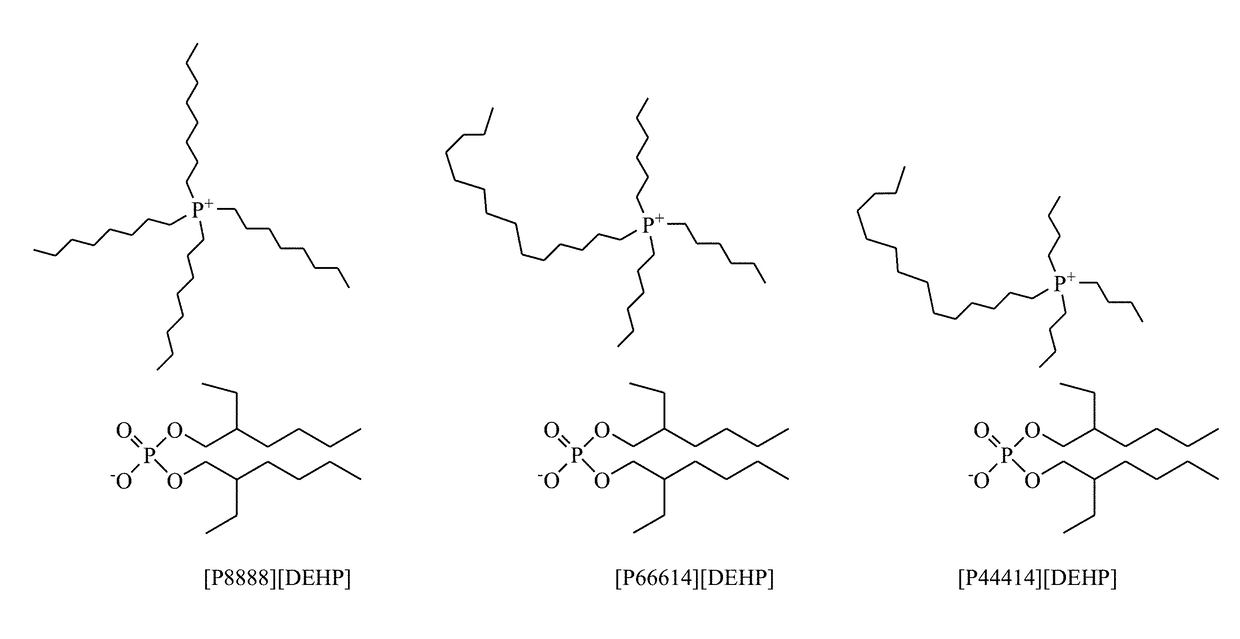
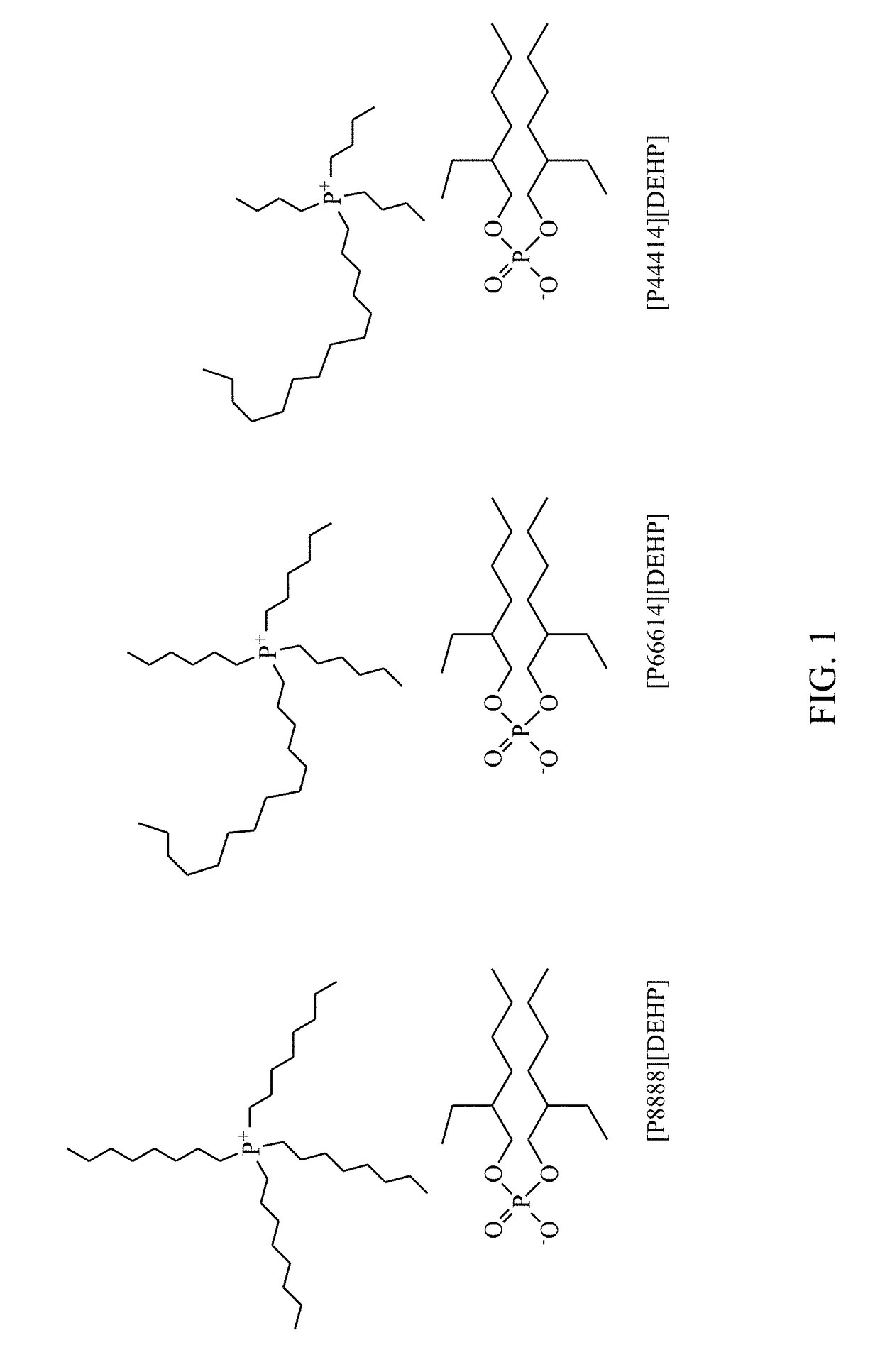
Ionic liquids containing symmetric quaternary phosphonium cations and phosphorus-containing anions, and their use as lubricant additives
PatentActiveUS20180208869A1
Innovation
- Development of a symmetric quaternary phosphonium ionic liquid with a phosphorus-containing anion, such as phosphate, phosphonate, or phosphinate, which ensures complete solubility in base oils at higher concentrations, effectively reducing wear and friction in mechanical components.

Ionic liquids containing quaternary phosphonium cations and carboxylate anions, and their use as lubricant additives
PatentInactiveUS20160024421A1
Innovation
- Development of an ionic liquid composition with a quaternary phosphonium cation and a carboxylate anion, specifically a trihexyltetradecylphosphonium-based ionic liquid dissolved in a base oil, enhancing solubility and anti-wear performance.


Environmental Impact and Sustainability Considerations
The environmental impact of lubricants has become increasingly significant in industrial and consumer applications, with ionic liquid lubricants offering promising sustainability advantages over conventional petroleum-based options. Traditional lubricants contribute substantially to environmental pollution through their production, use, and disposal cycles. These conventional formulations typically contain toxic additives, heavy metals, and non-biodegradable components that persist in ecosystems, contaminating soil and water resources when improperly disposed.
Advanced ionic liquid lubricants present a more environmentally responsible alternative due to their inherent chemical properties. Their negligible volatility significantly reduces harmful volatile organic compound (VOC) emissions that contribute to air pollution and respiratory health issues. This characteristic also extends their operational lifespan, reducing the frequency of lubricant replacement and associated waste generation. Studies indicate that ionic liquid lubricants can reduce waste volume by up to 30-40% compared to conventional counterparts in certain applications.
Biodegradability represents another critical environmental advantage of newer ionic liquid formulations. While first-generation ionic liquids faced criticism for poor biodegradability, recent advancements have yielded bio-derived ionic liquids with enhanced environmental compatibility. These advanced formulations incorporate naturally sourced components and demonstrate improved degradation rates in environmental conditions, minimizing long-term ecosystem impacts when released.
The carbon footprint associated with lubricant production warrants consideration in sustainability assessments. Life cycle analyses reveal that despite energy-intensive synthesis processes for some ionic liquids, their extended service life and reduced replacement frequency often result in a net reduction in carbon emissions over their complete life cycle. Emerging green synthesis methods utilizing renewable feedstocks and energy-efficient production techniques are further enhancing the sustainability profile of advanced ionic liquid lubricants.
Regulatory frameworks worldwide are increasingly prioritizing environmentally friendly lubricant alternatives. The European Union's REACH regulations and similar initiatives in North America and Asia are driving industry transition toward more sustainable lubricant technologies. These regulatory pressures, combined with growing corporate sustainability commitments, are accelerating market adoption of advanced ionic liquid lubricants despite their currently higher production costs.
Water conservation represents an additional sustainability benefit, as ionic liquid lubricants typically require less water during manufacturing and minimal water for maintenance operations compared to conventional alternatives. This advantage becomes particularly valuable in water-stressed regions where industrial water usage faces increasing scrutiny and regulation.
Advanced ionic liquid lubricants present a more environmentally responsible alternative due to their inherent chemical properties. Their negligible volatility significantly reduces harmful volatile organic compound (VOC) emissions that contribute to air pollution and respiratory health issues. This characteristic also extends their operational lifespan, reducing the frequency of lubricant replacement and associated waste generation. Studies indicate that ionic liquid lubricants can reduce waste volume by up to 30-40% compared to conventional counterparts in certain applications.
Biodegradability represents another critical environmental advantage of newer ionic liquid formulations. While first-generation ionic liquids faced criticism for poor biodegradability, recent advancements have yielded bio-derived ionic liquids with enhanced environmental compatibility. These advanced formulations incorporate naturally sourced components and demonstrate improved degradation rates in environmental conditions, minimizing long-term ecosystem impacts when released.
The carbon footprint associated with lubricant production warrants consideration in sustainability assessments. Life cycle analyses reveal that despite energy-intensive synthesis processes for some ionic liquids, their extended service life and reduced replacement frequency often result in a net reduction in carbon emissions over their complete life cycle. Emerging green synthesis methods utilizing renewable feedstocks and energy-efficient production techniques are further enhancing the sustainability profile of advanced ionic liquid lubricants.
Regulatory frameworks worldwide are increasingly prioritizing environmentally friendly lubricant alternatives. The European Union's REACH regulations and similar initiatives in North America and Asia are driving industry transition toward more sustainable lubricant technologies. These regulatory pressures, combined with growing corporate sustainability commitments, are accelerating market adoption of advanced ionic liquid lubricants despite their currently higher production costs.
Water conservation represents an additional sustainability benefit, as ionic liquid lubricants typically require less water during manufacturing and minimal water for maintenance operations compared to conventional alternatives. This advantage becomes particularly valuable in water-stressed regions where industrial water usage faces increasing scrutiny and regulation.
Performance Metrics and Testing Methodologies
The evaluation of lubricant performance requires standardized metrics and rigorous testing methodologies to ensure reliable comparisons between conventional and ionic liquid lubricants. These assessment frameworks provide quantitative data that enables engineers and researchers to make informed decisions about lubricant selection for specific applications.
Friction coefficient measurement stands as the primary performance indicator, typically conducted using tribometers such as pin-on-disk, four-ball, and ball-on-flat configurations. These instruments measure the resistance force when surfaces move relative to each other under controlled conditions of load, speed, and temperature. For ionic liquid lubricants, these tests often reveal superior performance at extreme temperatures compared to conventional petroleum-based options.
Wear rate determination constitutes another critical metric, usually quantified through profilometry, scanning electron microscopy (SEM), and weight loss measurements. Advanced ionic liquid lubricants generally demonstrate reduced wear scar diameters and material removal rates, particularly in boundary lubrication regimes where direct surface contact occurs.
Thermal stability assessment involves thermogravimetric analysis (TGA) and differential scanning calorimetry (DSC) to determine decomposition temperatures and phase transitions. Ionic liquids typically exhibit decomposition temperatures exceeding 300°C, significantly outperforming conventional lubricants that begin degrading around 150-200°C.
Viscosity-temperature behavior, measured using rheometers and viscometers, reveals how lubricant flow properties change across operating temperatures. The viscosity index (VI) quantifies this relationship, with higher values indicating more stable performance across temperature ranges. Many ionic liquid formulations maintain more consistent viscosity profiles than their conventional counterparts.
Corrosion protection capabilities are evaluated through standardized tests such as copper strip corrosion and humidity chamber exposure. While some early ionic liquid formulations showed corrosive tendencies toward certain metals, advanced designs incorporate anti-corrosion additives or utilize inherently non-corrosive ionic structures.
Environmental impact assessment has become increasingly important, with biodegradability testing following OECD guidelines and toxicity evaluations using aquatic organisms. Many advanced ionic liquid lubricants are designed with environmentally benign cations and anions, offering improved ecological profiles compared to conventional petroleum-based products.
Specialized application testing simulates real-world conditions, including high-vacuum environments, extreme pressures, and radiation exposure. These tests often reveal the exceptional performance of ionic liquids in niche applications where conventional lubricants fail, such as aerospace mechanisms and nuclear equipment.
Friction coefficient measurement stands as the primary performance indicator, typically conducted using tribometers such as pin-on-disk, four-ball, and ball-on-flat configurations. These instruments measure the resistance force when surfaces move relative to each other under controlled conditions of load, speed, and temperature. For ionic liquid lubricants, these tests often reveal superior performance at extreme temperatures compared to conventional petroleum-based options.
Wear rate determination constitutes another critical metric, usually quantified through profilometry, scanning electron microscopy (SEM), and weight loss measurements. Advanced ionic liquid lubricants generally demonstrate reduced wear scar diameters and material removal rates, particularly in boundary lubrication regimes where direct surface contact occurs.
Thermal stability assessment involves thermogravimetric analysis (TGA) and differential scanning calorimetry (DSC) to determine decomposition temperatures and phase transitions. Ionic liquids typically exhibit decomposition temperatures exceeding 300°C, significantly outperforming conventional lubricants that begin degrading around 150-200°C.
Viscosity-temperature behavior, measured using rheometers and viscometers, reveals how lubricant flow properties change across operating temperatures. The viscosity index (VI) quantifies this relationship, with higher values indicating more stable performance across temperature ranges. Many ionic liquid formulations maintain more consistent viscosity profiles than their conventional counterparts.
Corrosion protection capabilities are evaluated through standardized tests such as copper strip corrosion and humidity chamber exposure. While some early ionic liquid formulations showed corrosive tendencies toward certain metals, advanced designs incorporate anti-corrosion additives or utilize inherently non-corrosive ionic structures.
Environmental impact assessment has become increasingly important, with biodegradability testing following OECD guidelines and toxicity evaluations using aquatic organisms. Many advanced ionic liquid lubricants are designed with environmentally benign cations and anions, offering improved ecological profiles compared to conventional petroleum-based products.
Specialized application testing simulates real-world conditions, including high-vacuum environments, extreme pressures, and radiation exposure. These tests often reveal the exceptional performance of ionic liquids in niche applications where conventional lubricants fail, such as aerospace mechanisms and nuclear equipment.
Unlock deeper insights with Patsnap Eureka Quick Research — get a full tech report to explore trends and direct your research. Try now!
Generate Your Research Report Instantly with AI Agent
Supercharge your innovation with Patsnap Eureka AI Agent Platform!